
Railway negotiations highlight the importance of paid sick time for U.S. workers and the broader economy

""

The U.S. Congress this week is considering legislation imposing a new contract on U.S. railroad workers to avert a potential strike following a breakdown in negotiations between several of the nation’s railroad unions and U.S. railroad companies. At the heart of these negotiations is workers’ access to paid sick time.

U.S. railway companies currently provide workers with zero days of paid sick time while union negotiators have been requesting 15 days. Previous negotiations, which several unions voted to reject, offered just one additional personal day. Congress is considering adding 7 days of paid sick time to the package, with the U.S. House of Representatives voting in favor of 7 days (alongside a companion bill with zero days). The House legislation is now before the U.S. Senate.

The request for paid sick time makes sense. Paid sick time not only supports the health and economic well-being of workers but also the economic situation of their employers and the broader economy.

Paid sick time is typically used when a worker experiences an illness or injury that lasts a short time or when a worker needs to address a short-term care need of a loved one. Unlike all economically comparable nations, there is no national guarantee to paid sick time in the United States, but it is a relatively common benefit for U.S. workers. In 2021, 77 percent of all private industry workers had access to paid sick time, including 87 percent of unionized workers and 73 percent of workers employed at transportation and material moving firms.

Rather than asking for an overly generous concession, U.S. railroad workers lacking any paid sick days are actually an outlier among their peers.

For U.S. workers and their families, paid sick time is about a basic right to rest or recovery from an injury or illness without sacrificing critical paychecks. Research shows that workers with paid sick time are better able to manage their own health needs, reducing costly hospital visits and, ultimately, mortality across a range of health issues. And by making it easier to stay home when sick, paid sick time reduces the instances of workers showing up to work while sick and spreading contagious viruses, such as influenza or COVID-19.

The primary purpose of paid sick time is to allow workers to address short-term medical needs without suffering economic hardship, including losing their job for taking off too much time, but the broad economic and public health benefits cannot be overlooked. Local paid sick-time laws, for example, reduce influenza-like infections by 30 percent to 40 percent. And amid the ongoing COVID-19 pandemic, sick leave is an essential tool for controlling communicable diseases and ensuring that workers are able to produce and transport goods and services and that consumers can purchase those goods and services—in other words, to ensuring that large parts of the U.S. economy can function normally.

The benefits of better health and economic security for workers are clear, but a happier and more productive workforce also benefits firms, too, making paid sick time a win-win policy for all involved. Paid sick leave is frequently found to reduce costly presenteeism, when workers show up to work while sick, and resulting in productivity losses. And, rather than increasing rates of absenteeism—when employees call out of their regularly scheduled shifts—paid sick time can slow the spread of illness in a workplace an ultimately reduce infection-related absences, potentially saving U.S. employers billions of dollars.

U.S. workers with paid sick leave also experience fewer occupational injuries. This means workers can avoid potentially disastrous impacts on their well-being and economic security, which in turn can expose their employers to expensive liabilities.

The costs associated with a sick and dissatisfied workforce are high. In addition to absences and productivity losses, low job quality due to erratic work schedules and limited benefits that are currently experienced by U.S. railroad workers, can translate to expensive turnover, particularly in a tight labor market. And these costs pale in comparison to that of a drawn-out workers’ strike on a critical component of the nation’s supply chain.

The good news is that railroad companies can avoid this disaster with low-cost, high-reward paid sick time benefits. For the workers that kept the nation’s supply chain functioning during the uncertainty COVID-19 pandemic, such an investment makes good economic sense for all involved.

Posted in Uncategorized

Frequently asked questions about paid sick time for U.S. workers and their families and the broader U.S. economy

""

Sometimes people in the United States experience health conditions that affect their ability to work, whether it’s a cold, flu, or cancer. This may lead to questions about whether they can take time off from work to address their health, without sacrificing pay. Below, we address and answer frequently asked questions about what paid sick time is, and how it affects the U.S. economy.

Question: What is paid sick time for?

Answer: Workers often need paid time away from their jobs, whether they are experiencing a short-term illness, undergoing a surgery and recovery that will last a few days, or simply visiting the doctor for a wellness exam. In the United States, paid sick time allows workers to address such short-term needs. It also allows workers to spend time caring for their loved ones when they fall ill or suffer an injury.

Q: How can U.S. workers access paid sick time?

A: Some employers voluntarily offer paid sick time to their workers, and currently 36 states and localities require that employers provide paid sick time, though workers have no federal right to paid sick time, meaning some workers do not have access to paid sick time.

Q: Who does and doesn’t have access to paid sick time?

A: Seventy-eight percent of U.S. workers can access paid sick time through their employers. But paid sick time is out of reach for typical low-income workers. Only 4 in 10 workers in the lowest-paid jobs, who are disproportionately workers of color, have access to paid sick time.

Q: Is paid sick time an economic policy?

A: The primary purpose of paid sick time is to allow workers to address short-term medical needs without suffering economic hardship. But paid sick time also benefits employers and the overall U.S. economy. In supporting personal health, public health, and productivity, paid sick time helps stabilize and grow the U.S. economy.

Q: What does paid sick time do for U.S. businesses?

A: Paid sick time policies reduce rates of worker turnover and lower rates of absenteeism, both of which lead to productivity gains for U.S. businesses. Paid sick time also helps businesses reduce the incidence of occupational injuries.

Q: What does paid sick time cost U.S. employers?

A: One study estimates the cost of providing paid sick leave was just 2.7 cents per worker per hour, and other research shows that when businesses implement paid sick-time policies, they do not cut other employer-provided benefits, indicating that employers are likely to be able to absorb the average cost of providing paid sick time.

Q: What does paid sick time do to help the broader U.S. economy?

A: Controlling communicable disease is essential to ensuring that workers are able to produce goods and services and that consumers will purchase those goods and services—in other words, to ensuring that large parts of the economy can function normally. Local paid sick-time laws reduce influenza-like infections by 30 percent to 40 percent. Similarly, when the federal government enacted a temporary, coronavirus-specific paid sick time policy in 2020 through the Families First Coronavirus Response Act, states where workers gained new access to the emergency paid sick leave program saw COVID-19 cases drop by 56 percent.

Q: Are there efforts to extend paid sick time to all U.S. workers?

A: Federal policies are needed to ensure that all workers can access leave to address health issues they or their loved ones face, thus encouraging long-run economic growth and benefitting the overall U.S. economy. One bill that proposes a federal paid sick time policy is the Healthy Families Act.

Posted in Uncategorized

Ahead of the November jobs report, here’s what recent disaggregated data say about the state of the U.S. labor market and economic growth

""

Ahead of the release of November’s Employment Situation Summary on December 2, an examination of the past few months of U.S. Bureau of Labor Statistics employment data shows some signs that the U.S. labor market is cooling down. After nonfarm payrolls recovered to pre-pandemic levels late in the summer—and as the U.S. Federal Reserve Bank continues increasing interest rates to cool the economy in an effort to manage inflation—employment growth, hires, and job openings are all now below their 2022 peaks and trending down, BLS data show.

One example of these dynamics at play is net monthly job gains. While employment growth remained strong as the U.S. economy added an average of 289,000 jobs in the 3 months of August, September, and October, these gains represent a substantial deceleration, compared to the previous 3-month moving average of 381,000 jobs added. (See Figure 1.)

Figure 1

Change in total nonfarm U.S. employment, monthly change and 3-month moving average (in thousands), July 2021-October 2022

As the U.S. labor market loses steam, disparities faced by some vulnerable groups of workers remain—and may be reverting to previous unequal trends prior to the recent downturn. For instance, the employment-to-population ratio of workers between the ages of 20 and 24 who are not in school has dropped substantially since the beginning of the year. Workers with a high school degree or more are still experiencing historically low unemployment rates, but the joblessness rate of those without a high school diploma has been trending up since early 2022. That joblessness rate went from a series low of 4.3 percent in February 2022 to 6.3 percent in October—a rate that is about three times higher than the unemployment rate for workers with a bachelor’s degree or more. (See Figure 2.)

Figure 2

U.S. unemployment rate and unemployment rate by level of formal education (3-month moving average), workers 25 and older, March 2019 – October 2022

If these trends continue, a weaker U.S. labor market is also likely to be felt most by workers of color in general, and Black workers in particular—many of whom are especially exposed to joblessness because of the interplay of occupational segregation and discrimination in employment. The effects of discrimination and Black workers’ vulnerability across business cycles can also be seen in what researchers call the “first fired” phenomenon, in which Black workers are more likely to be laid off than their White counterparts—a finding that holds even when comparing workers of the same age, with the same level of formal education, and working in the same job and industry.

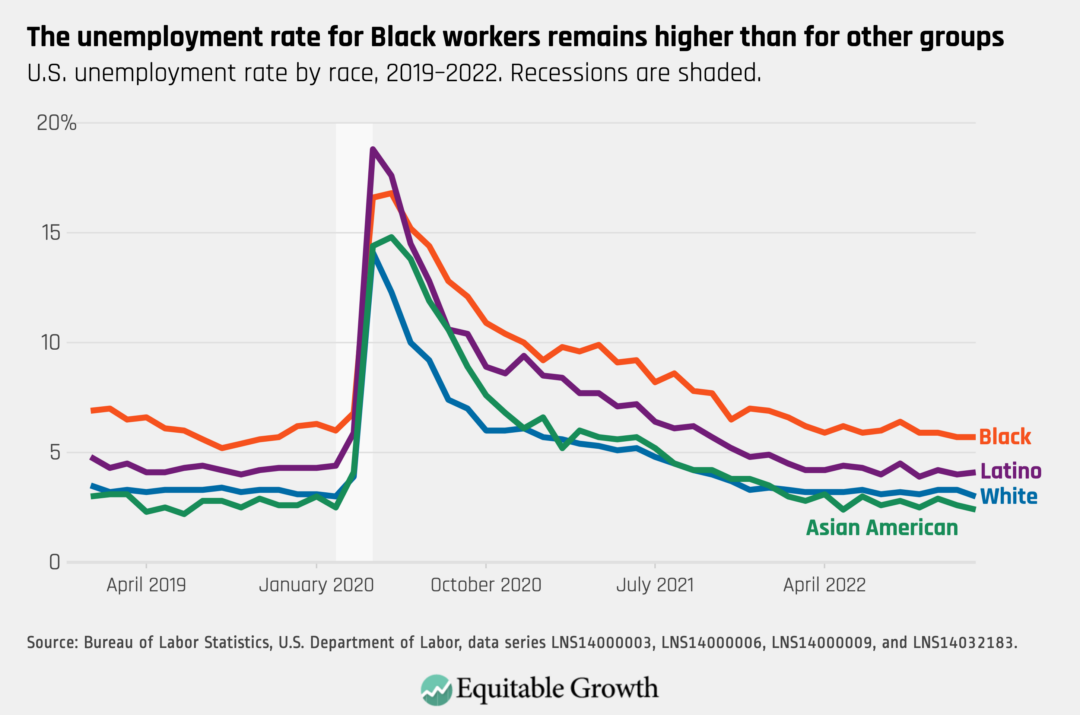
Data from the current economic recovery show the persistence of these structurally racist barriers, providing further evidence that market dynamics, such as business cycles, cannot fully account for or resolve the longstanding employment divides between Black and White workers. Not even the robust U.S. labor market of late 2021 and early 2022—a labor market some analysts called “red hot”—was enough to substantially narrow racial divides in economic outcomes. Throughout 2021 and 2020, for instance, the unemployment rate of Black workers consistently doubled the unemployment rate of their White counterparts. (See Figure 3.)

Figure 3

U.S. unemployment rate and unemployment by race and ethnicity (3-month moving average), 2019-2022

New data shed light on the experiences of Indigenous Americans and Native Hawaiians and Pacific Islanders during the COVID-19 recession and current recovery

In addition to releasing monthly data on the U.S. labor market outcomes of Asian American, Black, Latino, and White workers, earlier this year, the Bureau of Labor Statistics began publishing monthly data for two groups of workers: American Indians and Alaska Natives and Native Hawaiians and Pacific Islanders. These newly available data series are not seasonally adjusted, meaning that BLS has not performed statistical procedures to account for seasonal variations in the labor market, such as retailers’ hiring of temporary workers ahead of the December holiday season.

That these data are not seasonally adjusted and are composed of small sample sizes—American Indian and Alaska Native workers make up slightly less than 2 percent of the U.S. workforce, while about 0.5 percent of U.S. workers are Native Hawaiian or Pacific Islander workers—make month-to-month comparisons difficult, since the series are volatile and generally not statistically significant. Yet they still offer a timely snapshot of the experiences of these workers in the labor market, contributing to our understanding of how race and ethnicity shape the economic outcomes of U.S. workers.  

American Indian and Alaska Native workers

In the case of American Indian and Alaska Native workers, the data series show that this group faced particularly sharp economic pain due to the COVID-19 recession, suffering a massive increase in unemployment and a commensurate drop in employment as the pandemic hit service-providing industries especially hard.

In April 2020—the height of the recession—the American Indian and Alaska Native employment-to-population ratio dropped to 42.4 percent, an almost 15 percentage point fall compared to April of the previous year. While the aggregate U.S. employment rate also fell, the decline was much more moderate for the country’s overall workforce. (See Figure 4.)

Figure 4

Employment-to-population ratio for American Indian or Alaska Native workers and U.S. workers overall, 2019-2022

At the same time, the unemployment rate of AIAN workers reached a recession high of more than 28 percent, a rate that was more than double the national unemployment rate at the height of the recession. (See Figure 5.)

Figure 5

Unemployment rate for American Indian and Alaska Native workers and U.S. workers overall, 2019-2022

But American Indian and Alaska Native workers faced barriers in the U.S. labor market long before the onset of the pandemic. Research by Equitable Growth grantee Blythe George (now an assistant professor at the University of California, Merced) finds that the decline of industries that have been important sources of employment for certain tribal communities led to weak labor force attachment for male workers there. Research on Native American women in the labor market is limited and more data are needed, but existing empirical findings demonstrates that the intersection of gender for this marginalized group creates further barriers and has resulted in stagnant wage growth, compared to those facing fewer intersecting barriers.

Structural barriers also shape the experiences of Indigenous American workers amid the ongoing pandemic and economic recovery. A recent analysis by Matthew Gregg, senior economist at the Federal Reserve Bank of Minneapolis, and Robert Maxim, senior research associate at The Brookings Institution, explains that while the unemployment rate for Native American workers has improved, these workers still have lower access to remote work. This is probably due to occupational differences, infrastructure issues in housing and broadband access, discrimination, and other factors.

The Bureau of Labor Statistics began separately reporting monthly data on American Indian and Alaska Native unemployment earlier this year, but more comprehensive and granular data are needed to fully understand the current employment situation for these workers to inform future policy. In addition to improving data collection, Randall Akee, a senior economist at the Council of Economic Advisers (on leave from the University of California, Los Angeles) and an Equitable Growth grantee, has written about the importance of supporting tribal sovereignty and industry innovation, as well as reducing barriers to economic development, in order to improve economic and labor conditions of American Indian workers and their families.

Native Hawaiian and Pacific Islander workers

Native Hawaiian and Pacific Islander workers, BLS data show, generally experience higher employment rates and similar unemployment rates as U.S. workers on average. Part of the reason is that this group of workers is more likely to be between the ages of 25 and 54, the range that economists consider to be the “prime-age” working population. In mid-2020, however, Native Hawaiian and Pacific Islander workers experienced a deeper—and later—decline in employment than U.S. workers overall. (See Figure 6.)

Figure 6

Employment-to-population ratio for Native Hawaiian and Pacific Islander workers and U.S. workers overall, 2019-2022

The NHPI unemployment rate saw a similar increase as the national unemployment rate. Like the decline in employment, however, these workers experienced the highest joblessness rate in the fall of 2020, rather than in the spring of that year. (See Figure 7.)

Figure 7

Unemployment rate for Native Hawaiians and Pacific Islander workers and U.S. workers overall, 2019-2022

What explains this lag? Research by Julie Cai at the Center for Economic Policy Research finds that in 2021 and early 2022, Asian American workers and NHPI workers were less likely than other groups of workers to find a job if they became unemployed. This lower probability of reemployment held, Cai finds, even when accounting for levels of formal education, state of residence, and age, and was especially true for Asian American and NHPI women.

There is not much empirical evidence yet on what drove these lower unemployment-to-employment transition rates, but recent data do show that the pandemic affected service-providing occupations in which NHPI workers are overrepresented, which likely played a role. In addition, there is evidence that the surge in discrimination against Asian American communities and NHPI communities hurt the economic outcomes of these workers and business owners.

Determining fiscal and monetary policies in a ‘tight’ labor market that is now also cooling

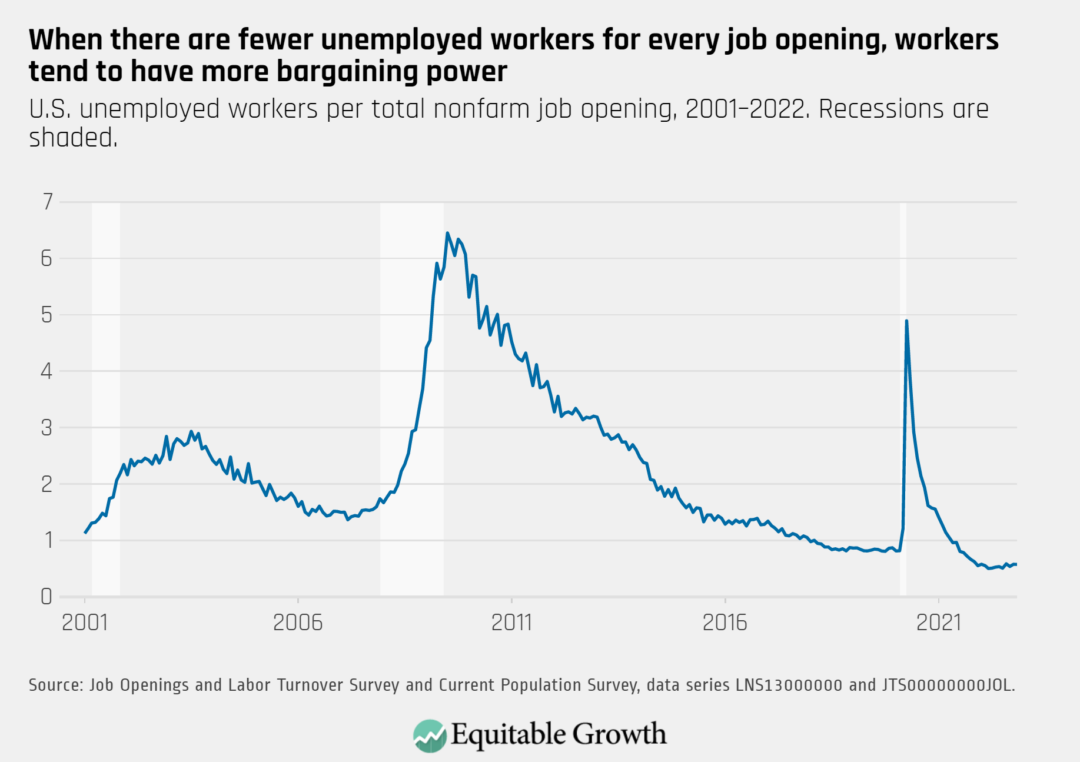
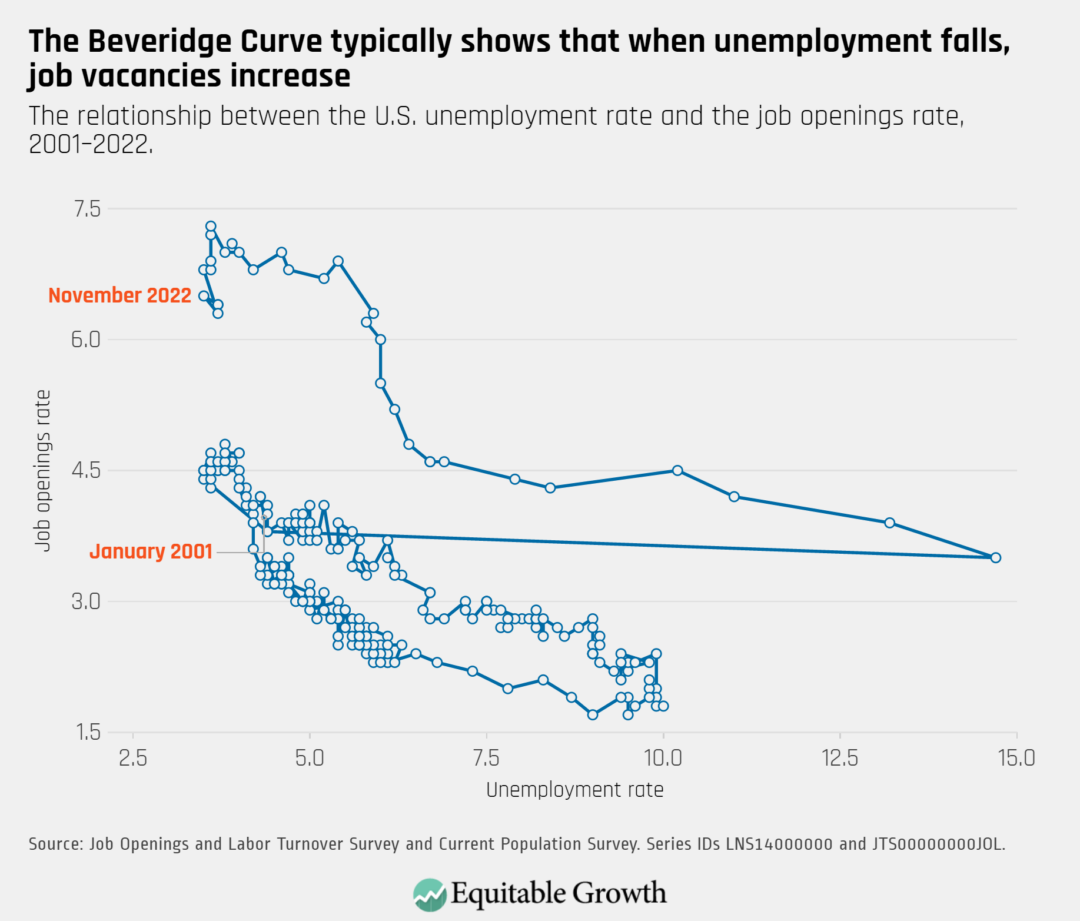
Broadly, a tight labor market is one in which demand for workers is strong, most people who can and want to work are able to find a job, and workers are in a good position to bargain for better wages. One important metric that economists use to determine the degree of “tightness” or “slack” in the labor market is the ratio of unemployed workers per job opening. In a hot or tight labor market, there will be few unemployed workers for every job vacancy. Conversely, when there is a lot of slack or the labor market is loose, there are many unemployed workers for every job opening.

By this metric, the labor market is currently extremely tight. During the height of the recession, there were about five unemployed workers for every job opening. In the past year or so, however, there have been about two job openings for every unemployed worker. (See Figure 8.)

Figure 8

U.S. unemployed workers per total nonfarm job opening, 2001–2022. Recessions are shaded.

But there are other ways to measure labor market tightness. The unemployment rate, wage growth, and the share of workers who quit their jobs in a given month also capture information on the degree to which employers are looking and competing for workers.

In addition, research by Katherine Abraham, John Haltiwanger, and Lea Rendell at the University of Maryland, College Park proposes that the standard measures of labor market tightness can fail to accurately capture how difficult it is for workers to get a job and for employers to hire workers. This is because economists and policymakers alike do not normally account for job switchers, for workers who are not actively participating in the labor force, and for the effort employers are making to hire workers.

Abraham, Haltiwanger, and Rendell propose that during economic downturns, the intensity with which firms hire workers declines since there is a larger pool of both employed and unemployed workers competing for job opportunities. During booms, firms have to ramp up their efforts to hire by paying higher wages, offering more or better benefits, lowering the amount of experience or educational attainment required of candidates, or investing in their recruitment processes.

Currently, there is some evidence that U.S. employers’ hiring intensity is declining. Not only is wage and employment growth tempering, but less traditional indicators suggest that businesses are having an easier time filling their job openings, too. LinkedIn data show, for instance, that firms’ willingness to offer remote positions is lower now than it was early in 2022, when about 20 percent of job listings offered remote work. As such, even though 50 percent of all job applications went to remote positions, as of October of this year, only 15 percent of all job postings offered remote work.

An analysis by Burning Glass Institute, a think tank that advances research on the future of workers, is equally telling. It shows that while the share of job postings that require a bachelor’s degree declined substantially in 2020—evidence that employers are willing to ask for fewer credentials in order to fill their open positions—in 2022, this number started to increase again.

A cooling labor market means policymakers should consider how that affects different groups of workers and boost institutional support for worker power for a robust recovery

It is important for policymakers to understand the causes and consequences of persistent disparities by race, ethnicity, and gender within the context of relative labor market tightness. As the Federal Reserve Board of Governor’s Federal Open Market Committee continues to address elevated inflation with monetary policy and other policymakers reinforce these efforts through fiscal policy, the data discussed above demonstrate that an economic expansion is not sufficient to ensure convergence in labor market outcomes across groups of U.S. workers.

Furthermore, there is limited evidence that wage gains are a significant cause of current inflation. Designing economic policy for the current moment without attention to these details risks further entrenching disparities that limit U.S. economic growth by holding back the potential and economic security of groups with lower levels of educational attainment and those that have been historically marginalized and excluded from economic opportunities due to structural racism and sexism.

Though wages have been rising for workers at the bottom of the wage distribution, and many gaps narrowed during the rapid labor market recovery, the policies and institutions that fostered the rapid rise in economic inequality over the past four decades remain without a sufficient countervailing force. Inequality continues to be a drag on U.S. economic growth.

As monthly gains in the U.S. labor market naturally temper over the coming months, fundamental policies to improve worker outcomes are still lacking, including a sufficient minimum wage, the ability to unionize workplaces, and protection against discrimination. Workers of color remain vulnerable to outsized impacts from future downturns—perhaps even more so now, after the stresses of the pandemic, including family health shocks and caregiving needs, and a higher likelihood of job displacement and unemployment scarring.

The upshot? A focus on topline labor market indicators by policymakers from the Monthly Jobs Report as part of the effort to mitigate inflation will ultimately reduce the effectiveness of economic policy tools that foster robust and inclusive U.S. economic growth. Understanding the disaggregated nuances of the U.S. labor market is key to effective monetary and fiscal policymaking.

Posted in Uncategorized

JOLTS Day Graphs: October 2022 Edition

Every month the U.S. Bureau of Labor Statistics releases data on hiring, firing, and other labor market flows from the Job Openings and Labor Turnover Survey, better known as JOLTS. Today, the BLS released the latest data for October 2022. This report doesn’t get as much attention as the monthly Employment Situation Report, but it contains useful information about the state of the U.S. labor market. Below are a few key graphs using data from the report.

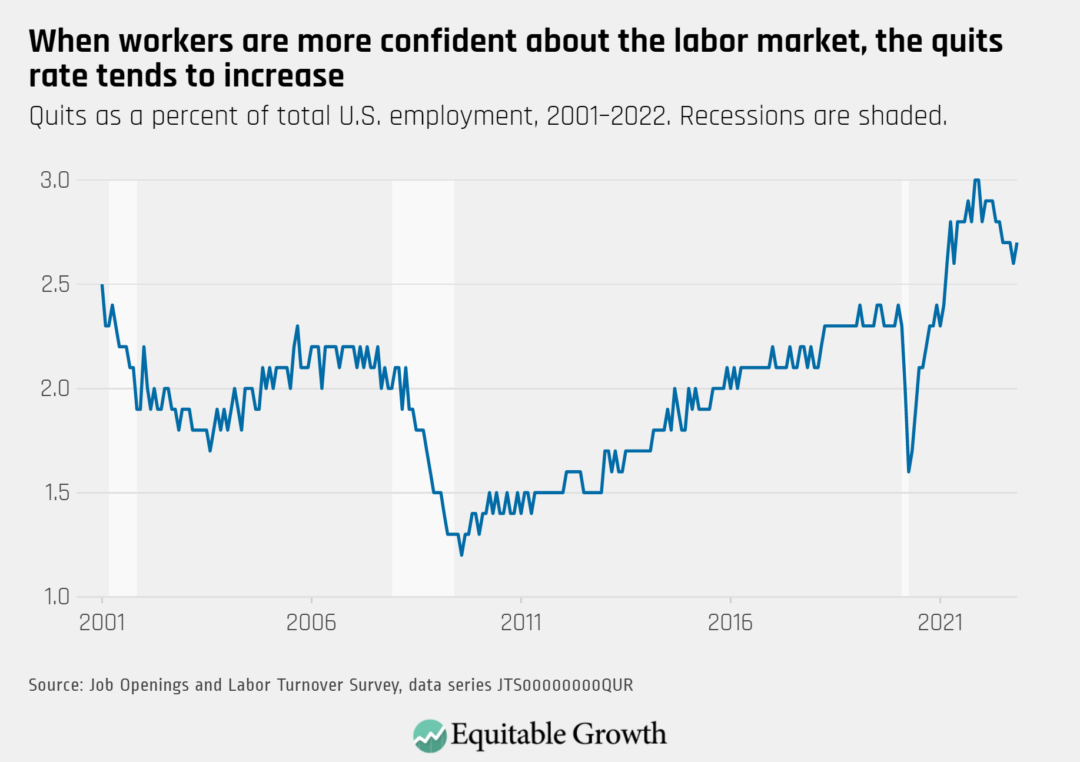
Around 4 million workers quit their jobs in October, similar to the previous month, and the quits rate declined to 2.6 percent for the first time since May 2021.

Quits as a percent of total U.S. employment, 2001–2022. Recessions are shaded.

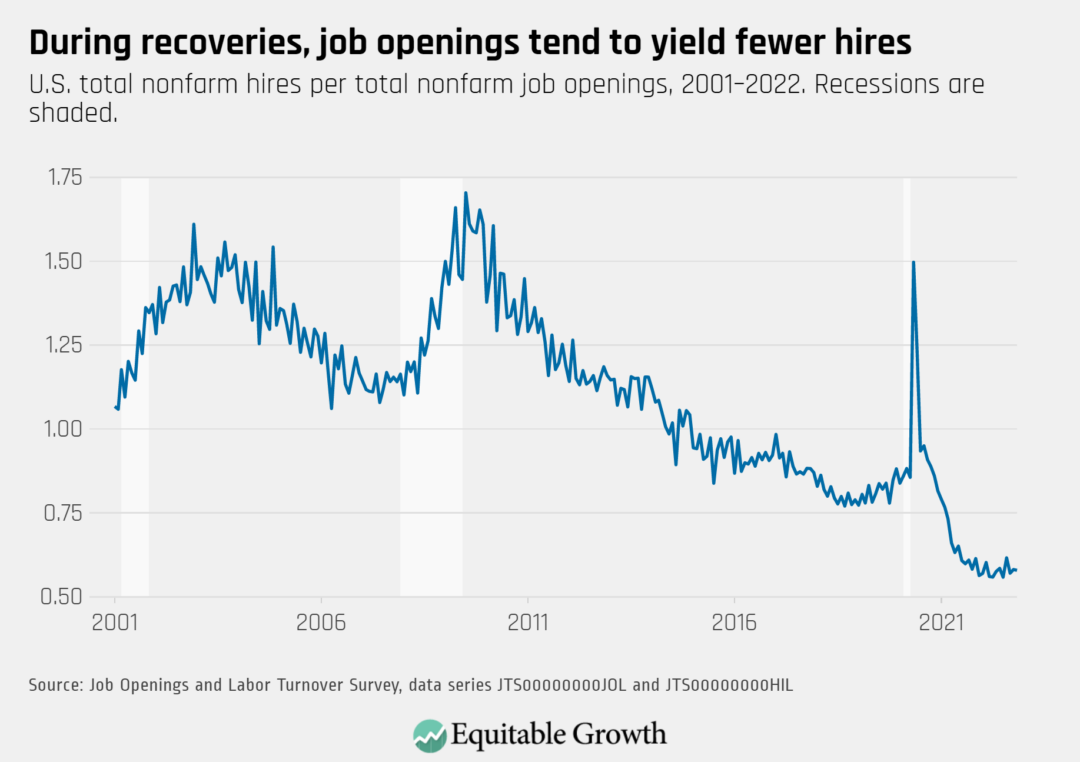
The vacancy yield increased to 0.58 in October from 0.57 in September as the number of reported job openings declined to 10.3 million while hires remained relatively constant at 6.0 million.

U.S. total nonfarm hires per total nonfarm job openings, 2001–2022. Recessions are shaded.

The ratio of unemployed workers to job openings increased to almost 0.59 in October from just under 0.54 in September.

U.S. unemployed workers per total nonfarm job opening, 2001–2022. Recessions are shaded.

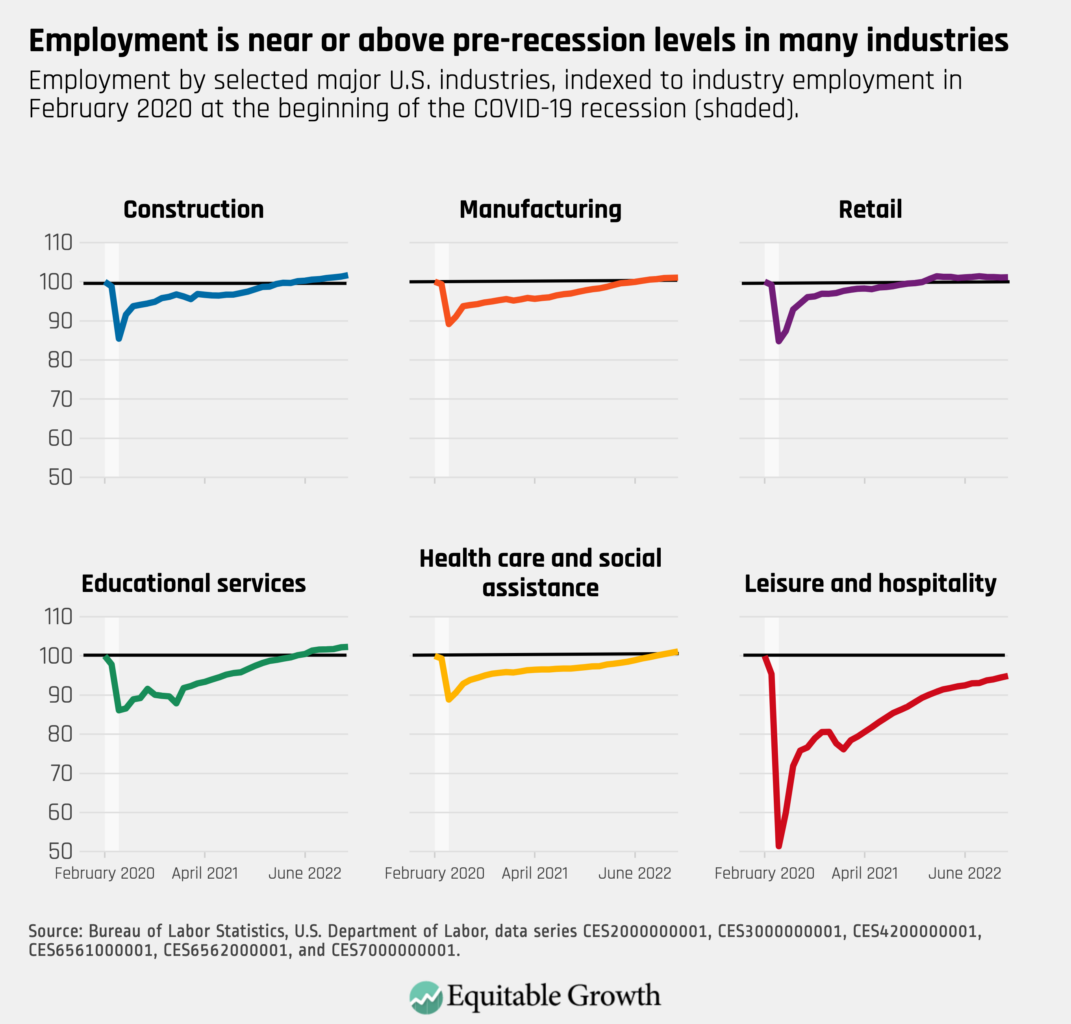
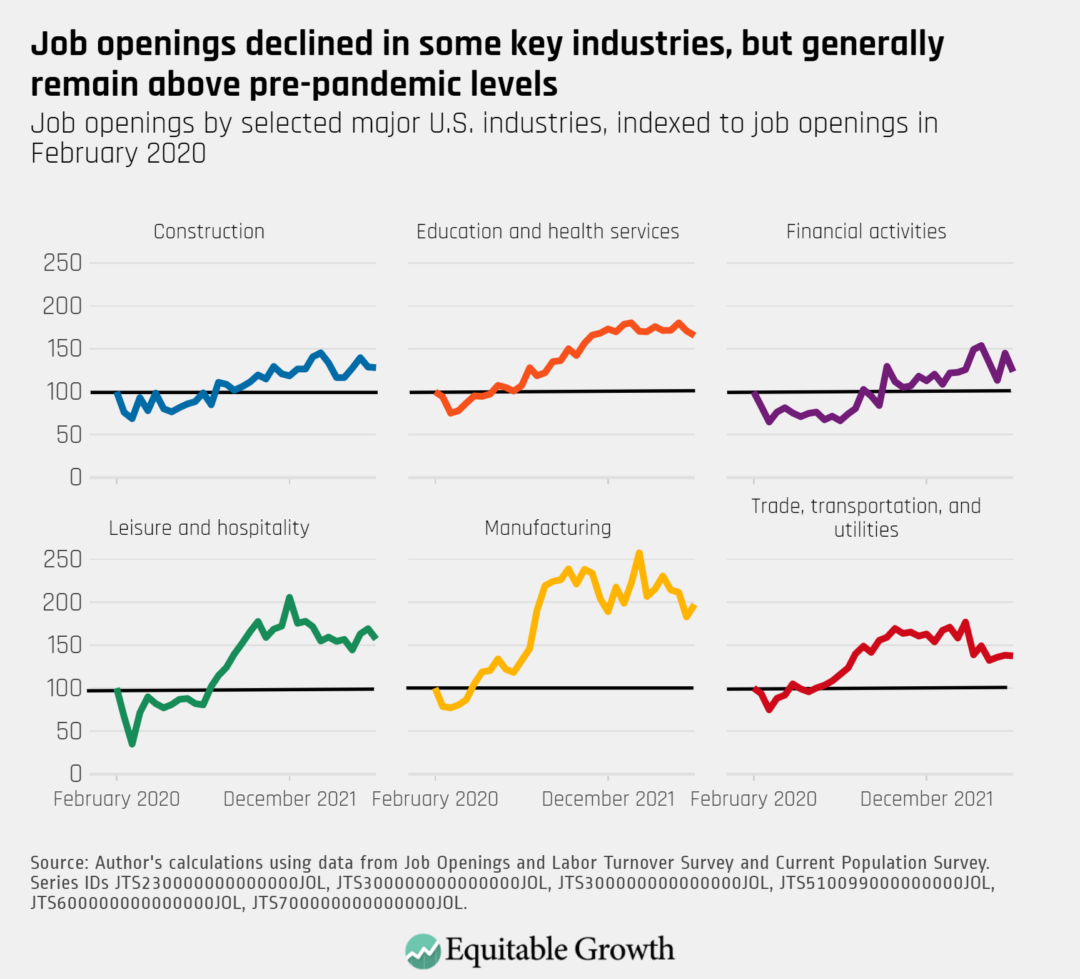
Job openings ticked down but remain elevated in industries such as education and health services and in manufacturing, and remained steady in leisure and hospitality.

Job openings by selected major U.S. industries, indexed to job openings in February 2020
Posted in Uncategorized

Expert Focus: Studying the future of work and technology’s impact on workers

""

Equitable Growth is committed to building a community of scholars working to understand how inequality affects broadly shared growth and stability. To that end, we have created the series “Expert Focus.” This series highlights scholars in the Equitable Growth network and beyond who are at the frontier of social science research. We encourage you to learn more about both the researchers featured below and our broader network of experts.

Since the onset of the COVID-19 pandemic, millions of workers have transitioned to remote work or telework, vastly increasing their use of certain technologies and software as a result. Digital technologies, while enabling this switch to home offices, are a double-edged sword, often coming with increased employer monitoring of workers and their activities.

Yet workplace surveillance is nothing new and was becoming more rampant across sectors of the U.S. economy before the COVID-19 crisis. This increasing use of technology to monitor and control workers has widespread implications for worker power, protections, and well-being.

This month’s Expert Focus highlights leaders in the field of the future of work who are examining technology’s impact on workers and the U.S. economy. These researchers are seeking to clarify how workers are affected by various forms of monitoring and algorithmic management, how technology shapes new forms of work such as the gig economy, the impacts of Big Tech companies and their innovations on the workplace, and how to protect workers and ensure worker power in the age of digital technologies.

Much is still unknown about how employers use technology and its effects on workers, and how employers’ use of technology for monitoring and management will continue to affect the U.S. workforce in the future. That’s why Equitable Growth’s 2023 Request for Proposals seeks to fund projects looking into technology and the workplace, including studies examining how employers’ use of technology affects work and workers in areas of hiring, work conditions, scheduling, and more; how employer decisions around automation, algorithms, and other technologies will impact workers, wages, and labor markets; the role of policy and labor market institutions in shaping these outcomes; and whether there are disparate effects on different demographic groups of workers and protected classes.

Find more information on the 2023 RFP, funding channels, who is eligible, and how to apply.

Annette Bernhardt

University of California, Berkeley

Annette Bernhardt is the director of the Technology and Work Program in the University of California, Berkeley’s Labor Center and a senior researcher at Berkeley’s Institute for Research on Labor and Employment. She is a leading labor market scholar in the areas of low-wage work and the future of work and workers, with a focus on the impact of new technologies, the minimum wage and other labor standards, the gig economy, and enforcement of employment and labor laws. One of her recent reports, co-authored by colleagues Lisa Kresge and Reem Suleiman, looks at how employers are increasing their use of data and algorithms in ways that impact workers, wages, working conditions, and racial and gender equity, and then proposes policies that ensure worker technology rights. As an expert in these areas, Bernhardt also helped to develop and analyze innovative policy responses to the changing nature of work in the United States.

Quote from Annette Bernhardt

Peter Cappelli

University of Pennsylvania

Peter Cappelli is the George W. Taylor Professor of Management at the University of Pennsylvania’s Wharton School of Business and the director of Wharton’s Center for Human Resources. His research focuses on human resource practices, public policy related to employment, and talent and performance management. His research on contract-based workers and the future of work looks at employer-employee relationships and workplace structures. He also examines the impact of the COVID-19 pandemic and remote work—including the technology that enables it—on professional outcomes and opportunities. Cappelli’s 2021 book, The Future of the Office: Work from Home, Remote Work, and the Hard Choices We All Face, looks at these issues in more detail and puts them in the context of broader labor market trends and changes.

Quote from Peter Cappelli

Timnit Gebru

Distributed Artificial Intelligence Research Institute

Timnit Gebru is the founder of the Distributed Artificial Intelligence Research Institute. She has spent much of her career working in technology and artificial intelligence and is widely recognized as an expert in AI research and ethics. Gebru is an strong advocate for diversity in tech and is the co-founder of Black in AI, a nonprofit that aims to increase the presence and foster the inclusion of Black people in artificial intelligence. In 2018, her co-authored study on racial and gender biases in facial recognition software led Microsoft Corp., her employer at the time, and IBM Corp. to diversify the datasets that inform their facial recognition algorithms. A recent co-authored paper lays out a “doctrine of universal human rights” to serve as a guiding framework for responsible artificial intelligence, centering humans and the risks to their rights—from the right to freedom from discrimination to the right to share in scientific advancement—in the research around AI and ethics.

Quote from Timnit Gebru

Karen Levy

Cornell University

Karen Levy is an associate professor in the Department of Information Science at Cornell University. Her research centers on how law and technology interact to regulate and control social life, with a particular focus on surveillance and contexts that are marked by inequality. One of her main areas of interest is the impact of data-intensive technologies and monitoring on work and workers. Levy’s upcoming book, Data Driven: Truckers, Technology, and the New Workplace Surveillance, looks at how new forms of digital surveillance and automation are affecting long-haul truckers in the United States and upending their lives and work on the road. A co-authored chapter in The Oxford Handbook of Ethics of AI of 2020 looks at how technology and artificial intelligence will affect workers in ways other than displacing them—including employers using technology to shift risks from themselves to workers—in the workforce and offers some policy responses.

Quote from Karen Levy

Peter Norlander

Loyola University Chicago

Peter Norlander is an associate professor of management and the director of the master’s degree program in human resources and employment relations at Loyola University Chicago Quinlan School of Business. His research examines the balance of power in employment relationships, discrimination against certain groups of workers, and the future of work—including gig work, outsourcing, and remote work. Recently, Norlander has written about guest worker visa programs and their impacts on workers and firms, stigmatization against unemployed workers amid the COVID-19 pandemic and the 2020 recession, and the effects of digital surveillance tools in the gig economy. His latest working paper on predictors of remote work opportunities before and after the pandemic finds that firms play a key role in deciding if a job is remote, and that workers who are unionized, professionally licensed, or federal government employees were more likely to have remote opportunities before the pandemic.

Quote from Peter Norlander

Meredith Whittaker

Signal Foundation

Meredith Whittaker is the president of the Signal Foundation, a nonprofit organization that runs the ultra-private encrypted messaging app Signal. She previously served as a senior advisor on artificial intelligence to Chair Lina Khan of the U.S. Federal Trade Commission and was the Minderoo research professor at New York University, where her research focused on AI policy and the state of AI, and surveillance business practices. In her 17 years of experience, she has become known as a fierce critic of tech companies, their harmful business practices, and the impacts on workers. She is an advocate for including those who are most impacted by technology and surveillance in decisions about when and whether to share their data. Whittaker has testified before the U.S. Congress on various aspects of technology, including ethical implications of AI and the transparency and accuracy of facial recognition.

Quote from Meredith Whittaker

Equitable Growth is building a network of experts across disciplines and at various stages in their career who can exchange ideas and ensure that research on inequality and broadly shared growth is relevant, accessible, and informative to both the policymaking process and future research agendas. Explore the ways you can connect with our network or take advantage of the support we offer here.

Factsheet: What the research says about the economics of the 2021 enhanced Child Tax Credit

""

The Child Tax Credit has historically provided income support to middle- and high-income taxpayers with children. In 2021, however, the U.S. Congress enacted a temporary enhanced Child Tax Credit with three key changes:

  1. Eligibility was expanded to lower-earning taxpayers because the credit was made fully refundable, and the earnings requirement was dropped.
  2. The maximum amount was raised to $3,000 per child ages 6 to 17 and $3,600 per child younger than 6 years old, from $2,000 per child younger than 17.
  3. Families could receive six monthly payments of between $250 and $300 per child during the second half of 2021, with the remainder paid after filing 2021 taxes in 2022.

The temporary expansion of the Child Tax Credit increased benefit levels the most for low-income households, as shown below. (See Figure 1.) All of these changes have since expired.

Figure 1

Average change in income support due to the elimination of the earnings requirement and full refundability elements of the expanded CTC program, in thousands of dollars

This factsheet summarizes the current research on the effects of the enhanced Child Tax Credit. Early evaluations of its temporary expansion generally find that it increased economic well-being with limited or no detriment to the U.S. labor supply. A well-established body of research suggests that the improved well-being of these children will boost U.S. productivity and growth when they reach adulthood.

Research finds that the 2021 enhanced Child Tax Credit improved the well-being of U.S. children and their families

  • Recent research by economist Zachary Parolin and his co-authors at Columbia University estimates that the CTC expansion reduced child poverty by 40 percent.1
  • The enhanced Child Tax Credit also supported families with children by reducing food insecurity, lowering reported difficulties affording expenses, and cutting the rate of missing housing payments. (See Figure 2.)

Figure 2

The percentage of low-income U.S. households with and without children reporting food insufficiency, difficulty with expenses, and missed mortgage payments, April 14, 2021 – August 16, 2021
  • Recent research by Natasha Pilkauskas and her colleagues at the University of Michigan finds that the enhanced Child Tax Credit reduced the number of food hardships by nearly a third for the average low-income family receiving the credit.2
  • Pilkauskas and her co-authors also find that the expansion significantly reduced the experience of medical hardship among low-income families.3
  • A large body of literature on financial transfers similar to the Child Tax Credit finds beneficial effects in the areas of health, education, and adulthood earnings.4

Research finds that the 2021 enhanced Child Tax Credit did not affect parental work effort

  • More research by Parolin and his co-authors compares changes in U.S. labor supply for households with children versus those without, finding no consistent differences in the monthly employment outcomes of these two groups around the time of the CTC expansion.5
  • More research by Natasha Pilkauskas and her co-authors does not find a statistically significant relationship between employment and the CTC expansion among families in their sample, suggesting that the expansion did not deter work.6
  • Simulations, which use estimates from existing research to predict the effects of the enhanced Child Tax Credit in the future rather than measuring actual effects from the 2021 expansion, find mixed results that are contingent on their assumptions. Of the three most prominent simulations of a permanent CTC expansion, two suggest that labor supply effects would be small.7 One suggests that they would be substantial.8

The design of the enhanced 2021 Child Tax Credit improved racial and socioeconomic equity in the program

  • Columbia University researchers find that prior to the temporary expansion, about one-third of children lived in families that earned too little to receive the Child Tax Credit, and that children of color, rural children, and young children are overrepresented in this group.9
  • The design of the enhanced 2021 Child Tax Credit removed structural barriers, such as earnings requirements, and research suggests that many families with children who had previously been carved out of this income support received it. Specifically:
    • Early survey evidence reported by Katherine Michelmore and her University of Michigan colleague Pilkauskas suggests that approximately two-thirds of very low-income families received monthly CTC payments.10
  • Yet research suggests that some barriers remained.
    • A remaining barrier may be that families who wouldn’t ordinarily file taxes may not have known about their newfound eligibility. Indeed, families with little or no earnings had substantially lower rates of receiving the expanded Child Tax Credit in the first several months of the expansion.13 (See Figure 3.)

Figure 3

Receipt of enhanced Child Tax Credit by monthly household income among low-earning households that use the “Provider” app to manage SNAP benefits
  • Language barriers also may have affected access. Pilkauskas and Michelmore find lower rates of receipt among respondents who took the survey in Spanish, despite high rates of tax filing.14

Policy implications

Research broadly supports a permanent expansion of the Child Tax Credit. There seems to be a consensus that such a policy would improve well-being. The trial expansion of the enhanced Child Tax Credit in 2021 did not seem to cause parents to work less. Most simulations of a permanent expansion of this income support suggest that labor disincentives would be small.

Indeed, the primary argument for not expanding the Child Tax Credit is that it would allow low-income parents to work less, which would work against the program’s goal of reducing child poverty. Yet a large body of evidence on income support for children makes a strong case that these policies tend to improve children’s well-being, as well as their socioeconomic outcomes in adulthood, thus boosting U.S. economic productivity and growth over the long term.

Posted in Uncategorized

Equitable Growth delivers comment letter responding to FTC’s Advanced Notice of Proposing Rulemaking on Commercial Surveillance and Data Security

""

The Washington Center for Equitable Growth this week delivered a comment letter responding to the Federal Trade Commission’s Advanced Notice of Proposing Rulemaking on Commercial Surveillance and Data Security. The comment letter responds to many of the FTC’s questions about practices related to commercial surveillance and data security, as well algorithmic management and other automated decision-making systems.

Mounting evidence shows that companies’ decisions in using workplace surveillance and algorithmic decision-making can and do cause immediate and long-term economic and health and safety harms to workers and their families, as well as undermining existing labor and consumer protections and contributing to discriminatory practices and anticompetitive labor markets.

The comment letter discusses key points on the impact of commercial surveillance and algorithmic decision-making on workers and their families, which outline the clear role for the Federal Trade Commission in regulating workplace surveillance and connected practices:

  • Workplace surveillance is widespread in the United States and among U.S. companies, and the potential use of the data it generates is growing as companies and vendors seek new ways to link data and incorporate algorithmic decision-making in work processes.
  • Commercial surveillance is all but impossible for most workers to avoid, both due to its ubiquity and because of the erosion of labor protections and the rise of anticompetitive labor practices that reduce workers’ ability to meaningfully consent to surveillance or bargain over these issues.
  • Evidence also shows that invasive workplace surveillance leads to direct and diffuse harms to workers and undermines other protections or possibilities of fairness. The dangers posed by workplace surveillance fall most heavily on the most vulnerable workers, exacerbating an array of economic inequalities and preventing these workers from challenging invasive practices.
  • Worker monitoring is part of a cycle of fractured work arrangements through which firms de-skill work and misclassify employees, allowing them to pay workers less, sidestep worker protections, and undermine workers’ bargaining ability, ultimately increasing economic inequality and distorting economic growth.
  • The known and potential harms to workers from surveillance and related algorithmic management practices are not justified by gains to workers, companies, or the economy, and in fact undermine existing labor protections and contribute to the growing concentration of corporate power in the United States.

Read the full letter submitted to the Federal Trade Commission.

Posted in Uncategorized

How the Infrastructure Investment and Jobs Act of 2021 is promoting sustainable U.S. economic growth and mitigating climate change

""

In an issue brief earlier this year, Equitable Growth discussed how the Infrastructure Investment and Jobs Act of 2021 rests on sound economic principles and analyzed the ways that its $1.2 trillion in government investments helps address urgent and immediate economic needs. But it’s also crucial to reflect on the ways the law establishes a path for addressing long-term economic and climate needs.

The 1-year anniversary of the Infrastructure Investment and Jobs Act this week is a good time to do so. Why? Because the investments set in motion by the law are beginning to bear fruit. These investments are now setting a path for long-term economic growth while addressing the risks of climate change.

This column examines how the Infrastructure Investment and Jobs Act is helping to build the foundations for addressing persistent trends constricting strong, sustainable, and broadly shared economic growth, while also addressing the consequences of climate change over the long term.  Fundamentally, long-term growth cannot exist without addressing the consequences of climate change: Long-term economic growth and runaway climate change are mutually antagonistic.

The Infrastructure Investment and Jobs Act addresses long-term growth

Lagging U.S. economic growth is a problem that has been identified by economists over many decades, though perspectives have varied on the precise causes. One prominent recent explanation, beginning in the 2010s, is “secular stagnation.” This phrase refers to the phenomenon of a chronic excess of savings, relative to investment, in the economy, resulting in downward pressure on real interest rates, low inflation, and weakened demand, leading to slow growth.

There was significant debate about secular stagnation during this time, yet slower growth and weakened aggregate demand, relative to the U.S. economy’s productive capacity, were nevertheless well-documented prior to the start of the COVID-19 pandemic in early 2020 and the resulting recession. There is still an ongoing debate about secular stagnation in light of the strong U.S. economic recovery from the short-but-sharp COVID-19 recession, yet the structural factors contributing to constricted growth have not disappeared.

In short, even if the U.S. economy is not currently facing secular stagnation, the evidence demonstrating that decades-long trends in inequality are a drag on growth is nevertheless well-documented.

There are several ways that economic inequality drags down economic growth. The primary way is through distorting demand and dulling the private sector’s incentives to invest. That is, growing economic inequality destabilizes spending because more consumers either don’t have enough earnings to spend or are taking on too much debt to buy what they need. As a result, businesses are reluctant to invest.

The $1.2 trillion in investments sparked by Infrastructure Investment and Jobs Act address inequality’s effects on growth in two ways. The first, discussed in the issue brief mentioned above, is by prioritizing equitable growth head-on through its emphasis on unionization and racial equity. The second is by addressing diminished public investments head-on—the subject of this column.

Since the 1980s, firms have steadily held onto cash at historically high rates. Some estimates indicate aggregate cash and marketable securities positions of close to $4 trillion for nonfinancial firms, which is almost triple what it was 20 years ago. In what they term the “savings glut of the rich,” economists Atif Mian and Ludwig Straub of Princeton University and Amir Sufi of the University of Chicago Booth School of Business note that the rise in savings by the top 1 percent of the income or wealth distribution since the 1980s has been substantial, but it has not boosted investment.

In fact, Mian, Straub, and Sufi also note the average annual savings by the top 1 percent of the income or wealth distribution have been larger than average annual net domestic investment since 2000. In contrast, savings by the bottom 90 percent of the income or wealth distributions have fallen significantly since the 1980s, driven by an increase in their borrowing and a decline in their accumulation of financial assets.

Indeed, the co-authors find that almost two-thirds of the rise in financial asset accumulation of the top 1 percent of the wealth distribution since the 1980s has been due to a rise in the accumulation of claims on U.S. government and household debt by the most exceedingly wealthy. Investment has been correspondingly lagging.

Direct public investments are also at historical lows. Federal investments today stand at roughly 1.5 percent of Gross Domestic Product, their lowest level since 1947. The decline in investments at the state and local levels has been less dramatic but still significant. Spending by state and local governments on all types of capital dropped from its high of 3 percent of GDP in the late 1960s to less than 2 percent now.

The $1.2 trillion in investments provided by the Infrastructure Investment and Jobs Act enable the kind of large-scale projects necessary to untether constricted economic growth that has resulted from persistent public-sector disinvestment. What’s more, public investments of this significant size can pave the way for private-sector innovation and growth. This is especially the case for the investments enacted by the law for innovation and technology, such as the Public Transportation Innovation program, which includes construction technologies such as 3D modeling and digital project management platforms that can innovate supply chains and reduce environmental waste.

In the past, of course, many of the biggest advances in U.S. economic productivity, innovation, and technological capacity have been the result of government action. Consider, for example, the internet, which was originally a project funded by the U.S. Department of Defense. Likewise, NASA maintains a catalogue of thousands of technologies that became commercial products. The Apollo Space program helped accelerate innovation and create technologies that have widespread use and application today, such as the integrated circuit, which is the basis for computer chips today.

In her book, The Entrepreneurial State: Debunking Public vs. Private Sector Myths, University College London economist Mariana Mazzucato highlights the role of government investment at the heart of major technological breakthroughs, noting that Apple Inc. and other successful private companies owe much of their value to government-supported research and development. Nearly all the technologies in the iPhone, for example—including GPS navigation, voice recognition, and touchscreen capabilities—were developed through government investments, while Alphabet Inc.’s Google search engine algorithm was funded by the National Science Foundation.

There is certainly room for increasing these types of public investments. Funding for the National Institutes of Health and National Science Foundation, for example, is well below previous highs. In a recent working paper, Pierre Azoulay of the Massachusetts Institute of Technology and his co-authors find that increased funding for the National Institutes of Health would spur the development of private-sector patents. Specifically, they find that a $10 million increase in funding for an area would lead to 2.3 additional patents. Put another away, the co-authors estimate one private-sector patent would be generated for every two to three NIH grants.

Infrastructure investments such as the ones made in the Infrastructure Investment and Jobs Act are especially complementary to private-sector economic activity. One recent meta-analysis examined the rate of return on infrastructure investments, finding that each $100 spent on infrastructure boosts private-sector output by a median of $13, and $17 on average in the long run.

Infrastructure investments also have large multiplier effects—that is, a proportionally higher increase in Gross Domestic Product for every dollar increase in investment—especially when compared to other fiscal interventions, such as tax cuts. Research by Sylvain Leduc and Daniel Wilson at the Federal Reserve Bank of San Francisco suggests investments in transportation infrastructure have particularly large multiplier effects and can be as high 3 to 7 times after 6 to 8 years.

Moreover, the latest projections by the Congressional Budget Office suggest that the Infrastructure Investment and Jobs Act will have positive effects on GDP and productivity over the next decade. These CBO projections are telling because of the CBO’s high degree of uncertainty and undue pessimism about the U.S. economy’s capacity in recent years.

The Infrastructure Investment and Jobs Act addresses the consequences of climate change

The Infrastructure Investment and Jobs Act also provides a path for long-term, sustainable growth by making key investments in environmental and energy infrastructure. By doing so, the legislation helps to mitigate climate change over the long term, especially when coupled with the recently enacted Inflation Reduction Act of 2022.

One example of the how these two laws complement each other with climate investments is in the transportation sector, which accounts for 27 percent of greenhouse gas emissions. The Inflation Reduction Act establishes a tax credit of $7,500 for new electric vehicles and $4,000 for used ones, and allows for the tax credits to be transferred to auto dealers at the point of sale. This accelerated deployment of electric vehicles can reduce emissions as much as 280 million metric tons by 2030, or about 28 percent of the total emissions cut by the Inflation Reduction Act during that time period, according to some projections.

The Inflation Reduction Act also provides $2 billion in grants to incentivize domestic manufacturing. Correspondingly, the Infrastructure Investment and Jobs Act provides $7.5 billion to build out EV charging infrastructure, thereby making more accessible the charging of these electric vehicles. Incentives for coordinated technology deployment such as these are doubly effective because they both eliminate wasted investments in incompatible technologies and accelerate adoption of new technologies.  

To be sure, the precise impact of these investments is contingent on the ways state and local governments implement them. An analysis by the Georgetown Climate Center estimates the impact of the $600 billion that the Infrastructure Investment and Jobs Act provided for surface transportation investments. The analysis finds that these investments boast the potential to cut emissions by 1.6 percent below their projected baseline emissions within just 5 years, which is about the equivalent of emissions from 4.5 million passenger vehicles. But the analysis also estimates this scenario based on policymakers prioritizing low-carbon strategies, such as the electrification of transit and school buses, within the portfolio of transportation investments.

If policymakers instead prioritize high-carbon strategies, such as highway expansions, then greenhouse emissions may trend upward overtime. And there are already examples of state and local governments implementing low-carbon strategies, such as Colorado incorporating funding into the state’s greenhouse gas emissions reduction plan.

The estimated hundreds of thousands of green jobs created by both the Infrastructure Investment and Jobs Act and the Inflation Reduction Act are crucial for creating more equitable economic growth. In a recent paper, E. Mark Curtis of Wake Forest University and Ioana Marinescu of the University of Pennsylvania develop a measure of green jobs—specifically, occupations in the solar and wind energy fields—and find these jobs benefit workers. Specifically, they find that green jobs tend to be in occupations that are about 21 percent higher paying than the average in other industries—including fossil-fuel extraction—with the pay premium being even greater for green jobs with low educational requirements. They also find that green jobs in general have the same educational requirements as other jobs, with about 40 percent requiring only a high school degree.

Ultimately, long-term economic growth is impossible without addressing the consequences of climate change. One recent study by economists Gregory Casey and Matthew Gibson at Williams College and Stephie Fried at Arizona State University’s W.P. Carey School of Business finds that existing models used in the research that evaluates the economic costs of climate change may be underestimating the damages. Instead, their model suggests climate change disproportionately affects investment goods, or goods used in the production chain, and thus have longer-term ill effects on economic growth and productivity.

The Infrastructure Investment and Jobs Act is helping to set in motion some of the investments necessary to combat climate change over the long term. But more legislative action is needed to complement these investments. This will require comprehensive climate action and reevaluating assumptions about what makes the U.S. economy grow.

Posted in Uncategorized

What are the distributional effects of monetary policy?

""

The Washington Center for Equitable Growth recently announced our 2023 Request for Proposals to support research investigating the various channels through which economic inequality, in all its forms, may or may not impact economic growth and stability. One particular area of interest is monetary policy. Indeed, in recent years, policymakers and economists alike have been interested in the distributional effects of monetary policy, especially in the aftermath of policies implemented after the 2008 global financial crisis.

More recently, in light of the current state of inflation, the economic recovery from the COVID-19 recession, and the Federal Reserve’s response, there has been renewed interest in how monetary policy—both expansionary and contractionary—can affect economic inequality and growth. New research examines how monetary policy can affect inequality across different types of workers and firms. As part of Equitable Growth’s Working Paper series, Martina Jasova of Barnard College and her co-authors provide novel evidence on the heterogeneous effects of monetary policy on workers’ labor market outcomes and how effects on firms via the credit channel affect their wages.

Using a unique granular administrative dataset that matches linked employee-employer data and firm loan-level credit registry in Portugal, Jasova and her co-authors find that expansionary monetary policy disproportionately improves the labor market outcomes for workers at smaller and younger firms. The first benefit of expansionary monetary policy for workers at smaller and younger firms is wages. The co-authors find that following a 1 percentage point decrease in the monetary policy rate, workers in small firms experience a 1.16 percentage point increase in wages, compared to workers in large firms. In the same monetary policy scenario, workers in young firms experience a 0.4 percentage point increase in wages, compared to old firms.

The co-authors also find a 1 percentage point decrease in the monetary policy rate reduces the wage gap between small and large firms by approximately 5 percent, and between young and old firms by about 4.4 percent. This is probably because expansionary monetary policy relaxes financial constraints that hit growing firms harder and therefore enables firms to increase the wages of their workers whose wages were previously back-loaded—that is, wages that were lower at the beginning stages of a job in exchange for higher wages at a later stage.

The second benefit of expansionary monetary policy is employment. A 1 percentage point decrease in the monetary policy rate is associated with a 1.73 percentage point increase in employment in small firms, compared to large firms, and a 2.16 percentage point larger increase in employment in young firms, compared to old firms. Taken together, the authors conclude that expansionary monetary policy improves labor market outcomes more in small and young firms and hence reduces inequality between firms in the economy.

Yet the distributional effects of monetary policy on labor market outcomes are not consistent for all types of workers. Namely, the co-authors show that high-skilled workers—defined in the working paper as workers with at least a college degree—benefit the most both in terms of wages and hours worked. A 1 percentage point decrease in the monetary policy rate is associated with a 1.14 percentage point increase in wages and 2.7 percentage point increase in hours worked for high-skilled workers, relative to the outcomes of low-skilled workers.

Furthermore, Jasova and her co-authors find that these skills-premium effects are concentrated in smaller, younger firms. As high-skilled and high-wage workers tend to be already employed by large and high-wage firms, expansionary monetary policy is associated with a labor reallocation of the skilled workforce toward smaller firms. The co-authors argue, consistent with the capital-skill complementarity mechanism, that expansionary monetary policy disproportionately enables financially constrained firms to increase both capital investment and employment of skilled workers. These results are consistent with the typical macroeconomic explanation for monetary policy driving faster economic growth, but this research provides novel details that map that macro story onto different firms and workers.  

To be sure, expansionary monetary policy is associated with economically and statistically significant wage effects in small and young firms only if they have previous bank-borrowing relationships. In contrast, the effects are null for workers in firms that do not have any bank borrowing in the previous periods. The research therefore illuminates the importance of the credit channel for the distributional effects of monetary policy through the labor market. That is, while smaller and younger firms can benefit the most from the increased access to credit during times of expansionary monetary policy, insofar as it can help alleviate financial constraints, this only matters if the firm has an existing bank-borrowing relationship.

Other economists also have highlighted the ways in which expansionary monetary policies may reduce inequality. For example, a paper by University of Texas at Austin economist Olivier Coibion and his co-authors finds that expansionary monetary policies by the Federal Reserve reduce income and consumption inequality across U.S. households, while contractionary monetary policy shocks increase U.S. income and consumption inequality. The contrasting effects are primarily due to the differences in the composition of incomes and household balance sheets across the U.S. income distribution. Contrary to claims that expansionary policy in the form of low interest rates drove up inequality through asset prices, this work shows the opposite.

In Confronting Inequality: How Societies Can Choose Inclusive Growth, economists Jonathan D. Ostry, Prakash Loungani, and Andrew Berg also find that expansionary periods of monetary policy are associated with reduced income inequality across the globe, with the labor share of income rising and the shares of income going to the top 10 percent, 5 percent, and 1 percent all falling. They conclude that there is evidence that unanticipated, or exogenous, monetary policy easing lowers income inequality.

Monetary policy may have distributional effects on wealth, too, although these effects are less understood. Research by Michele Lenza and Jiri Slacalek at the European Central Bank find that with expansionary monetary policy, high-wealth households tend to benefit from higher stock prices, while middle-wealth households benefit from higher house prices. There are household balance sheet effects, but many low-income households have too little (positive or negative) wealth to be affected through this channel.

Nevertheless, more research is needed to make definite conclusions about the distributional effects of monetary policy, especially during bouts of inflation. We are in the middle of an historic contractionary monetary policy, and research will be needed to understand how today’s policy affected inequality.

There also are other important questions to investigate in order to provide a comprehensive picture of the relationship between monetary policy, inequality, and growth. How do financial market responses to changes in monetary policy affect wealth inequality? How do the costs of inflation vary across household characteristics, such as age, income, or race? How do a household’s asset and debt positions affect its experience of inflation? Equitable Growth seeks to support researchers answering these questions and more.

Posted in Uncategorized

Supermarket chain Kroger’s takeover of rival Albertsons is a test for U.S. antitrust law on pre-closing dividends

""

The recently proposed $24.6 billion takeover of the nation’s fourth-largest supermarket chain, Albertsons Companies Inc., by the second-largest chain, Kroger Co., poses an array of serious and apparent antitrust concerns for federal and state antitrust enforcers. There are myriad reasons why state and federal antitrust enforcers could either block the merger or require the two firms to divest some of their grocery stores. The combined firms could raise prices on consumers in an already-inflationary environment and close overlapping stores, leading to employee layoffs, creating “food deserts,” and putting downward pressures on wages and job standards in local labor markets.

But one more immediate aspect of the proposed acquisition is particularly disconcerting—Albertsons’ proposed $4 billion “pre-closing dividend” to its shareholders—because it may well test the boundaries of competition enforcement laws in the United States, particularly the premerger review process. This pre-closing dividend is a novel way in which the shareholders of Albertsons—particularly private equity firms Cerberus Capital Management L.P. and Apollo Global Management Inc., which collectively, with several other private equity firms, hold a majority stake in Albertsons—are seeking to pull money out of the supermarket chain by borrowing more than $1 billion of that $4 billion and raiding the firm’s cash reserves before presumably converting the remainder of their equity to cash when the proposed merger closes.

The use of dividends to enrich private equity shareholders is not new, but the timing of this dividend and its connection with the merger raises novel competition issues. Had the payout of the pre-closing dividend not been blocked by the courts, it would have already been disbursed, long before competition authorities had a chance to decide whether to allow the merger.

The purpose of premerger review is to allow antitrust authorities to block mergers that threaten competition to preserve the status quo. By paying out a crippling dividend before the antitrust authorities have a chance to weigh in on this merger, Albertsons and Kroger would all but guarantee that the status quo would be irrevocably altered, even if the antitrust authorities block the merger.

The threat is not, as some have suggested, that the dividend would open Albertsons to a so-called failing firm defense, which would force authorities to approve the merger. Indeed, the parties appear to have disclaimed any such defense. The threat instead is that the issuance of a pre-closing dividend, no matter whether the authorities approve the merger, would neutralize Albertsons as a competitor.

The proposed pre-closing dividend is being challenged and has been temporarily blocked by a Washington state court. A federal court in Washington, DC, however, declined to do the same. The merger will be the subject of a hearing of the Senate Judiciary Subcommittee on Competition Policy, Antitrust, and Consumer Rights later this month.

State and federal antitrust enforcers have already signaled they will consider the broader anticompetitive consequences of the takeover for consumers in regional retail supermarket sectors where the two companies’ grocery store chains and brands overlap. But if the Washington state court does not continue its injunction, then the pre-closing dividend itself will likely get paid out to Albertsons’ shareholders before the merger is scrutinized by competition regulators or elected officials.

The pre-closing dividend, if it proceeds, would reward private equity investors who acquired Albertsons in 2006 and then listed the company on the New York Stock Exchange in an $800 million initial public offering in 2020, valuing the company at about $9.3 billon. The mandatory lock-up period for Cerberus Capital Management—Albertsons’ largest shareholder at about 30 percent and the firm which led the initial private equity acquisition of the company for $350 million—and other institutional investors controlling a majority stake in the company expired in September, allowing them to sell the bulk of their shares.

But first, these investors want that special $4 billion pre-closing dividend. Washington state Attorney General Bob Ferguson went directly at this aspect of the proposed merger in his motion before the state court to block the payout. Ferguson asked the court to stay the pre-closing dividend payout until he and other state attorneys general address the anticompetitive concerns with the larger merger. Kroger and Albertsons “have disputed the interrelation between” the merger agreement and the payment of the dividend, and a federal court in Washington, DC last week found the dividend is independent of the merger, even though Albertsons’ own press release announcing the merger described the dividend as “part of the transaction.”   

The Washington state court temporarily blocked the payment of the pre-closing dividend on November 3, and late last week, the court extended that temporary injunction until it holds a hearing on November 17. In so ordering, the court noted that once Albertsons distributes the dividend to shareholders, “Albertsons will be in a weakened competitive position relative to Kroger.” By hobbling Albertsons’ ability to compete before authorities have had a chance to review the merger, Albertsons and Kroger will have made antitrust authorities “unable to carry out [their] statutory duty to protect commerce and consumers.”

Whether Washington Attorney General Ferguson prevails in that hearing presents a challenge for him, for all antitrust enforcers, and for the state and federal courts that will eventually hear the broader case against the proposed merger, should it go forward. The reason: Adjudication of pre-closing dividends in antitrust law is thin. Nevertheless, a recent securities law decision on the significance of dividends sheds some light on how courts should treat the use of dividends to thwart effective review of transactions.

A 2022 case before the Delaware Supreme Court (called “novel” by one law firm because of its decision on pre-closing dividends) involved a merger in which compensation to shareholders of the nonsurviving company was paid primarily through a large ($9 billion) dividend, followed by a nominal (31 cents per share) closing payment. By structuring the payment in this way, the companies hoped to “eviscerate[]” the shareholders’ appraisal rights—the rights of company shareholders to demand a judicial proceeding or independent valuation of a firm’s shares with the goal of determining a fair value of the stock price—by limiting their application to the 31-cent closing payment. 

The court, in GPP Inc. Stockholders Litigation, ruled, though, that while the dividend was legal, the amount of the dividend must be considered part of the purchase price and is subject to appraisal rights. Notably, the merging parties in GPP, similar to Albertsons and Kroger, had maintained that the dividend and the merger were entirely separate transactions—although it should also be noted that in GPP, the dividend was conditional on the merger, whereas the Albertson-Kroger dividend is not. Delaware is the corporate home of the bulk of large U.S. companies and its Court of Chancery and Supreme Court rulings on corporate matters carry weight around the nation.

Appraisal rights are not at issue in the Albertsons-Kroger merger—or at least not yet. Nevertheless, the Delaware court’s approach to premerger interest payments suggests that where  parties attempt to use dividend payments to avoid scrutiny of their merger, courts will look through the form of those payments to preserve the right to merger review. There is no reason this principle would not apply as much, if not more so, to agency antitrust review as to shareholder valuation review. There also is no reason why this principle should not apply to other aspects of financial and transactional engineering common in private equity transactions.

A signature feature of private-equity-controlled companies is heavy debt loads because private equity firms borrow on the back of corporate assets and cash flow to pay themselves regular dividends. Albertsons is no different and finds itself heavily in debt, yet it’s tapping the leveraged loan market for a portion of the pre-closing dividend. The cash part of the dividend is, in effect, a pre-down payment on Kroger’s merger offer, although under the terms of the pre-closing dividend, the cash portion comes from Albertsons’ cash position.

Private equity funds sapping companies of their ability to compete by loading them with debt and looting their assets is nothing new; indeed, it is unfortunately commonplace. And, while problematic in many ways, such practices are typically not an antitrust violation. What makes this maneuver by Kroger and Albertsons novel, and what makes it an apparent violation of the antitrust laws, is that the decision to hobble Albertsons as a competitor through a massive, debt-funded dividend was the result of an agreement between Albertsons and one of its direct competitors. If this is borne out by the facts, then it would be a novel form of gun-jumping

Kroger and Albertsons claim the two transactions are independent. In support, they cite that the payment of the dividend is not conditioned on the consummation of the merger. This is true, as far as it goes, but it does not go far enough. The merger and the associated agreement between Kroger and Albertsons could still have enabled the dividend, even without express conditioning.  The key to understanding why is the $600 million reverse breakup fee included in the larger merger agreement.

If the merger is approved, the agreement to pay this dividend will not matter much—Kroger will pay for it as part of its purchase price, Albertsons will no longer be a competitor, and the companies will become a legal unity, unable to conspire. If the merger is blocked, however, Albertsons will be on the hook for the dividend and the money it borrowed to pay for it, making it that much harder for Albertsons to compete with Kroger and other supermarkets.

Albertsons’ board surely knew this merger would be closely scrutinized, so why would it agree to this dividend, in which the company might be left holding the bag? Because Kroger will pay for at least part of the dividend either way, thanks to the $600 million reverse breakup fee included in the merger agreement. 

In this way, this type of pre-merger dividend can be analogized to a pay-for-delay agreement from the pharmaceutical context, which the U.S. Supreme Court held is illegal in its 2012 ruling in Federal Trade Commission v. Actavis Inc. Instead of a branded pharmaceutical company paying a generic company to delay its entry in the market, as in the Activis case, here, the question is whether Kroger is paying Albertsons—by means of the $600 million reverse breakup fee—to shoot its prospects as a competitor in the metaphorical foot. One way or another, then, Kroger will be buying Albertsons’ competitive silence. And either way, competition and consumers will lose.

Whether the merger agreement and the associated breakup fee were part of the Alberstons’ board’s calculus in approving the dividend is a factual question, but it is one that cannot be answered just by looking at whether the pre-closing dividend is expressly conditioned on consummation of the merger. Instead, what matters is whether the board members considered the interplay between the two transactions and whether they would have made the dividend payment even if Kroger were not footing some or all of the bill. The two transactions were voted on in the same board meeting, and hopefully, this week’s evidentiary hearing in Washington state will help illuminate what went on behind those closed doors.

Regardless of the outcome in this transaction, both the courts and Congress should weigh in on pre-closing dividends before this practice becomes another way for private equity firms and their wealthy investors to use this new twist on financial engineering to undermine merger reviews and harm U.S. consumers, workers, and their families, and overall U.S. economic competitiveness in other industries in which private equity firms are major corporate players.

Posted in Uncategorized