
The political implications of bad jobs and the decline of unions

""

Overview

Bad jobs have become a distinctive feature of the U.S. economy over the past few decades. Globally, a lack of adequate demand, or what economists call “secular stagnation,” has meant there are too few jobs for too many people, leading to wage suppression and jobless recoveries.1 Poor job quality—where workers earn low wages, work unstable hours, and receive declining benefits—means that in addition to reduced earnings, workers also derive less social standing from their jobs.

This joint crisis of economic and social backsliding has contributed to increasing working-class support for far-right populism both in the United States and around the world. The combined effects of material deprivation and social marginalization has fueled a politics of resentment and right-wing resurgence among this group of workers who were, historically, reliable Democratic voters.2 The perceived status anxiety of many low-wage workers, including those who anticipate that their wages and status could decline soon, are strong predictors of right-wing beliefs.3

But job quality does not have to continue its decline in the United States, and right-wing populism does not need to continue to ascend. Indeed, both can be reversed. In fact, studies show that labor unions increase working-class support for democracy by ensuring that democracy delivers good jobs for workers.4 Unions are therefore essential to defend against authoritarian politics.

In this essay, we will review the effects and implications of declining job quality both for workers and for democracy in the United States. We then turn to how unions bolster workers’ well-being and why unions can counteract the rightward trend among working-class voters. We detail findings of our own research on the effects of unions in the health care industry on workplace conditions before offering closing thoughts on the importance of unions in combatting right-wing populism.

The consequences of declining job quality

The U.S. labor market has undergone a profound transformation over the past several decades, with high-quality, well-paying jobs becoming increasingly scarce, especially for less-educated workers.5 Between 1973 and 2015, the real wages of working-age men with only a high school diploma declined by almost 20 percent, and their labor market participation rate plummeted. Meanwhile, the earnings of their college-educated peers increased substantially.6

The 2008–2009 economic crisis exacerbated this trend, giving rise to an even more polarized “hourglass economy” that expanded the number of high- and low-skill jobs relative to middle-income occupations.7 The emphasis, however, has been on the creation of low-paying jobs. Indeed, the U.S. Private Sector Job Quality Index shows that since 1990, 63 percent of newly created jobs in the United States have been classified as low quality.8

Over the past four decades, this essentially has meant that most U.S. workers receive lower wages and fewer benefits and experience greater instability—even when accounting for an “unexpected compression”  in the wake of the COVID-19 pandemic, in which the wages of non-college-educated workers increased more rapidly and significantly than in recent decades.9 As a result of these changes to the labor market, working-class Americans—who, in previous decades, derived a decent standard of living and higher social status from their jobs—have been marginalized.10

The deterioration in U.S. job quality stems from a variety of factors, including the decline of labor unions, the erosion of workplace protections, the rise of precarious employment, deindustrialization, and shifts in employer strategies designed to place more economic risk onto workers. While U.S. workers today work more hours than they have in decades, with more volatile schedules, employer strategies to suppress wages ensure that their earnings don’t keep pace with the rising cost of living.11

By contrast, European workers generally enjoy shorter working hours, stronger labor protections, and greater union representation than their U.S. counterparts—though the ground is shifting there too, as economic instability contributes to broad conservative shifts among working-class voters across Europe.12

Another driver of poor job quality is the managerial and hiring practices that U.S. employers increasingly utilize. So-called fissuring of the workplace, a term coined by Brown University economist David Weil, occurs when major employers outsource key services, such as janitorial work, food services, and delivery, to third-party contractors. By doing so, companies absolve themselves of responsibility for these workers’ wages, benefits, and working conditions, allowing large corporations to evade labor laws and forcing employees into lower-paid, less stable jobs.

Fissuring not only affects outsourced workers, but it also drags down labor standards across entire industries. When some employers cut wages and benefits, competitors feel pressured to do the same to remain profitable, creating a race to the bottom. Workers across various sectors then end up with lower pay and fewer actionable rights.13

Like wages, workplace benefits have also increasingly come under attack. Unlike workers in all other peer nations, most U.S. workers get their health insurance and retirement benefits through their jobs rather than from the government. But the proportion of Americans covered by employer-sponsored health insurance has steadily declined in recent decades, with low-income workers experiencing the steepest drop.14

At the same time, health care costs have skyrocketed in the United States. Between 2008 and 2018, premiums for employer-sponsored health plans increased by 55 percent, while wages grew at less than half that rate.15 Employers have responded to these price increases by shifting the costs onto workers. Today, nearly half of working-age adults are underinsured, meaning they technically have health coverage but still cannot afford essential medical care.16

The combined effects of low wages, routine schedule instability,17 and weak social infrastructure have made life increasingly precarious for U.S. workers. Yet declining economic conditions alone cannot account for rising right-wing sentiment among so many workers. Indeed, hard times for workers in the past gave rise to broad public support for the New Deal.18

Today, however, workers often compare themselves to a time when many were doing better, not worse.19 The current right-wing surge therefore seems to be a reaction to a sense of nostalgia for better economic times that also provided for more stable social positions. Sociologist Arlie Hochschild at the University of California, Berkeley describes many disaffected right-wing working-class voters as “strangers in their own land,”20 adrift from their former lives as high-earning, high-status individuals and feeling betrayed by a social system that lifted up the fortunes of immigrants, people of color, and the unemployed before their own. Other research shows this general trend playing out in Europe and parts of the global South, too.21

Low-paid and precarious jobs are a direct threat to democracy because they can undermine both elite and popular support for democracy. For economic elites, the problem is that the proliferation of bad jobs threatens to increase demands for redistribution.22 Rather than watch as democracy delivers higher taxes, the wealthy respond to high levels of income inequality by welcoming nondemocratic alternatives.23 And for those with precarious employment, the problem is that bad working conditions convince people that the political status quo is unfair and decreases support for democracy.24 Unsurprisingly, recent research finds that economic precariousness has been a main driver of working-class support for radical, anti-democratic parties in Europe.25

The role of unions in improving job quality and bolstering democracy

Improving job quality would seem to benefit both workers and the democratic system in general. Labor unions play a crucial role. On average, unionized workers earn 11.2 percent more than their nonunion counterparts in the same industry. Black and Hispanic workers see even greater wage gains, with Black union members earning 13.7 percent more and Hispanic union members earning 20.1 percent more than their nonunionized peers.26 In addition to closing the racial wage gap, labor unions tend to decrease the politics of white racial resentment outside the workplace.27

Unions also secure better benefits.28 While only 68 percent of nonunion workers have access to employer-sponsored health insurance, 94 percent of union workers do. Union employers also contribute more to health premiums, ensuring that employees pay less out of pocket for their health care costs. In terms of retirement security, union workers are 22 percent more likely to have employer-sponsored pension plans, and those pensions provide 28 percent more in benefits, compared to nonunion plans. Additionally, union members receive more paid sick leave, vacation days, and job protections.

Perhaps most crucially, unions offer workers a voice to express their collective and individual grievances on the job. One concrete effect of this is that unionized workplaces tend to be safer than nonunion workplaces in the same industry. This is because unionized workers are more likely to report workplace hazards and injuries because they are protected from retaliation. Strong union representation has been linked to lower injury rates, better enforcement of safety regulations, and improved overall working conditions.29

Unions therefore play a dual role. They directly increase workers’ economic standing by improving working conditions, including wages and benefits. Such positive changes could help pull workers away from the populist appeal of right-wing politics and toward a progressive alternative that fosters unions and democracy. At the same time, unions are more than mere avenues to higher economic status. They are large political organizations that embed workers’ lives in a collective social fabric, which can buffer trends toward social alienation and the disappearance of social capital. In so doing, unions increase workers’ social status and guard against the social divisiveness that is at the heart of right-wing populism.

Unions’ effect on the health care industry: Lessons from our research

Our research specifically shows how labor unions improve working conditions for U.S. health care workers.30 Making these jobs better is crucial for four reasons. First, health care workers are essential for society. The COVID-19 pandemic highlighted their sacrifices and broader contributions to caring for the sick and elderly, and this work will remain crucial even as the pandemic recedes into the past. Second, low-wage health care workers are disproportionately women of color. Improving working conditions for health care workers therefore increases racial and gender equity. 

Third, health care workers’ working conditions also are our care conditions. Improving jobs for health care workers increases the quality of care that patients receive. And fourth, the health care workforce is expected to grow faster than any other part of the U.S. economy in the coming decades. If decreasing workers’ economic precariousness can buttress U.S. democracy, then improving the quality of health care jobs will only become more important for the sustainability of our democratic system and institutions.

The economic benefits of unionization in this industry are clear. As with to the benefits of unions more broadly, unionized health care workers have higher weekly earnings and are more likely to have retirement benefits and employer-sponsored, full-premium-covered health insurance.31 Unionized health care workers also report greater job satisfaction, and unionized workplaces see greater worker retention and less staff turnover.32

Our research shows that unionization also improves workplace safety for health care workers by compelling employers to comply with basic labor laws. One of our recent studies reveals that while all U.S. nursing homes are required to report workplace injury and illness data to the Occupational Safety and Health Administration (the federal agency tasked with regulating workplace safety), compliance is low, with only 40 percent of nursing homes meeting this requirement between 2016 and 2021.

Such low compliance is a major problem, as the tracking of injuries is a vital part of safety management, and injury-prevention programs need to be based on reliable, complete data. We found that unionization increases compliance by 78 percent, suggesting that higher unionization rates would improve workplace safety in a sector with one of the highest injury rates in the United States.33

The benefits of unionization were especially stark during the COVID-19 pandemic. In another study, we found that during the first year and a half of the pandemic, unionized nursing homes throughout the continental United States had 7 percent lower COVID-19 infection rates among workers.34 This union “safety premium” was especially large for Black workers, who are often exposed to the most dangerous workplace hazards, in nursing homes and writ large in U.S. workplaces. In nursing homes with higher percentages of Black workers, unions were associated with 14 percent lower COVID-19 infection rates for workers.35

We also found that the lower infection rates for workers meant lower mortality rates for nursing home residents. In unionized nursing homes, the COVID-19 mortality rate for residents was 11 percent lower than in nonunion nursing homes. As many health care workers succinctly explained, “If we get sick, you get sick.”36 Our research suggests that industry-wide unionization would have avoided 8,000 nursing home resident deaths in the United States from June 2020 through March 2021.

In short, increased unionization in health care could help to transform hazardous, low-wage jobs into safer jobs, and those workplace improvements would also boost the quality of care for millions of patients. Beyond workplace safety, unionization would increase wages for a vast and rapidly growing workforce of roughly 22 million workers. A recent study found that unionized health care workers earn an additional $123 per week.37 With only 7 percent of U.S. health care workers unionized, industry-wide unionization could transfer $130 billion a year to health care workers and significantly decrease the country’s run-away income inequality.

Moreover, as a way to elevate the social status of these workers, health care labor unions routinely frame workers as “caregivers” who work for the “greater good.” This is a purposeful critique of the commonly held designation of nursing, for example, as “women’s’ work,” which is deemed less socially valued. This conscious effort to improve the perception of these jobs is another way that unions can work to combat the trend toward right-wing populism, as they address both economic and social backsliding among lower-wage workers.

Conclusion

Changes in the U.S. health care workforce both during and after the COVID-19 pandemic illustrate the complex relationships between economic well-being, social status, and union strength. During the pandemic, nurses and other health care workers enjoyed a surge in social standing as they were declared essential workers and national heroes. At the same time, health care workers’ economic standing improved as the pandemic labor shortage drove up wages throughout the country. 

What did not happen, however, was an increase in health care union density that could have translated these positive developments into lasting gains. When the pandemic ended, so did the labor shortages and public appreciation that had driven up health care workers’ economic and social standing. Hospitals and nursing homes then quickly reduced the wages and benefits—and nonunionized workers were helpless to stop them.

There is a vital need for more research on how these dynamics influenced health care workers’ political views. These workers’ economic and social gains during the pandemic may have increased support for the political status quo and decreased their support for right-wing populism. Alternatively, the erosion of these gains after the pandemic may have created the kind of political resentment that fueled President Donald Trump’s 2024 re-election. To the extent that unions helped health care workers defend their pandemic-era gains, union membership has likely reduced such right-ward political shifts. 

As unions have come under attack and unionization rates have declined, conservative institutions—gun clubs, for example—have tended to replace them, promoting a particular brand of social conservatism.38 In 2024, we witnessed a majority of working-class voters throw their support behind President Trump and his right-wing populist message; exit polls show that Vice President Kamala Harris won only 47 percent of voters who earn less than $100,000 a year. Yet a closer look suggests that unions still help to inoculate workers from the appeals of right-wing populism: Vice President Harris won 57 percent of union members, a group of voters with a median annual income of $70,000.39

If union membership shifted support away from President Trump by anything close to 10 percentage points, then increased unionization would radically reshape future elections. Doubling overall U.S. union density from its current level of roughly 10 percent to 20 percent (the level of U.S. union density in 1983) would have shifted roughly 1.5 million votes from President Trump to Vice President Harris in 2024—likely enough for the vice president to have won the election.

The future of American democracy depends crucially on a growing labor movement to improve job quality, increase the social status of average workers, and regain unions’ standing as a progressive force for the broad public interest—a real alternative to right-wing populism.

About the authors

Adam Dean is an associate professor of political science at George Washington University. His research focuses on international trade and labor politics, as well as the socioeconomic determinants of public health. His second book, Opening Up by Cracking Down, was published by Cambridge University Press in 2022.

Jamie McCallum is a professor of sociology at Middlebury College. His research focuses on work and labor issues in the United States and the global South. His third book, Essential: How the Pandemic Transformed the Long Fight for Worker Justice, was published by Basic Books in November 2022.


Did you find this content informative and engaging?
Get updates and stay in tune with U.S. economic inequality and growth!

Federal and state governments can help solve the employment problems of people in distressed places to spur equitable growth

""

Overview

Places in the United States differ greatly in their residents’ access to jobs, including access to good jobs. In economically distressed places, these job problems can be addressed by creating more jobs, particularly good jobs, and by improving residents’ access to those jobs. Effective policy solutions require customized public services for businesses to create jobs where they are needed alongside similarly customized public services for individuals seeking work to improve their access to good jobs.

The federal government and state governments already provide about $80 billion a year to help create jobs around the nation through a variety of longstanding programs that are detailed in my analysis below. These current job-creation programs are rarely targeted to distressed places, however, and instead spread job creation to all places. In addition, as I discuss below, most of the dollars devoted to these job-creation policies are business tax incentives, which are less cost-effective than some alternative job creation policies that emphasize various public services to businesses and individuals. Although the Biden administration did adopt some programs to spur job creation in distressed places, these programs were funded by Congress at a pilot scale compared to the need.40

Because distressed places lack the resources to provide such public services at a large enough scale, federal or state aid that is specifically adapted to places’ diverse needs is required. As I have proposed in the past—and again propose in this essay—this flexible federal or state aid should be targeted in its per-capita funding based on a local community’s prime-age employment rate. As I argue below, a place’s prime-age employment rate provides a good measure of the availability of labor market opportunities for local residents.    

In this essay, I will discuss how best to target distressed places with job creation programs and what job creation programs are most effective. First, I will map out how the prime-age employment measure gauges the job creation needs of local labor markets and neighborhoods across the country. Then, I will examine a number of different government programs at the federal and state levels that have tried to increase people’s access to jobs—and particularly good jobs—and, importantly, what types of programs are most successful at a reasonable cost per job opportunity created. I then close my essay with a set of principles and policy proposals to help guide federal and state aid to distressed places so that the scale is sufficient to significantly alleviate these distressed places’ problems and the aid’s design is targeted, cost-effective, and adaptable to each place’s needs.

The problem of distressed places and their sizes and distribution across the country

Distressed places include both local labor markets and neighborhoods. A local labor market is one or more counties that are sufficiently linked by commuting such that changes in labor market conditions can quickly spread throughout the area. A neighborhood is a portion of a county that has a defined identity and similar within-neighborhood amenities, such as the quality of schools and levels of crime. Examples of local labor market definitions include metropolitan areas, commuting zones, and a definition that I developed of “spillover-based” local labor markets.41 Neighborhoods are defined in an ad hoc way in different local communities and are typically based on what residents identify as distinct neighborhoods.

A useful measure for discerning whether a local labor market or neighborhood is experiencing labor market distress is its so-called prime-age employment rate, or the employment-to-population ratio for those ages 25 to 54. Prime-age persons generally both want to work and are expected by society to work. As a result, increases in employment for this prime-age group are widely perceived as enhancing social well-being, in contrast to increased employment for persons who might be closer to retirement or enrolled in college or graduate school.

In addition, a focus on the local prime-age employment rate roughly controls for a place’s age mix. It would be a mistake to classify a place as “distressed” simply because there is a high proportion of its population that is not working due to being in college or retired.

An increase in the local prime-age employment rate by itself signifies increased earnings per capita for residents, due to a higher proportion of the population having a job. A higher prime-age employment rate also indirectly increases earnings per capita by putting upward pressure on local real wages and making it easier for residents to get hired for better jobs.42 A reduced prime-age employment rate has the reverse effects.

The prime-age employment rate is not a perfect or comprehensive measure of local labor market distress.43 But it is a measure that is closely associated with how many of a place’s residents are experiencing problems in getting jobs or getting good jobs. Furthermore, the prime-age employment rate is one of the few reasonable measures of local labor market distress that can be consistently defined for all U.S. counties and census tracts.44

The most recent comprehensive data on the prime-age employment rate for all counties and census tracts comes from the 2019–2023 period.45 However, as discussed further below, the relative prime-age employment rate for places, compared to the national rate, is highly persistent over time. Therefore, places whose prime-age rate is far below the national average in 2019–2023 will typically be similarly far below the national average in 2025.

Based on 2019–2023 data, the prime-age employment rate varies widely across local labor markets in the United States. About 10 percent of the U.S. population lives in local labor markets that, as of 2019–2023, have a prime-age employment rate of 84.1 percent or higher. These places’ economies are not showing escalating wage and price inflation and thus, their labor market situation can be considered economically sustainable. Indeed, this 84.1 percent rate is a rough-and-ready approximation of full employment because the overwhelming majority of local residents who want a job can find a reasonable-quality job, and yet the economy is not experiencing excess inflationary pressures.

In contrast, 10 percent of the U.S. population lives in local labor markets where the prime-age employment rate, as of 2019–2023, was 73.8 percent or lower, indicating that local residents have much more difficulty finding jobs and, in particular, finding good jobs. These difficulties have large social costs: Low employment rates lead to poorer mental health, increased substance abuse, higher crime, more family break-ups, and poorer outcomes for children.46

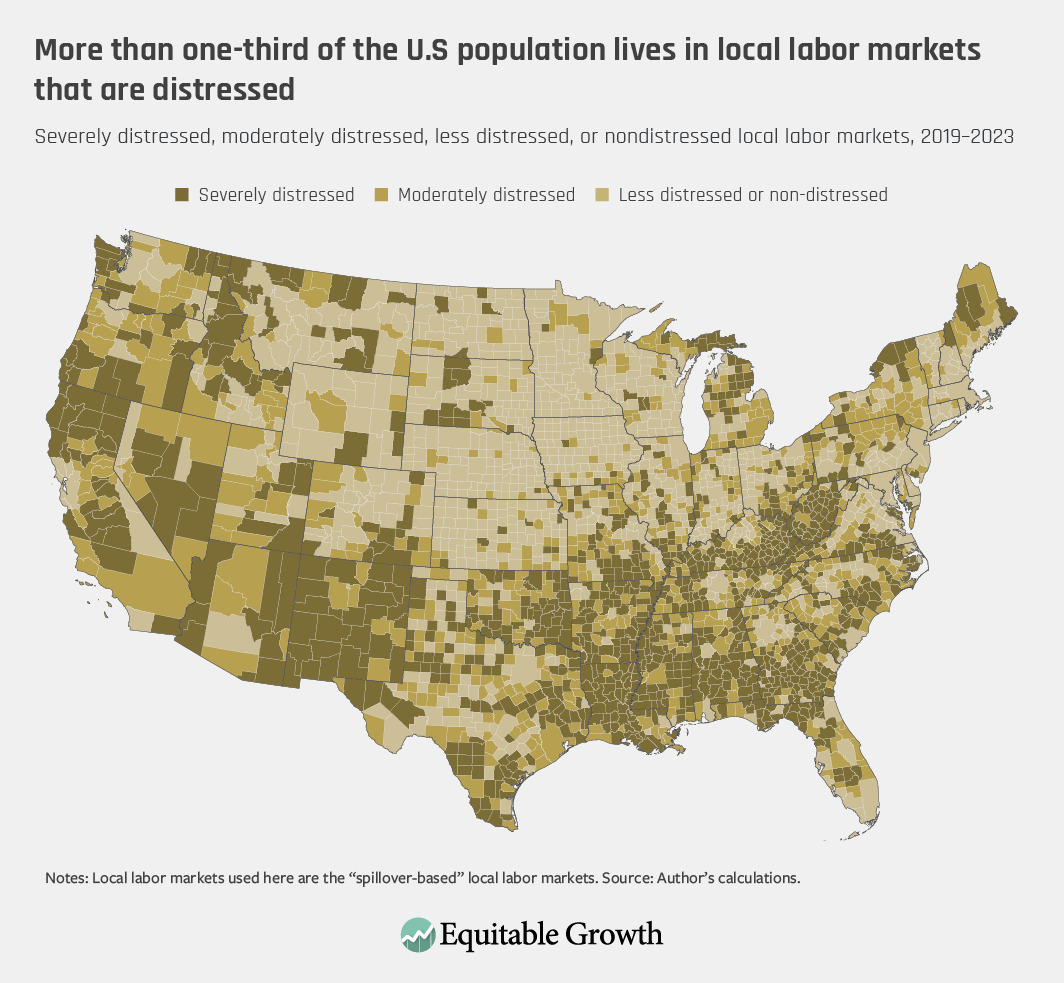
The map below shows local U.S. labor markets that are “severely distressed” or “moderately distressed,” as well as those that are less distressed and not distressed, according to the 2019–2023 data. The former is defined as more than 10 percentage points below the “full employment” prime-age employment rate of 84.1 percent and the latter as between 5 percentage points and 10 percentage points below that rate. Under these definitions, 10.5 percent of the U.S. population lives in local labor markets that are severely distressed, and another 28 percent lives in moderately distressed areas. (See map.)

Map

More than one-third of the U.S population lives in local labor markets that are distressed

Severely distressed, moderately distressed, less distressed, or nondistressed local labor markets, 2019–2023

Severely distressed, moderately distressed, less distressed, or nondistressed local labor markets, 2019–2023

Distressed local labor markets include most of Appalachia and the rural South and Southwest. But many rural areas elsewhere in the country also are distressed, including in upstate New York, northern Maine, Michigan, and many rural areas in the western United States. Many urban areas are at least moderately distressed, among them Detroit and Flint, Michigan; Gary, Indiana; Fresno and Bakersfield in California; Memphis, Tennessee; and Spokane, Washington.

In both booming and distressed local labor markets, some neighborhoods have much lower prime-age employment rates. If we define a distressed neighborhood as at least 10 percentage points below this local labor market average, then 10.7 percent of the U.S. population lives in distressed neighborhoods, based on the 2019–2023 data.

Although distressed neighborhoods are widespread, the size of the problem differs. Among the 30 largest local labor markets, the three local labor markets with the highest percentage of their population in distressed neighborhoods are Detroit (16.2 percent), Philadelphia (14.3 percent), and Cleveland (14.3 percent). The three local labor markets with the lowest percentage of their population in distressed neighborhoods are Portland, Oregon (6.1 percent), Seattle (6.5 percent), and Minneapolis/St. Paul (6.5 percent).

The racial and ethnic composition of distressed local labor markets is similar across demographic groups. In contrast, Black and Hispanic people are more likely to reside in distressed neighborhoods: The national average percentages of the population living in distressed neighborhoods are 7.3 percent for White, non-Hispanic persons, 11.8 percent for Hispanic persons, and 21.7 percent for Black persons.47

The prime-age employment rate in different local labor markets goes up and down with the national economy’s rate, yet different places’ relative positions, compared to the nation, often persist. In 2000, for example, about 47 percent of the U.S. population lived in severely or moderately distressed local labor markets. Of this population living in distressed local labor markets as of 2000, 74 percent still lived in severely or moderately distressed local labor markets as of the 2014–2018 period.48

But, sometimes, places dramatically improve. The local labor market’s prime-age employment rate in the New York City area, for example, went from 6.9 percentage points below the national average in 2000 to slightly above the national rate in the 2014–2018 period.49

Solving places’ job distress: Effective programs are services to promote job creation and job access

The jobs problems of distressed places cannot be solved at scale by moving people from distressed places to better places, a strategy that local economic development specialist Jason Segedy has called the “U-Haul School of Urban Policy.”50 Why doesn’t the “U-Haul” strategy work? The arguments for this position are two-fold. First, people are hard to move. More than half of Americans spend most of their careers in their childhood local labor market.51 Even large local job losses increase out-migration over the next decade by less than 1 percentage point.52 Estimated moving costs, both financial and psychological, often exceed 100 percent of annual income.53

Second, moving some people out of distressed places does not help those left behind. In local labor markets, population loss leads to a similar percentage loss of employment, with no improvement in the local employment rate.54 Population loss lowers demand for local goods and services and disproportionately removes younger and more entrepreneurial workers. In neighborhoods, population loss leads to abandoned housing, higher crime, and loss of local retail outlets.55

In sum, places that are distressed cannot be helped simply by encouraging individual out-migration because people have valuable ties to places, and out-migration has spillover costs. Instead, policymakers need to enact place-based policies to help people in their home places.

Boosting employment rates in distressed places requires different strategies for local labor markets versus neighborhoods. For distressed local labor markets, local employment rates can be increased by creating jobs. In severely distressed places, local job creation can result in half the jobs boosting local employment rates and the other half going to in-migrants.56 In other words, if a distressed local labor market is able to add 100 jobs, 50 of those jobs could go to additional in-migrants to the local economy, while the other 50 jobs would then be reflected in the original local residents having a higher probability of having a job.

In contrast, in booming local labor markets with high employment rates, any added local job creation almost entirely boosts in-migration, with little effects on local employment rates.57 In booming local labor markets, newly created jobs will be filled mostly by in-migrants or already-employed local workers, as few readily employable, local, nonemployed workers are available.

The hiring of already-employed local workers results in job vacancies, filled in the same two ways. At the end of this job-vacancy chain, the initial job creation will be reflected close to 100 percent in in-migration.58 In booming places, job creation mostly increases property values for property owners rather than helping workers.59

How can local jobs be created? Most government job creation dollars come from state and local governments, and most of these job creation dollars are in the form of business tax incentives or cash grants to business to create jobs, which total more than $70 billion annually.60 Examples include property tax abatements, job creation tax credits, or cash grants tied to a firm’s job creation or investment.

But federal, state, and local governments together devote about $10 billion annually to various spending programs that promote job creation by what I describe as customized business services: providing business with better business sites, more productive labor, or business-relevant information.61 These services are customized in that they are typically designed to meet the needs of a particular industry, or even a particular firm. 

One type of customized business service is business-specific infrastructure. A regular part of the local economic developer’s toolkit is to create industrial parks or high-tech research parks, which provide land that is zoned for a particular industry type and has appropriate supportive infrastructure. State economic development agencies or state transportation agencies frequently pay for industrial access roads, which provide new roads in association with a major new firm location, to facilitate movement of supplies, workers, or output. Business incubators, of which there are about 1,400 in the United States, help provide affordable business space for new or small businesses, along with some support services.62

States also seek to create jobs through customized job training programs. Rather than targeting disadvantaged residents, these programs target firms that are either creating jobs or facing competitive threats, providing them with free or heavily subsidized job training. This training is customized in that it is designed around the particular firm’s skill needs. Training is typically provided by local community colleges. Around 42 states provide such customized training, at a cost of around $1 billion annually.63

Jobs also can be created by providing individual firms with business-specific information or advice. For example, the Manufacturing Extension Partnership in the U.S. Department of Commerce provides federal support that pays for part of the costs of manufacturing extension services in all 50 states.64 In manufacturing extension services, program staff or reliable consultants provide small- and medium-sized manufacturers with advice, typically paid for partly by fees and partly supported by government, on how to best adopt new technology or move into new markets. 

The federal Small Business Administration also provides funding that pays for part of the costs of Small Business Development Centers that exist in all 50 states and help new or small businesses develop and implement better business plans.65 In both manufacturing extension services and Small Business Development Centers, the information and advice is customized to the needs of the individual business.

Which of the above types of job creation is most cost-effective? While tax incentives can create jobs, the cost per job is high. The various customized business services are more cost-effective because they provide businesses with better access to inputs, such as real estate, labor, and information, which are difficult for many firms, particularly smaller firms, to access on their own.

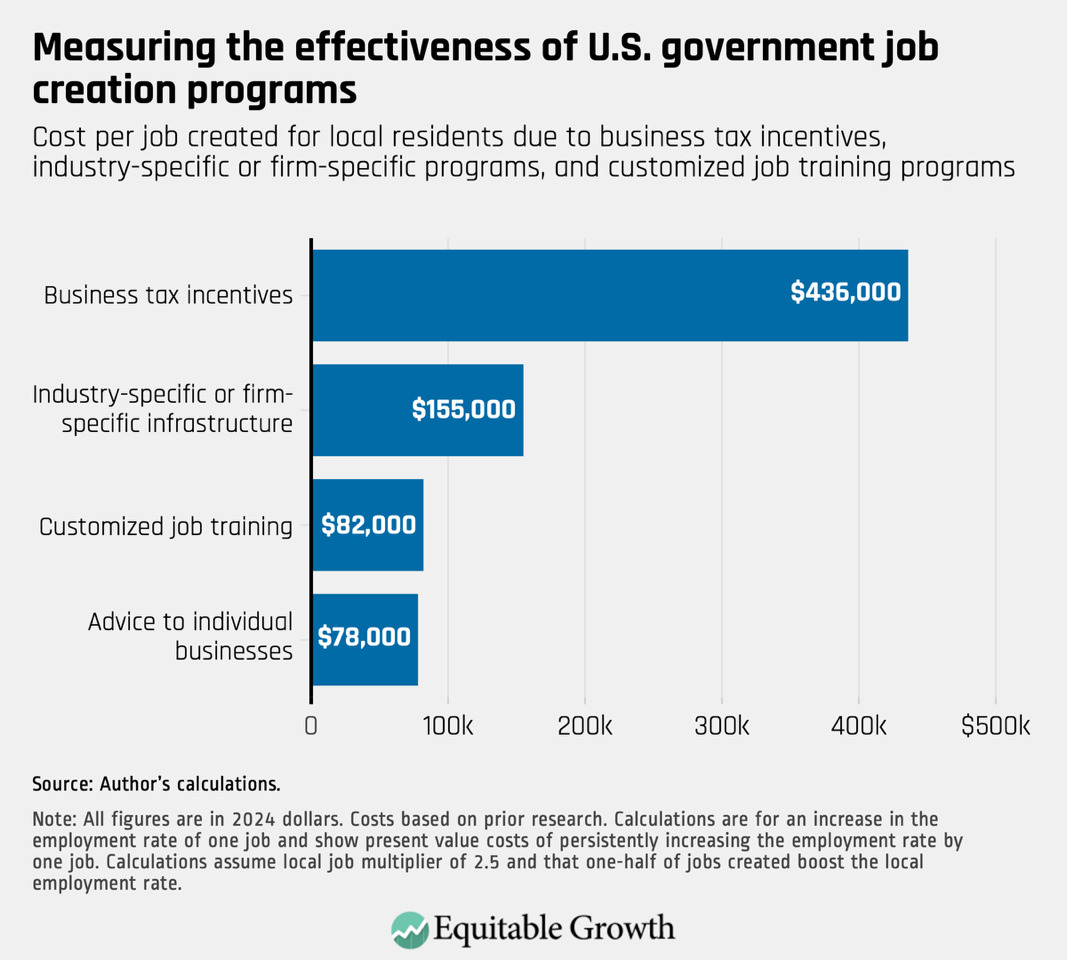
Based on my research, Figure 1 below shows the cost in severely distressed local labor markets of increasing the overall employment rate by one job.66 To avoid possible misinterpretations, it is important to note that this figure is based on research that estimates the cost of government job-creation programs per job actually induced by the particular program. These induced jobs numbers will be lower than the number of jobs subsidized by the program. For example, only a minority of firms receiving tax incentives or customized services would have changed their location and job creation decisions due to being provided this incentive or service.67

The figure then takes these research findings on costs per job actually induced and translates these costs into costs in 2024 dollars. Furthermore, this figure translates research findings about costs per induced job into costs, divided by total jobs created, for jobs that actually boost the employment rate of local residents in distressed local labor markets. As mentioned above, in severely distressed local labor markets, about half of jobs created can go to increase the employment rate of local residents, and the other half go to in-migrants. This focus on jobs that boost the local employment rate actually doubles the cost per job.68

Figure 1

Cost per job created for local residents due to business tax incentives, industry-specific or firm-specific programs, and customized job training programs

Are these costs of increasing the employment rate outweighed by the benefits? In severely distressed local labor markets, benefits probably do outweigh the costs. Permanently increasing the employment rate has economic benefits whose present value in many cases will exceed $1 million per job.69 As a result, even business tax incentives can have benefits greater than costs. But the cost per job of these three types of customized business services is less than half the cost of business tax incentives, as presented in Figure 1. More cost-effective local job creation strategies would emphasize these services, as opposed to tax incentives.

One example of successful local use of these job creation strategies is Grand Rapids, Michigan.70 This medium-sized city in the west-central part of the state has experienced manufacturing job growth of more than 10 percent since 1990, while the United States as a whole has lost one-quarter of its manufacturing jobs. Grand Rapids’ economic development strategy included extensive use of both state and local incentives but also included supporting a local manufacturing extension office that helps some auto suppliers diversify their markets into health care, customized training programs to better meet the skill needs of different local manufacturing clusters, and support for a biotech research corridor.

For distressed neighborhoods, neighborhood job creation is ineffective in helping residents. Most Americans do not live and work in the same neighborhood, so adding more jobs to a distressed neighborhood will not significantly boost the employment rates of its residents. What residents need is better job access, including improving public transit or helping provide reliable used cars, helping residents find affordable, quality child care, and both classroom training and on-the-job training services for in-demand jobs in the local labor market, among others. Studies show that these neighborhood job access services can increase employment rates at a cost per job of $103,000.71

Job access services for distressed neighborhoods should be combined with investments in improving the neighborhood’s amenities, including by lowering crime rates, improving schools, and investing in public parks, neighborhood business districts, and other neighborhood infrastructure. If neighborhood amenities are improved without increasing neighborhood residents’ earnings, though, the result is excessive gentrification, with housing price increases outpacing residents’ ability to pay. At the same time, if neighborhood residents’ earnings are boosted without improving a distressed neighborhood’s amenities, the result is excessive out-migration, undermining neighborhood improvement. Simultaneously boosting both neighborhood amenities and residents’ earnings is more likely to lead to neighborhood improvements that actually help residents. 

A good example of job access services is the Employer Resource Network program. The ERN model started in west Michigan in 2007 and currently is a loose network of programs active in 25 local labor markets across eight states that all follow a similar model. The national network provides certification of local programs and some training support for programs, but programs are administered and funded locally.72

Under the ERN model, employers share in the cost, typically alongside a public subsidy, of providing what amounts to support for social work casework services for newly hired workers, particularly disadvantaged workers. The ERN “success coach” can provide counseling to both the worker and their supervisor to help overcome problems with attendance or personal relationships that might impede job retention.

The ERN model can be viewed as a form of on-the-job training in so-called soft skills. Success coaches also can help employees find new child care arrangements if needed. In some ERN programs, if an employee’s car breaks down, the success coach can work with a local credit union or bank to quickly obtain a loan to repair the car.73 For the local ERN program in the Kalamazoo, Michigan, area, for example, car repair loans of up to $1,000 can be provided, and about 3 percent annually of all ERN-served workers need such a loan.74

Job access services can be coordinated by Neighborhood Employment Hubs, as has been done in Battle Creek, Michigan.75 Such hubs move the workers in job training agencies out of impersonal downtown office buildings into trusted institutions in distressed neighborhoods, making services more accessible to residents, both physically and psychologically. In Battle Creek, these trusted neighborhood institutions include a neighborhood group, a subsidized housing project, and a neighborhood church.

Moving the training agencies’ workers into these local hubs makes these workers more aware of neighborhood weaknesses and assets and more in touch with neighborhood services and needs. For example, workers at the hubs may be more in touch with neighborhood businesses, which may increase awareness of job vacancies and facilitate more productive job placements.

What it takes: A federal government or state governments that can provide significant resources to target and empower distressed places

Based on these costs of around $100,000 per job added, significantly increasing distressed places’ employment rates requires providing these places with annual assistance of around $300 per capita76 for at least 10 years.77 The total national costs of significantly helping severely distressed places sum to around $20 billion per year for at least 10 years.78

This total amount is obviously just rounding error compared to total annual federal spending, which is more than $6 trillion. Yet such a commitment to local economic development would be large compared to recent federal commitments to local development. In fiscal year 2024, for example, federal appropriations for the Community Development Block Grant program, which supports various types of community and economic development activities in distressed urban neighborhoods and distressed rural communities, were about $3 billion.

As another example, the public perception that the Biden administration succeeded in getting large-scale appropriations for programs targeting distressed places is incorrect. Most of the programs targeting distressed places ended up receiving appropriations that were at a pilot scale.79

Yet the Biden administration did succeed in getting the U.S. Congress to appropriate significant dollars for industrial policies that targeted specific industries for job creation. For example, the CHIPS Act appropriated $53 billion to revitalize the U.S. semiconductor industry.80 But such a subsidy program for the semiconductor industry is not really a place-based program—it is certainly not targeted at distressed places.81 Other programs tried to geographically diversify the tech industry, but, in most cases, that is not the same as targeting distressed places.82

Consider one example of a program that did explicitly target distressed places. The Recompete program was originally proposed by former Rep. Derek Kilmer (D-WA) in 2022 as a program specifically targeting distressed places with low prime-age employment rates, offering flexible funding that could include many of the customized services advocated for earlier in this essay. The suggested funding level in Rep. Kilmer’s original bill averaged more than $17 billion per year for 10 years. In the CHIPS Act, the program was authorized as the Recompete Pilot Program, with a one-time authorization of $1 billion. Actual appropriations ended up at $200 million.83 Recompete may be a promising program, but it was not funded at scale. In fact, Recompete was not even funded at a sufficient scale to be readily evaluable, to simply see if this approach works.84

In sum, recent experience suggests that it is difficult politically for the federal government to target $20 billion annually in aid to distressed places. But $20 billion annually is comparable to what has sometimes been spent in the past. For example, just after it was created in 1974, Community Development Block Grant funding, which replaced urban renewal and other categorical community development programs as part of President Richard Nixon’s new federalism policies, peaked in the late 1970s at an annual funding level equivalent to more than $15 billion today.85 The question is whether the federal government for the foreseeable future can recover its ability to fund such targeted development aid at scale.

What, then, are the alternatives, if federal aid of the required scale is not forthcoming? Distressed places cannot realistically afford annual costs of $300 per capita, which is more than 10 percent of average local tax revenues.86

State governments, however, could afford to invest $300 per capita in their most distressed quintile of places, which would have a statewide cost of $60 per capita ($300 times 20 percent).87 As mentioned above, state governments in total invest more than $70 billion per year in business tax incentives for economic development, which typically do not do much to target distressed places. Simply cutting current incentive programs by less than one-third would free up the $20 billion per year needed to help the most severely distressed places.

Yet such federal or state aid requires targeting distressed places. And targeting is politically challenging and has rarely been sustained at scale for development aid from federal or state governments.

As I have argued before, perhaps federal or state targeting of development aid would be more feasible if it were “targeting within universalism,”88 which has usually been discussed as a political consideration in the design of social programs. The argument is that a social program to help the poor is more politically feasible if significant benefits also go to the middle class and other groups.89 Applying such a concept to development aid could mean providing some job creation aid to all places but tying per-capita aid to a place’s prime-age employment rate.90 The argument is that such an approach would be more politically feasible because all places would get some aid.

Such a targeting-within-universalism approach has sometimes been used for various large government programs.91 Social Security, for example, provides retirement income help for almost all workers, but the benefit formula provides higher benefit payments relative to payroll taxes for lower-wage workers. Perhaps the most relevant example is intergovernmental aid for public schools: Many states tie school aid for Kindergarten-through-12th grade school districts to the district’s number of low-income students.92 This extra state aid per low-income student is sometimes 40 percent to 50 percent greater than the general support per student. So-called federal Title I aid to school districts, funded annually at more than $18 billion, is even more targeted, with the funds mostly determined by a school district’s number of low-income students.93 

All of these are precedents for basing a government program’s aid on need while still recognizing that everyone may have some level of need. Doing so for place-based jobs policies simply requires conceptualizing this local economic development aid as a way to help, first of all, nonemployed or under-employed workers. Greater aid to local labor markets or neighborhoods with lower prime-age employment rates can then be viewed as fair. Funding would be proportionate to the number of local residents needing jobs.  

Aid for distressed places by the federal government or state governments also must recognize the need for local flexibility. When attempting to increase local employment rates, one size does not fit all. Whether a local labor market’s job creation strategy should emphasize manufacturing extension services, for example, depends upon the viability of local manufacturing. As another example, the specific business real estate or local skills that are needed will vary greatly across places.

At the neighborhood level, the transit or car options that are most needed will depend on the area’s size and the neighborhood’s proximity to job centers. The availability of child care also varies greatly by neighborhood. And the need for job training programs can depend on residents’ skills compared to the jobs in locally growing industries. Local leaders and residents should help design local strategies, as local investments will be needed to complement federal or state investments.

Conclusion

Helping distressed places requires a different philosophy of federal or state aid to local places. The federal or state aid must be generous and long term yet highly targeted, while also allowing for considerable local discretion. Such an aid strategy differs from usual intergovernmental aid, which comes in the form of categorical programs. These categorical programs provide short-term funds whose allowable uses are dictated from the top down to the localities.

This long-term, flexible, and targeted aid is needed to visibly help the residents of distressed places. The aforementioned Recompete Pilot Program, which used the prime-age employment rate as its investment metric, is a start, but these investments need to be made at scale in distressed communities across the country.94 Such aid would show respect for the worth of distressed local communities. It would honor the high value that many residents place on where they live because people care that their home community is doing well economically and socially.

Promoting employment via such aid would offer residents in distressed communities the dignity of work. A key part of personal identity and self-respect for many residents of distressed communities is the ability to find a good job in their home community, rather than being forced to move out. This flexible aid approach also shows respect for the unique characteristics of local places. Flexible aid empowers local leaders and institutions, rather than dictating to them from the top down.

Can federal or state governments say to the leaders and residents of distressed places: “I am from the federal or state government, and I am here to help,” and credibly deliver? The outlook is hazy. We need to try again with this new approach—and continue trying until we get it right.

About the author

Timothy J. Bartik is a senior economist at the W.E. Upjohn Institute for Employment Research, a nonprofit and nonpartisan research organization. He co-directs the Institute’s research initiative on policies for place. Bartik received his Ph.D. in economics from the University of Wisconsin-Madison.


Did you find this content informative and engaging?
Get updates and stay in tune with U.S. economic inequality and growth!
More accurately measuring economic sentiment will help build a U.S. economy—and democracy—that works for all

""

Overview

When politicians and members of the media discuss the state of “the economy” in the United States, they often use a small handful of data points. Of all the indicators of economic performance, just four are relied on as the primary gauges of the U.S. fiscal direction: Gross Domestic Product, the Dow Jones Industrial Average index, the inflation rate, and the unemployment rate.

Economic measures such as these are seen as objective in their ability to capture how the U.S. economy is doing. These data are certainly prepared dispassionately, according to predefined formulas. But the choice of which metrics to use is highly subjective—and highly revealing of what a society values. As the old saying goes, “What gets measured, gets managed.”

Traditional metrics seek to offer a portrait of how an economy is doing. But the U.S. political and economic system should focus less on how the U.S. economy is doing and more on how Americans are doing. By adopting indicators that are more closely attuned to Americans’ economic and political lives—and by listening to the hopes, dreams, and concerns of those Americans—policymakers can steer toward an economy focused on the well-being of the greatest number of people.

This essay begins with a look at current indicators and their shortcomings in reflecting economic sentiment among the U.S. population. We then discuss how these shortcomings impact U.S. political institutions and civic life. Next, we offer a new method of measurement—what we call the CORE Score—and preview how transitioning to people-focused indicators could yield economic discourse that more accurately reflects how the economy is in fact performing for the majority of Americans.  

The need to reimagine U.S. economic measurements is readily apparent in the aftermath of the 2024 presidential election. For months leading up to Election Day, op-ed pages were roiled in debates (to which we contributed95) over the disconnect between traditional economic indicators, which looked positive, and responses to polls and surveys asking for people’s views on the economy, which were decidedly less positive. Democrats were understandably perplexed by the outcome of the election: By traditional measures, the Biden administration had shepherded the nation through the economic morass of the COVID-19 pandemic, especially in comparison to peer nations.96 Why didn’t voters reward them for this stewardship at the ballot box?

We can hardly claim to have the answer, but our past work provides some clarity. In 2022, as part of the Commission on Reimagining Our Economy at the American Academy of Arts and Sciences,97 we organized small-group conversations across the country, including with service, care, and airport workers, tribal leaders, teachers, small-business owners, and community college students, among others.

What we heard in these listening sessions reflected the consumer sentiment being captured in polling. Inflation was on people’s minds, and many participants expressed that they were living on a financial knife-edge.

But the people we talked to were not only upset because of short-term economic circumstances. They also felt the U.S. economy as a whole was not designed for them. “We really live in a world of abundance,” a woman in Chicago told us, “but the abundance is misdistributed.” Other people in other places were doing better and better, while their economic situation stayed the same or got worse. “Twenty years ago, you didn’t have to work two jobs to get by because we still had [factory jobs]. There’s no factories or anything around here [anymore],” one Morehead, Kentucky, resident explained. Many, including a tribal leader in Arizona, felt that ours is a “greed-based economic system.” And while services were available to help people through adversity, participants talked about the difficulty learning about or accessing these services.

The sentiments that we heard in our listening sessions were actually evident in nontraditional economic indicators—most of which were overlooked in the pre-election discourse about the supposedly robust economy. For example, in 8 of the 10 quarters since the start of 2022, total credit card debt increased, and the percentage of balances delinquent for more than 90 days climbed steadily since the middle of 2023.98 The percentage of auto loans that fell into delinquency by the end of 2023 was at its highest point since the Great Recession of 2007–2009, and rates of food insecurity have been increasing.99

Voters and lawmakers can be forgiven for not providing equal attention to these nontraditional economic proxies. Part of the problem stems from how the media covers the economy. Indeed, a 2021 study finds that, because of the news media’s focus on economic aggregates, “the tone of the economic news strongly and disproportionately tracks the fortunes of the richest households.”100

Additionally, GDP and the Dow Jones are reflective of well-being—but the well-being of those who are already rich, not of all participants in the U.S. economy. After all, about 40 percent of U.S. households do not own stock, including through retirement accounts.101 Yet fluctuations of the Dow frequently make front-page headlines. Of course, changes in the stock market affect the entire economy, even those not directly invested in it. But the reduction of the state of economy to the state of one stock market index obscures as much as it reveals.

Impacts on U.S. democracy and political institutions

Our push for a broader array of economic metrics is born not only of concern for Americans’ material well-being but also the well-being of U.S. democracy. Economic security and opportunity play an outsized role in shaping social trust. Studies show that when people feel economically unstable, are insecure in their jobs, or feel they are not getting what they deserve at work, they are less likely to place their trust in political institutions.102

People’s worries about their financial well-being generally foster support for government intervention to bolster their security, but a perception of government inaction might feed a sense that the system in place is not designed for them.103 Why should someone have faith in the economy if the economy is not working for them?

Such distrust is not confined to the economy but rather extends to a broad array of institutions, both private and public, that, to some, seem to conspire to damage their lives and communities. Take, for instance, the research that University of Wisconsin–Madison’s Katherine Cramer (one of the authors of this essay) did in Wisconsin from 2007 to 2012.104 She invited herself into small groups in dozens of communities across the state, particularly in rural areas, where residents often claimed they were not getting their fair share of resources, attention, and respect in comparison to those who lived in urban areas. In fact, an analysis of tax collections and per capita expenditures at the time showed that, if anything, people in rural counties were getting more than their fair share.105

Yet the cycle of trust in these communities had broken down. People generally tend to make assessments about whether the status quo is working based on both their absolute and relative well-being—in other words, both how their community and their racial/ethnic group is doing, and how they compare to other communities and to other groups.106 Levels of poverty and unemployment were higher in rural places, and household income was lower than in more urban counties.

These comparative disparities registered with many rural residents and fed resentment against urbanites and government actors. And the perception that the government was not working for rural people or rural communities turned out to be fertile ground for Republicans.

The so-called politics of resentment—these sentiments and the political use of them—is hardly confined to Wisconsin. It has taken over much of the national Republican Party and, through it, the White House and the U.S. Congress. In recent U.S. elections, people who perceive that their social group has declined from high to low status appear to be more willing to support candidates who pledge to restore old status hierarchies.107

In fact, the greatest supporters of resentment politics are not necessarily those who actually are experiencing the lowest levels of economic well-being but rather those who perceive that the place where they live is disadvantaged.108

Such a phenomenon is likewise hardly confined to the United States. One study from Europe finds that in EU member states, declining manufacturing and lower per-capita GDP bears a strong association with voting share for right-wing populist parties.109 As seen in Wisconsin during the Obama administration, the breakdown of the economic system fosters support for leaders willing to tear much of that system down.

Many of the uneven shifts in economic well-being that set the stage for the politics of resentment in the United States are not reflected in traditional measures of the U.S. economy. Before 2020, GDP and the Dow Jones had generally shown a steady recovery since the Great Recession. Someone following the economy just through the headlines of a national newspaper will be forgiven if they missed that the recovery in Washington, DC, did not quite reach Washington County, Pennsylvania.

The United States has always had rich and poor places. But while scholars have found a convergence in the fortunes of these places for much of the mid-20th century, this convergence decreased or disappeared entirely between 1980 and 2010.110 The result? Parts of the country are not progressing together—and are even moving in different directions.

Measuring what matters: Changing how we capture economic performance

Even some economic metrics themselves do not necessarily reflect what they purport to measure. Indicators such as the unemployment rate appear straightforward: They measure the percentage of the adult population that is unemployed, right? Not exactly.

As the former Comptroller of the U.S. Currency Eugene Ludwig argues, the traditional headline unemployment rate does not account for those who are without work and no longer actively looking for employment, counts underemployed people who are looking for more work as fully employed, and does not account for how well someone’s job pays.111 Similar issues plague other headline indicators—most obviously inflation, GDP, and the Dow Jones.

Between the problems underlying these metrics and the importance of observing geographic economic trends, policymakers and the media should shift their focus away from aggregate, national measures of economic performance toward more localized, people-centric indicators. We have just such a measure for them to consider.

The CORE Score

Because it became clear to us that traditional metrics do not reflect the well-being of many of the Americans with whom we spoke, we and our colleagues on the Commission on Reimagining our Economy created the a county-level economic index called the CORE Score.112 Crucially, this score’s north star is well-being: It traces not how well-off communities are but how well they are doing, as measured through an annual score. Since even county-level measurements can disguise disparities, the CORE Score provides visibility into disparities within counties along lines of race/ethnicity, age, sex, income, and education level.

This score takes into account indicators from four categories: economic security, economic opportunity, health, and political voice. (See sidebar below.) Many other factors determine well-being, of course—for example, the degree to which someone is free to spend their time how they wish. But many such measures are only available at the national level, without sufficient sample size for geographic disparities, particularly at the county level. For the Score, each U.S. county is scored along each category, with the average producing its CORE Score, and each category score is constructed using a scaled average of the metrics within each category.

We picked these categories because of how well they can capture elements of well-being. A community lacking security, for example, or the chance to pursue or achieve a better life, cannot be a thriving community. Neither can one where people have short lifespans or are unable to receive medical coverage. Measures along these categories are somewhat standard for alternative economic indices such as ours.

Our use of a measure of political voice is less common. We include it because we believe that in a democratic society, the civic health of a community contributes to and reflects its overall well-being. When people engage in activities with one another and when they voice their concerns to their government, they are toning muscles that can help them address community problems and redirect government toward the challenges they find most pressing.

To that end, the CORE Score includes data on voter turnout and civic participation, as well as a new measure of the quality of political representation developed by Commission member and Yale University political scientist Jacob Hacker. This latter data point captures political congruence, or the degree to which members of Congress vote in line with the preferences of their constituents, as expressed by those constituents in public opinion surveys. Being well-represented is hardly a predictor of economic well-being, but identifying who is getting what they want from the political system is important when comparing the well-being of different parts of the country.

Using population-weighted county Scores, we generate state-level CORE Scores. We find, for example, that between 2013 and 2023, the states with the highest average CORE Scores were Minnesota, North Dakota, Iowa, and Wisconsin. In fact, we find that the upper Midwest generally boasts strong results across a variety of measures, particularly economic security. These are many of the same states that, according to a widespread political narrative, turned to populism and President Donald Trump because of economic anxiety.

Yet we find that many of these places are thriving relative to the coastal elites of whom they seem so resentful. Well-being is rooted in perception as much as in reality. So, even if these places—at least at the state level—seem to offer some of the highest levels of well-being in the country, the perception that other places are doing even better, or are receiving unfair levels of help from the government, can breed distrust.

We hardly claim that the CORE Score can singularly explain the emergence of the politics of resentment. Still, this score tells stories that can help explain dissatisfaction with the current state of the U.S. political system. For instance, we see a modest negative correlation (-0.49) between a county’s political voice—the average of its voter turnout, civic participation, and political congruence score, scaled from 1 to 10—and vote share for Donald Trump in the 2024 presidential election.

In general, people living in counties with worse political voice, defined as lower turnout, worse rates of community political involvement, and worse quality of representation, were more likely to support the candidate who has long promised to disrupt the political system. (See Figure 1.)

Figure 1

People in counties with worse political voice tended to vote for President Donald Trump in 2024

Average voter turnout, civic participation, and political congruence scores in U.S. counties, 2023, and the share of each county’s vote that went to Donald Trump in 2024

Average voter turnout, civic participation, and political congruence scores in U.S. counties, 2023, and the share of each county’s vote that went to Donald Trump in 2024
Source: CORE Score metrics, compiled by data analyst Zach Broeren.

Some of the stories that emerge from the CORE Score contrast sharply with the dominant economic narratives of the past few years. Gross Domestic Product and the Dow Jones, for example, plummeted in early 2020 amid the onset of the COVID-19 pandemic, but both measures had recovered almost fully by the end of that year.113 In contrast, in 2023, the nation’s CORE Score (5.60) still had not recovered to its 2019 level of 5.87, the highest since 2011. (See Figure 2.)

Figure 2

Nominal per capita U.S. GDP and CORE Score, indexed to 2008

Such a change may appear marginal, but that is part of the problem: The Score shows a modest (7 percent) decline to national well-being since the start of our data in 2008. Between 2008 and 2023, Virginia and the District of Columbia were the only states (or state equivalents, in the case of Washington, DC) whose Score improved, while just 158 out of 3,143 total U.S. counties114 saw improvement.

Conclusion

Further research using data from the CORE Score and other nontraditional indicators is needed to explain geographic disparities and associated changes in U.S. politics. But the case for these metrics is clear: The fixation on aggregate economic measures has papered over the fact that the economy is made up of people, and that the U.S. economy should serve people, not the other way around.

Using geographically attenuated indicators more closely tied to people’s well-being would allow policymakers and economic storytellers alike to offer a more accurate picture of how the United States is doing. Properly capturing the true extent of economic insecurity represents a crucial step in reshaping public discourse—and, ultimately, public policy—in favor of economic policies that would address the needs of the Americans with whom we spoke. Doing so would also help identify places where normal politics are breaking down and where the politics of resentment may be emerging.

Adopting measures such as these can be as simple as including them in briefing materials for lawmakers or in standard-fare news coverage of the U.S. economy. After all, why shouldn’t the release of data on credit card delinquencies receive the same headline treatment as the latest unemployment figures?

Policymakers could also support the production of additional measures by providing greater support—financial, administrative, or both—to the nation’s statistical agencies. Doing so would help facilitate the timelier release of certain data points, which would allow measures with inherent lags—such as health data, which can take months or years to compile—to compete with the quarterly releases of inflation, GDP, or unemployment data or even the daily vicissitudes of the Dow Jones.

A continued focus on top line measures cultivates misperceptions of widespread economic growth, which abet ongoing anger toward a system that seems to not be working for those who could use its help. Such a trend helps explain why some of the places in the country that have the highest average levels of well-being according to the CORE Score are also some of the places where the politics of resentment has found its greatest purchase.

By listening to Americans, and by measuring what truly matters, the nation’s leaders can forge a path to rebuilding trust and building an economy that works for the people who make it work.

About the authors

Katherine J. Cramer is a political science professor at the University of Wisconsin–Madison. Jonathan D. Cohen is a senior program officer at the American Academy of Arts and Sciences.


Did you find this content informative and engaging?
Get updates and stay in tune with U.S. economic inequality and growth!
Understanding the role of immigration and economic factors in boosting support for far-right political parties

""

Overview

Far-right and right-wing populist political parties differ in many respects, but nearly all share one common thread: strong opposition to immigration. These parties often push for stricter border controls and, in some cases, advocate for repatriating immigrant communities already in the country.

Research also shows that immigration consistently ranks among the top concerns for the voters and supporters of far-right parties.115 Yet studies examining the relationship between immigration levels and support for right-wing populist parties remain inconclusive. Some find that immigration fuels support for these parties, while others suggest no effect—or even the opposite.

This essay offers a new way to understand how concerns about immigration translate into political behavior. Below, I distinguish between two core concepts: triggers and channels. Triggers refer to changes or shocks to voters’ circumstances—such as the rising presence of immigrants or the increased risk of unemployment—while channels describe the mechanisms through which these shocks lead to greater support for right-wing populist parties.

This framework helps clarify how both cultural and economic factors can interact to generate increased support for right-wing populist parties. I also explore how a different kind of demographic shift—emigration, or the movement of people out of an area—can influence voter behavior in similar ways. Finally, I discuss how increased exposure to immigrants can, somewhat counterintuitively, lead to reduced opposition to immigration, particularly when contact is meaningful and cooperative.

Explaining increased support for anti-immigration parties

The rise of far-right and right-wing populist parties marks one of the most significant political developments across advanced democracies in recent decades. These parties have gained ground in national legislatures around the world, and in several countries, such as Italy and Sweden, they have entered governing coalitions.116 As a result, their influence on policy—especially immigration policy—has grown substantially.

Despite their differences, nearly all right-wing populist parties share a defining trait: firm resistance to immigration. Throughout this essay, I refer to them as anti-immigration parties, reflecting both their platforms and their rhetoric. These parties typically advocate for policies that restrict immigration, including hard limits on annual inflows and, in more extreme cases, calls for repatriation or denaturalization of foreign-born residents.

Research shows that the leaders of these parties overwhelmingly support such views.117 The same applies to their voters.118 Supporters of anti-immigration parties tend to rank immigration among their top political concerns and consistently favor tougher policies toward immigration. As a result, immigration is a unifying issue for both the leadership and the base of these parties.

Much of the academic and political debate around the rise of these far-right parties has focused on immigration as the key driver. The common assumption is that an increase in local immigrant populations directly fuels support for these parties, primarily through cultural concerns among the native-born population about perceived loss of status or identity as a result of increased diversity. Some research backs this up.119 But other studies complicate the picture, suggesting that economic insecurity—rising unemployment or growing inequality, for example—plays a more central role than immigration.120

This debate often pits cultural explanations of populism’s growing support against economic ones. But are these really opposing forces, or do they interact in more complex ways? Rather than viewing cultural and economic explanations as mutually exclusive, some scholars have suggested that these factors often operate in tandem.

One way to understand this interaction is by distinguishing between triggers—the immediate events or conditions that prompt political reactions—and channels—the interpretive or mediating frameworks through which these reactions are shaped. Both triggers and channels can reflect cultural or economic concerns, particularly when it comes to immigration.

How triggers and channels shape political behavior

Much of the existing research on support for anti-immigration parties focuses on identifying the conditions that drive changes in voting behavior. In many cases, these studies isolate specific shifts in local or national contexts that correlate with rising support for anti-immigration parties.

Political scientist Dominik Hangartner at ETH Zurich and co-authors, for example, examine the impact of refugee arrivals during the so-called European refugee crisis of 2015-2016.121 The study compares Greek islands that received refugees to those that did not, arguing that the only meaningful difference between the two was the presence of refugees. Since other economic and social conditions were largely similar, the presence—and particularly the visibility—of immigrants served as a clear triggerfor changes in political behaviors. In this case, immigration itself acts as the stimulus that pushes voters toward anti-immigration parties.

By contrast, economic triggers are at the heart of other explanations for populism’s rise. For instance, University of Bocconi scholars Italo Colantone and Piero Stanig link job losses from rising import competition in the United Kingdom with support for the 2016 Brexit referendum.122 Here, exposure to worsening economic conditions—rather than immigration itself—is believed to have shifted political preferences toward populist ideas.

These two examples are often used to illustrate a broader divide in the research. The first case highlights a cultural trigger, while the second focuses on an economic one. But to fully understand how these triggers lead to political change, we must also consider the channels through which they operate.

There are two main channels: an economic channel and a cultural or immigration-related channel. Both types of triggers—those related to immigration and those related to economic conditions—can influence voting behavior through either channel. Increased immigration, for example, might lead native-born voters to feel that their cultural identity is under threat, or it might raise concerns about labor market competition and the allocation of public resources. In both scenarios, the trigger—increased immigration—is the same, but the channel—threat to cultural identity or to economic security—differs.

The interaction can also work in reverse. Economic hardship can heighten awareness of immigration policies, leading voters to blame immigrants for declining services or limited job opportunities. Here, the economic trigger operates through a cultural channel, as economic stress is interpreted through the lens of increased immigration.

These interactions complicate the simple dichotomy between cultural and economic explanations. Rather than viewing them as competing theories, this framework helps us understand how they often work together through different channels to shape political behavior.

Immigration as a trigger shaping political behavior

Because immigration is a central policy concern for anti-immigration parties, it is no surprise that many demand-side explanations in the research focus on it. Numerous studies have shown that immigration consistently ranks among the most salient political issues for both voters and representatives of these parties.123

In most analyses, immigration is operationalized as either the level or the change in the share of foreign-born individuals within native-born populations’ local areas. These aggregate-level indicators are then linked to either individual-level survey data or election outcomes at the aggregate level.

Scholars generally identify two main reasons why increased immigration in a neighborhood might influence native-born voters’ propensity to support anti-immigration parties. The first is cultural: Immigrants—particularly those perceived as coming from “culturally distant” regions—are often viewed as a threat to the cultural and social status of native-born residents. As the presence of immigrants becomes more visible, some voters fear that their traditions, identity, and social position are at risk.124

The second is economic, with two separate but related mechanisms. First, there is concern over labor market competition. Native-born workers may fear that immigrants, especially from low-income countries, will accept lower wages or take jobs that would otherwise go to them.125  Second, there is concern over access to welfare services. Economically vulnerable voters might worry that increased immigration will lead to greater competition for unemployment benefits, public housing, or other forms of public assistance.126 The visibility of immigrants in these neighborhoods makes such concerns more immediate and politically salient.

Notably, these economic fears are expected to have the greatest impact on voters who are themselves economically insecure.127 Yet there is a related economic channel that can affect voters beyond those facing direct economic vulnerability: Increases in local immigrant populations may signal to native-born residents that the government will need to redirect public funds—for education, health care, or transportation—toward accommodating new arrivals.

Some voters might also worry that taxes will be raised to meet these demands. These concerns are not limited to lower-income groups. Indeed, even higher-income voters may perceive immigrants as a net burden on public finances, resulting in increased demand for restrictive immigration policies.128

While immigration serves as the trigger across these examples, the channel through which it affects political preferences varies—cultural for some, economic for others. These competing interpretations often lead to different conclusions about what drives support for anti-immigration parties: either immigration itself or the underlying economic conditions that shape how immigration is perceived.

Economic conditions as triggers shaping political behavior

An alternative category of triggers relates to economic factors. These can be broadly divided into two subtypes. The first concerns changes to voters’ personal economic circumstances, and particularly their labor market status, such as wage reductions, job losses, or heightened unemployment risks. The second involves shifts in broader neighborhood or regional economic conditions, such as long-term industrial decline or the erosion of both private and public goods and services, often as a consequence of austerity policies.129

These economic shocks can feed into anti-immigration sentiment through several channels. One common pathway connects economic hardship to immigration-related fears. For instance, a laid-off worker might attribute their displacement to labor market competition from immigrants.130 Others might worry that, in the wake of personal economic decline, they now face greater competition from immigrants over access to welfare services, such as unemployment benefits or social assistance. In these cases, economic hardship acts as the trigger, while immigration becomes the perceived threat—making anti-immigration policy more salient.131

Voters also can perceive declining neighborhood conditions as stemming from immigration. Government resources directed toward immigrant populations may be seen as coming at the expense of investment in struggling local economies. In this view, the state is seen as prioritizing immigrants over native-born citizens, reinforcing perceptions of neglect among these groups.132

Importantly, economic triggers can also operate through direct, nonimmigration channels. Although anti-immigration parties are primarily known for their positions on immigration, many also advocate for protectionist trade policies. They frequently oppose free trade and international agreements, arguing that these policies harm domestic industries.

In this context, economic distress—especially that caused by import competition—can drive voters toward anti-immigration parties not because of immigration, but due to dissatisfaction with global trade. Workers laid off due to competition from low-wage countries, for example, might demand more protectionist policies at home and find their views reflected in these parties’ platforms.133

Finally, most anti-immigration parties also adopt populist narratives that blame mainstream political elites for economic decline. These parties portray themselves as champions of “the people” in opposition to the interests of a distant political class, which is often aligned with economic, media, and cultural elites.134 Within this framework, established parties are blamed for rising inequality and regional economic stagnation.

Voters in these economically depressed areas may feel “left behind” as wealth and opportunity become concentrated in urban centers. While immigration can still factor into this narrative, the core grievance may focus more broadly on elite neglect, austerity, or perceived urban bias in public investment.135

Beyond immigration: Emigration and the effects of intergroup contact

So far, this essay has focused on how immigration is expected to increase support for anti-immigration parties. Yet two additional demographic dynamics merit attention: emigration from depopulating areas and the role of intergroup contact in shaping attitudes toward immigration.

First, let’s consider emigration as a trigger. When working-age residents leave depopulating areas in search of jobs or education, this lowers the local tax base and reduces demand for both public and private goods and services. When a former mill town loses its main employer, for example, its young residents might move away in search of opportunities elsewhere, leading to cuts in services, such as health care, education, and transportation. As demand shrinks and revenue declines, public infrastructure deteriorates. The remaining population faces reduced access to essential services and amenities.136

Beyond material consequences, emigration can also foster a psychological sense of abandonment. Residents might literally feel “left behind,” giving rise to a form of collective low self-esteem or resentment. These sentiments can be politically mobilized by populist parties and politicians, who blame the decline on neglect by established political elites. While regional decline can result from long-term structural changes beyond any government’s immediate control, populist narratives often frame it as a deliberate political failure.137

Second, while much research emphasizes how immigration can increase anti-immigration sentiment, a growing body of work challenges this assumption. Under certain conditions, the presence of immigrants might actually reduce support for anti-immigration parties. This insight draws on the so-called contact hypothesis, which posits that intergroup contact—especially when cooperative and repetitive—can reduce prejudice.138

Studies have shown that extensive, cooperative interactions between majority and minority group members can undermine negative stereotypes and foster more tolerant attitudes.139 When contact is brief, superficial, or perceived as competitive, however, it may instead heighten anxiety and reinforce negative attitudes.

One important social arena is the workplace, where cooperative interactions between co-workers are often facilitated and encouraged. In this context, intergroup contact has the potential to reduce opposition to immigration. At the same time, the increased visibility of immigrants in the workplace might reinforce native-born workers’ fears of labor market competition—potentially more so than visibility in other everyday settings, such as public squares or supermarkets. Workplace contact can therefore have both positive and negative effects on attitudes toward immigration.

Using Swedish administrative data, one recent study investigates how increased exposure to foreign-born co-workers affects political preferences.140 The results suggest that intergroup contact can indeed reduce support for anti-immigration parties—but only in smaller workplaces and among co-workers of similar skill levels. In such settings, interactions are more likely to be intimate and sustained, often centered around shared goals. These conditions appear to offset fears of labor market competition with similarly skilled immigrant co-workers.

Conversely, the study finds that same-skill intergroup contact in large workplaces tends to increase opposition to immigration. In these environments, workers can more easily opt out of social interactions, leading to more superficial or incidental contact. Without the benefits of meaningful engagement, the perception of competition remains unmitigated.

Most importantly, the study shows that vulnerabilities in the labor market influence the effects of contact. Specifically, when immigrant co-workers become more visible in occupations characterized by high insecurity, such as office and customer service clerks, then opposition to immigration increases. The reverse is true for secure occupations, such as managers and associate professionals, where contact leads to decreased opposition to immigration. In short, workers who face real risks of losing their jobs are more likely to interpret the presence of immigrants as a threat to their employment prospects.

The distinction between meaningful and superficial intergroup contact helps explain why some studies find that increased immigration boosts support for anti-immigration parties, while others show the opposite. The quality and context of intergroup contact matter significantly.141

Together, these two perspectives—on emigration and on the moderating effects of intergroup contact—complicate the assumption that more immigration automatically generates demand for more restrictive policies. They underscore the importance of local context, social dynamics, and psychological perceptions in shaping political behavior.

Conclusion

There are many demand-side explanations for increased support for right-wing populist parties and various reasons why voters turn to them. Although immigration remains the most salient political issue for these parties—and for most of their voters—the existing evidence on the relationship between immigration and native-born voters’ propensity to support them is mixed.

At the same time, there is growing scholarly consensus that economic factors also play a key role in rising support for right-wing populist parties. They are widely believed to benefit from periods of economic downturn.

This essay highlights that economic and immigration-related explanations for rising support for right-wing populism are often intertwined rather than mutually exclusive. For instance, both increased immigration in native-born voters’ neighborhoods and negative shocks to their economic circumstances can heighten perceptions of competition over economic resources.

While these trigger factors differ, they can lead to similar outcomes—namely, increased support for more restrictive immigration policies. Immigration, as a trigger, might then translate into opposition to immigration through economic concerns. Likewise, economic insecurity can fuel demand for stricter immigration policies due to fears of increased competition from immigrants.

Yet increased local immigration can have the opposite effect, depending on the nature of intergroup interactions. Meaningful, repeated contact—particularly when characterized by cooperation—tends to reduce prejudice and lower opposition to immigration. The mixed empirical findings in the research can, in part, reflect differences in the quality and character of contact between native-born and foreign-born individuals.

Lastly, a growing body of research highlights the importance of another major demographic shift: emigration. Increased support for right-wing populist parties has been observed in areas where large shares of working-age residents have moved away—either to urban centers or abroad—resulting in both material and psychological consequences for those who remain. This dynamic adds yet another dimension to the broader puzzle of how and why voters are drawn to populist movements.

As such, policymakers seeking to stem the growing support for right-wing populism must consider all of the above when determining how to use immigration policy to garner more support among voters.

About the author

Sirus H. Dehdari is an associate senior lecturer in political science at Stockholm University. His work has been published in both political science and economics journals, including the American Political Science Review, American Journal of Political Science, British Journal of Political Science, and American Economic Journal: Applied Economics.


Did you find this content informative and engaging?
Get updates and stay in tune with U.S. economic inequality and growth!

America’s job-quality crisis and how to revive workers’ pay, dignity, job advancement, and economic well-being

""

Overview

The poor quality of jobs in the United States is a slow-burning crisis that has been underway for many decades and has eroded many workers’ quality of life. Too many U.S. workers—especially but not exclusively workers without college degrees—are working in jobs with lower pay, lack of opportunities, and challenging work conditions, such as unstable schedules, all of which are detrimental to these workers’ well-being. 

In contrast, a good job can bring not only a paycheck but also meaning and social standing because it allows us to care for ourselves, our families, and contribute to something larger in our communities and our nation. Beyond earnings, the conditions of our work can affirm our dignity and our sense that our worth is recognized.142

As other essays in this project explain, the crisis of poor job quality has encouraged right-wing populist leaders to pitch divisive rhetoric to struggling workers and their families, even if their proposed policies do little to resolve the underlying crisis. This essay focuses on the drivers of poor job quality and concrete policy responses to address those drivers.  

The slow-burning job-quality crisis and its consequences, explained

Poor-quality jobs are by no means a new phenomenon in U.S. history, but the modern variant reached different industries and populations at different times starting in the 1970s and 1980s. The steady loss of manufacturing jobs and a decline in union power eroded job quality for many workers.143 Globalization and increased automation then hit, with some workers facing acute declines in their economic situations, as well as threats to their social standing.144

Pressure from financial markets on employers to cut labor costs grew, too, and managers changed practices to reduce costs.145 The rapid growth of the low-paid service sector as manufacturing jobs declined added new twists to poor jobs—unstable schedules and limited opportunities for advancement.146

Some groups, including White men working in manufacturing, have experienced real declines in job quality and economic security over their lives. Others have faced limited opportunities throughout their working lives, including Black workers, who still face hiring biases in many firms and industries.147 Those who experienced a slide and those who have long felt stuck may feel similarly frustrated, but they often are not united in pushing for change and may not see plausible strategies for collective action.

In recent years, unusually tight labor markets have provided some relief, pushing up wages for those at the bottom and creating some short-term leverage for better working conditions.148 Still, the broad trends in wages, benefits, and many other dimensions of work experience, unfolding over decades, have left many people with a sense that their lot at work is unfair and also out of their control.

Poor job quality and a sense of limited opportunities prompts anger, fear, and sadness about being disrespected and discarded at work, which plausibly leads to a sense of being disrespected and discarded in society more broadly. And that can push many workers and their loved ones to respond eagerly to politicians who articulate emotions of anger and fear and promise change.149 This assessment builds on a very strong research base linking job quality to mental health,150 as well as compelling qualitative studies making the connections to right-wing populism.151

We need to develop—and communicate—a more holistic understanding of job quality and its impact on workers, considering psychological and social, as well as economic, implications. The economic and psychological impacts of losing one’s job are well-known, but, additionally and critically, the remaining jobs are often of poor quality, and many feel their future options for good work will be limited.  

What policymakers need to understand to address the job-quality crisis

To develop a positive, holistic vision for improving job quality, policymakers need to be aware of the specific ways in which many Americans’ quality of work has declined in the past several decades. Specifically, these job-quality issues fall into at least seven areas:152

  • Diminished purchasing power for low-wage workers
  • Unstable work schedules
  • Lack of paid leave
  • Limited advancement opportunities for low-wage workers
  • Lack of job security
  • Work design and autonomy
  • Gaps in worker voice

Diminished purchasing power for low-wage workers

Many federal laws regarding work and supporting workers have not been updated to reflect new economic realities. One obvious example is the U.S. federal minimum wage of $7.25 an hour, which has not increased since 2009 and has fallen, in real terms, by about 30 percent since then.153 The failure to update federal wage floors reinforces the sense that, while elite employees can negotiate what they need, large numbers of ordinary workers are stuck on the wrong side of growing income inequality.

In some areas, state and local ordinances have surpassed the federal minimum wage—often creating better conditions in progressive states and on the coasts.154 Currently, 22 states have a minimum wage at or above $12 an hour, including California, Oregon, Washington state, Colorado, Illinois, New Jersey, New York, and Massachusetts. But state minimum-wage laws seldom reach workers in regions that already feel “left behind.” The effective minimum wage is still $7.25 in 20 states, including Indiana, Kansas, Kentucky, Mississippi, Pennsylvania, Texas, and more.

Unstable work schedules

Earnings obviously depend on both wage rates and work schedules. Overall, workers value stable schedules and the flexibility to adjust hours as needed for personal reasons.155 Yet there has been a clear trend toward more “just-in-time” or unstable scheduling practices, driven by employers.

Scheduling software helps tightly link schedules to variations in demand, based on sales by the day or even by the hour, leading to cancelled or shortened shifts, last-minute shift extensions, little advance notice of schedules, volatility in the number of hours worked across weeks, and limited say in schedules.156 These scheduling practices have negative consequences for economic security, including income volatility and difficulties holding a second job.157

Workers with unstable schedules are more likely to face economic hardships, including hunger, housing insecurity, and difficulty paying bills.158 Unstable schedules increase the odds of workers’ quitting their jobs, prompting lost earnings for these workers in the short run.159

Unstable schedules convey that employees are expected to be at the beck and call of employers. This workplace practice harms employees’ mental health and family life, as indicated by work-family conflicts, complex and more varied child care arrangements, and worse mental health among children whose parents or single parent have unpredictable schedules.160

Salaried employees also may experience frustrations about their earnings in relation to their work hours. Under the Fair Labor Standards Act, salaried workers making more than $35,568 a year are not paid for overtime hours, which means some supervisors and lower-level managers work long hours without additional pay. In my own research, salaried IT professionals earning much more than that put in very long hours and responded to emails, text, and chat any time of day or night because they frantically hoped to hold on to their IT jobs threatened by offshoring and emerging technologies.161

Even with relatively high earnings and good benefits, then, some workers still felt “owned,” disrespected, and stressed. This adds further fuel to the poor-jobs crisis.

Lack of paid leave

The United States is the only rich, industrialized country with no paid leave policy for new parents, and we are among just a few countries without paid sick leave laws.162 A lack of leave can feel like a lack of respect, and workers resent feeling forced to choose between their job and taking care of their health and their families.

Federal policies have not kept up with increases in mothers’ labor force participation, men’s caregiving, and an aging population. The Family and Medical Leave Act, passed back in 1993, guarantees the job of a leave-taker but does not provide income replacement. Moreover, due to size, tenure, and hours requirements, only 56 percent of employees are covered by FMLA-guaranteed unpaid leave, and only 49 percent of workers with just a high school education are covered.163 The inequality is obvious, with higher-income workers much more likely to have access to job-protected or paid leaves.164

Paid leave laws have been adopted by 13 states and Washington, DC. Again, most of the middle of the country has no guarantee of paid family leave, with the exceptions of Colorado and soon Minnesota.165

Limited advancement opportunities for low-wage workers

The possibility for advancement is a critical part of a quality job. Workplaces that provide training are valuable for moving up and building transferable skills that can lead to a good job elsewhere. About 59 percent of U.S. employed adults received some formal employer-provided skills training in the past year, and about 50 percent had gained skills via informal training from other employees.166 These opportunities, however, are not evenly available; training is less common for workers without a college degree, Hispanic workers, Black workers, contracted employees, and freelancers.167

Moreover, there has been a trend toward flattened firms, reductions in management positions, and outsourcing of some work roles, leaving many front-line workers without a clear career ladder for them to move up.168 While internal promotion systems have not disappeared, workers starting in low-paying occupations are more likely to move into higher-paying ones by switching employers than by staying with the same employers.169

Lack of job security

Job quality involves both adequate earnings and confidence that you can keep the job or find a similar one if needed. While the archetypal story in the news may be manufacturing workers who lost jobs to China, people in many white-collar occupations have faced job loss tied to offshoring, automation, and related pressures from financial markets to cut costs.

Job loss is often felt acutely as disrespect and triggers shame, even if workers are caught up in much broader trends.170 About half of Americans do not experience continuous employment through their 50s, and those unemployment spells reduce the odds of working into your 60s and beyond.171

Job insecurity also impacts those who manage to keep their jobs, negatively affecting health and pressuring those who “survive” a downsizing to do more and more with minimal complaint.172 Algorithmic management can prompt terminations, and often, front-line workers in warehouses, fast-food restaurants, and retail feel these decisions are out of their control.173 Insecurity is normalized, with persistent anxiety even among those who are currently employed.174

Of course, job security is completely absent from nonstandard work, such as contracting, temp, and gig work. This built-in insecurity is not uniformly negative, however, as the appeal of this work is often the ability to set one’s own schedule. But this purported flexibility also creates pressure to always hustle, putting in long hours and lining up new options to weather possible decreased demand, increased competition, or changes in algorithms for those doing platform-based work.175

Work design and autonomy

The way that work is designed—the organization of tasks into jobs—matters to workers. To take one element of work design: Workers with more autonomy (discretion over how they do their work) and more variety in the tasks entailed in their work have better mental and physical health.176 The same job can be designed either to allow for autonomy or to narrowly specify every action, communicating to workers that they are interchangeable and not seen as capable of self-direction and judgment.

Some experimental studies find that changing work practices and policies to increase autonomy and variety can reduce psychological distress, perhaps because such changes signal respect.177 Yet in many workplace settings, new technologies have further reduced autonomy and opportunities to learn. Technological surveillance of individual productivity in production, logistics, and retail settings creates even greater pressure to speed through narrowly specified tasks.178

Gaps in worker voice

Voice at work—having a say and potentially influencing what happens in your organization—affirms workers’ dignity and worth, and can be conceptualized as a dimension of job quality.179 A workplace that welcomes and incorporates worker voice conveys that employees are valued for their ideas, not just the specific tasks they complete.

Yet today there is a sizable voice gap, captured by the difference workers report in the say or influence they believe they ought to have and the say they currently have. The largest gaps are on topics such as compensation, benefits, job security, and changes in technology.180

Working in an environment where you feel you can use your voice with confidence is associated with better well-being, higher job satisfaction, and less interest in quitting.181 What’s more, a field experiment in warehouses by me and my colleagues finds that a new voice channel—specifically, a committee of front-line workers and a few managers, who hear and respond to employees’ concerns and ideas—significantly reduces turnover and also improves mental health in the short term.182

Unions are a critical and classic channel for worker voice, providing a structured and collective process for elevating workers’ concerns and bargaining with management. General approval of unions has grown to 70 percent in 2024, a level not seen since the late 1970s, and younger workers are more supportive of unions than other workers.183

Nonetheless, the percentage of U.S. workers who are members of a labor union has dropped from 20.1 percent in 1983 to 9.9 percent in 2024.184 This decline has implications not only for worker voice, but also for the financial and physical well-being of these workers and their families over the long term. Recent studies estimate that being a union member throughout one’s career results in an average of $1.3 million in additional lifetime earnings185 and also supports physical health.186 Additionally, the racial wealth gap is narrower among union members.187

As noted by other authors in this series, unions improve job quality and also connect workers in a “collective social fabric” that helps “increase workers’ social status and guard against the social divisiveness that is at the heart of right-wing populism.”188

Directions for policy and practice to improve job quality

Policymakers need to pursue both familiar and new approaches for addressing the job-quality crisis and its implications for U.S. democracy. The focus is not on a novel approach but a coordinated vision for a fair future of work that takes into account the numerous ways in which job quality has declined. Specifically, policymakers need to take action to:

  • Improve economic security
  • Address the economic and care needs of working families
  • Facilitate opportunities for job advancement and autonomy
  • Support worker power and union organizing

Let’s delve into each in turn.

Improve economic security

While the federal minimum wage only applies to a small proportion of the workforce, updating it and ideally indexing it to inflation would improve job quality for a critical segment of low-wage workers and symbolize a renewed commitment to those earners across the entire nation. Many progressive states and cities have done more to set the minimum wage above the federal floor, but some movement also is evident in more conservative political contexts, with ballot measures passed in 2024 in Missouri and Alaska.189 More states need to take this step in lieu of changes at the federal level.

Importantly, the evidence is clear that increasing the minimum wage does not reduce jobs. A recent review concludes that “minimum wage policies have had limited direct employment effects while significantly increasing the earnings of low-wage workers.”190 Some research suggests, however, that injuries may rise in the wake of minimum-wage increases, perhaps because employers push workers harder to increase productivity.191

Wage theft—including minimum-wage violations, failure to pay for all hours worked, and violations of overtime pay requirements—occurs routinely and is patently unfair.192 The misclassification of workers as independent contractors when they should be counted as employees also robs them of minimum-wage protections and overtime pay, as well as Unemployment Insurance and coverage by other labor laws.193 Enforcement could certainly be increased, and the financial penalties for violations also should be adjusted to motivate compliance and level the playing field for firms that follow the law.194

Currently, most employers who are identified as violating the minimum-wage law only pay back wages; civil monetary penalties are assessed in less than half of cases, even for repeat and/or willful violators.195 Specifically, the Wages and Hours Division at the U.S. Department of Labor could levy back-pay damages and pursue civil monetary damages more aggressively. Additionally, some states have required violating employers to pay triple or quadruple back pay and have pursued criminal penalties for repeat offenders.196

Address the economic and care needs of working families

Earnings are critical to workers, but jobs also must work with employees’ personal and family responsibilities. Scheduling reforms and paid leave help people stay in decent or good jobs when they have them.

Scheduling laws, often referred to as fair workweek, fair scheduling, or predictive scheduling laws, aim to shift employers’ scheduling practices by requiring more stable schedules, advance notice of schedules, or commitments to minimum hours. These regulations are standard in many countries and could be expanded in the United States.

An evaluation of Seattle’s Secure Scheduling Ordinance, for example, finds that “eliminating schedule unpredictability would reduce the share of workers experiencing at least one material hardship by 45 percentage points (from 64% to 19%).”197 Additionally, that policy evaluation and a study of a stable-scheduling initiative at GAP Inc. stores find workers’ well-being and sleep improved with more schedule stability.198 The GAP study also demonstrates benefits to the firm via reduced turnover among experienced employees and increased productivity.199

Passing paid leave laws also is an important priority for improving job quality for working families. Laws enacted in 13 states and Washington, DC demonstrate feasibility.200 Paid leave recognizes workers’ legitimate needs and signals respect for workers and their families. Paid leave also supports economic security by keeping people employed and providing income replacement at a critical time.

California’s leave law, for example, nearly doubled access to pay during leaves, increasing benefits especially for low-income and less-educated workers and for men.201 New paid leave laws at the federal level would address these variations across states and help meet the needs of lower-income workers who are not as well-served by the federal unpaid family leave law and employer-provided benefits.

Facilitate opportunities for advancement and autonomy

Public policy can help expand collaborative training initiatives that engage multiple employers within a given industry. Such sectoral programs typically provide training for jobs in specific industries, such as health care, life sciences, and technology, that have both good starting wages and promotion opportunities.202

Rigorously evaluated programs, such as Project Quest and Year Up United, combine the training for these fields with soft-skills training, job-placement support, and a variety of services, including transportation support and child care. Successful sectoral programs increase employment in high-wage jobs, but public investments and long-term commitments are needed to scale these programs.203 For instance, the Economic Development Administration within the U.S. Department of Commerce recently supported new communities of practice focused on specific industries’ or regions’ workforce development initiatives.

Other strategies include encouraging employers to remove educational credentials from job listings when alternative training could prepare people for those jobs.204 Yet research is needed on the impact of those changes. A recent audit study finds employers are less likely to hire applicants with alternative training and related work experience than degree holders; this is still true for employers who have removed educational credentials from their job postings.205

Policymakers also can also champion and incentivize employers who design work with autonomy and learning in mind. A long tradition of “high-performance work systems” research finds that the combination of certain practices, such as building autonomy, cross-training and other skills development, and performance-based pay, can improve productivity, raise pay in some settings, and also support workers’ well-being.206

Public procurement policies that incorporate job-quality data could encourage employers to design work in these ways.207 Additionally, local policymakers and community leaders can establish community benefit agreements with developers and new employers, encouraging job-quality standards, the hiring of local workers, and more.208

Support worker power and union organizing

Worker power, including collective bargaining by unions, can advance all the elements of job quality discussed here. To protect workers’ rights to organize and pursue their own job-quality priorities, we need to strengthen the enforcement of existing laws and ideally update federal labor law as well.209

Given how few U.S. workers are currently represented by unions and the limitations of current federal law, though, it is also important to pursue organizing innovations and state and local changes.210 One such innovation is the industry standard board, also known as a workforce standard board or sectoral co-regulation. These boards involve employers, state officials, and worker representatives in certain industries. They give workers a formalized role in setting wage rates and benefits, often improving pay for those already above the minimum wage. Additionally, these boards can support the effective enforcement of labor laws, acting as partners to educate workers, employers, and the broader community.211

“Bargaining for the common good” is another strategic innovation in which unions and other local organizations develop integrated campaigns focused on community concerns, such as housing, climate, racial justice, schools, and also decent jobs.212 This approach may foster solidarity across people with different employment statuses, work experiences, and backgrounds and provide a path toward feeling respected and recognized both at work and in the larger community.

Conclusion

This may seem like a daunting set of policy challenges, but the time to begin articulating a better vision of work is now. Rebuilding a fair economy over the next decade is particularly critical because of expected disruptions in the U.S. labor market tied to AI technologies and transitions in energy production. As jobs are altered and many jobs are lost while others emerge, there is a clear risk of greater alienation and despair unless another model of quality work is on the horizon.

About the author

Erin L. Kelly is the Sloan Distinguished Professor of Work and Organization Studies at the Massachusetts Institute of Technology Sloan School of Management and co-director of the MIT Institute for Work and Employment Research.


Did you find this content informative and engaging?
Get updates and stay in tune with U.S. economic inequality and growth!

How the China trade shock impacted U.S. manufacturing workers and labor markets, and the consequences for U.S. politics

""

Overview

In the early 2000s, manufacturing-intensive communities in the United States entered a period of economic upheaval that would reshape their labor markets over the next two decades. China’s dramatic rise as the world’s leading exporter of manufactured goods, abetted by receipt of Permanent Normal Trade Relations from the United States in 2000 and accession to the World Trade Organization in 2001, exerted immense pressure on manufacturing in the United States and many other high-income countries.213 Entire industries—textiles, furniture, and home electronics among them—struggled to compete with surges of low-cost imports.

In the United States, the China trade shock accounts for approximately one-quarter of the decline in manufacturing jobs between 2000 and 2007.214 Although the aggregate loss of U.S. manufacturing jobs attributable to China’s changing competitive position in those 7 years—approximately 1.5 million to 2 million manufacturing jobs lost—is modest relative to the overall size of the U.S. labor market, these impacts are highly geographically concentrated, meaning that they loom large in places that specialize in producing the goods in which China rapidly gained global market share.

While economists anticipated manufacturing workers in heavily China-shocked locations to encounter some difficulties in adjusting to changing labor market conditions over the course of their careers, the extent of the disruption and the slow and faltering pace of adjustment proved far more severe than expected. The economic distress brought on by the China trade shock reshaped the lives of U.S. workers and families in trade-exposed regions along multiple dimensions. Earnings for low-wage workers fell.215 Children became more likely to live in poor, single-parent households.216 And deaths of despair among working age-adults—primarily due to drug overdoses among men—increased.217

The profound economic and social consequences of the China trade shock shaped U.S. political preferences and electoral results. Across the country, trade-exposed regions became more likely to elect politicians from the right wing of the Republican party, often at the expense of moderate Democrats.218 The same trends are evident in European countries, where local exposure to Chinese import competition similarly favored nationalist and isolationist parties.219

This essay provides an empirically grounded perspective on how the China trade shock of the early 2000s shaped the evolution of trade-exposed local labor markets in the United States during the ensuing two decades, from the onset of the 21st century to the year prior to the COVID-19 pandemic of 2020. Much of the extant research on the China trade shock focuses on the first decade of the 2000s, when China’s goods exports to the United States and other high-income countries surged. Chinese exports to the United States stabilized (at high levels) after approximately 2010, however, thereby affording a sufficient time window to characterize how trade-exposed local labor markets and workers adapt to changed circumstances.

Examining changes in the labor market composition of communities affected by the China trade shock alongside the evolving prospects of their incumbent workers, relative to less affected communities across the United States, provides economic context for understanding how individual experiences of globalization may contribute to the rise in right-wing populism. To provide this long-term perspective, we draw on annual worker-level data on earnings, employment, and geographic movement from the U.S. Census Bureau’s Longitudinal Employer-Household Dynamic data, which we augment with data from several other sources.

These data facilitate two vantage points for understanding the adaptation of U.S. workers and their local labor markets to the China trade shock. The first characterizes how trade-exposed places adapted, meaning how employment, industrial structure, and earnings evolved in these locations. The second characterizes how trade-exposed people adapted, referring to paths of employment, earnings, and the geographic and sectoral mobility of workers who were employed in highly exposed labor markets in the year 2000. These two perspectives suggest distinctly different conclusions about the nature and extent of the recovery from the shock.

The first key finding of our study—and an unexpected one—from the perspective of places is that starting approximately one decade after the onset of the China trade shock in the early 2000s, trade-exposed local labor markets began to recover robustly. This recovery was enabled by the entry of a demographically distinct set of workers from the previous groups of incumbent workers. These entrants were disproportionately younger (under age 18 at the time of the shock onset), female, U.S.-born Hispanic, foreign-born non-Hispanic, and college-educated workers.

These new local labor market entrants disproportionately flowed into nonmanufacturing employment, typically into low-wage sectors with lower earnings than the manufacturing industries displaced by the China trade shock. This rapid, post-2010 transformation of the industrial and demographic structure of trade-exposed labor markets arguably reflects a manifestation of what the economist Joseph Schumpeter termed “creative destruction.”

The second key finding, from the vantage point of people, is that we find no similar worker-level dynamism. Although employment in manufacturing drops steeply and persistently in the two decades after the China trade shock, this contraction is due to the decline in workers entering manufacturing, not due to greater mobility out of manufacturing jobs by incumbent workers to other labor markets or sectors.

Indeed, only a small share of incumbent manufacturing workers moved to nonmanufacturing jobs, while another subset of these workers simply exited the labor market altogether. The majority, however, remain in manufacturing until retirement, albeit with diminished earnings growth. And opposite to the widely held expectation that incumbent workers in trade-exposed places would relocate to growing labor markets elsewhere, we instead find reduced outmigration of incumbent workers, perhaps reflecting the difficulty of relocating their households under economic duress.

Seen from the perspective of incumbent workers—particularly, U.S.-born, noncollege, White males, who are heavily overrepresented in manufacturing—the adjustment therefore looks static and largely unsuccessful, as another essay in our series also explores.220 These workers age in place as the labor market changes dramatically around them.

In short, labor market adaptation to the China trade shock appears generational. Incumbent manufacturing workers remained largely frozen in the declining manufacturing sector in their original locations, while a fresh set of workers—mostly younger, demographically distinct, and, in many cases, immigrants—entered employment in nonmanufacturing sectors of these local economies. At the level of local labor markets, this looks like a long-run adjustment, but it is easy to see how the dynamic of incumbent manufacturing workers slowly adjusting to living in rapidly changing places might give rise to divisive politics. We return to this point at the close of this essay.

U.S. manufacturing did not recover from the China trade shock

Manufacturing industries historically provided relatively high-paying job opportunities for workers without 4-year college degrees, whom we refer to as noncollege workers for brevity. Forty-three percent of noncollege manufacturing workers in 2000 were in the top one-third of all wage earners, as compared to only 23 percent of noncollege workers in nonmanufacturing jobs.221 Throughout the 2000s, manufacturing as a share of all jobs sharply declined: At the outset of 2000, manufacturing encompassed 13.2 percent of total U.S. employment. By the close of 2019, that share was 8.4 percent.222

To characterize the relationship between exposure to trade shocks and labor market adjustments, our analysis reports the estimated impact of a one-unit (one standard deviation) trade shock between 2000 and 2007 (the height of the China shock, prior to the Great Recession of 2007–2009) on the manufacturing employment in U.S. commuting zones over varying time horizons. This impact is expressed as a percentage of the total local working-age populations in these commuting zones in 2000.

The role of the China trade shock in the decline in manufacturing employment is large, persistent, and cumulative. Between 2000 and 2019, manufacturing employment as a share of places’ initial working-age populations fell by an average of 1.4 percentage points per standard deviation of import exposure—amounting to the net displacement of 1 in 7 manufacturing workers. More than one-third of manufacturing workers (36 percent) were exposed to a shock of at least this size. (See Figure 1.)

Figure 1

Cumulative impact of trade shock since 2000 per one standard deviation of exposure on manufacturing employment, 2000-2019

Economic theory suggests four main channels by which workers will adjust to adverse trade shocks. Workers will flow into and out of employment. They will flow across sectors, from manufacturing and nonmanufacturing jobs. They will flow to jobs in different labor markets that are presumably less exposed to trade shocks. And older workers will flow into retirement, replaced by young adults reaching working age. None of these four channels appear to have operated as robustly as economic theory expected in response to the China trade shock.

What’s more, the inflow of immigrant workers is the opposite of what economic theory predicts. In general, economists expect places experiencing economic duress to attract relatively few new job-seeking entrants. And in the case of U.S.-born White and Black workers, this is precisely what we find. But after 2010, trade-exposed local labor markets saw large influxes of U.S.-born Hispanic adults and foreign-born adults (primarily non-Hispanics).

Foreign-born workers, who tend to be much more geographically mobile than U.S.-born workers, tend to flow toward places with strong job growth in new, expanding industries, such as biotech, digital technology, and business and professional services. This is what occurred in the 1980s, 1990s, and 2000s. The commuting zones whose manufacturing industries had been hollowed out by the China trade shock after 2000 by and large lacked a footprint in the most innovative sectors, making them unlikely job magnets. We suspect, however, that trade-exposed places offer a “brownfield” opportunity, in which rents were low, commercial properties were readily available, and where a growing retiree population—supported by earned Social Security retirement and Medicare benefits—had substantial need for care and hospitality services.  

Our first finding is that as older manufacturing workers aged into retirement, new workers were not hired to replace them. That is, local labor markets exposed to the China trade shock did not register a subsequent manufacturing rebound. Instead, these labor markets experienced a continuous manufacturing decline through at least 2019, the end point of our sample.

A sharp decline in young workers entering manufacturing is the primary numerical contributor to the long-term decline in manufacturing employment, responsible for 56 percent of the contraction from 2000 through 2019. Among adult workers, the decline is due to reduced inflows into manufacturing employment of young, White and Black, non-college-educated men and women.

Economic theory also anticipates that workers exposed to adverse local labor market conditions would relocate to other labor markets to seek employment. For trade-exposed manufacturing workers in the first two decades of the 21st century, however, this is not what the data show. Rather than relocating to less trade-exposed labor markets, these workers became more likely to stay in their original locations. Some manufacturing workers did move, of course, to other labor markets in both exposed and nonexposed labor markets. But the geographic mobility of manufacturing workers in trade-exposed local labor markets fell, relative to comparable workers residing in nonexposed markets after the onset of the China trade shock.

Manufacturing workers’ geographic mobility in response to the trade shock also differed substantially by race and gender. In particular, the entirety of the increase in staying in trade-exposed labor markets was due to the reduced mobility of White male workers, who were and remain today the largest demographic group in the manufacturing sector.

What might explain this immobility? There are several plausible explanations. Place-based conceptions of personal identity are one explanation.223 Financial constraints or kinship ties that may deter workers from leaving are another.224 Tax-and-transfer payments, or income supports, provided to manufacturing workers, in combination with shock-induced lower costs of living may have incentivized workers to remain.225 The concurrent trade shock exposure of similar labor markets may also have reduced the attractiveness of moving.226

Unsurprisingly, workers from other locations also became increasingly less likely to migrate into manufacturing in trade-exposed labor markets. Thus, cross-market worker migration did reduce employment in trade-exposed locations. But it did so by deterring worker inflows by even more than it deterred outflows. The movement of manufacturing workers out of the labor force contributes modestly (by about one-third) to the numerical decline of manufacturing employment. Yet this impact dissipates by 2019 so that it is not much greater over the long run in trade-exposed versus nonexposed labor markets.

Earnings also were adversely impacted. Through 2019, earnings of trade-exposed manufacturing workers remained depressed relative to comparable workers in nonexposed locations. These outcomes, however, differed substantially according to workers’ initial earnings levels. Manufacturing workers initially in the bottom third of the U.S. wage distribution experienced a sharp reduction in employment. Workers initially in the middle third of the earnings distribution also experienced a reduction in employment, as well as an increase in their likelihood of falling into the bottom third of earnings. Workers initially in the highest third of earnings sustained a slight decline in employment, but by 2019, they essentially regained their ground relative to comparable workers in nonexposed locations.

Finally, while economic theory anticipates that trade-exposed manufacturing workers would transition to nonmanufacturing jobs, relatively few do so. This does not mean jobs aren’t reallocated within firms across sectors. Recent research documents that 40 percent of trade-induced job reallocation from manufacturing to nonmanufacturing stems from shifts within firms across locations.227

Our findings indicate, however, that manufacturing workers are not reallocated in tandem with these jobs. Though trade-exposed manufacturing firms may increase nonmanufacturing employment in less-exposed locations, these expansions do not, for the most part, directly re-employ workers displaced by the trade shock.228

This is ultimately not altogether surprising. Much of the job losses at these firms occurred in low-wage, less-educated areas in the South, where production work was concentrated. Much of the reallocation into nonmanufacturing by these same firms occurred in high-wage, high-education areas where design, management, and marketing were concentrated.

Local labor market adjustments are generational

Although the employment and earnings prospects of workers who were initially employed in 2000 in trade-exposed labor markets declined, the labor markets in which they are located began to reconstitute in the first decade after the initial onset of the China trade shock. More specifically, increases in nonmanufacturing employment fully offset the numerical decline in manufacturing employment by 2013. From that year forward, employment grew more rapidly in trade-exposed labor markets, compared to nonexposed ones. Despite this rebound in the number of jobs, however, the employment-to-population ratio remained depressed in these locations as population growth outpaced employment growth. (See Figure 2.)

Figure 2

Cumulative impact of trade shock per one standard deviation of exposure on U.S. employment (panel A) and employment-to-population ratio (panel B), 2000-2019

The employment growth seen in Figure 2 after 2010 stems from two tributaries. Between 2001 and 2019, trade-shocked labor markets received steadily increasing inflows of workers who were already of working age (18 and over) in the year 2000 but not employed in the United States. As it turns out, these workers were largely immigrant adults who disproportionately found their first U.S. jobs in trade-exposed labor markets.

The second tributary of new workers—and the most significant driver of long-term growth in nonmanufacturing employment—was the entry in trade-exposed labor markets of young adults who reached working age approximately a decade after the initial shock in 2000. Many of these new entrants were U.S.-born Hispanics, but approximately one-quarter are immigrants.229

By contrast, the entry of U.S.-born White workers into trade-exposed labor markets fell sharply after the onset of the China trade shock, both in manufacturing and nonmanufacturing industries. The net increase in employment of young labor market entrants thus reflects a dramatic rise in inflows of U.S.-born Hispanics and immigrants, primarily non-Hispanic immigrants, offset in part by declining inflows of U.S.-born White workers. Also noteworthy is that women and college graduates were substantially overrepresented among these new entrants.230

Although the employment levels of U.S.-born White workers in trade-shocked areas remained largely unchanged between 2000 and 2019, their share of employment in these locations dropped while their average age rose (due to a decline in both the entry and exit of workers in this demographic group). Simultaneously, inflows of younger U.S.-born Hispanics and immigrant workers rapidly reshaped the demographic composition of local workforces.

Job quality in trade-shocked places declines

While manufacturing employment in trade-exposed local labor markets declined continuously after 2000, growing nonmanufacturing employment more than offset these losses from 2010 forward. The retail, health care, and education sectors experienced the largest employment growth, particularly in retail grocery, physician’s offices, Kindergarten-through-12th grade education, and restaurants. (See Figure 3.)

Figure 3

Impact of trade shock per one standard deviation exposure on U.S. employment in select industries, 2000-2019

Figure 3 also highlights that as trade shocks remade the industrial composition of trade-exposed labor markets, the gender composition of employment shifted markedly. Despite the overrepresentation of men in manufacturing, trade-induced losses in manufacturing were equally sizable among men and women.231 But the growth in nonmanufacturing employment had a distinct gender skew: Women’s employment in nonmanufacturing rose by 1.54 percentage points per standard deviation of shock exposure between 2000 and 2019, while men’s employment rose by just 0.57 percentage points. Thus, more than three-quarters of net employment growth in trade-exposed labor markets reflected an increased employment of women.

In the three largest growth subsectors—retail, health, and food and restaurants—women’s employment increased by more than twice that of men. One proximate explanation for this pattern is that the sectors leading the employment recovery were all disproportionately female, though of course men entered these sectors as well. The rise in female employment was disproportionately driven by the entry of adult female immigrants. (See Figure 4.)

Figure 4

Impact of trade shock per one standard deviation exposure on U.S. employment in manufacturing, nonmanufacturing, and overall, by earnings tercile, 2000-2019

Since post-shock employment increases were disproportionately concentrated in traditionally low-paid service-sector industries, it is no surprise that the wage structure in trade-exposed labor markets shifted toward lower pay. As shown in Figure 4, almost all trade-induced job losses in manufacturing are accounted for by a loss of middle and upper-third jobs. Conversely, almost all employment gains in nonmanufacturing are accounted for by bottom-third and (secondarily) middle-third jobs. As such, approximately two-thirds of overall employment growth in trade-exposed labor markets between 2000 and 2019 is accounted for by rising employment in the bottom third of the earnings distribution.

In summary, the post-shock labor force in trade-exposed local labor markets as of 2019 consisted of two distinct groups: a new generation of workers who found employment in low-paid jobs concentrated in the service sector and a cohort of long-term incumbent manufacturing workers whose employment and earnings did not rebound from the manufacturing trade shock that began at least a decade earlier. Despite the eventual rebound in overall employment, the employment-to-population ratio remained depressed, low-pay jobs replaced high-pay jobs, and there remained groups of long-term economic losers in trade-exposed places.

Trade shocks, tariffs, and the U.S. political landscape

By reshaping employment and opportunity, perceptions of the China trade shock may also recast political preferences, including support for right-wing populist candidates and parties. As seen above, White non-college-educated males, a core constituency of President Donald J. Trump, experienced particularly adverse employment outcomes post-shock. For incumbent manufacturing workers in trade-shocked areas, declining economic prospects were closely followed by the arrival of immigrants and broader demographic shifts. (See Figure 5.)

Figure 5

Changes in log odds of employment relative to 2000, 2000-2019

The relative decline in the prevalence of U.S.-born, White, noncollege male workers in trade-exposed labor markets is shown vividly in Figure 5. While the share of U.S.-born White workers in trade-exposed labor markets remained relatively stable in the two decades following the China trade shock, the prevalence of noncollege U.S.-born White men fell steeply—by 8 percentage points for workers ages 40 to 64 and by 5 percentage points for workers ages 18 to 39. White noncollege men thus increasingly found themselves working in more diverse labor markets alongside colleagues of different racial, ethnic, and national backgrounds.

Against this backdrop, it is natural that the Fox News Network, with its appeal to conservative voters, generally aligned against freer immigration and in favor of strengthening U.S. manufacturing and gained media share in trade-exposed markets as ideological affiliations and voting patterns of White voters shift to the right.232 The China trade shock’s polarizing ideological impact is directly manifest in the increased electoral success of Republicans at the expense of moderate Democrats in trade-exposed voting districts over the first two decades of the 21st century.

Investigations into the political effects of surges of Chinese import competition in Europe yield corresponding patterns. In Germany, France, Italy, and other Western European nations, local exposure to Chinese import competition induced electoral shifts to the right.233 These studies highlight the relevance of economic experiences, such as trade shocks, in shaping political outcomes.

Under the first Trump administration’s trade war in 2018–2019, its promised manufacturing employment growth from tariffs failed to materialize while consumer prices rose.234 Even though 37 percent of Republican voters agreed with the proposition that the United States is hurt more than China by tariffs, 80 percent remained in favor of tariffs in a 2019 poll.235 Voters in communities protected by new U.S. import tariffs also became less likely to identify as Democrats and were more likely to support President Trump in the 2020 presidential election.236

In response to the increasing political resonance of trade, Republicans became more likely to interact with trade issues via China-critical communications strategies.237 Trade and trade policies have remained salient political issues through the start of the second Trump administration. Surging imports of critical value-added goods from China—such as electric vehicles, solar panels, and semiconductor chips—present a not insignificant risk of a second China trade shock. The political and economic consequences will depend not only on the actions of foreign exporters, but also on how the United States responds.

Conclusion

The persistent earnings losses and employment displacement triggered by the China trade shock did not just alter local labor markets—they also reshaped political behavior, as declining job prospects, demographic shifts, and foregone mobility fueled a concentrated and understandably bitter electoral response. While net employment in trade-exposed places eventually rebounded by 2019, incumbent manufacturing workers’ economic prospects did not. Trade-shocked places adapted through generational adjustments made possible by immigrants and young workers entering the labor force.

An at-first-blush appealing response to these findings, and the continuing impact of the China trade shock over the past 4 years, is that governments should invest in place-based policies that assist displaced workers to adapt by investing in their communities. As our results imply, however, place-based trade-adjustment policies carry complex targeting effects—offering stability for incumbent workers who are less likely to relocate while simultaneously shaping opportunities for new local labor market entrants.

To the extent that workers’ experiences of the economic adjustment process contribute to political polarization, place-based policies that mitigate local trade-shock-induced distress may plausibly temper its scope and trajectory.238 Even as the economic consequences of the China trade shock constrained the geographic mobility of incumbent workers—narrowing the physical and economic boundaries of their lives—the political reverberations of this same shock extend nationally, as concentrated disaffection becomes increasingly consequential in a polarized and closely contested electoral landscape.

About the authors

David Autor is the Daniel and Gail Rubenfeld Professor of Economics at the Massachusetts Institute of Technology. He is co-director of the National Bureau of Economic Research’s Labor Studies Program and co-leader of both the MIT Work of the Future Task Force and the MIT J-PAL Work of the Future experimental initiative.

David Dorn is a professor of globalization and labor markets at the University of Zurich and affiliated professor at the UBS Center of Economics in Society. He was previously a tenured associate professor at the Center for Monetary and Financial Studies in Madrid, a visiting professor at Harvard University, and a visiting scholar at Boston University, the Massachusetts Institute of Technology, and the University of Chicago.

Gordon H. Hanson is the Peter Wertheim Professor of Urban Policy at the Harvard Kennedy School. He is a research associate at the National Bureau of Economic Research, a member of the Council on Foreign Relations and co-editor of the Journal of Economic Perspectives. *

*The authors note that the U.S. Census Bureau has ensured appropriate access and use of confidential data and has reviewed these results for disclosure avoidance protection (Project 7511151: CBDRB-FY24-CES014-008, CBDRB-FY24-0253, CBDRB-FY24-0328, CBDRB- FY24-0391, CBDRB-FY24-0433, CBDRB-FY25-0060). They also note that the main findings presented in this essay were originally reported in “Places versus People: The Ins and Outs of Labor Market Adjustment to Globalization” by David Autor, David Dorn, Gordon H. Hanson, Maggie R. Jones, and Bradley Setzler (2025).239


Did you find this content informative and engaging?
Get updates and stay in tune with U.S. economic inequality and growth!

Housing insecurity and U.S. economic policies: Lessons from tenant organizing

""

Overview

The destructive force of authoritarian power has become a prominent feature of U.S. political life. In just the first few months of 2025, we’ve seen unprecedented moves to use the levers of government to aggrandize the wealth and power of the few, while eluding constitutional checks and balances,240 defying legal dictates,241 dismantling core government operations,242 and repressing resistance.243 Though striking, such realities are hardly surprising. Intensifying right-wing populism has laid the foundation for this democratic attenuation.244

While the sources of this phenomena are various, a robust and nuanced body of scholarship points to economic insecurity and racism as a pernicious nexus driving the xenophobic, zero-sum, and anti-democratic impulses at the heart of right-wing populism.245

In this essay, I make the case that these forces converge particularly acutely in the domain of housing, a fulcrum around which populist sentiments pivot.246 I argue that tenant organizing—a growing and important political response to housing insecurity247—illuminates a path toward U.S. economic policies that are responsive to the needs of people and communities, nourishing to democracy, and an antidote to the worse excesses of populism.

Housing defines both economic and political life in the United States.248 Home prices have risen more than 420 percent over the past 40 years.249 At the same time, rent has been on an unsustainable upward trajectory.250 This has led to surging housing insecurity,251 increased evictions,252 and growing demand to alter the constellation of winners and losers in the housing market.253 Housing was a chief concern for U.S. voters heading into the 2024 election.254 More than three-quarters of Americans believe that housing affordability is a significant and growing problem, and they expect government to address it.255 Yet the politics necessary to achieve change are fraught.

The economic elites who extract the most profits from the commodification of housing are politically powerful. What’s more, socio-political cleavages, such as race, partisanship, and geography, are barriers to effective political coalitions among those who suffer the brunt of housing-related harm and predation. Wealthy elites leverage such cleavages to avert demands for affordable and humane housing.

The links between housing and right-wing populism reflect these political dynamics. Consider this: JP Morgan Chase & Co, an immensely wealthy multinational financial corporation with a history of predatory and discriminatory practices around housing,256 points to immigrants as one cause of increased housing demand.257 Elite political actors seeking to justify draconian immigration policies echo the same unfounded claims.258 With skyrocketing costs of living, scarce housing options, and high underlying levels of racial resentment,259 discourse such as this resonates with some denizens, shoring up support for far-right political parties.260

Similarly, false stereotypical depictions of “Section 8” and “public housing” as undeserved assistance to Black communities at the expense of other groups fuel the racialized economic grievances that stymie support for policies targeting the roots of U.S. housing problems.261 As Americans grow (understandably) disillusioned about their housing struggles,262 right-wing populist discourses pit groups with acute housing struggles against one another—low-income rural White people versus low-income urban people of color—undermining possibilities for transformative policy change.

Such divisions are not a political inevitability. To the contrary, there is widespread popular support for many of the economic policies that hold promise for making housing affordable and humane: higher wages,263 more robust income support programs,264 caps on rental inflation,265 deeper investment in affordable housing, regulatory limits on homeownership by hedge funds, and much more. Of course, none of these policies is a silver bullet. But taken together, they highlight that pervasive U.S. housing woes are a policy choice—not a market-induced necessity.266

Yet most of these policies remain off the table in most places. This chasm between the acute needs of communities and the (inadequate) solutions on offer propels the disaffection that gives rise to right-wing populism.267 So, are there political paths toward economic policies that can break this impasse and forge a housing market that serves the needs of ordinary people rather than the profits of wealthy elites?

At base, that path necessitates a fundamental shift in the distribution of power among those who rely on housing to survive and those who leverage it as a tool for amassing wealth. To achieve this shift, policy must be responsive to power from the margins and rooted in bottom-up processes, such as grassroots organizing.268

Admittedly, this is not within the purview of most discussions about economic policy and housing. But that is precisely the problem. Housing policy has remained too firmly within the ambit of policy analysts and technocrats while being insufficiently tethered to the agency, power, and dignity of people with the most at stake. Tenant organizing offers a vital reorientation away from this status quo and toward democracy-enhancing, economy-transforming policy.

Why organizing matters for U.S. economic policy                                         

Grassroots organizing is the “strategic development of political formations (groups, networks, coalitions) that equip people and communities to exercise collective power over the processes that affect their lives.”269 The main components of organizing entail:270

  • Building transformative relationships that equip people to work and act together
  • Developing common understandings and shared narratives about the causes of problems and the processes of change necessary to address those problems
  • Building the capacity of people and communities to shift narratives, set agendas, and influence decisions
  • Galvanizing group members to participate in strategic political action that is tactically designed to drive political change at the local, state, and national levels

Too much of the handwringing over right-wing populism neglects the power and agency of regular people.271 But nonelites can exert influence over the political processes that affect them most acutely.272

This doesn’t happen as an automatic function of discontent or harm. Nor is it a knee-jerk reaction to policies that deliver material benefits.273 Instead, it happens when people organize into strategic political formations that can shape politics and policy. There are at least two mechanisms that account for the ways organizing can dampen right-wing populism:

  • Organizing confronts and diffuses cleavages (based on race, party, religion, and geography) that facilitate right-wing populist movements.
  • Organizing produces material wins within the context of a community that makes those wins more legible and politically meaningful.

These two mechanisms underscore why organizing to advance economic policies is precisely what this moment in U.S. history calls for. Let’s examine each of them in turn.

Diffusing cleavages to undermine right-wing populism

Overlapping and intersecting racial, economic, geographic, and partisan divides are core drivers of right-wing populism. Toothless pushes toward unity and bipartisan compromise are not adequate for addressing this multilayer dynamic. But political organizing in marginalized communities necessitates confronting and overcoming perennial divisions. Successful organizing builds this muscle among the very groups whose exercise of power will (and should) determine the direction of U.S. economic policy.

To better understand this, consider the circumstances of tenants in Crest Hill Apartments,  a privately owned 80-unit building in a small Northeastern state. The qualitative information used in this essay is drawn from formal academic research, which is why I mask the names of some of the organizations and people involved to protect the anonymity of participants. Because Crest Hill has rent-stabilized apartments, it is one of the only affordable options for low-income tenants in the rural community where the building is located. For this reason, many Crest Hill tenants were elated by the opportunity to rent in an affordably priced modernized building.

But when a young child in the complex fell ill and a local pediatrician identified lead poisoning as the underlying problem, Crest Hill tenants discovered that they were living in conditions that were perilous for their health. Tenants were infuriated. Many of the children in the building had been experiencing respiratory and other health issues. When Melissa, a young mother with some political organizing experience, learned about the threat of lead toxicity, she jumped right into action:

It was such an egregious revelation that … I was like, we have to have a meeting—a tenants meeting. There’s just no option. We have to deal with this. And if we do it individually, there’s just too many units for it to get mishandled by management … it was … obvious … I literally have to do this. So, I put up fliers around the building.

Melissa spread the word, and before too long, the tenants in the building formed a tenants union to collectively confront the lead hazard that was sickening their families. Within a month, three-quarters of the units in the building signed a petition, but the building’s owner was indifferent to tenant demands. Crest Hill was one of many buildings they owned, and paltry state fines did not outweigh the significant cost of lead abatement.

Crest Hill tenants then pursued multiple strategies for holding the owner accountable. They initiated a civil case against the building’s owner, organized protests, engaged media, and began working with tenants unions across the state on policy campaigns aimed at expanding affordable housing, addressing habitability violations, and more. Even when some of the tenants were forced to move out of the building for health reasons, they remained involved in the organizing efforts and connected to the continuing political work locally, across the state, and eventually even in coalitions with other tenant organizations across the state and even the country.

Importantly, Crest Hill tenants are a very mixed group. All are rural residents. Some are White, others are people of color. Some are staunchly conservative Republicans, others moderate Democrats, and a few are progressive. Melissa (one of the progressives in the group) described the local area as “a county that has pockets of extreme conservatism … someone walking down the street could either be a fascist or just your run-of-the-mill Democrat.” These are not the sort of people who usually come together to make common cause politically.

Melissa herself was worried about this at first and had resolved to “steer clear of politics proper and just focus on the organizing for the housing.” Though that was how the group began, members ultimately ended up having deeper political conversations, and to Melissa’s surprise, it worked:

I didn’t want to turn someone off by being super explicitly political from the jump because … I don’t believe … that someone will magically change all their opinions … [but] class consciousness does alter your framework … honestly, I have to give people a lot of credit …We have only had a positive response from tenants.

Melissa found that hard conversations among the group about the limits and excesses of capitalism, the need to regulate landlords, the problem with treating housing as a commodity, and the need to begin a rent strike had been well-received, regardless of tenants’ partisan and ideological dispositions. Everyone in the building was fighting the same struggle, and organizing together clarified their shared interests in ways that would not have otherwise happened.

Indeed, Crest Hill tenants lived in a community where exercising economic power was an unfamiliar practice. Melissa described it this way:

I already feel like there’s been success in even introducing the concept of tenant organizing [and] a rent strike to this immediate area. It was like a foreign language. We are absolutely the first people [in this county] to do something like this. When we went to the housing court, [the court clerk] was like, “What are you talking about?” She didn’t even know … because we were trying to say that we wanted a joint escrow account for [the rent strike] and that more of us would be doing it. And she was like, “I don’t know what a rent strike is.”

When Crest Hill tenants decided to pursue a rent strike to force the owner’s hand, they had to protect themselves legally from eviction. So, they planned to deposit their monthly rent payments into a joint escrow account held by the court. This would stop the owner from having legal cause to evict based on nonpayment but allow them to withhold rent until the lead was abated. Though this is a common practice, it had never been done in a community like the one Crest Hill tenants inhabited.

The very idea of challenging power and capital in this way was foreign to Crest Hill tenants. It was also unifying in ways that have clear implications for right-wing authoritarianism. In a rural town with a poverty rate twice that of state poverty levels, and in a state with a growing foreign-born population and limited housing stock, Crest Hill tenants could easily blame immigrants for their woes. They could lament a government that doesn’t care about people like them, retreat to the excesses of populist sentiments, and focus their limited political energies on supporting right-wing candidates.

Instead, they built relationships, babysat one another’s children, had potlucks, and stood in support of one another as they fought for better living conditions. These struggles enabled them to generate distinctive lenses on economic policy. It pushed them to question why one property owner could buy up so much property in town, why luxury housing had been built in lieu of affordable units, why rental prices were so high, and how they could be compensated for the harms they suffered at the hands of their building’s owner. These questions pointed to a varied but distinct constellation of economic policies. Even more importantly, tenant organizing generated demand for such policies while short-circuiting right-wing populism.

Material wins through community organizing

What wherewithal can local organizations such as the Crest Hill Tenants Union really have when it comes to fighting the pervasive currents of right-wing populism? While scale may seem like a constraint, the local grounding of organizing enables connection in ways that can counter both the micro- and macro-foundations of rightward populist shifts.       

On a micro level, loneliness and disconnection from community are associated with movement toward right-wing ideological stances.274 Social deprivation and economic insecurity make a powerful cocktail of political resentment. Yet getting people to bowl together is not a sufficient response.275 Political choices drive many of the economic processes that produce disconnection and alienation in people’s lives. Housing and local context are among a range of important factors in this regard. Where people live and the conditions in which they live are crucial mediators of social connections.276 Because tenant organizing requires forging community-rooted relationships, it addresses the socio-emotional foundations of right-wing populism.

On a macro level, organizing is a uniquely apt mechanism for attenuating populist tendencies both because it can deliver—allowing people to see real wins relevant to their material interests—and because it does so by generating shared narratives and coordinating collective action. Organizing ensures that the means of delivering foster a politics that will yield continued gains in the medium to long term.

To illustrate the micro- and macro-dynamics of material gains through community and to clarify the connections to right-wing populism, consider the work of the Louisville Tenants Union. I do not mask its name because their work is now well-known and readily identifiable.277 This tenants union operates in a southern red state (Kentucky), in a metropolitan area (Louisville/Jefferson) with a sizable rural population, a majority White population, a significant share of Black residents, and a growing immigrant population.278

The city and state are marked by significant geographic, racial, and economic inequalities.279 In some ways, the Louisville Tenants Union sits within a context that can readily incubate right-wing populism.280 Echoes of this were present in the subtext of my conversation with Josh, one of the founding organizers of the tenants union. Josh came from a rural working-class background where he, “didn’t see hillbillies win. Not on television, not in popular media. We didn’t win. We were not powerful ever, you know. We were the joke. We were the joke of the entire country.”281 These kinds of sentiments lend themselves to rightward populist shifts.

Going against that grain, however, the Louisville Tenants Union organizes tenants from the very communities that feel left behind, disdained, and neglected. Within just a few years, it built power that enabled tenants to shape economic policy in ways that had direct material consequences for local tenants. One of its big wins was a historic ordinance preventing local government subsidies from being invested into housing developments that would displace existing residents.282

This policy protected tenants in gentrifying Black and low-income communities from developers who sought to use local housing as a vehicle for generating profits. While anti-displacement campaigns might seem unrelated to right-wing populism, they are indeed pivotal antidotes to it. Josh’s logic clarifies why:

In [our state] … we’re really looking at serious fascism attaining power … and, you know, there’s nothing that we won’t do to stop that. And we believe that organizing working-class people is the key to that … we organize in public housing, we organize in a lot of low-income housing tax credit properties … and we also organize in trailer parks … we have some older White rednecks that join [plus we have] trans people in our base … we believe that bringing those groups together … that is how we’re gonna win … [we had this] … guy from the trailer park who had some deplorable politics at the first meeting he came to. Now, he’s speaking at a council meeting in favor of an anti-gentrification ordinance … We believe that through the struggle, those deplorable politics can be [addressed] by building deep, strong relationships with each other.             

My systematic observation of the Louisville Tenants Union and many other tenant organizations paints a clear picture: Organizing around shared experiences of housing precarity is a pathway to achieving economic policy that is responsive to the needs of people and communities.

Conclusion

Organized groups and communities are crucial for building a just U.S. economy that strengthens democracy by balancing the dual prerogatives of economic growth and fairness. Recognizing the ways that organizing can defeat right-wing populism is an important first step. But going beyond recognition, policymakers must engage and respond to grassroots organizers. Even more importantly, they must design policy both with an eye toward securing material benefits for economically precarious communities and with an explicit aim of doing so in ways that strengthen community groups and institutions.

The anti-displacement ordinance that the Louisville Tenants Union championed is a striking example of how policy wins can build community power.283 The ordinance requires the development of an Anti-Displacement Commission tasked with defending Louisville communities from displacement driven by housing discrimination and gentrification. The commission is empowered “offer remedies to support individuals and their households to live in their communities for the long term” and “impose consequences on companies, organizations, and individuals with documented cases of discrimination in communities vulnerable to displacement.”284

Community-driven policies such as these constrain elites, grow the influence of people most vulnerable to precarity and predation, and confront important economic needs. Policy designs that meet these benchmarks are uncommon and difficult to achieve. But policymakers who are serious about defanging right-wing populism can learn from and work with grassroots organizers to fashion economic policy that delivers both resources and power. It will take at least this much to resuscitate democracy in the United States.

About the author

Jamila Michener is an associate professor of government at Cornell University.


Did you find this content informative and engaging?
Get updates and stay in tune with U.S. economic inequality and growth!

Countering right-wing populism: Identifying its cultural roots and charting a path forward

""

Overview

Donald Trump’s victory in the 2024 U.S. presidential election set off an animated debate among Democrats over what went wrong with their policymaking, messaging, and campaigning. Specifically, Democrats puzzled over why the working class abandoned the historical party of workers in ever-larger numbers, seemingly in favor of President Trump’s populist message.

Much of this debate has centered on the electoral failings of “Bidenomics,” the economic policy approach pursued by the Biden-Harris administration. Some pundits argue that Bidenomics did not sufficiently re-balance the U.S. economy to address the hardships of the working class, while others criticize it for stimulating higher inflation through increased spending, thereby hurting the very working-class voters that the president desperately sought to win over.285

Looking for a path forward, the need to settle on an economic agenda for governing after President Trump’s second term in office is surely an important endeavor. But as a formula for countering the appeal of right-wing populism, it misses much of the point.

Importantly, the rise of populism and its electoral successes are not confined to the United States or a few of its recent elections. In fact, over the past two decades, a slew of other advanced democracies around the world also witnessed a resurgence of populism, a political movement defined by its opposition to elites and its claim to represent the “true people.”

From the Brexit vote in the United Kingdom and the surge of the National Rally in France, to Italian President Georgia Meloni of the Brothers of Italy’s takeover and the rise of the AfD in Germany, right-wing populism has emerged as a powerful force, disrupting political norms and reshaping electoral landscapes. To effectively counter President Trump’s widespread appeal in the United States thus requires a better understanding of the underlying causes of this (predominantly right-wing) populist wave around the globe. Yet despite its global character, the antecedents of modern right-wing populism remain a subject of deep disagreement.

A central point of contention is whether economic or cultural factors instigated the populist wave. Economic-centered arguments emphasize the role of globalization, automation, and global financial crises in generating widespread dislocation and economic insecurity, fueling a sense of resentment upon which populists have capitalized. In contrast, cultural explanations for the success of populism focus on societal changes. Higher rates of immigration and growing diversity, they argue, in addition to urbanization and a shift to more progressive values on cultural issues, have generated a backlash among those who perceive such developments as a threat to their identity and way of life. Seizing on this discontent, populist parties attracted growing numbers of voters.

The dichotomy of explanations is problematic because the two forces—economic and social-cultural—are intertwined. But understanding the relative importance of the different causes and correctly identifying the roots of popular disaffection is key because it carries weighty implications for the positions and policies that elected officials should pursue to effectively counter the appeal of right-wing populism both in the United States and abroad.

I contend that the role of economic insecurity in explaining populism is quite different from the one attributed to it in conventional wisdom. While economic factors are sometimes important in explaining electoral outcomes on the margin, they do not account for the broad support for right-wing populist issues, candidates, and parties. That support should instead be understood predominantly as a result of anxiety about cultural and demographic shifts and people’s sense that core aspects of their identity are under threat. These cultural dimensions are connected to economic transformations and policies, but voters’ attitudes and preferences cannot simply be attributed to their economic circumstances alone.

In thinking about the path to counter the appeal of right-wing populist candidates and parties, there’s a need to distinguish between two different questions. The first is what center-left parties should do to win in the next election. The second is how center-left policymakers can counter populism to durably regain the trust and votes of the working class and those without a college degree.

As I shall explain, these two questions may require different answers.  The first question will greatly depend on the failings of the second Trump administration and the short-term openings it will provide the opposition. In this short essay I will use evidence from other advanced democracies to address pertinent, long-term implications of the latter.

The economic argument and its limitations

Economic explanations for the rise of right-wing populism have dominated much of the scholarly and public discourse. These arguments often trace populism’s roots to dislocation and economic insecurity caused by globalization (primarily via trade policies and immigration), technological change, and financial crises.286

For instance, the so-called China trade shock—a massive surge in imports following China’s accession to the World Trade Organization in 2001—hurt manufacturing industries in advanced economies around the world, leading to significant job losses and economic pain in some regions.287 Studies have shown that these hard-hit regions showed higher levels of support for President Trump in his first presidential bid in 2016 and for populist candidates in Europe over the past two decades.288

Yet the focus on such economic drivers conflates two distinct concepts that I term explanatory significance and outcome significance. Explanatory significance refers to the role of a given factor in accounting for the overall phenomenon, while outcome significance is the marginal impact of a given driver in bringing about an observed outcome.

The adverse effects of the China trade shock, for instance, are estimated to have led to a shift of about 4 percentage points in the UK’s Brexit referendum289—just enough to secure the Leave camp’s narrow victory. In that sense, this shock had high outcome significance in that it determined the eventual election result. Yet it does little to explain why 52 percent of Britons decided to support Brexit. In that sense, those 4 percentage points have low explanatory significance for the phenomenon of interest (the support for Leave overall). This distinction is important to our understanding of the broader impact that economic insecurity plays in the populist vote.

Indeed, examination of the empirical evidence from other countries and elections indicates that the explanatory significance of economic factors, taken by themselves, is rather limited. The most in-depth empirical analyses of individual-level data consistently reveal that economic insecurity accounts for only a modest share of the populist vote. In a 2017 comprehensive study of 25 countries, for example, researchers found that an increase of one standard deviation in economic insecurity was associated with a 0.3 percentage point increase in the likelihood of voting for a populist party. Even when taking account of additional indirect influences of economic insecurity, this represents only about 7.4 percent of the overall share of the populist vote.290 Other studies that assess the effect of trade-induced economic insecurity on regional voting in Europe have revealed similarly modest effects.291

The limits of economic insecurity as an explanation for the populist surge also are evident when one examines the descriptive characteristics of the populist support base. Consider, for example, that if the data show that only 20 percent of the supporters of a populist party fit the definition of working class, then an explanation centered on “working-class economic anxiety” in that country can account for at most 20 percent of the party’s support.292

This descriptive analysis is what my colleagues and I have done using detailed survey data from Europe.293 Figure 1 below compares the share of voters that match the profile of “economically insecure” in 10 European countries, which we defined using four alternative measures: people’s subjective reports of economic hardship; being unemployed or working in the manufacturing sector; having no college degree and a low income; or only having a low income.294 We then separately examine support of right-wing populist parties versus support of other political parties. (See Figure 1.)

Figure 1

As expected, Figure 1 shows that higher numbers of populist voters were economically insecure than among those who voted for other parties. This is the case regardless of which measure of insecurity one uses. Yet, crucially, the data also show that in absolute terms, the economically insecure represent, at best, a limited share of the populist support base, typically ranging between 15 percent to 35 percent across countries. Low-income voters without a college degree, for example, account for, on average, only a fifth of the populist support base. Taken together, these findings indicate that economic insecurity, while not trivial, is far from being a dominant factor driving the broad support of the populist right.

Some will argue that while economic insecurity itself may be a limited factor, fears over the economic repercussions of immigration—on the availability of jobs, say, or declining wages—are crucial to driving support for right-wing populism. This view, again, does not hold empirically. While immigration itself is largely driven by market forces, voters’ opposition to immigration is only weakly rooted in economic considerations. Instead, research consistently finds that apprehension about immigration is driven far more strongly by cultural factors and identitarian concerns295—a topic which I turn to next.

The cultural roots of populism

Culture-centered explanations of populism’s global rise highlight the role of long-term societal changes in generating resentment among certain groups of voters. Based on a systematic review of the research literature, my colleagues and I identified five distinct “storylines” that capture the main cultural explanations put forth:296

  • Intergenerational backlash: Elderly people who feel that traditional values have been trampled and overtaken by a post-materialist culture and politics
  • Ethnocultural estrangement: Native-born citizens who fear that demographic changes and incoming waves of migration are changing their country’s cultural identity
  • Rural resentment: Residents who feel excluded and looked down upon by urban elites and by policymakers who represent the interests and lifestyles of those living in big cities
  • Social status anxiety: Primarily White men anxious about a decline in the privileged social status that their race, gender, or occupational standing have traditionally afforded them
  • Community disintegration: People who feel isolated and alienated by the absence of a cohesive local community to which they can belong or rely upon

After disentangling these different accounts and laying out the social developments that underlie each of them, we assessed their usefulness across several Western democracies in accounting for support for populist parties or politicians, compared to other political parties. Figure 2 below shows that there is notable variation across the countries we studied in the patterns associated with each of these five explanations, but two drivers emerge consistently as both highly prevalent and unique among the populist base: ethnocultural estrangement and rural resentment.

Specifically, the data show that voters who match the profile associated with ethnocultural estrangement—empirically measured as native-born citizens who feel that their culture is being eroded by immigration—are particularly receptive to populist rhetoric. Additionally, resentment among rural voters is the second factor that appears to contribute most to electoral support for populist parties. This resentment stems from the growing divide between urban and rural communities, not only in terms of material resources but also in cultural recognition. It reflects a sentiment among rural residents that their interests are ignored by the decision-making elites, and that their sensibilities are looked down upon by city dwellers. (See Figure 2.)

Figure 2

As Figure 2 shows, in France, Poland, the Netherlands, and Germany, between 30 percent and 40 percent of populist voters match the descriptions for ethnocultural estrangement and rural resentment, compared to between 10 percent and 25 percent of voters for nonpopulists. The difference is even starker in Switzerland and Sweden.

As the United States was not part of the surveys we used to analyze European populist support, we used different data to assess the strength of the five cultural explanations, and hence the results are not entirely comparable to those from Europe. Nonetheless, the same two explanations—ethnocultural estrangement and rural resentment—were, again, the best indicators for distinguishing between people who voted for President Trump in 2016 and those who did not.

Interestingly, in the U.S. case, we also find evidence consistent with the intergenerational backlash theory, in which older voters turn to populism to defend the core values that have long informed their worldview and that they feel are being overwhelmed or eroded by modern-day culture and politics.297 We find that older people with more traditionalist values were indeed substantially more likely than other age groups to vote for President Trump.

Countering populism by addressing its cultural roots

“Liberty, equality, fraternity” is the often-used motto of the social democratic ideal. The progressive agenda has, in recent years, been defined by its preoccupation with the first two values—liberty and equality—through the prism of social justice. A focus on the third value—fraternity, or solidarity, as it is now more commonly referred to—provides an overarching goal that can tie together an effective and enduring progressive platform for countering populism’s growing appeal.

No doubt, designing policies that address cultural anxieties is a woolier challenge than addressing economic insecurity. Nonetheless, aiming for this objective is crucial. Considering the strong relationship between support for right-wing populism and sentiments associated with ethnocultural estrangement and rural resentment, the policies I discuss below primarily center on these two drivers. This is not an exhaustive list of proposals, however, as other policies could work in tandem with these to confront the different cultural factors discussed above.

Alleviating anxiety about immigration

A pertinent finding in my research is that people make a clear distinction not only between authorized and unauthorized immigration, but also between the authorized immigrants already residing in a country (the “stock”) and those expected to arrive in the future (the “flow”). Specifically, the data show that Americans tend to be more accepting of the stock but exhibit far less support for the future inflow of migrants.298

To gain credibility in controlling immigration therefore does not mean adopting a sweeping agenda that is hostile to all immigration. Standing for a stricter approach toward the flow of immigrants—by supporting stronger border control, for instance—even while opposing harsh treatment of immigrants already residing within the country—by, for example, defending the Deferred Action for Childhood Arrivals program, which protects young undocumented people who were brought to the United States as children, known as “Dreamers,” from deportation—could make progress in reducing the political potency of immigration.

Research points to several other potential interventions that also may help to do so. Evidence from the United States, for example, shows that a large door-to-door canvassing campaign that consisted of “the nonjudgmental exchange of narratives” was highly effective in reducing exclusionary attitudes toward unauthorized immigrants—and did so in a lasting manner.299 There also is some evidence that inducing native-born citizens to have personal contact with immigrants can reduce hostility toward them.300

The limitation of these approaches is that they are labor-intensive and relatively costly, and the body of evidence supporting them is still small. But, potentially, programs such as national service opportunities or workplace organizing initiatives provide apt settings for such interactions, so further consideration of this approach is warranted. Indeed, a study in Norway shows that military service is effective—via shared rooming with ethnic minorities—at increasing trust in immigrants.301

Information campaigns, in which citizens are given relevant information and facts about immigration—such as their actual numbers or contribution to the local economy—are easier to scale-up nationally and are cheaper to carry out. Examples of this approach include the Canadian government’s “#ImmigrationMatters” campaign. Launched in 2018, it used social media, television, and print media advertisements to promote content designed to dispel common myths about immigration and promote positive engagement between native citizens and new migrants. Germany, Australia, and Sweden also have advanced such campaigns.

To date, however, evidence indicates that the impact of information campaigns is dependent on context. In some cases the effect of providing information on the attitudes of native citizens was substantial, while in other instances, it had little impact.302 Yet given the outsized role that immigration-related concerns play in the appeal of right-wing populism, an all-of-the-above approach should be a priority for center-left policymakers.

Revitalizing rural communities

Addressing rural resentment no doubt requires targeted investments in exurban areas to create high-quality jobs and enhance access to government services. Crucially, however, research indicates that economic revitalization of these areas is not enough.

Indeed, the closure of village halls, libraries, post offices, and parks has hollowed out many rural communities, removing key hubs where people once gathered in their communities. Evidence from the United Kingdom links this social fragmentation to rising political discontent, showing, for example, that communities that lost local pubs exhibited higher support for populist candidates.303

To revive rural life thus requires investment in the conditions that strengthen communities and their social cohesiveness. Several policy measures can help, including:

  • Supporting community-owned businesses and cooperatives: Case studies from the UK and the European Union show that such community-run enterprises provide important services, help save local enterprises, and foster greater social cohesion, trust, and civic engagement.304
  • Investing in digital connectivity: Improving broadband access in rural areas enables residents to maintain social relationships and engage with the broader society, partly mitigating a sense of isolation.305
  • Provide funding and assistance for revitalization of downtown areas: A recent study of U.S. rural communities found that revitalizing Main Streets not only spurred local economic recovery but also created more “vibrant, reflective, and cohesive” social environments.306 Evidence also indicates that investments in streetscape improvements, small business support, and inclusive events, such as farmers’ markets and cultural celebrations, draw people to downtown areas and help achieve these goals.
  • Investing in so-called third places: Investing in these physical spaces that naturally encourage interaction—hence their name “third places,” as in neither home nor work—means providing funding for building or sustaining community centers, cultural or religious centers, and parks. The goal is to improve opportunities for socializing that underpin societal cohesion.

Investment in rural communities should therefore be an important focus of center-left policymakers. Strengthening these communities will require investment in expanding local economic activity and, crucially, also in creating conditions that facilitate social interactions and strengthen rural civic life. Beyond the economic and social dividends of this approach, it could also help assuage resentments that drive many rural voters to right-wing populism.

Other policy options to counter right-wing populism

The cross-country analysis I and my colleagues performed also confirms the role of anxieties about declines in social status as a driver of populist support in some countries. These anxieties may be partly attributed to concerns about changing demography and the erosion of traditional social roles, but they also could be due to labor market changes and rising employment precarity. 

The anxieties about social standing might be addressed through a combination of a targeted industrial policies and active labor market programs designed to create “good jobs” for lower- and middle-class workers.307 Greater emphasis also should be placed on policies that promote a sense of dignity in the workplace. And strengthening workers’ voice through union representation and collective bargaining may help make workers feel that their concerns are heard and addressed by employers and policymakers alike.

Beyond these options, center-left policymakers and politicians should not forget that sentiment does not equate policy. Allaying people’s anxiety about, say, immigration, does not begin and end with putting forth tough and detailed policies regarding entry quotas, visa eligibility criteria, or numbers of border patrol agents.

Speaking to people’s anxieties also requires acknowledging their gravity and selecting candidates that can genuinely express concern—and even anger—about the factors underlying these anxieties and convey a commitment to address them. After all, it is hardly the case that right-wing populist parties have effective solutions to the core problems modern societies currently face; their appeal is much about the sentiment they convey when talking about the problems. Combating populism therefore requires using some of its own effective communication methods.

Conclusion

While grievances stemming from economic dislocation and insecurity contribute to populist support and can be a decisive to the outcome of specific elections, they do not explain why it has garnered such broad appeal across diverse contexts. My research and others suggest that the appeal of right-wing populism is, to a large degree, rooted in culture and identity-based grievances. How center-left policymakers should address these grievances is a question without easy answers, but they should not over-emphasize economic factors simply because it is easier to conceive of a policy remedy for them.

The rise of right-wing populism in the United States and other advanced democracies reflects a profound political shift. To counter this movement effectively, center-left parties must recognize people’s anxieties about issues of identity, social belonging, and cultural change, and focus on policies and messages that speak to these issues in addition to addressing their concerns about rising economic insecurity.

The list of policy solutions provided above is neither exhaustive nor sufficient in itself to counter right-wing populism, but it does sketch out a number of important directions to consider. By crafting an agenda based on solidarity that speaks to voters’ concerns about identity and purpose, in terms of both the policy and the sentiment it conveys, the center-left can chart a more effective path toward countering populism and regaining the trust of the electorate in elections to come.

About the author

Yotam Margalit is the Brian Mulroney Chair in Government at the School of Political Science and International Affairs at Tel Aviv University and a professor in the Department of Political Economy at King’s College London. He has written extensively on the politics of globalization, the rise of populism, and the political repercussions of economic crises.


Did you find this content informative and engaging?
Get updates and stay in tune with U.S. economic inequality and growth!
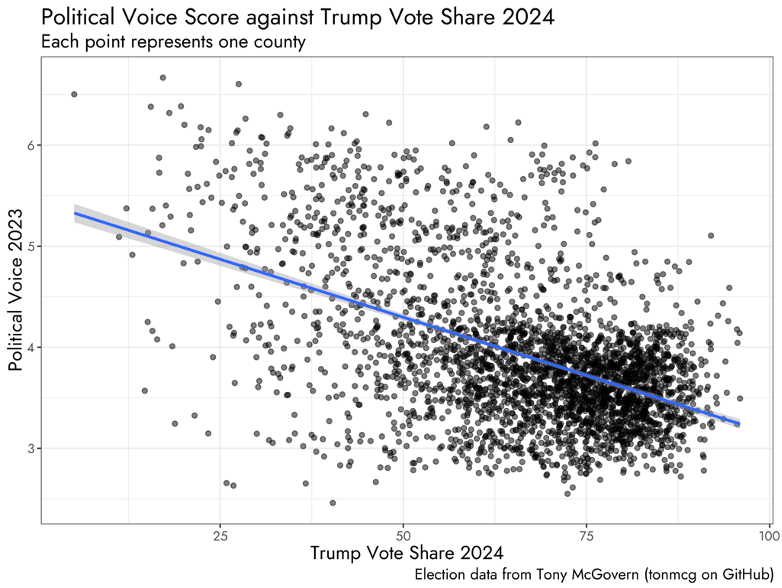
How the economic and political geography of the United States fuels right-wing populism—and what the Democratic Party can do about it

""

Overview

In wealthy nations around the world, the rise of the knowledge economy has increased political and economic divides that fuel right-wing populism. These divides generally have a strong geographic dimension, and the United States is no exception. Dense metro locales—advantaged in the knowledge economy—have shifted toward the Democratic Party. More sparsely populated nonmetro places—disadvantaged by this profound economic transformation—have shifted toward the Republican Party.

This growing geospatial divide mirrors and motivates many others, cleaving voters across lines of education, occupation, race, ethnicity, religion, age, and immigration status. It divides those who welcome a global knowledge economy and increased social diversity from those who feel threatened by them. In turn, this divide fuels the two political parties’ increasingly distinct appeals, strategies, and orientations toward democracy.

Many of these trends mirror shifts taking place in other affluent democracies. Yet the United States is distinctive in three fundamental respects. First, the U.S. system of representation is both highly territorial and biased in favor of nonmetro places, most starkly in the U.S. Senate. Second, the United States has an extremely rigid two-party system—an unusual feature that has enabled the remarkable right-wing takeover of the Republican Party. Finally, the large role of money in U.S. politics creates a powerful pull toward the interests of economic elites that has affected the two parties differently. These three factors have greatly intensified educational and geospatial polarization and encouraged culturally grounded conflict.

In particular, America’s version of right-wing populism is far more “plutocratic” than its counterparts abroad.308 Viewed alongside right-wing populist parties in other rich democracies, the Republican Party’s revanchist racial and cultural appeals and “anti-system” attacks on government are familiar. Its aggressively inegalitarian and deregulatory policy stances are not. These economic stances are to the right not just of typical right-wing populist parties, but also of typical Republican voters. The result is an even greater incentive for the party to foster affective “us-versus-them” divisions over race and culture—even as it cloaks its economic policies in similar terms, such as attacks on foreign countries, lazy government workers, and an undeserving racialized poor.309

We have called the Janus-faced effects of the knowledge economy the “density paradox.”310 The paradox is that while density enhances economic productivity in America’s transformed political economy, it is bad for electoral representation in the nation’s territorially based electoral system. To win durable governing power, Democrats need to gain and retain the allegiance of voters outside of metropolitan America, including in places unsettled by the transition from industrial to knowledge production.

Former President Joe Biden and congressional Democrats entered office in January 2021 seeking to tackle both sides of the density paradox. Strategic investments would boost prosperity in deindustrialized and nonmetro America; enhanced labor power would ensure this prosperity reached workers without a college degree. The idea was that workers who felt that they and their communities were more economically secure would be less vulnerable to right-wing populist appeals, and organized labor would help create alternative identities for populations who might otherwise find these appeals convincing. This was the promise of Biden’s “deliverism”—desirable policy would lead to Democratic power-building.

During the Biden administration, major new investments were launched through the Bipartisan Infrastructure Act, CHIPS and Science Act, and Inflation Reduction Act. Many of them flowed to nonmetro America. Between 2021 and late 2024, red counties received more than 73 percent of announced private strategic-sector investments—more than twice their share of economic output.311 These policies, alongside a vigorous fiscal response to the COVID-19 pandemic, fueled a faster recovery in the United States than seen in other rich countries—and lower-wage workers and slower-growth regions benefited. Coming out of the pandemic, the most distressed U.S. counties experienced increased job growth, particularly in strategic sectors.

Yet the hopes for “deliverism” were dashed in the 2024 general election. Democrats did not gain ground in nonmetro America, nor among White working-class voters, and a right-wing populist party seized power. What happened, and what lessons should be taken for the future?

In this essay, we first describe the shifting coalitional bases of America’s two major parties and how they are related to political-economic geography. Then, we consider how this has fed into the transformation of the Republican Party and the rise of plutocratic populism. Finally, we examine the economic and political effects of Democrats’ response during the Biden administration, focusing on their implications for future political and policy strategies to reduce regional inequalities and blunt the effectiveness of right-wing populism.

The density divide and U.S. right-wing populism

The Democratic and Republican parties look very different than they did even a decade ago. In two key respects, however, they have changed in parallel. First, both parties have become cross-class coalitions based on shared geography, as well as shared identities. Second, this geographic clustering has produced powerful feedback loops that have exacerbated us-versus-them polarization. These feedback effects, however, have had the most profound impact on the Republican Party.

Figure 1 tells the story of intensifying place-based divergence. It shows the average density (top panel) and median income (bottom panel) of congressional districts won by Democrats and Republicans.312 As the figure shows, Democratic congressional districts have become denser and higher-income, while the reverse is true for Republicans. (See Figure 1.)

Figure 1

While these results go only through 2022, the 2024 election did not change the trends. Democrats did lose ground in metro districts at the presidential level, yet 2024 saw continuing divergence in the characteristics of districts won by each party. And notwithstanding the fall-off in the Democratic presidential vote share in metro areas in 2024 (mostly driven by reduced turnout), nonmetro areas continued to shift away from the party. 

The places where Democrats dominate elections are generally both denser and more prosperous than the rest of the United States. They are also highly unequal. The Democrats’ multiracial coalition therefore includes both sides of the widening U.S. economic divide. So, too, does the Republican coalition, which represents many of the poorest regions of the country but has its own affluent voters, as well as a significant subset of the superrich who make outsized investments in the party.

Place-based party divisions, in turn, drive powerful feedback loops. Given winner-take-all elections, a polarized partisan map magnifies the effect of relatively small party edges and encourages both parties to accentuate appeals that map onto the economic and cultural divisions that cleave these places from each other.313 The decline of competitive seats makes intra-party primary challenges more important, reinforcing this polarization.

Finally, social media and legacy media intensify this division by creating within-party echo chambers based on national party divisions, rather than local issues. Gone are the days when particular states, House districts, or even state legislative districts featured ticket-splitting or fostered their own regional party brand. Geographically, it is polarization all the way down.

Asymmetric polarization

For at least four reasons, these forces have had more disruptive effects on the right than the left. First, the Republican Party is advantaged by the territorially based electoral and governing institutions in the United States, which reward parties not just for winning majorities but for winning majorities in particular places. As a result, Republicans have had a built-in edge in the U.S. Senate and, to a lesser extent, the Electoral College and the U.S. House of Representatives. Notably, Republicans have not represented states containing a majority of the nation’s population since the 1990s, while frequently garnering a majority of U.S. Senate seats.

Moreover, the bias is growing as the split-ticket voting that kept Democrats competitive in less populous states has disappeared. Meanwhile, the concentration of Democratic voters in metro areas hinders the translation of votes into seats in both the U.S. House and in statehouse elections—a disadvantage reinforced by aggressive Republican gerrymandering. An important consequence is that Republicans have greater electoral running room to take more extreme stances.

Second, the Republican Party’s voting base is more homogenous. Even with the shift of younger voters and working-class Latinos and Black men toward the party, Republican voters are disproportionately White, working class (with less than a college degree), conservative Christian, and in their mid-40s or older. Democratic voters, by contrast, are more demographically and ideologically diverse.

Third, compared with other parts of the media environment, right-wing media and social media are more influential, extreme, and insulated. Beyond the well-documented influence of Fox News, the online media environment—YouTube, Rumble, Twitch, Kick, Spotify, Facebook, Instagram, and TikTok—is dominated by right-leaning shows, which create powerful feedback loops influencing not only voters but also candidates and elected officials.314

Finally, the intense organized groups associated with the Republican Party—the religious right, gun rights activists, backlash-oriented advocacy groups, and deep-pocketed donors aligned with them—have invested more and more effectively in policing Republican moderation, including through primary challenges.

The result is a vicious cycle of growing extremism that now threatens U.S. democracy itself. Hailing from safe districts and states, where primary challenges are the greatest threat, Republican officials in the U.S. Congress have little incentive to challenge executive overreach and defend the authority of the legislature. Meanwhile, leaders of solidly red states add to this threat by undermining voting rights, aggressively gerrymandering to reduce electoral accountability, and pursuing partisan policies that reflect national party priorities rather than their states’ distinctive economic interests and citizen preferences.

The rural health crisis in red states is what happens when party priorities outweigh popular preferences. As public health professor Michael Shepherd and his colleagues argue, the Republican party has been able to pursue policies unpopular among—and indeed harmful to—its own constituents because it has effectively blamed Democrats and the federal government and because it has successfully elevated culture-war issues.315 As Republicans in Congress hurtle toward major Medicaid cutbacks to finance tax cuts mostly favorable to the affluent, the party’s combination of plutocratic policy priorities and right-wing populist rhetoric remain on full display.

Plutocratic populism 1.0 and 2.0

We describe this dangerous amalgam as “plutocratic populism.”316 Put crudely, Republicans have mobilized voters outside of metro areas with appeals animated by religious, racial, and anti-immigrant backlash—the rhetorical fare of right-wing populism worldwide—while the policies they have pursued in office have been strikingly oriented toward deregulation, cuts in social programs that benefit the less affluent, and tax cuts for corporations and the wealthy. This distinguishes the peculiar American right-wing hybrid from most of its European counterparts.

Crucially, plutocratic populism also magnifies the party’s incentives to engage in anti-system behavior. Despite escalating extremism, billionaire-financed organizations have lavishly funded and backed U.S. right-wing populism. This direct source of radicalization, in turn, fosters an indirect one: The plutocratic policies that these investments encourage have so little support among Republican voters that party elites must further stoke populist backlash to animate the base.

The distinctive brand of U.S. right-wing populism has gone through two phases separated by President Donald Trump’s loss in the 2020 presidential election. Plutocratic populism 1.0 was more plutocratic than populist. Mobilizing against President Barack Obama after the 2008 election, the plutocratic elements of the party—the Federalist Society, the Koch brothers and their Americans for Prosperity advocacy group; the state-level “troika” of the AFP, American Legislative Exchange Council, and State Policy Network; and an increasingly partisan U.S. Chamber of Commerce—were in the driver’s seat when it came to Republican policymaking and power-building, and Democrats struggled to respond.

These organized forces attacked public-sector unions. They stacked courts with business-friendly judges. They went into overdrive with gerrymandering. And tax cuts and deregulation reigned supreme. The plutocrats paved the way for the rise of President Trump, whom most of these groups initially opposed. In 2016, President Trump ran against both the political left and the plutocratic right. In office, though, he outsourced policy to then-U.S. House Speaker Paul Ryan (R-WI) and staffed his White House with Americans for Prosperity alumni. His big legislative achievement were the 2017 tax cuts, which skewed toward corporations and the superrich. And he pushed through three U.S. Supreme Court appointments that yielded the most business-friendly majority since the court sought to thwart President Franklin D. Roosevelt’s New Deal.

In 2025, however, plutocratic populism 1.0 gave way to plutocratic populism 2.0. The Trumpist shift of the Republican Party, which accelerated after the insurrection at the Capitol in Washington on January 6, 2021, is driven by right-wing media, the party’s intense voting base, and a distinct subsection of the organizational right that sees cultural and racial backlash as the party’s superpower. President Trump has had years to identify loyalists, and these loyalists are seeking not just to dismantle disfavored parts of the administrative state but also to weaponize the whole system.

Some plutocrats, among them tech entrepreneurs Elon Musk (the richest person in the world) and David Sacks and their tech colleague and co-investor Peter Thiel, are strongly aligned with the Trumpist-dominated Republican Party. Far more of the plutocratic alignment with the Trump administration, however, stems from a combination of self-interested policy aims (deregulation and tax cuts) and acute fears of retribution by President Trump and his administration. Organized plutocrats once sought to dominate the party’s center of power; now, the party’s center of power seeks to dominate them. In this pay-to-play world, control has shifted toward the MAGA side of the Republican Party and to President Trump himself, with dangerous implications not just for Democrats but also for democracy.

If economic populism means policies to benefit those left behind, plutocratic populism 2.0 is no more economically populist than version 1.0. Indeed, in this respect, it is even less populist. Tariffs that disproportionately hurt those on modest incomes, cuts to spending on social programs, tax cuts for the wealthy, extensive deregulation, and an emerging system of favors and corruption for the well-positioned add up to a massively inegalitarian package of policies.

Yet this package is now coupled with an even more extreme set of anti-system strategies—including attacks on public-sector unions, elite educational institutions, and the expert-informed institutions that once guided public investments in health, science, and technology. Designed to quell dissent and mobilize supporters, these actions make it much harder for critics to break through, undermine normal mechanisms of electoral accountability, and create institutional opportunities for unpopular policy changes that few could have contemplated during President Trump’s first term in office.

Assessing President Biden’s record

This troubling transformation raises a fundamental question: Could plutocratic populism 2.0 have been stopped? A key goal of the Biden administration was to lessen growing place-based divisions and soften the appeal of right-wing populism. Why this strategy failed to produce quick or large electoral effects in 2024—and what this means for political and policy strategy now—is our final topic.

The first step in charting a path toward winning nonmetro working-class voters away from right-wing populism is a sober assessment of the Biden administration’s strategy for remaking policy to strengthen appeals to these voters. It is now common to say that the strategy of improving job opportunities, well-being, and opportunities for unionization—sometimes known as “deliverism”—failed.317 The evidence, however, points to a more complex evaluation.

Electoral performance in the global context

The starting point for that evaluation is the recognition that in 2024, the incumbent Democratic administration faced a historically challenging global political environment. In Europe, governments of the left (Germany) and center (France) lost considerable ground. But so did parties of the right, with the British Conservatives posting their worst showing in their much longer history. Similarly, in Asia, the long-dominant center-right Liberal Democratic Party in Japan suffered its second-worst results ever. Post-COVID disaffection and, more specifically, a bout of pandemic-induced global inflation provoked electoral punishment for incumbent parties almost everywhere.318

Gauged against that backdrop, the Democrats’ electoral performance in 2024 actually looks relatively good. Although Vice President Kamala Harris lost ground almost everywhere, compared with Joe Biden in 2020, she came close to victory in the presidential contest. She lost the popular vote by just 1.5 percentage points—one of the closest results in recent U.S. history. And while some might note, rightly, that President Trump himself was a weak candidate, Democrats actually gained a couple of seats in the U.S. House and narrowly lost the U.S. Senate, despite an unfavorable map (victims of the density divide). Breaking recent patterns, four Democrats—in Arizona, Michigan, Nevada, and Wisconsin—won or held Senate seats in states that President Trump carried.

Democrats—and their presidential standard-bearer in particular—clearly paid an electoral price for high inflation. The damage likely would have been much worse, however, if the United States had not managed, in considerable part through vigorous (and, until 2021, bipartisan) stimulus, to generate an economic recovery in growth, productivity, and employment that far outpaced those of other rich democracies.

An incomplete agenda and implementation

The 2024 election represented a particularly difficult test for the Biden administration’s theory of coalition expansion in another respect, too. The institutional gridlock the administration confronted blocked very significant parts of its “deliverism” ambitions. Its proposed Build Back Better legislation had to shrink drastically to pass through the evenly divided U.S. Senate. Moreover, the parts that passed were often the least visible, direct, and politically traceable, such as tax credits to businesses to create new good jobs, which workers likely credit to the private sector, not government. And conservative courts blocked important administrative initiatives on student loan forgiveness and other issues.

Perhaps most deserving of emphasis is the manner in which halting implementation of the Biden administration’s infrastructure investments exacerbated these challenges. Many highly touted and costly investments struggled to break ground. By early 2025, only four states had worked through the administrative process for expanding rural broadband access. Only a handful of the promised charging stations intended to increase the attractiveness of electric vehicles had actually been installed. Even something seemingly straightforward—the $35 cap on insulin prices for Medicare patients—did not go into effect until 2025. The same was true for the highly popular initiatives to negotiate Medicare prices on important drugs.

Thus, the electoral trial of 2024 was a test of an incomplete version of the Biden agenda, sluggishly implemented, and facing the voters under quite unfavorable circumstances that were largely outside the administration’s control. These are among the reasons why a positive feedback loop between policy initiatives, voter attitudes, and election results largely failed to emerge.

We can see the limits of feedback in the 2024 election results. Figure 2 below focuses on two electoral battleground states—Pennsylvania and Wisconsin—with strong industrial histories and where the effects of the Biden administration investments might have been expected to show up in the election results. The figure shows four clusters of places in these two states, based on their changing mix of industrial and knowledge economy activity.319

Knowledge economy metro areas have shifted toward the Democratic Party, especially after 2010, while rural deindustrializing areas have shifted toward the Republican Party. On the periphery of metro America, suburban areas that are adjacent to metro knowledge hubs have moved toward Democrats, while those that have experienced deindustrialization without such knowledge economy ties have moved toward Republicans—in both cases less sharply than metro and rural areas, respectively.320 (See Figure 2.)

Figure 2

What is clear from Figure 2 is that these trends did not change appreciably in 2024 in either state. The geographic divisions that exploded between the Obama and (first) Trump presidencies appear quite locked in today. Certainly, the Biden administration did not achieve a much higher vote share in 2024 than in 2020 in the nonmetro places marked by deindustrialization.

Newfound limits of policy feedback

While no doubt disappointing to Biden administration officials, the limited feedback effects of its initiatives are consistent with recent scholarship on political behavior. This research mostly finds much weaker positive behavioral effects of policy initiatives than seen in prior research. The most extensive studies have focused on the Affordable Care Act, and they generally show that initial impacts in the mid-2010s were negative. Only after an extended period did public attitudes turn positive—tellingly, in the wake of Republican efforts to repeal the program early in the first Trump administration.321

At the heart of this discouraging record is disillusionment with government, especially among the White working class and in rural areas. Informational environments that mute or distort messages of new programs reinforce this distrust. The growth of partisanship as a political identity—combined with much more intense dislike of the party one does not identify with—has made it considerably more difficult to shake up voter attachments through policy action.322

In thinking about the difficult task of persuasion, it is worth emphasizing that disenchantment has been a long-term process, now reinforced by many social and cultural factors. It is unrealistic to think that policy change alone is going to produce a dramatic and rapid reversal. But there is reason to think that policy can help. More important, unlike many other things that will matter, policy is something over which decision-makers can exercise control.

Despite the grave risks facing our democracy, there is reason to believe that those seeking to contain right-wing populism may have an opportunity to exercise such control in the future. How they should approach this potential opportunity is our final topic.

Prospects for Democrats’ future progress

The cautious case for believing that results could be more favorable next time builds on three fundamental points. First, as has been common in recent U.S. history, considerable political momentum may emerge from backlash to the current administration and its policies. Second, while that administration and its policies have greatly undermined the public sector, backlash-driven campaigns for change are likely to emphasize the need to improve government capacities at the state and local levels, as well as the federal level. Finally, against this backdrop, lesson-drawing from the Biden record could increase the prospects that future initiatives targeting the economic well-being of working-class voters are visible, legible, effective, and popular.

Disillusionment with government and strengthening political attachment to the Republican Party among working-class voters undermined deliverism. Already, however, there are signs that the economic policies of the new Republican administration may be weakening those attachments, especially among the least committed Republican voters. Neither the Musk-led attacks on federal government agencies nor President Trump’s trade wars are popular. The prominence of an unpopular billionaire (Elon Musk) in the new administration undercuts the Trump administration’s populist bona fides.

Crucially, as noted, many of the administration’s policies are likely to be quite damaging to working-class and especially rural voters. This creates important opportunities to reach out to voters who have flocked to the banner of right-wing populism.

Disapproval of the president on the economy is already high and growing—a contrast with his first term in office, when the economy was often his most popular issue.323 And this is before the negative impact on employment and prices of these policies kick in. It is also prior to the possible passage of the Republican budget reconciliation package of high-income tax cuts combined with sizable cuts in Medicaid and food assistance, which is also likely to be quite unpopular.

Indeed, when asked in a recent poll whether voters favored cutting Medicaid to pay for tax cuts, 70 percent of voters were opposed, compared to 20 percent in favor, with swing voters opposed 67 percent to 21 percent, and even Trump voters opposed 51percent to 36 percent.324 Just as was true after 2004 and 2016, an unpopular Republican presidency may create considerable political opportunities.325

Lessons for future policymaking

The challenge in reaching those drawn to right-wing populism through economic policies is to put in place initiatives that generate material benefits and expanded opportunity and that are perceived to be doing so as close to implementation as possible. Democrats from 2021 to 2024 did moderately well on the first half of this equation, providing short-term stimulus and long-term investments that fueled job creation in many “left behind” areas. They fell short, however, on the second half.

As Equitable Growth’s Alexander Hertel-Fernandez and Shayna Strom discuss in their essay in this series,326 deliverism failed to incorporate many of the cautions and caveats coming from recent political science scholarship. These implications are not all negative—policy feedback can break through partisan polarization—but they point to critical necessary conditions. Three in particular stand out:

  • Policies need to be visible and traceable. Decades-old scholarship about how voters assess policies still holds.327 If voters do not perceive that a policy has affected them and/or do not know to whom to give credit or blame for that policy, new initiatives are unlikely to generate the kind of positive feedback loop that policymakers are looking for.
  • Policies should reinforce a sense of dignity and status tied to democratic citizenship, as well as provide benefits. Particularly in a political climate marked by disaffection, positive reactions to policies are in part a matter of symbolism. They involve not just material benefits but also moral recognition—a sense that recipients are seen and their efforts appreciated.
  • Policies are more likely to succeed when they activate organized supporters. In challenging and often hostile information environments, voters need organized allies who have the resources and credibility to enhance visibility and traceability. Even where voters experience governance directly, they often rely on trusted sources to develop their interpretations of those policies.

Although it is outside our purview, we wish to acknowledge that the challenge of creating these favorable perceptions is in considerable part one of communications. Making new programs visible to voters—especially the most skeptical ones—in today’s information environment is extremely difficult. Policy news seldom reaches the disengaged, and many of the disaffected are in partisan informational spaces disinclined to provide favorable or accurate coverage.

Even less-partisan media sources have incentives to play up the negative or controversial in their reporting. Having effective, empathetic organized messengers can help. So can new efforts to penetrate informational spaces popular with the politically disengaged.

Improving state capacity

For those focusing on the tools of governance, the priority is policy initiatives that lend themselves to clear and straightforward narratives of benefit for U.S. families. Enacting and funding initiatives is not enough. These initiatives also must rapidly translate into actual changes in lived experience that can be persuasively attributed to government action.

Without wading too far into the debate about so-called abundance framings, the case that procedural obstacles are far too often a roadblock to expeditious and effective policy change is extremely strong.328 The costs of building all kinds of infrastructure, as well as housing in many states, is now far higher in the United States than in comparable countries. And turning programs into facts on the ground takes far longer than it once did.

More broadly, various limitations of government capacity have become a major obstacle to turning ambitious policy plans into reality. In too many cases, intended beneficiaries confront a bewildering, sometimes overwhelming, set of roadblocks. Deliverism cannot work if the end results are not, in fact, delivered.

One reason for political optimism about future policy opportunities is that momentum is building to both reduce obstacles to implementation and bolster capacity for robust government action. Recognition of these roadblocks has grown among policy analysts and decision-makers. Generational turnover among policymakers, advocates, and thought leaders has encouraged a critical reevaluation of the benefits and costs of procedural barriers. A future set of initiatives targeted at working-class voters must be packaged with reforms to ensure that laws are not only passed but also implemented, and implemented quickly.

Elements of a new agenda

Ideas for place-based reforms and policies to boost working-class economic security and power abound—including a number that were part of the original Build Back Better legislation but did not make it into the Inflation Reduction Act. We close, therefore, not by laying out a laundry list of possible policies but by emphasizing what we think the key themes of these efforts should be. We focus on initiatives designed to address geographic polarization, the decline of working-class support for the center left, and the widespread mistrust of government and sense of economic dislocation that contribute to this decline.

The first theme is tackling the concentration of market power. The nation’s affordability crisis rests in considerable part on growing consolidation in sectors as diverse as telecommunications, meat processing, and pharmacies. The concentration of market power has led to both economic and political challenges. It is highly implicated in the decline of rural America. As the sociologist Robert Manduca has shown, “The waves of corporate consolidation over the past four decades have deprived many cities and towns of the corporate headquarters and local businesses that used to be a source of high paying jobs and demand for professional business …. [and] a strong predictor of community and civic health.”329

Market power often leads directly to political power. Rent-seeking interests have become an important part of the plutocratic populist coalition. Cases in point include big oil companies, the cryptocurrency industry, and many sectors of the tech economy. Addressing market concentration thus can both lead to direct material improvements for aggrieved voters and help to rebalance political power.

Equally important are efforts to reduce prices and boost supply in key sectors through the removal of process-related obstacles. In some crucial regulated markets—especially housing, but also education, electricity, and health care—regulatory reforms could lead to lower prices. This kind of regulatory reform is popular, effective, frees up public funds for other purposes, and generates higher productivity in the service sectors that now account for the bulk of employment.

The case for addressing these market power and price challenges is strengthened by recent evidence suggesting that there may be greater popular support for “predistributive” programs, such as antitrust actions and support for labor unions, than for redistributive ones, such as trade adjustment assistance and anti-poverty spending.330 At a time when suspicion of redistributive programs has grown among working-class voters, programs that boost market incomes and make key consumption goods less costly may be more attractive options.

Conclusion

Policy reforms along these lines—pursuing, for example, visible measures to reduce costs for health care and education while spurring expanded and more affordable construction of housing and infrastructure to meet demand, increase productivity, and create jobs—would have two important impacts on the spatial inequalities that have helped generate support for right-wing populism. First, by helping to address the affordability crisis in high-productivity areas, such policies would increase mobility to the places with greatest economic opportunity while slowing the population drain of the non-college-educated from those areas.

Second, out-migration of labor from disadvantaged areas should increase demand for workers among those who remain in areas left behind.331 Other authors in this series of essays show that non-college-educated workers in these areas tend to stay put and experience low economic mobility or drop out of the job market altogether when economic shocks occur. Predistributive policies could help address these ills and slow the population drain from those areas.

Even with such policies, it will remain important to target resources directly to disadvantaged communities to address both social dislocation and political disaffection. Realism will be needed in these efforts. Voters in distressed communities are deeply skeptical that government initiatives can make their lives better. That skepticism has developed over decades, is reinforced by the decline of local businesses and labor unions, and will not fade overnight, especially given the political homogeneity of many of these communities and the influence of nationalized media. Change will take time.

Still, in our nation’s closely balanced politics, where the plutocratic populist Republican Party has struggled to produce even razor-thin majorities, modest improvements could have decisive political effects. Reducing the sway of right-wing populism will require that Democrats and their allies focus on emerging political opportunities and the careful design of interventions that can seize those opportunities as they develop. Density is not destiny, and lessening the nation’s geographic divide is critical to rebalancing and strengthening U.S. democracy.

About the authors

Jacob Hacker is the Stanley B. Resor Professor of Political Science at Yale University. He is the co-director of the Ludwig Program in Public Sector Leadership at Yale Law School, director of the American Political Economy eXchange at the Institution for Social and Policy Studies, and co-director of the multi-university Consortium on American Political Economy.

Paul Pierson is the John Gross Distinguished Professor of Political Science at the University of California, Berkeley. He is the director of the Berkeley Economy and Society Initiative and co-director of the multi-university Consortium on American Political Economy.

Acknowledgments

We would like to thank Alex Hertel-Fernandez for extremely helpful comments and the entire Equitable Growth production team for excellent and expeditious editorial and production work. Very special thanks to Lucas Kruezer, a predoctoral fellow at Yale’s American Political Economy eXchange, for the brilliant data work behind the two figures.


Did you find this content informative and engaging?
Get updates and stay in tune with U.S. economic inequality and growth!
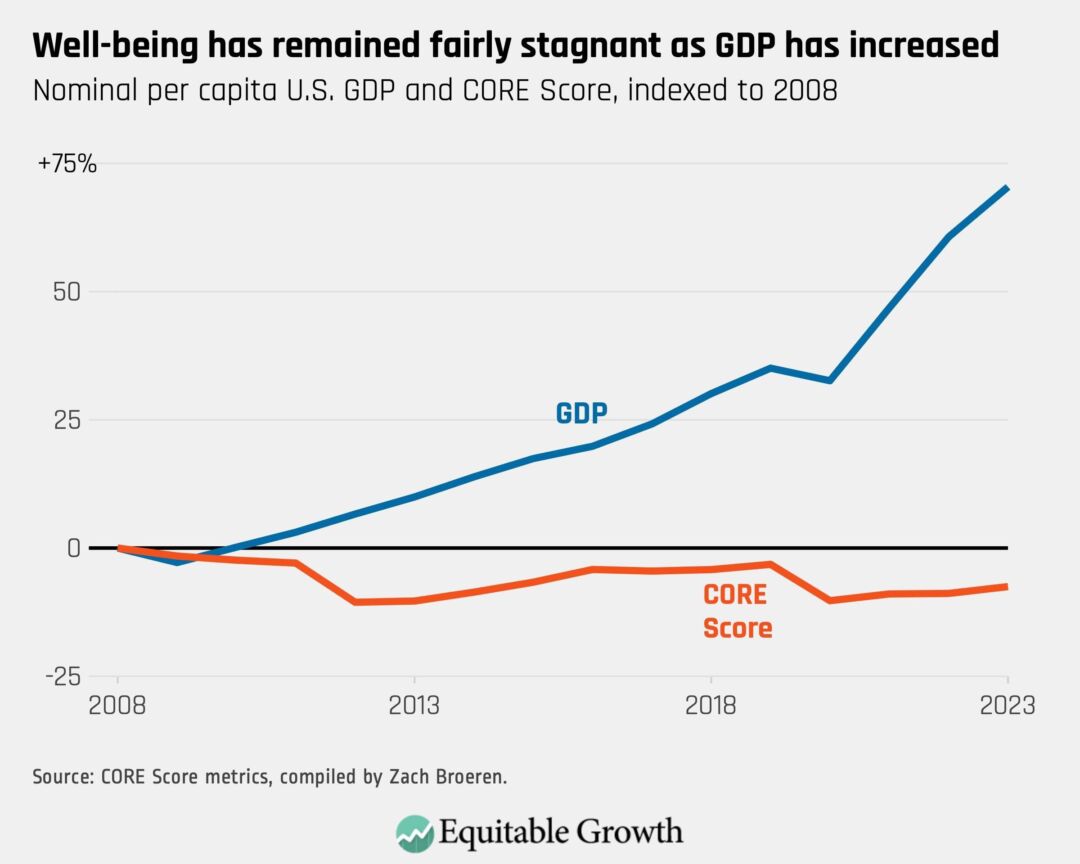
Tariffs pose real risks to the U.S. labor market

Uncertainty around trade policy makes it difficult to discuss the current state of the U.S. labor market. Businesses, workers, and policymakers at all levels make decisions based on both what they know about economic conditions today and what they expect to happen in the future. But policy announcements have moved much faster than data collection over the past several weeks, leaving few ways to use the good information gathered over the first few months of 2025 to understand where the labor market might be headed.

Fortunately, the available data suggest that the labor market remains solid, a sentiment echoed by Federal Reserve Chairman Jerome Powell in his statement following last week’s Federal Open Market Committee meeting. Despite clear cooling over the past year, the early 2025 labor market still looks comparable to the 2019 labor market—when it was the strongest it had been since the late 1990s and early 2000s—across a range of indicators. (See Figure 1.)

Figure 1

Some measures, including the prime-age employment-to-population ratio and various measures of wage growth, remain consistently stronger in 2025 than they were in 2019. These measures are particularly important because they address directly how many people are working in a way that is not distorted by the aging of the U.S. population and what those workers who are working are taking home in wages—the most important things to know about how the labor market is functioning. Other indicators, such as the unemployment rate, hiring rate, and quits rate, are clearly weaker now than in 2019. Overall, though, a labor market with low unemployment by broader historical standards and growing real wages is a good one.

While the available data depict a labor market that was strong prior to the Trump administration’s April 2 tariff announcement, it is not clear whether that strength will endure in the face of the higher input costs, higher prices, and slower growth that the large tariffs would likely cause. Uncertainty about which tariffs will ultimately be levied is itself a headwind, as businesses that don’t know their future costs have a hard time making decisions about investment and hiring.

Although it is almost a fool’s errand to speculate about what exactly the tariff regime that emerges over the coming months will look like, it does seem extremely likely that it will have meaningful effects on U.S. labor market dynamics. Exploring how the unemployment rate could respond to various possible scenarios (without making any statement about the likelihood of any particular scenario) is therefore a useful exercise.

To set a baseline, applying a simple “bathtub model” of how workers are transitioning into and out of unemployment suggests that if current labor market dynamics were to continue, the unemployment rate would dip slightly over the next few months before returning to its current level of 4.2 percent in April 2026 and then rising modestly in each of the following 2 years, to 4.5 percent in April 2027 and 4.8 percent in April 2028. For comparison, these levels are within the range of values reported in the Federal Reserve’s final pre-tariff-announcement Summary of Economic Projections for 2026 and 2027.

Perhaps the most immediate labor market concern related to tariffs is that hiring could slow while uncertainty lingers about what the Trump administration’s trade policies will ultimately be. Unfavorable resolution of that uncertainty could also spark layoffs if tariffs reduce the viability of some businesses.

Figure 2 below presents simulations of the unemployment rate going forward if modest versions of these concerns play out individually, as well as if they both occur. Specifically, it shows what would happen if transitions from unemployment to employment (corresponding roughly to hiring) decline by 10 percent immediately; if transitions from employment to unemployment (corresponding roughly to layoffs) increase by 10 percent starting in 6 months; and if both of those things happen, as well as if current dynamics continue. Each scenario assumes other labor market dynamics (such as transitions between unemployment and being out of the labor force) continue to follow their recent trajectories. (See Figure 2.)

Figure 2

As Figure 2 shows, over the next year, each of these scenarios would increase unemployment slightly. If only hiring slows, then the unemployment rate would be 0.26 percentage points above baseline in April 2026. If only layoffs increase, then it would be 0.2 percentage points higher next April. If both happen, it would be 0.46 percentage points higher. The longer these adjustments remain in effect, the more substantial their impact. By April 2028, the unemployment rate would be 0.64 percentage points higher if hiring persistently falls by 10 percent immediately and layoffs persistently increase by 10 percent starting in 6 months.

More substantial labor market adjustments, such as those shown below in Figure 3, are also well within the realm of possibility. Uncertainty-induced slowdowns in hiring could themselves lead to layoffs by reducing aggregate demand. Higher tariffs could lead more businesses to shut down. Disrupted relationships with overseas suppliers could take time to adjust to, slowing growth in the interim. Any or all of these dynamics could lead the economy to spiral into a recession. Even a fairly mild recession, with labor market dynamics analogous to the short recession in 2001, would drive the unemployment rate up to 6 percent by early 2027, more than 1.5 percentage points higher than the baseline scenario in which current labor market dynamics continue. (See Figure 3.)

Figure 3

Critically, there is no guarantee that a potential recession would merely be mild. The supply-side disruptions associated with substantial tariffs and the direct origins of a potential recession in discretionary and reversible policy choices would be without recent precedent, making it difficult to know how initial labor market responses might compound or be alleviated over time.

Some advocates for the aggressive use of tariffs argue that the short-term pain associated with adjusting to them will be outweighed by the longer-term gains associated with returning production of currently imported goods to the United States. The green line in Figure 3 illustrates a simple version of what this might look like. Specifically, it shows how the U.S. unemployment rate would respond if:

  • Hiring from unemployment drops by 10 percent immediately, remains at that level for two years, and then starts increasing toward levels in line with business cycle peaks, getting halfway there by the end of the third year
  • Separations to unemployment continue their recent trend for the next six months, then gradually increase (from the current low rate) to the long-run, pre-pandemic average rate over the following year, then decline back toward the current (low) rate, making it halfway back over the subsequent 18 months
  • Other labor market dynamics continue to follow their recent trajectories

In a sense, this scenario is optimistic—arguably overly so—because transitions from employment to unemployment would remain below the long-run average rate (calculated across all points in the business cycle) while hiring from unemployment falls only modestly before approaching rates seen in the strongest U.S. labor markets. But despite this fairly favorable formulation, the unemployment rate would remain 0.3 percentage points above baseline in April 2028, and the trajectory between now and then is not that different from the trajectory associated with a mild recession (seen in purple in Figure 3).

This is an important point. The short-term pain that tariff advocates want to look past could very well be a mild (or not so mild) recession with the attendant long-term consequences for the millions of U.S. workers who could lose their jobs.

These specific scenarios might or might not come to pass, and it is impossible to say how likely they are. More or less extreme adjustments could also occur, depending on the ultimate path of U.S. trade policies and other developments in the U.S. and global economy.

These scenarios do, however, serve to ground thinking about the possible consequences of tariffs in concrete magnitudes associated with specific changes in the U.S. labor market. In so doing, they make one important point clear: While the U.S. labor market is still on solid ground, there is a very real risk of reversion to the kind of labor market conditions that leave people who want to work on the sidelines and allow real wages to stagnate.

Posted in Uncategorized