
Analogies for AI policymaking

Overview

As a suite of technologies under the label of artificial intelligence increasingly take center stage, policymakers recognize the need to develop deep technical expertise about the deployment of evolving technologies in distinct contexts. But specific technical knowledge in the hands of a few will remain insufficient. All policymakers need to develop intuitions and an arsenal of heuristics to make decisions about automated systems across policy domains.

In this policy brief, we offer a series of analogies as a shorthand for policymakers who inevitably will need a range of short-term responses to AI and related automated systems. In doing so, we also emphasize that AI is more than just large language models; it includes smaller, simpler models that impact the public every day and systems that make use of AI as one of numerous components. These analogies are no substitute for an extensive understanding of specific tools and deployment contexts, but they offer an initial set of mental models to avoid over-heated first reactions based on hype or skepticism.

Analogies have developed a bad reputation in tech policy as it can be tricky to thread the needle of simplifying a complicated topic. They can make a policymaker or politician look woefully ill-informed, as was the case when Sen. Ted Stevens (R-AK) referred to the Internet as “a series of tubes” in 2006 and was widely ridiculed as being out-of-touch.1 This analogy, however, can be quite helpful. There are cables in tubes that form the physical backbone of the Internet. 2 Paying attention to the literal tubes matters enormously for infrastructure investment (to build more tubes) and for national security (to recognize who has jurisdiction over the tubes), but can be misleading when thinking in terms of content moderation (how does information actually flow?) or privacy (how is information appropriately safeguarded?).

Analogies remain central to policymaking. 3 The law relies on comparisons between websites and libraries or the public square, for example, while politicians may liken the internet to the highway system. 4 Over-indexing to one analogy is misleading, but so too is avoiding explicit frameworks.

Before diving into specific analogies, one stands out as particularly misleading. While we encourage a plurality of mental models, the most common analogy for AI has proven particularly detrimental: that a computer system is like human intelligence. The category of “intelligence,” and the associated metaphor that computers can “learn,” may have proven to be a generative research question in the lab, leading researchers aiming to create an intelligent machine to target logic and games (such as chess) and the capability of answering questions about generalized knowledge (as ChatGPT does), each time moving forward on the technical problems of AI.

Time and time again, however, the concept of intelligence is conflated with humanness, relegating some humans to a status of less than human. In practice, narrow definitions of “intelligence” have repeatedly aligned with or reinforced misogynistic and racist hierarchies. 5 Such definitions privilege some types of work and thus lead to the devaluing and automation of service and care work. 6 At its worst, discussions of “artificial general intelligence” have given a new framework and seemingly more palatable language to the dangerous ideas that human value is easily measured and assessed.

Artificial intelligence tools may pantomime human behavior, but evaluating them primarily on the uncertain yardstick of intelligence misses what the tools actually can do. The metaphor of intelligence encourages users to ignore the specific contexts in which AI is constructed and therefore capable of being effective. The headline-grabbing concept of intelligence has proven both normatively and descriptively dangerous when it leads to AI being both misused and misunderstood.

So, let’s turn now to some useful analogies for AI.

AI is like a hammer

Artificial intelligence is applied across many different domains, from tenant screening and cancer detection to content promotion and text generation. How can the same types of systems be used in so many different ways? Computer scientists use abstraction to translate problems in the real world into basic reusable computational forms. In the case of AI, this approach can allow information about people—including their background, health information, finances, demographic information, and more—as well as content, text, images, or other things in the world to be represented as data.

It is worth pausing on this initial step of essentially trying to put all relevant information into a big spreadsheet where all the context—the people, health information, meaningful content, or other reality—is abstracted away. Everything will look commensurable. AI systems are now like a hammer that can be applied to any data to make predictions, recommendations, or generate content. This is the impressive power of AI.

Yet abstracting away reality comes with real world risks. 7 Any data not represented correctly or fully in the spreadsheet will be misunderstood by AI, and AI can be applied in settings or based on data where the results don’t make sense. For better or worse, people are likely to apply AI across many domains. We fear AI is a powerful hammer, even when not everything is a nail.

AI is like the math you already know

Even policymakers who do not work with complex statistical assessments or econometric models have developed intuitions for the basic mathematical concepts. Relying on foundational mathematical frameworks offers a placeholder for the more elaborate work of AI-based systems.

AI is like a line of best fit

It may seem elementary, but one useful placeholder for the complex mathematics behind AI systems is the line of best fit, or trend line, from high school mathematics. Just as a line of best fit can be used to model a linear relationship between variables X and Y, AI systems aim to model relationships between variables and make predictions based on collected data—even when you could come to misguided conclusions based on those correlations.

Suppose, for example, that one used a line of best fit to create a linear model (function) between data collected about students’ high school Grade Point Average (X) and college GPA (Y). Given a new student’s high school GPA, we could use the linear model to predict their college GPA. (See Figure 1.)

Figure 1
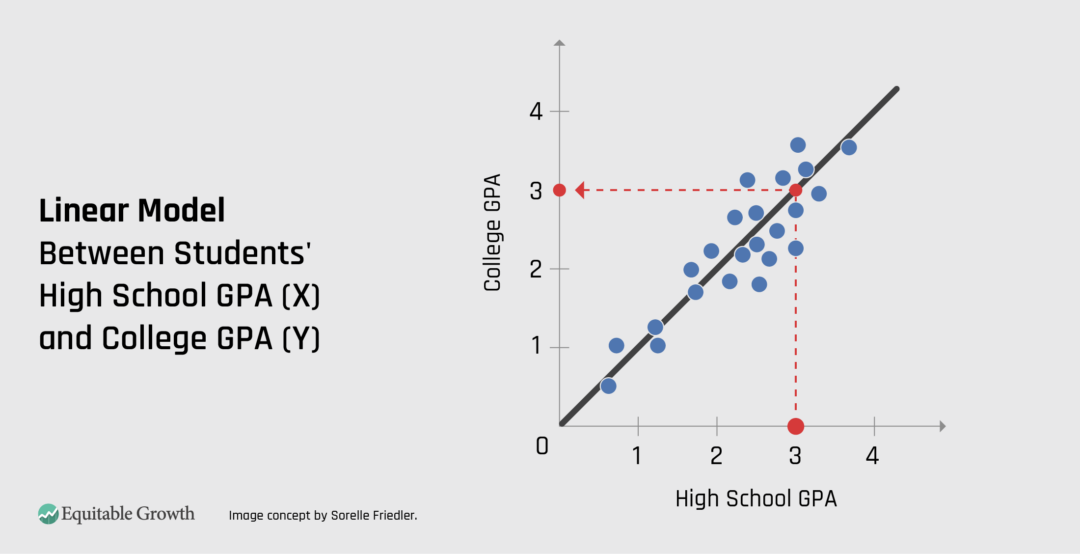
Of course that prediction might be wrong, and AI models generally include more variables to help improve the predictions; they take more than one input and make predictions based on patterns that are more complex than a line. In practice, these lines of best fit are made from the idiosyncratic collection of incomplete and potentially incorrect data available, which of course may not fully capture the phenomena of interest. As the saying goes, “garbage in, garbage out.”

AI is like a big flowchart

One example of a more complex AI system is a decision tree. These are a form of flowcharts that can be created (trained) to match patterns in given data. Just like flowcharts, decision trees can take inputs of various types and make branching decisions based on the data. (See Figure 2.)

Figure 2
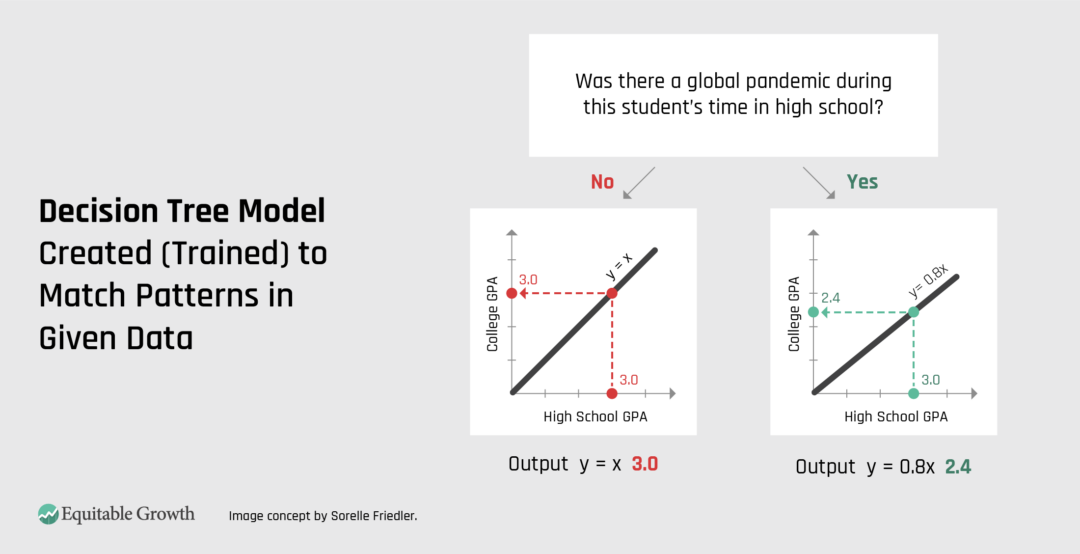
So, when looking at high school and college GPA data, along with other information about students, we might find that contextual information—such as whether there was a global pandemic while they were in high school—is useful in predicting a student’s college GPA. Maybe the first part of the flowchart checks whether there was a pandemic, and if “yes,” the flowchart points to one box while “no” points to a different next step in the process. The resulting output could still predict a student’s college GPA.

Neural networks that power many of the largest and currently best performing AI systems can also be thought of most easily as giant flowcharts. In neural networks, instead of a simple yes or no question in each box of the flowchart, there’s a mathematical function (such as a line of best fit) that provides an output value that’s sent to the next box of the flowchart as input. (See Figure 3.)

Figure 3
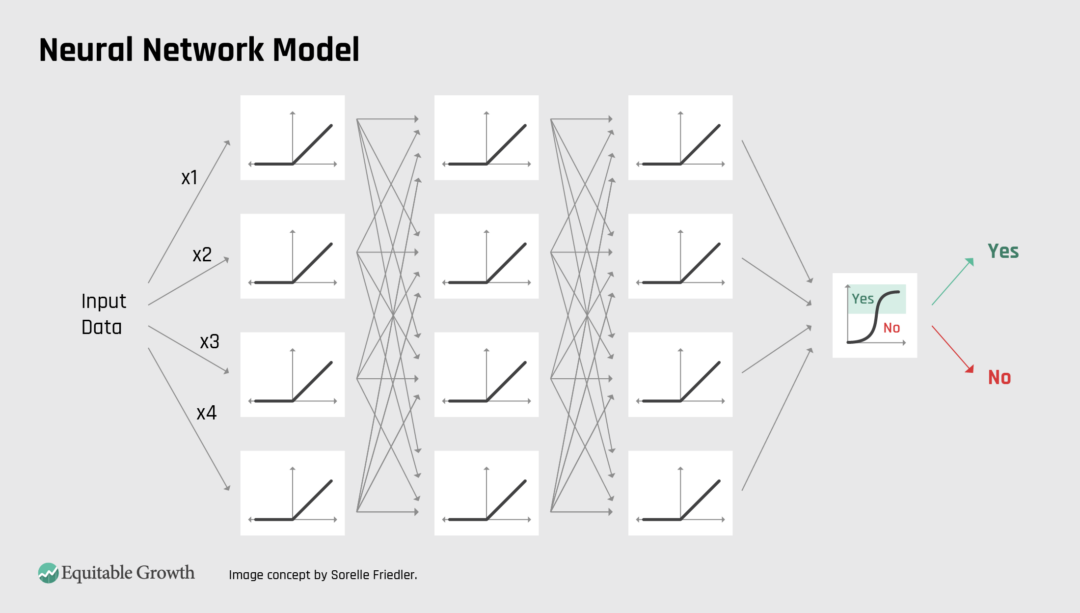
The complexity of neural networks comes from their size (flowcharts with billions of boxes and arrows) and because it’s hard to determine the right architecture (what boxes the flowchart needs and how it should be connected) and the right weights (how output values are scaled before being used as input into the next flowchart box). But after these choices are set, neural networks are really just big flowcharts that lead a given input through a series of mathematical expressions on the way to an output value.

AI is like a frequency table

When we think of modern AI, we often think of large language models, even though AI technology is much more general than these LLMs. In fact, all types of AI are built on the same basic mathematical ideas, from simple decision systems to more complex neural networks used for generative AI. But when considering LLMs, it’s useful to use one more mathematical analogy: the frequency table.

Frequency tables are just counts. For example, we might count the number of times each word appears in this paragraph (“word” appears 7 times). We could turn these counts into estimated probabilities that the word “word” appears by dividing by the number of total words (“word” would be 7/115). We could then use these probabilities to guess what word comes next; simply guess the word with the highest probability (or highest count in the frequency table). Of course, this won’t make great predictions. But if we counted multiple words in a row—phrases and sentences in this article, instead of words in this paragraph—then we’d get closer to something that looked like natural language.

If we expanded this example to all the text available on the internet we could get our hands on, as current LLMs do, then these predictions would become much more convincing. Still, it’s important to remember that what’s going on behind the scenes can simply be thought of as counting phrases and generating the most likely next phrase as output.

AI is like a curved mirror on society

AI is like a curved mirror in that it reflects the data it is given, even though it doesn’t exactly replicate that data.8 As we saw with the line of best fit and other mathematical analogies, AI is trained using pattern-matching schemes that then predict outcomes to replicate those patterns. It will take data and replicate patterns to determine whether the inputs are correct, whether the pattern makes sense, or whether the replication of that historical data and pattern is desired. When used in societal contexts, especially to assist in decision-making about people (think of the analogy above of AI’s use as a hammer), it can lead to inappropriate or even disastrous consequences.

AI is like redlining

Across sectors, it has become clear that AI systems are like redlining; they make decisions directly or indirectly based on protected characteristics, including race, and in practice further segregate people and solidify discrimination across multiple types of discrimination. AI systems are used to evaluate home buyers for mortgage approval and have been more likely to lead to a rejection of Black applicants than White applicants with similar financial standings, despite years of claims by financial institutions that the use of algorithms to screen applicants will lead to less discriminatory outcomes. 9

Similarly, hiring screening tools were found to inappropriately penalize women software engineers.10 Health care risk assessment tools were found to incorrectly mark Black patients at lower risk and less need of help. 11 And automated test proctoring and AI cheating detector systems were found to incorrectly identify disabled and international students as cheaters. 12

Understanding that AI systems are like a line of best fit, finding and replicating patterns in the given data, helps to make sense of these trends. Most software engineers have been men, so attempts by an AI system to replicate previous hiring patterns will lead to discrimination against women. Black patients historically have had less money spent on their care, so the use of the amount spent by a hospital to predict future risk will continue to treat Black patients poorly. And AI systems deal poorly with outliers, so students with disabilities and international students who don’t match the visual or linguistic patterns on which an AI cheating detector was trained will be incorrectly flagged as cheaters.

AI is like the Web remixed

When we consider generative AI—chatbots, image generators, voice synthesizers, and the like—it can seem uncanny how well some modern systems work. Yet these generative AI tools also are relying on the same mathematical underpinnings, engineered into a big neural network (flowchart). The trick is that they use a lot of data, remixed via AI to match your desired request. These systems can’t generate content entirely unlike any they’ve seen before, but with enough data remixed, the content can seem new. Unfortunately, a lot of content on the web is violent, racist, sexual, or otherwise undesired in many contexts. Without care, AI systems trained on such content will generate more of it.

It’s hard to conceive of the full extent of the data used to train these large AI systems; it is essentially as much online data as the companies creating the systems could collect. The data includes text from publicly accessible websites, transcriptions of YouTube videos, text from books, social media images and videos, and essentially anything that is available on the open or closed web. 13  

Unlike the social media era, it’s not obvious that the walled gardens of the Big Tech online platforms will represent a critical advantage. What is needed is a willingness to bend the rules to get access to large data and the semiconductor chips and money to train these models. 14 Big AI systems now use trillions of words and are projected to cost trillions of dollars for training in the near future, with much of that cost going to buy specialized chips and to pay for the cost of data centers running for months to train a single model. 

AI is like a factory that raises labor, infrastructure, and energy concerns

AI systems will lead to dramatic changes in labor force participation, the nature of work, and the workplace. Technical improvements alone do not drive these changes, but instead, novel technologies provide organizations with an opportunity to restructure work, as has been the case throughout history with the introduction of new technologies to the workplace. 15

Projecting what these changes will bring in terms of job loss or changes to the nature of work remains largely unsettled. Too many estimates of job losses serve as advertisements for AI services, often commissioned by AI companies themselves. Yet more grounded research increasingly points to the use of AI within the workplace and also to its surveillance capacities and harms. 16 These job changes are not preordained—workers are already pushing back against assumptions about how AI will be deployed and making AI use a core part of contract negotiations. 17

In order to work well, AI (and especially large language models) requires the labor of many workers and a vast infrastructure of data centers. Part of the illusion of AI is that it hides the people. Yet people are required to hand-create content, such as responses to chatbot prompts, and to label content. This includes the work of indicating whether a prompt response is satisfying or not to a human reader, whether a cat (or more often violence, especially sexual violence) is visible in an image, and so on. To be clear, workers in these jobs often labor under extremely exploitative conditions.18

Notably, however, workers and the problems of labor standards are not co-located with these data centers. AI systems require city-sized data centers for their creation and use, with high-speed internet infrastructure (Sen. Stevens’ “series of tubes”) between data centers and system users entering prompts. Within these data centers, the heart of the operation is state-of-the-art GPUs. These specialized chips allow for fast matrix operations, which are used to train neural networks efficiently. So many specialized chips are required that Nvidia Corporation (a chip manufacturer) is now a trillion dollar company. 19

While a substantial number of data-center jobs do not accrue to local communities, environmental impacts do. Data centers training and responding to queries for AI models use remarkable amounts of electricity, with projections that usage could spike to increase U.S. energy usage by between 5 percent and 20 percent by 2030. 20 Electricity bills are already rising in response.21 And concerns about the environmental health impacts of these AI factories are also increasing. 22

Water usage also is a problem, both for training and handling incoming queries from services such as ChatGPT, especially in local communities where water resources may already be tight.23 Yet companies have attempted to block these local communities from even knowing how much water they’re taking from the local water table. 24 In short, policymakers increasingly recognize that AI requires not just abstract thought but also a great deal of energy, water, and other critical resources. 25

Conclusion

We are starkly aware of a confidence asymmetry in AI policy—the gap between the assured claims from creators of AI and similarly automated systems and the uncertainty of state, local, and federal policymakers. This discrepancy is hindering effective and decisive policymaking.

In this paper, we offer a series of heuristics, not as a replacement for technical expertise, but to remind policymakers that AI systems are understandable within the context of specific policy choices. We urge policymakers to move with confidence by recognizing that questions about AI fall within existing policy domains, from industrial competitiveness and labor rights to nondiscrimination and consumer protection.

About the authors

Sorelle Friedler is the Shibulal Family Professor of Computer Science at Haverford College and a nonresident senior fellow at the Brookings Institution. She served as the assistant director for data and democracy in the White House Office of Science and Technology Policy under the Biden-Harris administration. Her research focuses on the fairness and interpretability of machine learning algorithms, with applications from criminal justice to materials discovery. Friedler is a co-founder of the ACM Conference on Fairness, Accountability, and Transparency. She holds a Ph.D. in computer science from the University of Maryland, College Park, and a B.A. from Swarthmore College.

Marc Aidinoff is currently a postdoctoral researcher at the Institute for Advanced Study, a research associate at the Cornell Digital Due Process Clinic, and an incoming assistant professor of the history of technology at Harvard University. Aidinoff recently served as chief of staff in the Biden-Harris White House Office of Science and Technology Policy, where he helped lead a team of policymakers on key initiatives. Aidinoff holds a Ph.D. from the Massachusetts Institute of Technology and B.A. from Harvard College. 


Did you find this content informative and engaging?
Get updates and stay in tune with U.S. economic inequality and growth!

Posted in Uncategorized

What makes a job ‘good’? How U.S. labor market data can provide insight to improve workers’ economic conditions

Since the Great Recession of 2007–2009, a great deal of U.S. economic policymaking has been dedicated to creating jobs. The tools used to do so vary widely, from awarding grants or contracts to companies for the production of goods or the provision of services to providing financial support for households whose spending drives commerce and creating tax and regulatory conditions that are conducive to business investment.

Successfully creating jobs is seen as a political asset, while failure is often seen as a political liability. Indeed, creating jobs is so important for politicians’ future electoral outcomes that the first Trump administration presented its signature policy achievement—a tax cut that predominantly benefitted corporations and high-income individuals—as the Tax Cuts and Jobs Act, even though the unemployment rate was at a low rate of 4.1 percent when the law passed in December 2017. Similarly, Congress passed the bipartisan Infrastructure Investment and Jobs Act in November 2021, when the unemployment rate was 4.2 percent.

In a sense, it is reasonable for policymakers to be very focused on jobs. A large majority of people earn their incomes predominantly by working, and voters routinely list economic issues among their top concerns. And during the prolonged recovery from the Great Recession, there was a clear connection between creating jobs and improving people’s economic standing: At the time, there were not enough jobs available for everyone who wanted one.

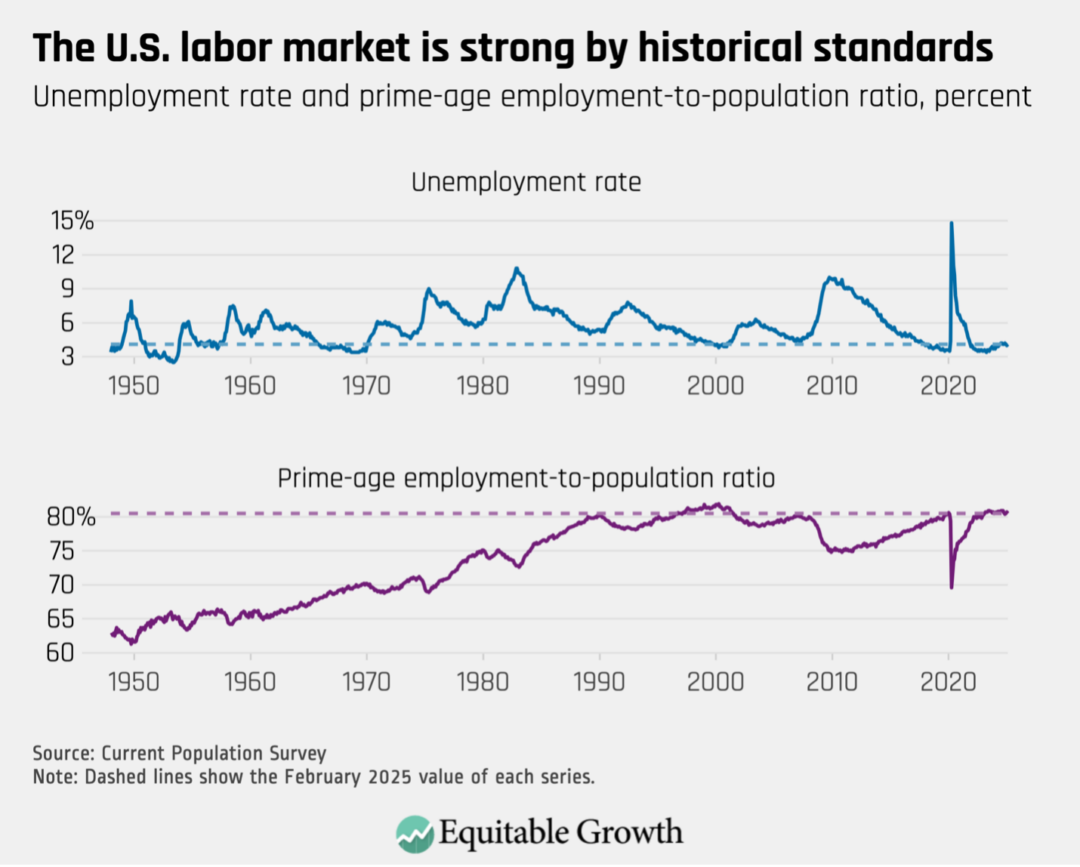
But nowadays, far fewer potential workers are on the sidelines, and it is much less clear how simply creating jobs might translate into higher standards of living. As at the end of 2017, the U.S. unemployment rate is currently 4.1 percent, and more than 80 percent of adults ages 25 to 54—the group of workers who tend to be most attached to the labor force, also known as prime-age workers— are employed. (See Figure 1.)

Figure 1

Unemployment rate and prime-age employment-to-population ratio, percent

When such a large share of people who want jobs already have jobs, the workers who ultimately take a newly created job are probably those who already had a different job doing something else. As such, the economic improvement for these workers is more incremental than the gains that would be made by someone moving from unemployment to employment.

This diminished ability for newly created jobs to materially improve well-being represents a challenge for policymakers. Many of their constituents remain frustrated by their economic circumstances. Making them better-off therefore requires improvements in not the quantity of jobs available but in the quality of jobs available.

To their credit, policymakers have not neglected job quality. Recent and ongoing conversations about industrial policy in the United States are partially driven by an interest in improving job quality. The Biden administration, for example, took a range of steps to promote high wages and widen access to benefits in jobs connected to investments made through legislation such as the CHIPS and Science Act and the Inflation Reduction Act.

When the government controls or influences the terms of employment, focusing on what a job delivers concretely to a worker in terms of pay or benefits is a reasonable way to think about job quality. But the government cannot simply require that jobs be good. A job that pays well today may disappear tomorrow, and the best jobs a decade from now may not even exist yet.

Understanding the content of jobs—the tasks workers do, the skills they develop, and the abilities they rely upon to complete their work—in a more granular way, how that relates to compensation, and then how those things have changed over time can provide broader insights into many questions policymakers have about job quality. Which jobs are good now? Which jobs might get better or worse in the future? To what extent does access to good jobs differ across groups of workers?

Considering job content also can help policymakers think about the fundamental question underlying all of those specific questions: What makes a job good?

To that end, over the next few months, the Washington Center for Equitable Growth will be publishing a series of columns that will analyze various aspects of the relationships between the skills and abilities jobs require, the activities they involve, and the wages workers earn doing them.

We will draw information about the content of jobs from the U.S. Department of Labor’s Occupational Information Network, or O*NET, which has published detailed data on approximately 1,000 occupations in consistent form since 2003. While O*NET is not among the labor market datasets most widely used for research purposes, these data have been critical to studies that have shaped our understanding of how the labor market has evolved in recent decades. O*NET data also are emerging as an invaluable resource for analyzing the impact of artificial intelligence on the U.S. workforce.

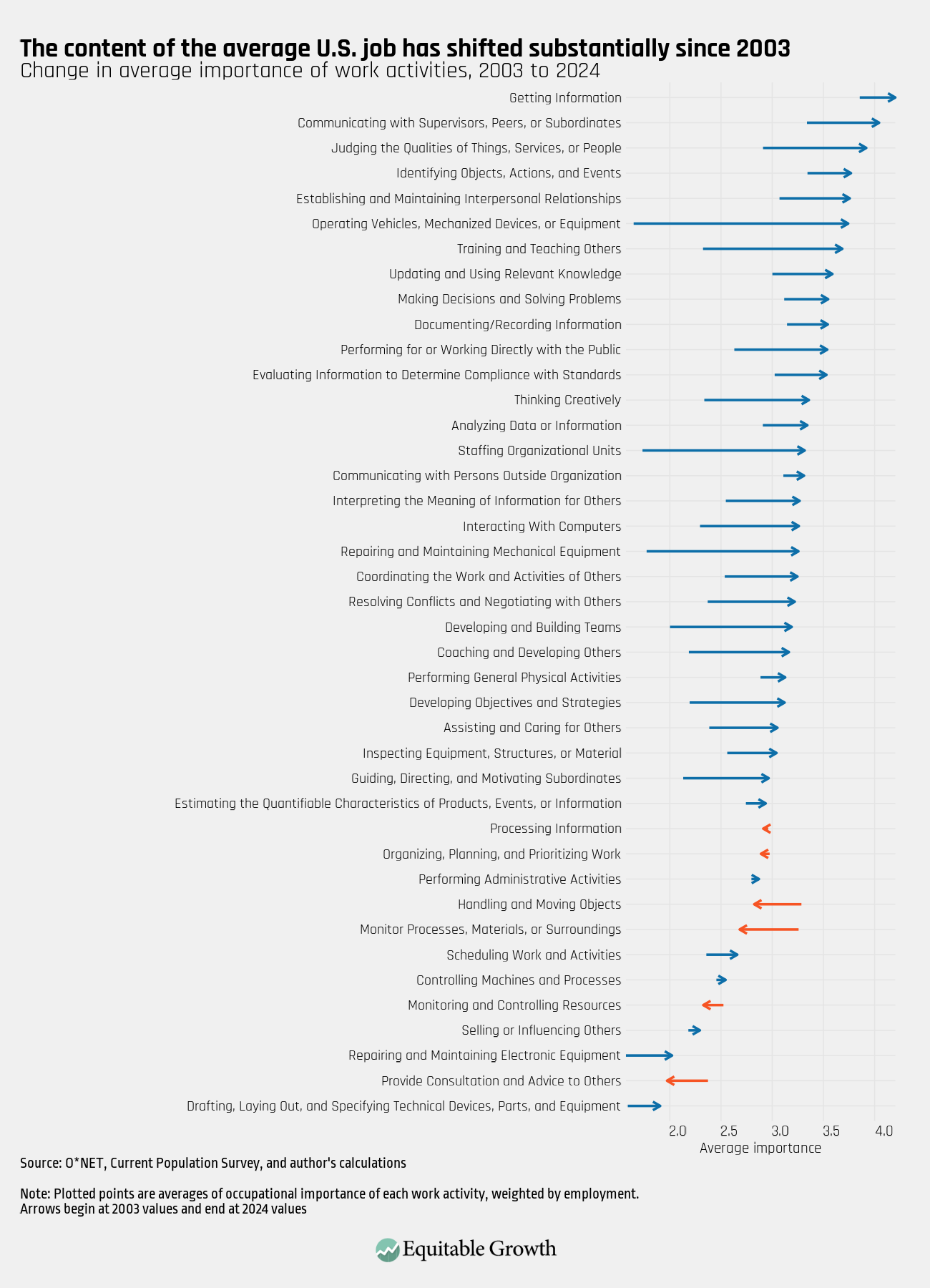
O*NET data can reveal a lot about job quality and job content in the United States. By consistently measuring detailed characteristics of jobs across the 1,000 occupations it surveys, O*NET data can help reveal changes in the U.S. labor market that would be missed if occupational titles were the only input studied. For example, Figure 2 below shows the average importance (on a scale of 1 to 5) across all surveyed jobs of 41 work activities in 2024, as well as how each activity’s importance has changed across all jobs since 2003. (See Figure 2.)

Figure 2

As we can see in Figure 2, a number of activities have experienced substantial shifts in their average importance over the period measured. This has happened even without large shifts in employment in jobs that may be most associated with those activities. For example, operating vehicles, mechanized devices, or equipment saw the largest increase in importance since 2003, from an average of about 1.6 in 2003 to about 3.7 in 2024. Of the major occupational categories, this activity seems most intuitively aligned with production, transportation, and material-moving occupations. Yet jobs in this category did not become correspondingly more common over this period. In fact, they declined as a share of total employment.

In the coming months, Equitable Growth will use O*NET data to tease out insights about how the tasks people do and the skills they use at work matter currently, how those developments came about, and what that means for the future of work and the U.S. labor market. This lens can be helpful for thinking through which jobs are good and how to make other jobs better—both of which are essential for policymakers and employers alike as they navigate changes to the labor market and labor force in the United States.


Did you find this content informative and engaging?
Get updates and stay in tune with U.S. economic inequality and growth!
Posted in Uncategorized

Do not abandon the care agenda

This column, co-authored by Equitable Growth President and CEO Shayna Strom and former Deputy Director of the White House Gender Policy Council Shilpa Phadke, first appeared in Democracy Journal in March 2025.

Reading all the post-election punditry, it would be easy to conclude that voters didn’t buy into President Biden’s post-neoliberal economic ideas—or, by extension, his vision of an economy where care is a public good and the government plays a meaningful role in ensuring access to it.

Yet that would be the wrong conclusion. It would be hard to see the election as a referendum on the care agenda, since the Administration wasn’t actually able to deliver on those policies. Voters don’t automatically give credit for promises—they give credit for what you actually accomplish. Many Americans are struggling to make ends meet, worrying that they have to choose between keeping their jobs and taking care of sick family members, and paying huge amounts of money for care out of pocket—sometimes more than the cost of their mortgage or college tuition. Post-election, care is as urgent a priority as ever. It is central to the economic security, well-being, and potentially even the democratic health of the nation. And delivering on this vision is key to ensuring the success of a post-neoliberal economy—one that is sustainable, equitable, and resilient.

The Care Agenda

As has been discussed before in the pages of this magazine, the care agenda is comprised of policies that help families manage their caregiving needs while ensuring care workers have high-quality jobs. These policies include access to affordable, high-quality child care; voluntary, universal free preschool; ensuring people have the ability to care for an aging family member or those with disabilities; and the creation of a national paid family and medical leave policy to help workers take time away after the birth of a child, to recover from a serious illness, or to care for a loved one with a significant health condition, without impacting their economic well-being. The care agenda can also encompass policies that provide income support to help families manage the high cost of raising children, such as the child tax credit, which makes a huge difference in family financial stability. Of course, child care and other early education policies also support the well-being of children by fostering brain development and foundational skills such as early literacy.

Importantly, the care agenda is also about work and the country’s economic growth. Because for most of us, work is an economic necessity. And in order for workers to participate in the labor force, we need to help them access care so they don’t have to choose between earning a living and taking care of their family members. By increasing labor force participation among parents, care policy can boost short-term economic growth. Yet significantly, investing in children is also one of the best public investments we can make. Early childhood programs provide essential support to infants and young children as they develop the human capital they will need as the workers of tomorrow. Research on early care and education programs finds that every dollar in spending generates roughly $8.60 in economic benefits in the long term. Accordingly, by investing in children’s well-being and ultimate economic success, care policy can increase economic growth over the long term, too.

Without care support, families—and especially women—are left in a precarious position. Of course, our care policies are rooted in a history where women, especially women of color, assumed the role of caregiver. These long-standing assumptions about “women’s work” surface racist and sexist stereotypes that continue to play out today. These stereotypes devalue women’s work at home and see the role of caregiving as one that still belongs in the private sphere. The result is the reality we see today, in which women’s work is often segregated into low-wage occupations concentrated in the service and care sectors. Black women and Latinas especially are overrepresented in the long-term care and child-care workforce. And the growing inequality between those who can afford care and those who can’t is so stark that even care workers often can’t afford child care or long-term care for their own loved ones despite dedicating their lives to caring for others. Many do not have a single day of paid family and medical leave.

Most other high-income countries have figured out a better way. The United States is an outlier among industrialized nations in its lack of work-family policies. We don’t guarantee paid time off for working parents to care for a new child, and we are one of only a handful of wealthy countries without federal universal long-term care insurance or federal paid family and medical leave. Instead, the current system leaves people struggling on their own.

The Big Biden-Harris Bet on Care

When the Biden Administration introduced the Build Back Better framework in 2021—including the American Rescue Plan (ARP) and what would later become the legislation known as the Build Back Better Act—it marked a significant shift away from the market-driven, neoliberal approach that has long dominated American economic and social policy. Although the plans were drafted in the midst of the COVID-19 pandemic, they were designed not only as a response to the immediate needs of families and the economy, but as long-overdue investments in areas that had been chronically underfunded. The Build Back Better framework proposed bold investments in the care economy, which it framed as essential to economic growth. This vision aimed to move away from treating care as an individual responsibility and instead depicted it as a public good that supports families, workers, and the broader economy.

The ARP, passed into law in 2021, was the first step in this broad agenda, providing immediate relief to families through direct stimulus payments, extended unemployment benefits, and investments in public health to respond to the COVID-19 pandemic. It included short-term investments in the care agenda: emergency funding to stabilize the child-care sector; an expanded child tax credit with refundability; and funding for home and community-based care for seniors and those with disabilities.

The other parts of the proposed Build Back Better framework—the American Families Plan and American Jobs Plan—contained a number of care provisions, including long-term care and supports; universal preschool; access to affordable, quality child care; paid family leave; and policies to lower the costs of health care and higher education. These initiatives were seen as necessary investments in human capital, and they had a clear focus on addressing care as a key pillar of equitable economic recovery. While some pieces of Build Back Better eventually passed into law as part of the Inflation Reduction Act, all of the direct care-related provisions ultimately stalled in Congress.

Yet the Biden-Harris Administration continued its momentum on the care agenda by issuing an executive order on care. Later, during the 2024 election, Vice President Harris made the care economy a key focus of her campaign, emphasizing its importance for the well-being of families and the broader economy. She proposed several new policies aimed at supporting families, including a new home care plan within Medicare and an expanded child tax credit that for the first time included a $6,000 credit for new parents upon the birth of a child.

Ultimately, despite their visions for supporting families, the Biden Administration and the Harris-Walz ticket did not succeed in persuading Congress or the electorate to make those visions into a reality. And the result is still felt deeply in Americans’ lives. In a recent news article, Ron Klain, Biden’s first chief of staff, reflected on the election: “We didn’t deliver what people wanted—help with child care, help with elder care, more security in their lives. Instead we delivered more remote things—bridges and roads, clean energy, future jobs in future [semiconductor plants].… Losing the caring stuff [from Build Back Better] hurt us badly.” Moreover, voters strongly supported state ballot initiatives on issues like paid sick leave and child care, and surveys continue to demonstrate robust support for caregiving policies. In other words, care is both good policy and good politics.

Care and the Post-Neoliberal Vision

Care is still crucial to a post-neoliberal vision—and the reasons have not changed since the election. If anything, the election showed just how squeezed people are financially, and care is a major driver of overall household costs. The cost of long-term care for the elderly and caring for disabled loved ones has almost doubled over the last two decades. Child care is consuming an ever larger share of household incomes, with most families now spending nearly a quarter of their income on it. For families under the poverty line, that grows to almost a third of their income—an unsustainable amount that leaves little for savings or life’s other necessities.

As the U.S. population ages, care (and in particular elder care) is going to be an even more urgent problem. The United States will need more than 800,000 new home health and personal aides over the next decade due to the demand of taking care of aging Baby Boomers. Meanwhile, as more people return to the office post-pandemic (including the federal government), cost and access to child care will become an increasing burden for workers. Finally, at a time when people are particularly frustrated with large corporations and their role in the economy, the rising trend of private equity ownership in the caregiving sector should concern us—and may lead to reduced quality of care, higher costs for families, and a more unstable workforce.

Today, only wealthy families have the ability to pay for high-quality care for their loved ones or to care for them personally by taking time out of the workforce. As we continue to define the kind of economy we want to live in, care and caregiving are core parts of the vision for a post-neoliberal society—one that treats people with dignity, not as commodities; that provides a healthy and fair working environment for care workers; and that allows everyone to participate fully in the economy and society.

Beyond all the more “traditional” reasons that the care economy matters, care may also be important for democracy. The literature on right-wing populism suggests that voters who support populist parties do so not only for economic reasons, but also for cultural ones—including a feeling that they lack agency and autonomy over their own lives. Across the globe, these are the voters who feel like society looks down on them, regardless of their social class.

Care is itself an issue of dignity and respect, not just economics. People want freedom in their day-to-day lives, not the feeling that they risk losing their job if they stay home from work for even one day to take care of a sick infant or aging parent. Without that choice, care is just one more area where Americans are losing control over their lives, a feeling that drives a growing anger and frustration with the status quo. Families want to make sure their loved ones are well cared for, either by them or by someone else who will treat their loved ones like family. Giving people meaningful choices about care could help them to feel like they have more dignity and autonomy, regardless of their income or type of work.

What Comes Next

With President Trump back in office, it is reasonable to ask what it will look like to make progress on care over the next four years. During the presidential campaign, the Trump-Vance ticket mentioned child care and even proposed a caregiver tax credit (although their proposals on care fell short of the more transformative policies the Biden-Harris Administration had pushed for). Given the importance of care across the ideological spectrum and the financial strain it puts on families across the country, it seems reasonable to expect that some progress on the care agenda might be feasible at the federal level, including potentially in the upcoming legislative fight over the expiring Trump tax cuts.

The question is: What will that work on care look like? Will it in fact make a real difference in Americans’ lives? And will other key policies, such as Medicaid, be harmed in the process? Some of the bipartisan or conservative care policies under discussion do not take the care system’s market failures seriously enough, and do not have a material role for government in remedying those failures. Additionally, it is important that any care policy supports Americans across the income spectrum and regardless of family structure (e.g., benefiting two-parent working households as well as one-parent working households). All of this suggests that, while it is theoretically possible to design a policy to address care issues in a neoliberal way, any plan that would make a meaningful impact on the problem would also advance a post-neoliberal vision for the economy. 

It’s also worth remembering that regardless of what happens at the federal level in the coming years, there can continue to be significant work at the state level. As mentioned above, one of the bright spots of the 2024 election was the strong support for care policies, even in traditionally conservative areas. For example, paid sick leave ballot initiatives passed by wide margins in Alaska, Missouri, and Nebraska, nearly matching or exceeding Trump’s support in those states. This momentum testifies to the fact that care is an urgent issue that resonates across the political spectrum.

It is hard to imagine an effective care infrastructure being built only at the state level given the ideological differences between states, the potential patchwork of policies, and the inherent inequity of a state-by-state strategy. But state experiments are important: They benefit the people who live in those states, help to showcase the merits of care infrastructure, and provide potential models for future federal policies, ultimately changing the landscape for work on the national level.

The potential for the care agenda is really just beginning. Care is central to the needs and hopes of so many Americans, and a core part of the promise of a post-neoliberal economy. In the coming years, hopefully there will be far more conversation on what a meaningful care infrastructure looks like. Whether at the federal or state level, there is a great deal of important work to be done. Americans from many different economic backgrounds and across the political spectrum are counting on all of us to find a way to deliver for their families and their futures.


Did you find this content informative and engaging?
Get updates and stay in tune with U.S. economic inequality and growth!
Posted in Uncategorized

Equitable Growth hosts Hill briefing on proliferation and taxation of U.S. pass-through businesses

On March 7, the Washington Center for Equitable Growth hosted a briefing—part of a series we call “Econ 101”—for Hill staffers curious about the proliferation of pass-through businesses and how tax breaks for such businesses could affect start-up investment, job creation, and workers’ earnings in the United States. The briefing was led by Equitable Growth’s Senior Fellow for Tax and Regulatory Policy David S. Mitchell and Max Risch, assistant professor at Carnegie Mellon University.

Lawmakers are engaged in fierce ongoing debates related to expiring provisions of the Tax Cuts and Jobs Act of 2017, including tax deductions for pass-through business owners. These pass-through firms have become increasingly common in the United States in recent decades, and a concurrent decline in IRS resources means the audit rate for pass-throughs has dropped to historic lows.

Mitchell began the briefing with an explanation of the basics of pass-throughs, contrasting their various types—sole proprietorships, S-corporations, and partnerships—and showing how legislative changes since 1986 have promoted their use. Partnerships in particular have grown rapidly as a preferred form of firm organization for finance and real estate investors seeking to take advantage of complex ownership networks to reap tax benefits. Partnerships account for at least a quarter of U.S. net business income, while pass-throughs altogether comprise more than half of net income.

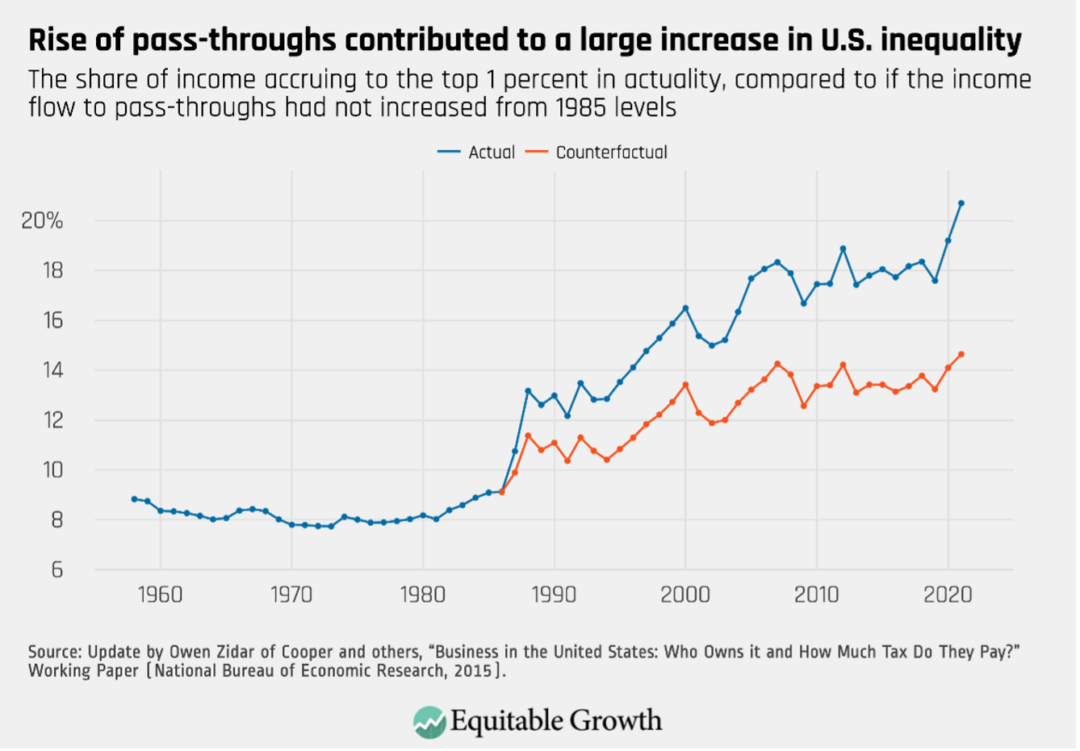
The essential feature of pass-throughs—that firm tax costs and benefits are funneled to owners rather than assessed at the firm level—means changes to the personal income tax regime could directly address distributional issues caused by the proliferation of partnerships. As Risch explained in the briefing, partnerships are often large businesses—nearly 40 percent are firms with more than 100 employees—whose gains accrue overwhelmingly to the top 1 percent of U.S. earners. In fact, income inequality would be significantly lower without the proliferation of pass-through businesses, as they account for about a quarter of the growth in income share accruing to the top 1 percent. (See Figure 1.)

Figure 1

The share of income accruing to the top 1 percent in actuality, compared to if the income flow to pass-throughs had not increased from 1985 levels

The briefing then focused on key legislative provisions of the expiring Trump tax cuts, including the qualified business income deduction, also known as Section 199A, which almost exclusively benefitted top U.S. earners and businesspeople. Mitchell highlighted several pieces of recent research showing how the introduction of Section 199A incentivized unproductive tax game-playing, including artificially modifying salaries to maximize income tax deductions. Other key provisions addressed by Mitchell include payroll taxes and carried interest—both of which are highly gameable within the partnership legal framework. Many of these tax strategies work to keep pass-through businesses artificially small and capital-constrained, with questionable value for the broader U.S. economy.

Finally, Risch tackled the questions of tax evasion and avoidance, showing how changes to reporting requirements for large complex partnerships could improve the federal fiscal outlook and reduce inefficient gaming of tax rules. Risch also spoke in favor of fully funding the IRS, particularly its Pass-Through Compliance Unit and Large Partnership Compliance Program, and introducing a user fee for partnerships above a certain level of complexity.

The Econ 101 event was the first of two business-tax-themed briefings for Hill staffers amid the ongoing tax and budget debate in 2025. The second, scheduled for March 28, will focus on taxing multinational corporations. These events follow a series of Econ 101s hosted in the fall of 2024 on the complexities of the U.S. tax code and the implications of tax policy for economic growth.

Review the presentation slides from the March 7 Econ 101 to learn more.


Did you find this content informative and engaging?
Get updates and stay in tune with U.S. economic inequality and growth!

Posted in Uncategorized

The U.S. House of Representatives’ budget resolution threatens social infrastructure programs, putting families’ well-being at risk

In late February, the U.S. House of Representatives passed a budget resolution that calls for $4.5 trillion in tax cuts and $2 trillion in federal spending cuts. This resolution provides a framework for a more detailed budget bill to come, mandating certain House committees to reduce spending over the next decade on government programs under their purview—for instance, calling on the Committee on Energy and Commerce to find $880 billion in cuts, $230 billion for the Agriculture Committee, and $1 billion for the Committee on Financial Services, among others. These committees will have to make difficult decisions about where to reduce federal spending and by how much as they draft their actual budgets in the coming weeks.

The implications of their decisions will be far reaching. Medicaid, the Supplemental Nutrition Assistance Program, and housing assistance programs are all at risk because they fall under the jurisdiction of the committees subject to large spending cuts and comprise a major share of those committees’ spending. Cutting back on these social infrastructure programs would come at a huge cost for the well-being of U.S. families, given the well-documented benefits these programs bring to the health, education, and financial stability of participating households.

The impact of cutting Medicaid

The U.S. private health insurance system does not cover large groups of people—for instance, low-income elderly people who need assistance for expensive long-term care, people with disabilities, and low-income children and adults—all of whom turn to Medicaid for health care coverage. The Medicaid program is the second-largest program under the jurisdiction of the House Committee on Energy and Commerce and appears to be a bigger target for federal spending cuts than Medicare, the largest program in their portfolio. More than half of Medicaid spending supports seniors or people with disabilities, and approximately a quarter supports low-income children and their parents, making these groups particularly vulnerable to Medicaid spending cuts.

Several decades of research show a wide range of positive impacts of past Medicaid coverage expansions. After Medicaid expansions in the 1990s, for example, the uninsurance rate decreased by approximately 11 percentage points to 12 percentage points for low-income children and their parents; it also dropped by 3 percentage points to 5 percentage points for low-income adults after the expansion of Medicaid under the Affordable Care Act of 2010. These expansions also reduced the probability of personal bankruptcy by 8 percent and the amount of debt collection balances by an average of $1,140.

In terms of health outcomes, Medicaid expansions have reduced infant mortality by 8.5 percent, the incidence of low birth weight by 2.6 percent to 5 percent, and teen mortality, too. Research even shows that Medicaid coverage for children has positive health effects into adulthood, reducing the presence of chronic conditions later in life by 0.03 standard deviations. Even the health of second-generation children—that is, the offspring of those exposed to Medicaid in utero—has been shown to be positively affected.

Medicaid coverage for children also improves nonhealth outcomes later in life. For instance, Medicaid expansions to cover children reduced the probability of being incarcerated by 5 percent and improved high school graduation rates and adult income—which, together, result in higher taxes paid in adulthood. In fact, research shows that a large fraction, including possibly the entire amount, of the cost of child Medicaid coverage is recaptured by the government in terms of higher taxes paid as adults.

If the House Committee on Energy and Commerce turns to Medicaid to satisfy their obligation to cut spending by $880 billion over 10 years, it would reverse these improvements in the well-being of low-income Americans.

The impact of cutting nutrition assistance

The Supplemental Nutrition Assistance Program, or SNAP, is a joint-run federal and state program that covers 40 million low-income U.S. families per month, with each state setting eligibility requirements based on resource or income constraints of applicants. It is by far the largest spending outlay for the House Committee on Agriculture, with federal spending totaling approximately $112 billion in 2023. As a result, funding for the program is at risk as the committee looks for ways to achieve its target of $230 billion in cuts over 10 years.

Research shows that not only does nutrition assistance dramatically reduce food insecurityby 12 percent to 30 percent—but it also has large benefits for the health, education, and long-term well-being of children in SNAP families. For example, SNAP benefits lower the probability of having a low birth-weight child by 5 percent to 11 percent and improves standardized test scores in both reading and math by about 2 percent of a standard deviation. The long-run impacts of receiving SNAP benefits as a child include a 3 percent of a standard deviation improvement in economic self-sufficiency, a 1.2-year increase in life expectancy, and a 0.5 percentage point decrease in the probability of being incarcerated.

As a result, a decision by the House Committee on Agriculture to reduce spending on the Supplemental Nutrition Assistance Program risks increased food insecurity in the short run, while also risking long-term effects for health, education, and economic outcomes of low-income U.S. children.

The impact of cutting housing assistance

The budget resolution requires the House Committee on Financial Services, which oversees housing assistance programs, to reduce spending by $1 billion over the next 10 years. Federal spending on housing assistance was $67 billion in 2023, with $32.1 billion going toward the Housing Choice Voucher program that provides subsidies for very low-income families to find housing in the private market.

Unaffordable housing is already a serious and well-known issue in the United States, with even minimally adequate housing out of reach for millions of people. Housing vouchers have been shown to reduce the percent of income paid on rent from 58 percent to 27 percent, which is within the general definition of affordable housing (no more than 30 percent of family income). By relieving the financial strain of high housing costs, research shows that the housing assistance program has positive effects in other dimensions as well. Housing vouchers reduce parental stress by 7 percent and hypertension by 50 percent, as well as reducing behavioral problems in children and increasing child test scores in school.

If the House Committee on Financial Services decides to reduce spending on housing assistance, many low-income families would not be able to afford decent, safe, and sanitary housing, which would have a negative impact on the overall well-being of parents and children alike.

Conclusion

A number of large social programs that provide support to millions of Americans may get cut as a result of the House-passed budget resolution, with Medicaid, the Supplemental Nutrition Assistance Program, and housing assistance particularly at risk. This would have a profound negative impact on the health, education, and financial stability of many low-income Americans—those who need this assistance the most.

Members of these House committees must carefully consider the benefits that these programs deliver to U.S. families before making decisions about where and how to make the required spending cuts. There are no doubt inefficiencies in social programs, just as in all government programs. But across-the-board cuts of this magnitude would inevitably hurt the vulnerable groups receiving these benefits across the United States.


Did you find this content informative and engaging?
Get updates and stay in tune with U.S. economic inequality and growth!

Posted in Uncategorized

Tackling AI, taxation, and the fair distribution of AI’s benefits

""

Artificial intelligence poses significant challenges to income growth, inequality, and meaningful work. At the same time, AI has geopolitical significance, with many national and supranational governments shying away from intervening in the rapidly growing industry to preserve its potential for global economic leadership and leverage it fully for national security.

Consequently, a handful of companies have become the sole players that are sufficiently resourced to compete in the heated global AI market that is already accelerating inequality both domestically and globally. As these highly capitalized tech corporations bank on AI’s disruptive power and future success, the question of how to level the playing field—whether by leveraging existing corporate income taxation regimes or introducing a novel AI tax—becomes extremely urgent. 

AI-powered services are slippery. They can be traded easily across borders, making it difficult for national governments to ensure that consumers, producers, government agencies, and workers benefit from them equitably. The emergence of multinational digital behemoths that amass significant economic and political clout thanks to their control of data and computing resources has been heightening social inequalities. Importantly, research finds this concentration of resources contributes to lower economic dynamism and less innovation—a longstanding concern both in the United States and around the world.

Unsurprisingly, then, governments, academics, and civil society are now looking for concrete approaches to address AI’s inequality issue, with some looking to the tax code as a potential avenue for change. Taxation can redistribute wealth and fund social services, reduce wealth gaps, and promote greater economic equity in society. Therefore, if taxation can address the high levels of concentration in the digital industry, then it will likely help stimulate a more equal, innovative, and prosperous society.  

Tax lawyers already have started investigating how so-called informational capitalism—the increasing role of data, networks, and digital platforms in driving growth, labor market transformations, and the distribution of gains from technological progress—affects states’ fiscal capacities and potentially contributes to tax avoidance by firms, including companies that dominate key parts of the AI supply chain. At the same time, scholars and policymakers alike have centered the fear of social costs flowing from large-scale automation through AI by contemplating a “robot tax” intended to disincentivize firms’ replacement of workers with machines.

Much of these discussions have informed significant advances regarding the global taxation of digital services. The Organisation for Economic Co-operation and Development’s Two‐Pillar Solution, for example, is designed to address tax avoidance and harmonize international tax rules by implementing a 15 percent minimum tax rate for multinational enterprises operating in the digital economy, regardless of the location of their operations. Yet this ambitious framework does not explicitly address AI, and the success of its implementation and enforcement remains to be seen.

Moreover, increasing corporate taxes can help rectify the inequity arising from taxing workers’ wages more than companies’ profits, yet increasing taxes on corporations’ incomes from AI risks reducing digital innovation—or, worse, encouraging tax evasion.  

AI-powered digital services also pose specific problems that are not properly addressed by broad-stroke approaches staked on a digital economy frame. First, utilizing AI systems requires significant and costly computing resources. This creates barriers to use by low-income countries or firms operating on thin margins, unevenly distributing the potential benefits of AI-driven automation and innovation.

Additionally, AI tools are trained on electronic data that are freely available on the internet—without the owners of that data being properly remunerated. Not only do the originators of these data used for AI training not benefit financially from their data being used, as shown by the recent writers’ strike in the U.S. film industry, but also governments may find it difficult to tax revenue streams from data and AI services that are intentionally based in jurisdictions that minimize tax liabilities and financial scrutiny.

Taxing inputs instead of outputs—that is, taxing the provision of data to AI developers through mobile applications or the use of cloud services as they build and train their systems—does not allow for differentiation between the actual contribution of these data and services to profits and the added value of the products and services produced by AI systems. Indeed, not all data used to train AI tools is valued to the same extent. How companies go about this valuation process is inaccessible to outsiders since disclosure is not required. A regulatory solution—whether through stress-testing the market or by gaining access to training data valuations processes—is urgently needed to ensure fair and competitive markets.

The development, training, and use of AI also causes significant negative externalities, including environmental and social costs, which are not fully accounted for. Indeed, the high energy costs and related carbon emissions produced by ever-increasing computing requirements to develop AI help explain the increasing concentration of the industry since it has become very expensive to break into the industry. Environmental taxation might provide a route to generate a fair distribution of incomes in the AI field, but such a step would need to address the challenges of existing frameworks, such as carbon credit trading. Additionally, taxing data inputs based on energy consumption only loosely reflects the value these tools create.

Clearly, the nascent field of AI taxation needs both expansion and deepening. Concrete and incremental strategies for taxing AI will be key, including:

  • Examine valuation practices and AI-relevant legislation, including intellectual property rights. There are court rulings in Europe, the United States, and Australia that ascribe a monetary value to AI systems, such as in product liability cases, antitrust rulings, or data-breach cases that quantify damages. These instances can be instructive for thinking about the profit-making dynamics of AI, especially the expropriation of intellectual property rights.
  • Sketch out the potential international AI tax base and how it can be measured. It remains unclear whether and how AI can be measured as an asset, as income, or as economic activity, as well as what components would need to be included, such as model, data, server, chips, and so on. Answers to these questions are key for considering potential AI tax liabilities but would require the development of a new accounting system for the digital commons, alongside (digital) compliance mechanisms. Interestingly, AI could potentially optimize tax, accounting, and compliance systems, making them more efficient.
  • Investigate loopholes and avoidance strategies in existing tax systems. Such an analysis would need to bedriven by the question of how the tax code incentivizes key AI actors and key adjacent industries, and how key players are evading current taxation regimes. Large global tech companies—notably those with the resources to develop and deploy AI—routinely avoid taxes by shifting revenue and profits through tax havens or low-tax countries, or delay payment of taxes. In this regard, tax authorities should themselves consider the use of AI for fraud detection and tax evasion.
  • Evaluate the size and impact of AI’s negative externalities across its entire value chain and integrate it into existing regulatory mechanisms. There are already models for ascribing monetary value to AI’s most immediate effects—for example, existing carbon emission frameworks can and do apply to the environmental footprint of AI. Assessing these existing frameworks could be instructive for considering strategies for AI taxation.
  • Assess how to leverage AI taxation frameworks both to prevent excessive use of AI that may heighten worker surveillance rather than improve productivity and to incentivize meaningful AI use. Increasingly, evidence is mounting that AI is not providing vastly improved productivity across all industries and types of jobs. Shifting the tax burden away from labor toward (digital) capital can go a long way to prevent inefficient automation and strengthen incentives for productivity-enhancing innovations.

In a world in which rapid AI deployment and aggressively heightened inequalities collide, it is time to find answers to the question of whether a bold AI taxation framework can be the key to curbing inequality, tackling environmental costs, and reshaping the unchecked dominance of tech giants.

Mona Sloane is an assistant professor of data science and media studies at the University of Virginia. She studies the intersection of technology and society, specifically in the context of AI design, use, and policy. She is a faculty lead in the Digital Technology and Democracy Lab at UVA’s Karsh Institute of Democracy, affiliated faculty with the Department of Women, Gender and Sexuality, and faculty affiliate with the Thriving Youth in a Digital Environment research initiative. Sloane also convenes the Co-Opting AI series and serves as the editor of the Co-Opting AI book series at the University of California Press, as well as the technology editor for Public Books. Her growing research group, Sloane Lab, conducts empirical research on the implications of technology for the organization of social life and spearheads social science leadership in applied work on responsible AI, public scholarship, and technology policy.

Ekkehard Ernst is chief macroeconomist at the International Labour Organization, where he is responsible for understanding the future of work and analyzing alternative paths for jobs and earnings to improve upon current trends. His work helps decision-makers understand developments in skills and labor costs around the globe, providing them with the necessary intelligence to make effective long-term decisions. Before joining the ILO in 2008, he worked at the Organisation for Economic Co-operation and Development and the European Central Bank. He has published extensively in the area of labor market trends and reforms and the impact of financial markets on jobs. Ernst studied in Mannheim, Saarbrücken, and Paris and holds a Ph.D. from the École des Hautes Études en Sciences Sociales.


Did you find this content informative and engaging?
Get updates and stay in tune with U.S. economic inequality and growth!
Posted in Uncategorized

New research finds capital gains are highly concentrated and hardly taxed, underscoring widespread U.S. inequality

""

For two decades, booming stock, housing, and private business markets have driven large capital gains in the United States. Real capital gains, which are the inflation-adjusted appreciation of a financial or physical asset, have averaged 20 percent of national income over the past two decades, compared to 5 percent prior to 1980. In 2021 alone, according to calculations using IRS and financial accounts data, capital gains totaled almost $6 trillion—a whopping 39.2 percent of national income.

Clearly, capital gains are becoming increasingly relevant to many U.S. households’ bottom lines. But who is actually receiving this money? And how does it affect already-widespread inequality in the United States? Our new working paper, which was funded in part by the Washington Center for Equitable Growth, seeks to answer these questions.

Capital gains are different than other forms of income for two reasons. First, they are extraordinarily concentrated, mostly flowing to the top income percentiles. And second, they are difficult to measure, which is partly why most studies of inequality do not include capital gains as part of their income series.

Using internal IRS tax return data, under a data-use agreement with the IRS under the Joint Statistical Research Program, our paper studies the distribution of capital gains in the United States and their contribution to both income inequality and tax progressivity. Using IRS data offers many advantages—the data are comprehensive, spanning the entire income distribution and wealth distribution in the United States.

At the same time, however, only realized sales of assets are reported on tax forms since the United States only taxes capital gains upon realization—though not all realized sales are taxed (for example, taxes are deferred on the return to assets held in retirement accounts, and the first $250,000 of a gain from the sale of a primary home is exempted entirely). This means a large portion of total appreciation, or the sum of unrealized and realized capital gains, is unreported in these data.

Specifically, between 1954 and 2021, $116 trillion in total capital gains were accrued, but less than 20 percent of that was reported on tax forms and subject to taxation. We cannot say with certainty whether the remaining 80 percent of gains will ever be taxed in the future (e.g., if they are sold in taxable accounts at any point after 2021). But much of these assets will likely escape taxation, thanks to avoidance strategies such as the so-called stepped-up basis rule that allows tax-free bequeaths of unsold stock to heirs. Due to these strategies, using taxed capital gains is therefore a poor proxy for total capital gains.

To overcome this limitation of realized gains, we utilize a three-step approach to more accurately estimate total capital gains: We link individuals to their portfolio holdings to ensure accurate valuation; capitalize income to estimate their wealth; and estimate capital appreciation by multiplying wealth by price appreciation in asset-class-specific returns—specifically, in public equities, private equities, owner-occupied housing, tenant-occupied housing, and pension assets.

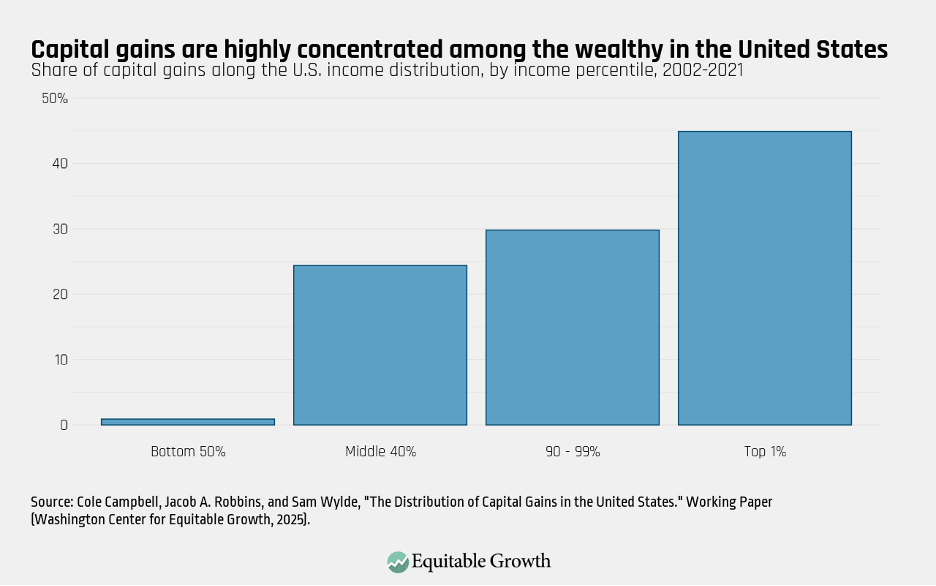
Upon doing so, we find that capital gains are both large and highly concentrated. Indeed, they are the most concentrated form of income in the United States. Overall, the top 1 percent of the income distribution received 45.3 percent of capital gains from 2002 to 2021, and the top 10 percent received three-quarters of capital gains (75.7 percent). (See Figure 1.)

Figure 1

Share of capital gains along the U.S. income distribution, by income percentile, 2002-2021

In fact, capital gains are so concentrated that they have a substantial impact on levels of inequality when included in calculations of income distribution in the United States. Our results show that the top 1 percent’s share of total U.S. income increases from 18 percent without capital gains to 21 percent with gains included. The top 10 percent of individuals receive 45 percent of income without gains, compared to almost 48 percent with capital gains included.

Accounting for capital gains also makes the U.S. tax system less progressive. Overall, as indicated above, only a small proportion of capital gains are taxed. We find this results in an effective tax rate on real capital gains of 5.2 percent—significantly below the statutory rate of between 15 percent and 20 percent depending on income level.

Because capital gains are concentrated in the top 10 percent of the income distribution, the average tax rate on income is lower for higher-income groups when capital gains are included, leading to an all-in tax rate that is essentially flat across the income distribution. We find that the middle 40 percent of the income distribution pays an average rate of 27.3 percent, the 90th to 99th percentile pays 27 percent, and the top 1 percent pays 26.8 percent. Further, we find that the top 0.01 percent pays 25.5 percent.

Lastly, we find that returns on capital gains exhibit marked differences across income levels. Richer individuals, for example, tend to have higher returns on real estate. This is because they tend to live in “superstar” cities, which have flourished over the past two decades. The private business wealth of the rich also sells for a premium because these businesses are large and more liquid, increasing their value, and they tend to be in industries, such as manufacturing, that investors prefer. This heterogeneity makes a material difference in measures of overall income and wealth inequality.

Our new working paper highlights the distributive impacts of capital gains, which almost entirely benefit the top 10 percent, and the current disparate treatment of capital gains income, which has a low effective tax rate. These findings are directly relevant to tax policy—particularly the debate around capital gains taxation, in which potential revenue gains are often pitted against the administrability of a more comprehensive capital tax system, such as a mark-to-market tax on unrealized gains, or what is sometimes called a Billionaires Income Tax, as well as possible effects on entrepreneurship.

Our paper suggests that the wealthy have long shielded capital gains from taxation and that raising substantial revenue from a capital gains tax would require closing certain loopholes in the tax code. As tax policy debates occur throughout 2025 in the U.S. Congress, policymakers interested in raising revenue, reducing income inequality, and making the tax code more progressive should keep these implications in mind.


Did you find this content informative and engaging?
Get updates and stay in tune with U.S. economic inequality and growth!

Posted in Uncategorized

Boosting U.S. worker power and voice in the AI-enabled workplace

""

Key takeaways

The deployment of Artificial Intelligence in the workplace has grown rapidly in the United States. Labor unions have been at the forefront of efforts to encourage more productive and sustainable workplace AI and digitalization strategies. Case studies from Germany and the United States show the importance of public policy for supporting worker voice in new technology adoption and deployment.

Policy options that could be considered at the state and local levels in the United States to boost worker power and voice in the era of AI innovation include:

  • Legislation regulating employer AI usage: laws that prohibit excessive surveillance, data collection, and automated decision-making by employers; that regulate employers’ use of electronic monitoring and automated decision systems; and that require employers to conduct impact assessments of AI usage
  • Legislation implementing human oversight of AI tools: laws that put guardrails on replacing humans with digital technologies by requiring human oversight in sensitive sectors
  • Protections for workers exposed to AI: requiring retraining and severance for displaced workers, state and local procurement of AI tools that focus on their equity and impacts on workers, and agency actions to take on deceptive and unfair practices by employers

Overview

Employers are rapidly deploying digital tools that apply algorithms and artificial intelligence26 to restructure operations and manage workers.

Economists have observed that this corporate deployment of AI embeds existing power relations in the workplace and is biased toward automation applications focused on short-term cost savings. These trends risk increasing unemployment and inequality, as well as stagnating productivity in the United States.27

Studies also have identified risks to workers, customers, and citizens from the widespread application of algorithmic tools to automate surveillance and management decision-making, based on often biased and faulty models.28

But AI does not have to be deployed as such and indeed can have positive impacts on workers and the workplace. Research shows that the quality of AI models improves when the people who use them participate in developing these models, selecting and maintaining data, and interpreting and verifying results.29 Management research likewise finds that workplaces with high trust, worker autonomy, and investment in workers’ skills experience better performance outcomes and innovations associated with AI investments.30

Public policy can help support this alternative approach to AI adoption and deployment that benefits firms, workers, customers, and our broader society. Legislated minimum standards and collective bargaining institutions that support worker voice are needed to rebalance power in the workplace and to place productive constraints on employers that encourage investments in expanded worker discretion and skills.31 These institutions have long supported quality-focused competitive strategies during technology-related restructurings,32 and they are just as crucial today.33

In this policy brief, we argue that policies strengthening worker rights and power are crucial to encouraging a high-road approach to AI that complements rather than replaces workforce skills. A case study of Deutsche Telekom AG in Germany shows the potential of collective bargaining to support this high-road approach in a context where strong worker rights support more balanced workplace power. We then turn to the United States to examine how unions are responding to similar challenges. We conclude with recommendations that follow from our analysis.

Let’s turn first to Germany.

Worker voice and mutual gains in Germany: The case of Deutsche Telekom

Institutional support for worker voice

Germany has among the strongest worker rights in the areas of data protection and participation in management decision-making.34 Two areas in particular stand out: protections against unauthorized worker data collection and strong collective bargaining rights.

German law has long prohibited the unauthorized collection, processing, and storage of workers’ personal data. Indeed, Germany has had a federal data protection act since 1978, which has been updated over the years, including to conform with EU data protection regulations.35

Worker representatives in Germany also have very strong legal bargaining rights. In Germany, labor unions typically negotiate collective agreements at the company or sector level, including over areas such as worker pay, working time, and job security. Meanwhile, works councils made up of elected employees within companies negotiate separate “works agreements” at the company and workplace levels over a range of management practices, including scheduling, variable pay, health and safety, and performance monitoring.

Strong co-determination rights, which give employees a voice in how their company is run, give works councils different possibilities to negotiate binding rules relevant to the usage of AI and algorithms. Many works agreements, for example, ban the collection of individual performance data, which can limit the use of speech analytics tools or workforce management software.

In addition, a revision to Germany’s Works Constitution Act in 2021 extended works councils’ consultation rights on new technologies to include AI-based tools. It also extended co-determination rights over selection guidelines for hiring, transfers, and terminations to include situations in which AI is used, and it requires companies to fund an expert (engaged by the works council) to consult on proposed changes or policies involving AI.

Worker voice at Deutsche Telekom

The case of Deutsche Telekom AG shows how this different institutional framework of rights supports strong worker voice in AI-based technology adoption and deployment.36 Deutsche Telekom’s works councils negotiate works agreements, and the labor union Vereinte Dienstleistungsgewerkschaft, or Ver.di, negotiates separate but coordinated collective agreements.

Works agreements restrict supervisors’ access to individual performance data and require that this information is used to develop, rather than to discipline, workers.37 In addition, an agreement from 2010 states that automation should first be used to reduce subcontracting. This provision gave workers a baseline of job security to encourage joint labor-management efforts to improve efficiency.

In the mid-2010s, Deutsche Telekom’s works council organized an 8-month project to analyze the workforce impact of new digital, algorithm, and AI-enabled tools. Based on that project’s findings, a series of works agreements established the following rules and processes:

  • Management must consult with the works council before purchasing new technology. After evaluating the risk to workers, the two parties decide jointly whether to prohibit or negotiate over the tool.
  • Management draws up a “digi-road map” laying out planned digitalization measures. Management then meets with the works council to discuss, and eventually negotiate over, the impacts on employment, service quality, and work content.
  • A labor-management Workforce Analytics Expert Group reviews how employee data and AI-enabled analytics tools are used. It holds regular evaluation workshops and provides training for employees to use workforce analytics responsibly.38
  • A labor-management AI Ethics Committee reviews AI-based tools and systems compliance with agreed-upon ethics provisions.39

Additionally, in 2024, aWorking Time Agreementwas negotiated to deploy an intelligent predictive shift-planning tool. With this tool, workers are able to choose their own shifts, and the AI-enabled system then creates an optimal “duty roster.”

Impacts on job quality and service quality

Together, these collective agreements placed productive constraints on management, supporting a high-road approach to AI adoption at Deutsche Telekom in two main ways: using AI tools that enhance skills rather than discipline workers and giving workers a choice in how they use AI tools.

First, job security and limits on individual monitoring encouraged management to invest in AI tools that enhanced skills and service quality rather than increasing worker discipline and control. Workers are protected from invasive monitoring and privacy abuses, and workforce analytics and coaching tools are only used where they comply with clear rules; the fairness and use of these tools is evaluated by joint worker-management committees.

This process reduced the risk to management that works councils would oppose expensive IT systems after they had already been purchased. It also improved worker trust in how managers were using controversial tools, such as speech analytics software, which uses AI and natural language processing to analyze recorded customer conversations and identify recurring issues to more quickly address network or service problems.

Second, these agreements gave workers more choice and control over how they use AI-based tools, encouraging creative applications that improve productivity, scheduling flexibility, and service quality. Call-center workers, for example, could choose whether and how to use Deutsche Telekom’s agent-assistant tool to look up information relevant to customer calls. A majority did choose to use it and also were involved in correcting its mistakes to improve the information it provided. Similarly, the intelligent predictive shift-planning tool mentioned above was broadly welcomed by workers, who were able to more closely tailor their schedules to balance work with their families and lives outside of work—all while meeting management’s goals of more flexible staffing.

Managers reported that the benefits of this deliberative approach to AI adoption could be most clearly seen in the company’s increasing service quality scores and so-called first-call resolution (meaning fewer customers had to call back due to unresolved problems). Meanwhile, worker representatives secured in-house jobs at good pay, with employment security and worker control over how they did their jobs, drawing on their experience and skills. This allowed employees to focus on providing good-quality customer and technician service.

The high rates of customer satisfaction and first-call resolution also added significant value to job quality, as stress and burnout in service jobs very often result from frequent interactions with dissatisfied or abusive customers.40

How workers are using collective voice in the United States

The United States has weaker data protection and labor laws than Germany. While a growing number of U.S. states have passed data privacy laws, most of these are targeted to consumer data, and some even explicitly exclude workers from protections.41

Yet there also are many examples where unions are using or building institutions that support worker voice to address similar challenges as those seen in Germany, including to prohibit certain uses of AI, to improve job security and reduce workplace monitoring, and to strengthen worker voice in AI decision-making.

Prohibiting certain uses of AI

The Deutsche Telekom example shows the benefits of clear, bright-line rules prohibiting certain uses of AI.

In the United States, recent hard-fought collective agreements negotiated by the Writers Guild of America,42 or WGA, as well as actors at SAG-AFTRA,43 similarly place strict limits on how generative AI is used in these creative jobs. The WGA, for example, won provisions in its 2023 contract restricting the use of AI-generated scripts, requiring disclosure of AI-generated material, and giving writers control over whether and how they use AI software. SAG-AFTRA’s agreement, meanwhile, restricts the use of digital replicas of actors, requiring consent for creating and using digital replicas and regulating compensation for the use of these replicas.

Likewise, members of The NewsGuild-Communications Workers of America, or CWA, have negotiated contracts that prevent any use of generative AI except by working journalists themselves, prohibit job cuts driven by AI, and make clear that only journalists do the work of journalism.44

Improving job security and reducing work intensification and monitoring from AI-based tools

Similar to the unions and works councils at Deutsche Telekom, the CWA has long responded to threats from automation at U.S. telecom employers, such as AT&T Inc. and Verizon Communications Inc., with agreements improving job security and retraining.45 Agreements also provide protections against disciplining employees if they do not meet certain time-based measures and specify that monitoring technologies should be used primarily for training purposes.46

Past research finds that these kinds of negotiated supports for worker skills and voice create benefits for sales, service quality, and employee retention.47 These agreements continue to protect workers from unfair discipline as new AI monitoring technology evaluates tone of voice and adherence to scripts, and new automation tools speed up work.48

Other unions have organized similar efforts in other service industries to adapt past agreements to new threats from AI- and algorithm-based tools. Unionized workers’ 2023 contract with United Parcel Service Inc. includes language prohibiting the implementation of new technologies that would eliminate significant parts of the workforce until 2028, including drones, driverless vehicles, platooning of semi-trucks, and other AI.49

Similarly, UNITE HERE Local 226 in Las Vegas negotiated new contracts in 2023 for 40,000 hotel and casino workers that strengthened existing technology protections, including advance notice, training, severance pay, privacy rights, and expanded bargaining rights.50 In one case, housekeepers won back control over the sequence of rooms they clean through analyzing data records from the software applications that workers were required to use for cleaning rooms and filling orders.51

Strengthening worker voice in AI decisions

At Deutsche Telekom, the works councils strengthened their own capacity through studying AI’s uses and employment impacts and then establishing clear principles and joint committees to steer those uses and impacts. Similar initiatives can be seen in the United States.

U.S. National Nurses United, or NNU, found that the use of generative AI for shift scheduling and remote patient monitoring was widely perceived by their members as harming patient care by undercutting nurses’ skills and nuanced understanding of patients’ needs.52 The union then developed an AI bill of rights for nurses and patients, drawing on these findings and experiences.53 These principles, in turn, have been deployed by NNU members in many hospitals through established technology committees.

The CWA also has organized Technology Change committees since the 1950s, and organizational support for these committees is included in many of its telecom collective agreements.54 A priority of worker representatives on these committees is to focus on technology applications that improve the quality of service, taking into account a broader range of stakeholders.

The CWA also has studied the use and worker impacts of AI.55 The union then used this research both to educate local representatives and to support collective bargaining. The union published a set of AI principles in 2023 based on the deliberations of a committee of members from the telecom, media, and technology sectors.56

Similar initiatives can be seen across other unions, including:

  • The WGA West’s Board, covering film, TV, radio, and new media writers, has appointed an AI advisory committee that is documenting writers’ experiences with and developments in AI.
  • IATSE, a union for theatrical stage workers, published a set of AI principles in July 2023 that includes a demand for “transparency from employers regarding their use of AI.”57 In 2024, IATSE members ratified a new contract that establishes ground rules for the use of AI, a committee to facilitate AI skills training, and requirements that AI use cannot be outsourced to nonunion labor, among other provisions.58
  • The United Auto Workers-Ford’s Letters of Understanding, which outline terms not covered in their union contract, include provisions under which a joint committee “will research AI technology for worker safety and how it applies to facility operations.” The Letters of Understanding also establish that management will provide advance notice on new technology, with investment in training programs.59

These examples show that U.S. workers and their unions have been creative in adapting existing agreements and developing new joint initiatives. Yet they also are limited in their ability to extend and deepen worker voice due to lower bargaining coverage,60 weaker bargaining rights, and an overall weaker framework of baseline data protection rules. Agreements protecting workers (and customers) from the worst abuses of algorithmic management and de-skilling cover only a minority of U.S. workers, even in the sectors where these agreements are present.

Policy recommendations

How can the lessons learned from these case studies from Germany and the United States be extended more broadly across the U.S. workforce? Most importantly, to support worker voice in AI decisions, we need policies and strategies that strengthen worker power. The German experience suggests that a longer-term goal should be labor law reforms that remove the steep obstacles to organizing unions in U.S. workplaces and strengthens collective bargaining rights.61 U.S. firms with union-represented employees can also pursue a high-road path by bargaining constructively over digital technology implementation.

Despite weak institutional supports, many U.S. unions have won contract provisions related to technology and, through decades of case law, established the right to negotiate over technology changes that impact working conditions and freedom of association.62 U.S. firms that aim to use digital technology to complement their workforces should look to the German model of co-determination, which harnesses the collective wisdom of front-line workers alongside management to guide changes to work processes that maximize both productivity and job quality.

Worker power also can be buttressed against the most harmful and invasive uses of digital technologies with baseline legal protections at local, state, and federal levels.63 The EU’s recent AI Act is a potential model in its explicit prohibition on using AI to measure or emulate human emotions in workplaces and educational settings—a red line that would rein in abuses in call centers and other service-sector jobs.64 To protect workers from exploitative use of digital metrics and monitoring, policymakers can prohibit excessive surveillance, data collection, and automated decision-making.

Some examples include:

  • State bills, such as California’s 2022 Workplace Technology Accountability Act,65 as well as New York State’s 2024 Bossware and Oppressive Technologies Act,66 lay out a broad framework for regulating employers’ use of electronic monitoring and automated decision systems, and also require employers to conduct impact assessments.67
  • Warehouse workers have called for limits on algorithmic metrics, such as Amazon’s “time off task,” that undermine worker health and safety, with legislation passed in California and proposed in several other states.68
  • So-called just cause bills in Illinois and New York City limit the use of electronic monitoring data in dismissing workers.
  • Bills that address sector-specific risks by requiring worker oversight on AI decisions can provide baseline protections requiring a human-in-command approach, for example, in healthcare and publishing.69

To protect against employers rushing to cut costs by substituting AI tools for human workers, unions also are pursuing contractual protections for job security. Many unions are exploring legislative strategies, too, including requiring notice, retraining, and severance for workers who experience technology-driven job loss, as proposed in New Jersey,70 and prohibiting replacement of workers with digital technology in specific industries that would harm the public, such as in community colleges,71 call centers,72 and healthcare.73

At the federal level, the Biden administration asserted that agencies have some existing authority to take on deceptive and unfair employer practices around AI tools,74 and President Biden’s Office of Management and Budget encouraged agencies to consult employee unions on the design, development, and use of AI—actions that have since been rescinded by the Trump administration.75

Government also has significant influence on technology development through its procurement of goods and services. In March 2024, the White House Office of Management and Budget issued a memo on AI governance that encouraged agencies to consult with federal employee unions, among other impacted groups, on the design, development, and use of AI.76 Though the Trump administration has since rescinded this guidance as well,77 states and localities have begun to adopt their own guidance on procurement of AI tools that foregrounds equity and impacts on workers.78

Conclusion

Workers and their unions have been at the forefront of efforts to regulate the use of AI and other digital technologies in a variety of U.S. workplaces. Yet collective agreements cover only a minority of workers. Most employers lack much-needed productive constraints on low-road strategies relying on automation, de-skilling, and intensified surveillance.

Frontline workers are well-positioned to steer AI investments toward the high-road alternative, but only if the broader public and policymakers have their backs. Policies that strengthen worker rights and worker power are critical for securing broadly shared prosperity in the era of AI innovation.

About the authors

Virginia Doellgast is the Anne Evans Estabrook Professor of Employment Relations and Dispute Resolution in the ILR School at Cornell University. Her research focuses on the comparative political economy of labor markets and labor unions, inequality, precarity, and democracy at work. She is currently studying the impact of digitalization and AI on job quality in the information and communication technology services industry, based on comparative research in North America and Europe. She is author of Exit, Voice, and Solidarity (Oxford University Press, 2022) and Disintegrating Democracy at Work (Cornell University Press, 2012); and co-editor of International and Comparative Employment Relations (Sage, 2021) and Reconstructing Solidarity (Oxford University Press, 2018).

Nell Geiser is director of research for the Communications Workers of America, a labor union representing workers in telecommunications, media, technology, public service, airlines, manufacturing, and other sectors. Geiser and the research department support CWA initiatives across collective bargaining, policy, and organizing. She has worked as a researcher for labor unions since 2006. Geiser has a B.A. from Columbia University and in 2014, she fulfilled the requirements to become a Chartered Financial Analyst.


Did you find this content informative and engaging?
Get updates and stay in tune with U.S. economic inequality and growth!

Posted in Uncategorized

As the U.S. labor market stabilizes, is nominal wage growth now too hot?

""

After the tumultuous swings of the early COVID-19 pandemic period and years of normalization since then, economic data from the past several months suggest that the U.S. labor market may have stabilized. While certain measures point to some cooling since the hottest post-pandemic period—in April 2023, for example, the unemployment rate was as low as 3.4 percent—they also indicate that the labor market remains strong by historical standards. (See Figure 1.)

Figure 1

Difference in various U.S. labor market measure from May 2024, percentage points

Data from the Job Openings and Labor Turnover Survey, which measures monthly employment dynamics, have generally been weaker than one would expect based on data from the jobs report (that is, the JOLTS data are more in line with values seen when the unemployment rate was meaningfully higher in 2013–2014). Yet even these data have shown some potential stabilization in measures of labor demand since last summer: The hires and quits rates are the same as they were in July 2024, and the job openings rate, while more volatile, is down only slightly. Each of those measures had trended down consistently since early 2022. (See Figure 2.)

Figure 2

Difference in job openings, quits, and hires from July 2024 rates, percentage points

Alongside this stabilization of employment dynamics, nominal wage growth also has been relatively stable, on balance, since mid-2024. Depending on the measure being used, annual nominal wage growth over that period has declined by 0.4 percentage points or more (according to the Employment Cost Index based on wages and salaries of private industry workers or on the Atlanta Fed’s wage growth tracker), while other data indicate that annual nominal wage growth has been virtually unchanged (based on average hourly earnings of production and nonsupervisory workers) or has increased by about 0.15 percentage points (per the average hourly earnings of all workers or median usual weekly earnings of workers employed full-time). At the end of 2024, annual wage growth ranged from 3.6 percent to 4.2 percent across these measures. (See Figure 3.)

Figure 3

Various measures of annual U.S. wage growth, percentage points

Six months ago, prior to this stabilization, weak and weakening JOLTS data suggested that the then-ongoing slowdown in nominal wage growth could continue to the point at which real wage gains would evaporate, threatening the labor market’s ability to deliver material gains for workers. With employment rates, wage growth, and inflation having held approximately steady since then, though, it is worth reassessing how these data figure into U.S. workers’ bottom lines going forward.

To that end, there are three important facts about nominal wage growth to keep in mind:

  • Nominal wage growth is faster than pre-pandemic averages. How much faster depends on the measure used, but averaging the five measures discussed above (giving each equal weight) suggests that annual nominal wage growth is currently about 1.1 percentage points faster than it was from 2015–2019 (a period that was itself the strongest labor market since the late 1990s).
  • Nominal wage growth is faster than inflation. Prices, as measured by the Personal Consumption Expenditures price index, increased by 2.4 percent in 2024. Of the wage growth measures considered here, the Employment Cost Index showed the slowest growth over that period, at 3.6 percent, suggesting inflation-adjusted wages grew at least 1.2 percent.
  • Depending on the measure, nominal wage growth is in line with or faster than the level consistent with 2 percent inflation, given current productivity growth. Annual labor productivity growth has slowed over the past several months, falling from 2.4 percent in the second quarter of 2024 to 1.6 percent in the fourth quarter of that year. As a rule of thumb, nominal wage growth is inflationary to the extent that it exceeds productivity growth. Based on current productivity growth levels, annual wage growth of 3.6 percent—a level which, as mentioned above, all wage growth measures considered here are currently at or above—would be consistent with inflation at the Fed’s 2 percent target.

Faster nominal wage growth is good for workers to the extent that it exceeds inflation. Because annual PCE inflation is also running a little more than 1.1 percentage points above its 2015–2019 average, current real wage gains are not meaningfully larger than the gains experienced before the pandemic, despite faster nominal growth.

Those real wage gains could become more vulnerable if productivity growth continues to decline and nominal wage growth starts to put more upward pressure on prices. Higher inflation directly threatens workers’ ability to take advantage of real wage gains, but so could the remedy for it—following interest rate hikes over the course of 2022, employment growth in interest-rate-sensitive sectors has declined relative to the rest of the U.S. economy.

Consumers want interest rates to be lower, but inflation remains above the Fed’s target. Consumer price data for January 2025 highlighted this persistent elevation: On an annual basis, inflation increased to 3 percent, and on a monthly basis, inflation was higher than the previous month for the sixth time in the past 7 months. Progress toward the 2 percent target seems to have stalled.

Both productivity and wage growth measures can be noisy, so it is far from certain that nominal wage growth is putting or will continue to put upward pressure on prices. The productivity growth buffer between nominal wage growth and inflation, however, seems to have shrunk. Further moderation in wage growth could help inflation progress back toward 2 percent without necessitating higher interest rates, even if productivity growth does not reaccelerate or returns to the lower levels seen during the previous business cycle.


Did you find this content informative and engaging?
Get updates and stay in tune with U.S. economic inequality and growth!

Posted in Uncategorized

Testimony by Michael Linden House Oversight Subcommittee on Healthcare and Financial Services

Michael Linden
Washington Center for Equitable Growth
Testimony before the House Oversight Subcommittee on
Healthcare and Financial Services

February 11, 2025

Chairman Grothman, Ranking Member Krishnamoorthi, and members of the Committee – thank you for the opportunity to be here.

Today, I’d like to make three main points.

First, federal investments in health, nutrition, housing, and other work supports for low- and very low-income people are both a moral and economic necessity. The major problem with our current approach is that we don’t do enough to lift children out of poverty and give struggling families a path to the middle class.

Second, if you are interested in efficiency and cost savings, you are looking in the wrong place. The federal tax code is rife with loopholes, special subsidies, and giveaways that benefit the very wealthy and giant corporations with little or no discernable benefit to the public.

And third, it is indefensible to scapegoat the hardworking Americans who are striving everyday just to make ends meet while the ultra-wealthy and giant corporations have been given trillions in tax breaks and even as we speak, this Congress is currently proposing yet another round of tax handouts.

Investments in health care, nutrition, housing, and other work supports for low- and very low-income people pay enormous dividends—not only for those families, but for the entire U.S. economy.

Children who receive nutrition assistance have better health and lower health care costs their whole lives.79 Children whose mothers receive WIC do better in school than children whose mothers did not.80 Children of families who use rental assistance earn more as adults and are less likely to become single parents.81 Boosting the incomes of very poor families through the Child Tax Credit results in more schooling, more hours worked, and higher earnings in adulthood for the children of those families.82 And Medicaid expansion has resulted in better financial security for millions of people, lower eviction rates, lower costs for hospitals—especially rural hospitals—fewer premature deaths, and positive statewide economic impacts.83

These conclusions, and the many others like them, are drawn from hundreds of studies. These facts are not disputed. But you don’t have to pore over studies to understand why these investments matter. You just need to talk to people who benefit from them.

Take the story of Zoe, for example. She is a young woman from Colorado who recently shared her story with The Arc of the United States. She completed a 4-year college degree, like so many other people her age, and is now applying to grad schools. Zoe has spinal muscular atrophy, or SMA, a genetic neuromuscular developmental disability. She relies on the caregiver support she receives through Medicaid in order to live independently while she pursues her education. For Zoe and the millions of other Americans who rely on Medicaid—1 in 5 Americans, in fact—slashing these programs would have devastating effects on their lives and livelihoods.84

We invest too little—not too much—in reducing poverty and providing pathways into the middle class. The federal government spent just 1.3 percent of Gross Domestic Product on “income supports” in 2024, down from 1.8 percent a decade ago and much lower than the average of 2 percent from the past 30 years.

Roughly 1 in 5 children in the United States is in poverty today. That’s twice the rate of other developed countries. 47.4 million people in this country are food insecure.85 More than 770,000 are homeless,86 and about 3.7 million report a form of housing insecurity.87 These numbers are especially concerning, given that there are more working-age Americans in the labor force and working than at almost any time in modern history.

That’s why it’s a grave mistake—both morally and economically—to slash benefits and services for low-income people. And don’t be fooled. Adding bureaucratic red tape, narrowing eligibility requirements, or setting arbitrary limits all amount to the same thing: indefensible harm to poor families and our economy.

But there is another place in the federal budget that truly is bloated with wasteful costs, unnecessary subsidies, and counterproductive incentives: the tax code. Over the past quarter-century, Congress has repeatedly enacted trillions of dollars in tax cuts that disproportionately benefit the wealthy.

Consider the 40 percent reduction in the tax rate for massive corporations in 2017 under President Trump. That single giveaway is estimated to have cost roughly $1 trillion already88 and will cost trillions more over the next decade.89 These corporations didn’t raise wages or create more jobs in response. They enriched their shareholders and executives.90 That is the definition of wasteful spending.

Those who are quick to scrutinize the choices of a poor family receiving $6 a day in nutrition benefits never get around to asking whether a giant corporation is doing what they promised to do with their billions in tax cuts—or whether they needed them in the first place.

The truth is that far too many Americans are struggling to make ends meet while those at the top get richer and richer. That’s why most Americans support investing more—not less—in supporting poor families.91

And that’s why it is surprising that Congress is considering spending another $5 trillion or more—not on lowering health care costs or improving public schools or making life a little easier for struggling people, but instead on tax cuts that mostly benefit those at the top. It is hard to take seriously claims that we spend too much on poor families as policymakers write a budget that would take money out of their pockets and give it to billionaires. That’s not effective government. That’s highway robbery.

Anyone truly interested in improving efficiency and reducing waste should be appalled by efforts to scapegoat those living in poverty, while padding the pockets of the super wealthy.

Posted in Uncategorized