issue Tax & Macroeconomics

Equitable Growth supports research and policy analysis on how tax and macroeconomic policies can promote stable and broad-based economic growth.

Photo credit: Bjoern Wylezich/shutterstock.com

A strong economy is one that operates at its potential and delivers a high standard of living to the entire population. Monetary, fiscal, and tax policy all play important roles in determining the level and distribution of income, wealth, and other, broader measures of economic wellbeing. Equitable Growth promotes research to improve our understanding of how these policy tools can ensure the economy works for everyone, and reduce the impact of economic downturns.

Featured Research

report

The debt-to-wealth ratio: A missing lens on the U.S. government’s fiscal capacity

Tax & Macroeconomics
In Conversation

In Conversation with Costa Samaras

LaborTax & Macroeconomics
post

Factsheet: Defining top U.S. income and wealth thresholds for tax policy

Inequality & MobilityTax & Macroeconomics
post

What is the relationship between inflation, interest rates, and economic growth, and what does it mean for the new Federal Reserve chair?

LaborInequality & MobilityTax & Macroeconomics
post

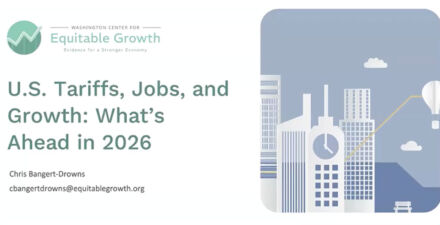
Equitable Growth event covers tariffs, tariff uncertainties, and the limits of U.S. trade policy

Tax & Macroeconomics
post

Congressional Republicans’ budget bill is the most regressive in at least 40 years

Tax & MacroeconomicsInequality & MobilityFamilies

Explore Content in Tax & Macroeconomics1266

Reset
post

Taxing wealth by taxing investment income: An introduction to mark-to-market taxation

Tax & Macroeconomics
grant

Does inflation inequality matter for monetary policy?

Tax & Macroeconomics
TOPICS: Monetary Policy
grant

The missing intercept: A sufficient statistics approach to general equilibrium effects

Tax & Macroeconomics
TOPICS: Monetary Policy
grant

How does capital investment affect workers? Evidence from bonus depreciation and matched employer-employee data

Tax & Macroeconomics
grant

Market design responses to inequality

Tax & Macroeconomics
TOPICS: Monetary Policy
post

Perceived fiscal space and the case for automatic stabilizers

Tax & Macroeconomics
post

Neither history nor research supports supply-side economics

Tax & Macroeconomics
post

Research and resources on the 2020 presidential debate issues and themes

CompetitionFamiliesInequality & MobilityLaborTax & Macroeconomics
post

Why it’s important to pay attention to distributional consequences of economic policies

Inequality & MobilityTax & Macroeconomics
post

Wealthier individuals receive higher returns to wealth

Tax & MacroeconomicsInequality & Mobility
working paper

Demographic Origins of the Startup Deficit

Tax & Macroeconomics
post

Inflation inequality in the United States is due to imbalanced product innovation

CompetitionLaborTax & Macroeconomics

Book

Recession Ready

Recession Ready

Edited by Heather Boushey, Ryan Nunn, and Jay Shambaugh

Read More

Experts on the issue

Guest Author

Mark Cooper

Consumer Federation of America

Learn More
Steering Committee

Karen Dynan

Harvard University

Learn More
Grantee

Stephanie Chapman Weishaar

Cornerstone Research

Learn More
Grantee

Gordon Phillips

Dartmouth College

Learn More
Grantee

Christian Moser

Columbia University

Learn More
Connect with us!

Explore the Equitable Growth network of experts around the country and get answers to today's most pressing questions!

Get in Touch