Must-Read: Felix Salmon: Annals of Dubious Research, 401(k) Loan-Default Edition

Must-Read: I have a huge amount of respect for the analytical abilities of Bob Litan and Felix Salmon–and for Elizabeth Warren, Jane Dokko, and Gary Burtless:

Felix Salmon (2012): Annals of Dubious Research, 401(k) Loan-Default Edition: “Remember that this is a paper written by the CFO of Custodia Financial…

…someone who clearly has a dog in this…. Smart’s interest [is] to make the loan-default total look as big as possible, since the bigger the problem, the more likely it is that Congress will agree to implement Custodia’s preferred solution. But when Litan and Singer looked at Smart’s paper, they weren’t happy going with his $6 billion figure. Indeed, as we’ve seen, their paper comes up with a number six times larger. So if even the CFO of Custodia only managed to estimate defaults at $6 billion, how on earth do Litan and Singer get to $37 billion?… They double the total amount of 401(k) loans outstanding, from $52 billion to $104 billion. Then, they massively hike the default rate on those loans, from 9.6% to 17.9%. And finally, they add in another $12 billion or so to account for the taxes and penalties that borrowers have to pay when they default on their loans. It’s possible to quibble with each of those changes–and I’ll do just that…. But it’s impossible to see Litan and Singer compounding all of them, in this manner, without coming to the conclusion that they were systematically trying to come up with the biggest and scariest number they could possibly find. It’s true that whenever they mention their $37 billion figure, it’s generally qualified with a “could be as high as” or similar. But they knew what they were doing, and they did it very well.

When the Chicago Tribune and the LA Times say in their headlines that 401(k) loan defaults have reached $37 billion a year, they’re printing exactly what Custodia and Litan and Singer wanted them to print. The Litan-Singer paper doesn’t exactly say that defaults have reached that figure. But if you put out a press release saying that “the leakage of funds in 401(k) plans due to involuntary loan defaults may be as high as $37 billion per year”, and you don’t explain anywhere in the press release that “leakage of funds” means something significantly different to–and significantly higher than–the total amount defaulted on, then it’s entirely predictable that journalists will misunderstand what you’re saying and apply the $37 billion number to total defaults, even though they shouldn’t.

But let’s backtrack a bit here. First of all, how on earth did Litan and Singer decide that the total amount of 401(k) loans outstanding was $104 billion, when the Department of Labor’s own statistics show the total to be just half that figure?…

Robert Litan and Hal Singer: Good Intentions Gone Wrong: The Yet‐To‐Be‐ Recognized Costs of the Department Of Labor’s Proposed Fiduciary Rule: “The Department of Labor (DOL) fiduciary rule has been justified based on economic analyses by the DOL and the Council of Economic Advisers (CEA) that are flawed…

…and filled with internal contradictions. These flaws come mostly from “cherry picking” and misreading the relevant economic literature, and from ignoring significant costs to millions of small savers that the rule would impose…. The DOL’s Regulatory Impact Analysis (RIA) thus concludes erroneously that the net benefit of the rule would be roughly $4 billion per year (the CEA, making related errors, pegs the benefit at $17 billion). A conservative assessment of the rule’s actual economic impact–taking into account the categories of harm noted above that are ignored by DOL and CEA–finds that the cost of depriving clients of human advice during a future market correction (just one of the costs not considered by DOL) could be as much as $80 billion, or twice the claimed ten‐year benefits that DOL claims for the rule….

Depriving clients of human advice during a future market correction could be as much as $80 billion…. The decision to stay invested (or not) during times of market stress swamps the impact of all other investment factors affecting long‐term retirement savings, including modest differences in advisory fees or investment strategies. “Robo‐advice”… cannot effectively perform this critical role. (An email or text message in the fall of 2008, for example, would not have sufficed to keep millions of panicked savers from selling, with devastating consequences for their nest eggs)….

The DOL… wagers the welfare of millions of Americans on the mistaken notion that ending commission‐based compensation is better for small savers than assuring them continued access to human financial advice through an affordable and time‐tested model…. A less costly alternative that would meet the DOL’s objectives would be to require enhanced but simple disclosures relating to brokers’ compensation from companies sponsoring investment products they sell…

Elizabeth Warren: Letter to Strobe Talbott: ”I am concerned about financial conflicts of interest…

…in a recent study authored by one of your nonresident Senior Fellows, Dr. Robert L. Litan…. Other Brookings-affiliated researchers raised concerns… that appeared to be directed at Dr. Litan’s work…. Dr. Litan’s study… contained a broad but vague disclosure, stating that “funding for this study was provided by the Capital Group”…. I asked Dr. Litan additional questions for the record…. The Capital Group commissioned… the study… paid $85,000… no other entity provided financial support…. Lita asserted that “the conclusions are our own”. However, he also noted that “The Capital Group provided us with feedback and some editorial comments”…. This statement appears to be inconsistent with Dr. Litan’s testimony before the Senate that “Dr. Singer and I are solely responsible for the analysis”….

These disclosures are highly problematic…. They raise significant questions about the impartiality of the study and its conclusions, and about why a Brookings-affiliated expert is allowed to use that affiliation to lend credibility to work that is both highly financially compensated and editorially compromised by an industry player seeking a specific conclusion, and has been implicitly criticized by the Institution’s own in-house scholars as bought and paid for research lacking in merit…

Jane Dokko: Caveat emptor: Watch where research on the fiduciary rule comes from | Brookings Institution: “To no surprise, those benefiting from current practices…

…have paid for research to try to discredit the proposed rule. Such research claims that people don’t lose as much money from biased advice as careful, independent research has shown. Research not funded by special interest groups concludes that when they are paid to recommend certain financial products over others, advisors tilt their recommendations so that they receive higher pay. In other words, advisors respond to financial incentives just like the rest of us. Such biased advice hurts savers by lowering returns and by increasing fees. Independent research must generally undergo an anonymous review process before publication. Studies funded by special interests need not face such scrutiny. When it is to their advantage, they may use analytic techniques that would not be accepted in academic research, draw inaccurate inferences, use inappropriate data, or selectively report the results. In addition to denying the harm of biased advice, critics of the regulation pivot and allege that the Department of Labor has not crafted the right solution to a problem whose existence they initially denied…

Gary Burtless: Financial Advice for Retirement Savers: Paying for Advice without a Conflict of Interest: “The proposed DOL rule would change the legal standard that applies to most financial advisors….

…Presently, most advisors are subject to a ‘suitability’ standard in giving advice to their clients. This requires advisors to understand their clients’ financial situation and to recommend investments that are suitable for that situation. The DOL proposes to subject advisors to a tougher ‘fiduciary standard’… [which] requires advisors to put their clients’ financial interests first…. As noted by the Council of Economic Advisors in a report describing the effects of advisers’ conflicts of interest, there is abundant evidence that some conflicted advisors recommend investments that are remunerative to the advisor but that reduce the expected return obtained by clients. The research showing the adverse effects of conflicts of interest on advisors’ recommendations and retirement savers’ decisions is extensive and persuasive.

A counter-argument to imposing a fiduciary standard on all advisors is that the commission system, which creates adverse incentives for advisors, is necessary in order to pay for financial advice to retirement savers… [that] even conflicted advice is better than no advice at all. This claim does not seem terribly compelling. There are alternative ways to compensate financial advisors that do not create an obvious conflict…. For a large percentage of the workers who have accumulated little savings, the best financial advice is often the simplest: Save as much as you can afford, and invest the bulk of your retirement savings in a low-cost target-date retirement fund that is appropriate given your age and tolerance for risk. It should not require a hefty commission to offer this advice.

Must-Read: Jared Bernstein: September Jobs

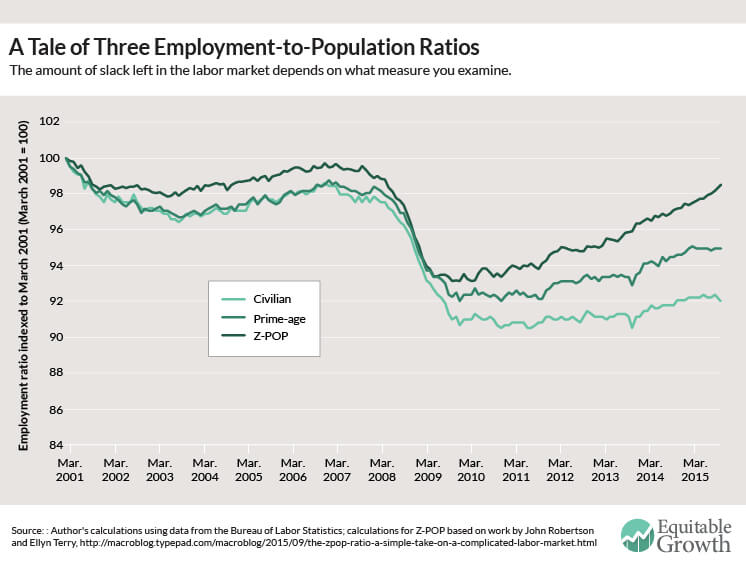
Must-Read: Jared Bernstein talks about the firm establishment survey, but there is also information in this month’s employment release from the household survey. The employment-to-population ratio is now back to 59.2%–a level it reached last October. No progress in raising the anemic and disappointing share of Americans with jobs in 11 months:

Civilian Employment Population Ratio FRED St Louis Fed

Now some of this is demography: the aging of the very-large baby-boom generation into retirement. But not much of it is demography: since 2000, the total employment-to-population rate has fallen at a faster pace than the prime-aged rate, but that faster pace is only 0.07%/year faster:

Graph Employment Rate Aged 25 54 All Persons for the United States© FRED St Louis Fed
Jared Bernstein: September Jobs: “Someone asked me the other day what the Fed would have to see…

…in this jobs report to make their mind up one way or the other about a rate hike in either their October or December meeting. The answer is: no one report could have that effect. If the report was a large outlier… it would be considered… um… a large outlier. If it was somewhat off trend, like today’s report, it would raise eyebrows…. If… suspicion is reinforced by the next two jobs reports, the Fed will very likely incorporate that into their evaluation at their December meeting and hold their target rate near zero…. ‘High-frequency’ data is but a dot on a painting by Georges Seurat. It’s not enough by itself to paint a picture of what’s going on in the job market, but if you combine it with a bunch of other dots, you may be onto something.

Where is the U.S. labor market recovery for prime-age workers?

The weak employment and earnings growth—reported today by the U.S. Bureau of Labor Statistics—shows that the labor market is still recovering from the shocks of the Great Recession. After six full years of consecutive monthly employment growth beginning in October 2010, when the labor market stopped contracting, employment rates for prime-age workers ages 25 to 54 are still low, and wage growth is not fast enough to reverse worsening income inequality.

Nominal wages grew 2.2 percent compared to a year ago, before adjusting for inflation, and at the same rate over the past three months. Although monthly data can be noisy, the lack of clear signs that wage growth is accelerating bolsters the case for the Federal Reserve to continue to wait to raise its benchmark interest rate. An additional recent concern is that wage growth for production and nonsupervisory workers—those who generally make up the bottom 80 percent of the labor market—has begun to see slower wage growth, at a rate of 1.9 percent compared to last year.

If overall nominal wage gains do not exceed annual increases of 3.5 percent then income inequality will tend to rise. Below this rate, real (inflation-adjusted) wage growth is likely to fall behind long-run productivity growth of about 1.5 percent, assuming the Federal Reserve’s inflation target of 2.0 percent. The current slow rates of nominal wage growth help to guarantee that national income will continue to shift away from labor and toward the owners of capital.

The establishment survey data also show that the economy added 142,000 jobs in September, with gains of about 36,400 in health care industries. After revisions to prior months’ data, further reducing estimates of employment growth in August, the economy has added jobs over the past three months at a slow monthly pace of 167,000. With this job growth, the economy increased the size of the employed workforce by only 1.2 percent last month at an annual rate, and by 1.9 percent compared to a year ago. These rates of job gains compare poorly to the faster growth one would expect a vigorous recovery to deliver. Just three years after the 1990-1991 recession, for example, annual employment growth exceeded 3 percent for more than one year straight.

Indeed, compared to prior business cycles, the labor market recovery has been especially weak when judged by the performance of employment rates for those in their prime working years, ages 25 to 54. From 1953 to 1990, the U.S. economy experienced seven business cycles, where the employment-to-population ratio for prime-age workers fell during a recession but then recovered to the level experienced just prior to the recession in less than three years on average. (See Figure 1.)

Figure 1

U.S. employment has not recovered for prime-age workers

After the recession beginning in 1990, the labor market for prime-age workers recovered more slowly, taking about five years to reach its prior employment rate. During the past two business cycles, the prime-age employment rate never fully recovered. The shift toward longer and incomplete labor market recoveries is inconsistent with the Federal Reserve’s mandate to promote full employment and coincides with the reluctance of using fiscal policy to reverse economic contractions.

Current employment rates for the prime working-age population are insufficient for ensuring satisfactory wage growth, even after six years of recovering from the Great Recession. Without a tight labor market, employees have lower bargaining power and employers have less incentive to raise wages in order to retain and recruit workers. Over the past 25 years, wages for production and nonsupervisory workers reliably grew at healthy rates of 3.5 to 4.5 percent only when the employed share of the prime-age population exceeded 79 percent. The current prime-age employment rate of 77.2 percent, which has stayed roughly the same over the entire course of this year, will continue to make it difficult for workers to obtain sustained, economically meaningful wage gains.

What happened to the job ladder in the 21st century?

The job ladder, Veer.com

A few weeks ago, we published an analysis showing that the lowest-paying industries saw the largest increases in workers with a college degree between 2000 and 2014. Today, we follow that up by showing that the pattern is similar among young workers ages 19 to 34 (as opposed to workers with a college degree), but with one big difference—the oil, gas, and mining resource extraction and refining industries, which pay relatively well, saw a substantial increase in the share of young workers hired.

Considered alongside our previous results, this new analysis implies that resource extraction and refining industries provided an outlet for young workers without college degrees to attain well-paying employment. These industries profited from the development of hydraulic fracturing and other new technologies, as well as a worldwide boom in demand for natural resources that seems to have reversed since late 2014.

Figure 1

But these young adults working in the high-paid extraction and refining sectors obscures the larger picture of the U.S. job ladder: Outside those industries, young workers are increasingly being hired into low-paying ones. That is important to document because, as we discussed in our previous column, the education level for most workers in the U.S. Census Bureau’s Quarterly Workforce Indicators database is imputed rather than observed directly—and that imputation is potentially faulty since it is based on the 2000 Census. In contrast, the age of workers is observed directly for the vast majority of workers.

Figure 2

Looking at the share of young workers hired in each quarter between 2000 and 2014 yields further insight, which our colleague Kavya Vaghul discussed in part in her column last week on the impact of student debt on economic security. It divides industries into thirds based on their average earnings in 2000, then traces the share of hires in each industry that went to young workers. The share of young workers hired in high-paying industries shrank right at the onset of the Great Recession, while in its aftermath that share grew in low-paying ones. (See Figure 3.)

Figure 3

These findings are consistent with previous findings on the evolution of the job ladder during and after the Great Recession of 2007-2009, though our analysis indicates that the job ladder had already started deteriorating even before that, following the recession of the early 2000s.

The labor market has always been characterized by what economists call a “last in/first out” or “last hired/first fired” structure, meaning that workers who are laid off during recessions are generally those with the shortest job tenure, many of whom tend to be young. We also know that high-paying firms exhibited the greatest decline in hiring during the Great Recession. In combination, these two patterns imply that young adult workers disproportionately lost out at high-paying firms and industries, which is what the darkest green line in Figure 3 shows.

Following the Great Recession, employment grew most in low-wage jobs, so that is where young adults entering the workforce could find work—even if they had a college education. And because the high-wage firms and industries aren’t hiring, many of these workers are stuck in low-wage jobs. That failure of the job ladder portends dire consequences for young workers’ lifetime earnings since the peak years for job-switching and wage growth are the early ones. If these workers do not find opportunities to climb, then they will potentially be stuck on the lower income rungs for the rest of their lives.

Appendix

The construction of the U.S. Census Bureau’s Quarterly Workforce Indicators, the data from which these charts are constructed, is discussed in the appendix to our previous column. To make these charts on young adult workers’ share of hires, we define “young adult workers” as QWI age groups 2, 3, and 4 (comprised of workers ages 19 to 34), and we exclude groups 1 (ages 14 to 18) and 8 (ages 65 to 99) from the analysis entirely. Industry average earnings of full-quarter hires in 2000, or EarnHiraS, are deflated to 2014 dollars using the U.S. Consumer Price Index for all Urban Consumer, or CPI-U. When industries are divided into thirds according to earnings levels in Figure 3, the three groups are weighted by employment so that each group corresponds to approximately one third of the total U.S. workforce.

The observations excluded between Figures 1 and 2 are the North American Industrial Classification System (three-digit) industries 211 (Oil and Gas Extraction), 212 (Mining except Oil and Gas), 213 (Support Activities for Mining), and 324 (Petroleum and Coal Products Manufacturing, including Oil Refineries).

Must-Read: Charles Evans: Thoughts on Leadership and Monetary Policy

Must-Read: Three people so far have told me that Chicago Fed President Charlie Evans’s “Leadership” speech is superb, and the kind of speech that the Fed Chair really ought to be giving these days–what with 10-year Treasury rates kissing 2%/year and the 10-year inflation breakeven below 1.5%/year:

Graph 10 Year Treasury Constant Maturity Rate FRED St Louis Fed

Charles Evans: Thoughts on Leadership and Monetary Policy: “Sometime during the gradual policy normalization process…

…inflation begins to rise too quickly. Well, we have the experience and the appropriate tools to deal with such an outcome. Given how slowly underlying inflation would likely move up from the current low levels, we probably could keep inflation in check with only moderate increases in interest rates relative to current forecasts. And given how gradual the projected rate increases are in the latest SEP, the concerns being voiced about the risks of rapid increases in policy rates if inflation were to pick up seem overblown.

Furthermore, as I just outlined, there is no problem in moderately overshooting 2 percent. After several years of inflation being too low, a modest overshoot simply would be a natural manifestation of the Federal Reserve’s symmetric inflation target. Moreover, such an outcome is not likely to raise the public’s long-term inflation expectations either — just look at how little these expectations appear to have moved with persistently low inflation readings over the past several years. So, I see the costs of dealing with the emergence of unexpected inflation pressures as being manageable.

All told, I think the best policy is to take a very gradual approach to normalization. This would balance both the various risks to my projections for the economy’s most likely path and the costs that would be involved in mitigating those risks.”

Things to Read on the Afternoon of October 1, 2015

Must- and Should-Reads:

Might Like to Be Aware of:

Must-Read: Atif R. Mian, Amir Sufi, and Emil Verner: Household Debt and Business Cycles Worldwide

Must-Read: Atif R. Mian, Amir Sufi, and Emil Verner: Household Debt and Business Cycles Worldwide: “A rise in the household debt to GDP ratio predicts lower output growth…

…and higher unemployment over the medium-run, contrary to standard macroeconomic models. GDP forecasts by the IMF and OECD underestimate the importance of a rise in household debt to GDP, giving the change in household debt to GDP ratio of a count… A rise in household debt to GDP is associated contemporaneously with a rising consumption share of output, a worsening of the current account balance, and a rise in the share of consumption goods within imports. This is followed by strong external adjustment when the economy slows as the current account reverses…. The pre-2000 predicted relationship between global household debt changes and subsequent global growth matches closely the actual decline in global growth after 2007 given the large increase in household debt during the early to mid-2000s.

Must-Read: George P. Topulos et al.: Planned Parenthood at Risk

Must-Read: The most surprising thing about all this–or maybe, come to think about it, given the goals of the players, it should not surprise me at all–is that, given our current Supreme Court and its legal structure, a world in which the federal government is prohibited from funding Planned Parenthood services is a world in which the abortion rate is significantly higher than it is today…

George P. Topulos et al.: Planned Parenthood at Risk: “Planned Parenthood is under attack–again…

…This time, a campaign of misinformation about the retrieval of fetal tissue used in research and therapy is the excuse. When women have made the decision to terminate a pregnancy, Planned Parenthood allows them the opportunity to have the fetal tissue that would otherwise be discarded be used by qualified researchers to help answer important medical questions. The organization does so carefully, following all applicable laws and ethical guidelines. In a Perspective article now published in the Journal, Charo presents compelling arguments defending these uses of fetal tissue.

Planned Parenthood, its physicians, and the researchers who do this work should be praised, not damned. The research is not easy to do, but as Charo explains, it has benefited millions of people worldwide. If the antichoice forces were allowed to rule the day, these advances would never have been made.

We strongly support Planned Parenthood not only for its efforts to channel fetal tissue into important medical research but also for its other work as one of the country’s largest providers of health care for women, especially poor women. In 2013, the most recent year for which data are available, Planned Parenthood provided services to 2.7 million women, men, and young people during 4.6 million health center visits. At least 60% of these patients benefited from public health coverage programs such as the nation’s family-planning program (Title X) and Medicaid. At least 78% of these patients lived with incomes at or below 150% of the federal poverty level. Planned Parenthood’s services included nearly 400,000 Pap tests, nearly 500,000 breast examinations, nearly 4.5 million tests for sexually transmitted illnesses (including HIV), and treatments. The contraception services that Planned Parenthood delivers may be the single greatest effort to prevent the unwanted pregnancies that result in abortions.

It is shameful that a radical antichoice group whose goal is the destruction of Planned Parenthood continues to twist the facts to achieve its ends. We thank the women who made the choice to help improve the human condition through their tissue donation; we applaud the people who make this work possible and those who use these materials to advance human health. We are outraged by those who debase these women, this work, and Planned Parenthood by distorting the facts for political ends.

Albert Hirschman’s linkages, economic growth, and convergence yet again…

When you think about it, broadly speaking, the question of why we have seen such huge rises in the real wages of labor–of bare, unskilled labor not boosted by expensive and lengthy investments in upgrading what it can do–is somewhat puzzling.

We can see why overall productivity-per-worker has increased. We have piled up more and more machines to work with per worker, more and more structures to work in per worker, and develop more and more intellectual blueprints for how to do things. But why should any of these accumulated factors of production be strong complements for simple human labor?

Karl Marx thought that they would not: he thought that what more accumulation of capital would do would be to raise average production-per-worker while also putting strong downward pressure on the wages and incomes of labor, enriching only those with property. Yet the long sweep of history since the early 18th century invention of the steam engine sees the most extraordinary rise in the wages of simple, unskilled labor.

There are, again broadly speaking, two suggested answers:

The first is that the accumulated intellectual property of humanity since the invention of language is a highly productive resource. Nobody can claim an income from it by virtue of ownership. Therefore that part of productivity due to this key factor of production is shared out among all the other factors. And, via supply and demand, a large chunk of that is shared to labor.

The second is that there is indeed a property of the unskilled human that makes its labor a very strong complement with other factors of production. That property is this: our machines are dumb, while we are smart. Human brain fits in a breadbox, draws 50 W of power, and is an essential cybernetic control mechanism for practically everything we wish to have done, to organize, or even to keep track of. The strong and essential complementarity of our dumb machines and our smart brains is the circumstance that has driven a huge increase in labor productivity in manufacturing. And, by supply and demand, that increase has then been distributed to labor at large.

Both have surely been at work together.

But to the extent that the second has carried the load, the rise of the robots—the decline in the share of and indeed the need for human labor in manufacturing—poses grave economic problems for the future of humanity, and poses them most immediately for emerging market economies.

So let me give the mic to smart young whippersnapper Noah Smith, playing variations on a theme by Dani Rodrik:

Noah Smith: Will the World Ever Boom Again?: “Let’s step back and take a look at global economic development…

…Since the Industrial Revolution… Europe, North America and East Asia raced ahead… maintained their lead… confound[ing] the predictions of… converg[ance]. Only since the 1980s has the rest of the world been catching up…. But can it last? The main engine of global growth since 2000 has been the rapid industrialization of China… the most stupendous modernization in history, moving hundreds of millions of farmers from rural areas to cities. That in turn powered the growth of resource-exporting countries such as Brazil, Russia and many developing nations that sold their oil, metals and other resources to the new workshop of the world.  The problem is that China’s recent slowdown from 10 percent annual growth to about 7 percent is only the beginning….

But… what if China is the last country to follow the tried-and-true path of industrialization? There is really only one time-tested way for a country to get rich. It moves farmers to factories and import foreign manufacturing technology… the so-called dual-sector model of economic development pioneered by economist W. Arthur Lewis. So far, no country has reached high levels of income by moving farmers to service jobs en masse…. Poor nations are very good at copying manufacturing technologies from rich countries. But [not] in services…. Manufacturing technologies are embodied in the products themselves and in the machines… used to make the products…. Manufacturing is shrinking… all across the globe, even in China… a victim of its own success…. If manufacturing becomes a niche activity, the world’s poor countries could be in trouble…

By “a niche activity” I read “does not employ a lot of workers”–the value added of manufacturing is likely to still be very high and growing, certainly in real terms, just as the value of agricultural production is very high and growing today. But little of that value flows to unskilled labor. Rather, it flows to capital, engineering, design, and branding.

Noah’s points about economic development are, I think, completely correct.

The point is, however, one of very long standing. The mandarins of 18th-century Augustine Age Whitehall had a plan for the colony that was to become the United States. They were to focus on their current comparative advantages: produce, I’m slave plantations and elsewhere, the natural Reese source intensive primary products that the first British Empire wanted in exchange for the manufactured goods and transportation services the first British Empire provided that made it so relatively ridge for its time.

Alexander Hamilton had a very different idea. Hamilton believed very strongly that the US government needed to focus on building up manufacturing, channels through which savings be invested in industry, and exports different from those of America’s resource-based comparative advantage. The consequence would be the creation of engineering communities of technological competence which would then spread knowledge of how to be productive throughout the country. Ever since, every country that has successfully followed the Hamiltonian path–that is kept its manufacturing- and export-subsidization policies focused on boosting those firms that do actually succeed in making products foreigners are willing to buy and not havens for rent-seekers–have succeeded first in escaping poverty and second in escaping the middle-income trap.

The worry is the China will turn out to be the last economy able to take this road–that after China manufacturing will be simply too small and require too little labor as computers substitute for brains as cybernetic control mechanisms to be an engine of economy-wide growth. And the fear is that a country like India that tries to take the services-export route will find that competence in service exports does not more than competence in natural-resource exports to produce the engineering communities of technological competence which generate the economy-wide spillovers needed for modern economic growth that achieves the world technological and productivity frontier.

Very interesting times. Very interesting puzzles.

Health Economists’ Keep-the-Cadillac-Tax Letter

Sarah Kliff on Twitter Letter defending Cadillac Tax from 101 economists reimagined with 101 Dalmatians http t co PP6td0zgDo

Health Economists’ Keep-the-Cadillac-Tax Letter:

October 1, 2015

The Honorable Orrin G. Hatch Chairman
Committee on Finance
United States Senate

The Honorable Paul D. Ryan Chairman
Committee on Ways and Means
U.S. House of Representatives

The Honorable Ron Wyden Ranking Member
Committee on Finance
United States Senate

The Honorable Sander M. Levin Ranking Member
Committee on Ways and Means
U.S. House of Representatives

Dear Chairman Hatch, Senator Wyden, Chairman Ryan, and Congressman Levin:

For decades economists and health policy experts of all political persuasions have agreed that the unlimited exclusion of employer-financed health insurance from income and payroll taxes is economically inefficient and regressive. The Affordable Care Act established an excise tax on high- cost health plans (the so-called ‘Cadillac tax’) to address these issues.

The Cadillac tax will help curtail the growth of private health insurance premiums by encouraging employers to limit the costs of plans to the tax-free amount. The excise tax will discourage the provision of insurance that covers such a large proportion of health care spending that consumers have little incentive to insist on cost-effective care and providers have little incentive to provide
it. As employers redesign health insurance plans to hold costs within the tax-free amount, cash wages or other fringe benefits will increase. Furthermore, repealing the Cadillac tax would add directly to the federal budget deficit, an estimated $91 billion over the next decade according to the Joint Committee on Taxation.

We, the undersigned health economists and policy analysts, hold widely varying views on other provisions of the Affordable Care Act, and we recognize that measures other than the Cadillac tax could have been used to restrict the open-ended health insurance tax break.

But, we unite in urging Congress to take no action to weaken, delay, or reduce the Cadillac tax until and unless it enacts an alternative tax change that would more effectively curtail cost growth.

Sincerely,

Henry Aaron Jason Abaluck David Albouy Joseph Antos Alan Auerbach Nikhil Agarwal Laurence Baker Martin Baily Ernst Berndt Linda Blumberg Thomas Buchmueller M. Kate Bundorf Leonard Burman Gary Burtless Stuart Butler Amitabh Chandra Michael Chernew Julie Berry Cullen David Cutler Leemore Dafny Patricia Danzon Angus Deaton Brad DeLong Peter Diamond Avi Dor Bryan Dowd Mark Duggan Susan Dynarski David Ellwood Douglas Elmendorf Ezekiel Emanuel Michael Frakes Austin Frakt John Friedman Donald Fullerton William Gale Martin Gaynor Paul Ginsburg Sherry Glied Lawrence Goulder Jonathan Gruber Gautam Gowrisankaran Ben Handel Ron Haskins Kate Ho John Holahan Jill Horwitz Hilary Hoynes
Robert Huckman Robert Inman Damon Jones Lawrence Katz Melissa Kearney Jenny Kenney Jonathan Kolstad Darius Lakdawalla Robin Lee Arik Levinson Frank Levy Helen Levy Erzo F.P. Luttmer Pinar Karaca Mandic Eric Maskin Thomas McGuire Ellen Meara David Meltzer Bruce Meyer Marilyn Moon Fiona Scott Morton Adriana Lleras-Muney Alicia Munnell Len Nichols Kavita Patel Mark Pauly Harold Pollack Daniel Polsky James Rebitzer Robert Reischauer Alice Mitchell Rivlin Christopher Ruhm Andrew Samwick Douglas Shackelford Louise Sheiner Kosali Simon Kent Smetters Neeray Sood Mark Stabile Amanda Starc Eugene Steuerle Katherine Swartz Richard Thaler Robert Town Paul Van de Water Tom Vogl Kevin Volpp Gail Wilensky Roberton Williams David Wise Justin Wolfers Richard Zeckhauser Stephen Zuckerman + MANY MOAR…