
Economic research shows immigration is good for U.S. workers, the economy, and affordability

Key takeaways:
- Immigrants to the United States are essential to U.S. economic growth. Immigrants are integral to U.S. history and cultural identity. They support a vibrant U.S. economy as workers, consumers, taxpayers, inventors, and entrepreneurs.
- Immigrants fill both low-skilled jobs that complement native-born U.S. workers and high-skilled jobs where domestic supply falls short of demand, boosting employment and productivity for their native-born counterparts. Negative employment impacts are limited to some lower-skilled native workers, including teenagers.
- Indiscriminate deportation efforts hurt native-born U.S. taxpayers twice—first through the direct expense of removal operations and expanded enforcement, and again through the loss of tax revenues and economic activity that immigrants contribute to the United States. Immigrant workers, particularly undocumented immigrants, on average pay more in taxes than they receive in public benefits, contributing a net positive to federal finances.
- Reduced immigration contributes to labor shortages, driving inflationary pressures as the supply of immigrant-dependent goods and services shrinks. Prolonged delays and cancellations of visa appointments and an end to Temporary Protected Status protections will worsen the affordability crisis facing all U.S. workers.
- What this means for growth: Indiscriminate immigration restrictions or large-scale deportation efforts will shrink the U.S. economy and hurt native-born and immigrant residents alike.
Overview
When President Donald Trump returned to the White House in 2025, mass deportations and immigration restrictions were renewed as one of the political priorities of his second administration. Since then, net migration has dwindled from 2.7 million in 2024 to an expected 321,000 in 2026 according to U.S. Census Bureau estimates. Proponents of stringent immigration restrictions and enforcement say fewer immigrants will translate into more economic opportunities for native-born U.S. workers. Political science research suggests personal economic hardships may be a driver of anti-immigrant sentiments among native-born and incumbent immigrant workers. Paradoxically, years of economic research shows that immigration has little to no negative effect and even some positive effect on employment for native-born workers, provides a net positive to long-run public finances, and spurs overall U.S. economic growth.
Indeed, reducing immigration may lead to the opposite of its proponents’ desired economic effects. Early evidence suggests the recent expansion in immigration enforcement has worsened inflation in product categories more reliant on immigrant labor while failing to produce promised employment and wage gains for native-born workers. And a recent U.S Supreme Court decision has opened the door for the Trump administration to cancel Temporary Protected Status for an estimated one million more immigrants, threatening not only those individuals and their families but also the economic health of communities across the country.
Washington College professor emeritus Robert Lynch, a former visiting scholar for the Washington Center for Equitable Growth, and his coauthor Michael Ettlinger, founder of the Carsey School of Public Policy at the University of New Hampshire, have compiled extensive economic research on the historic impacts of immigration, and complemented it with original research on the contemporary expansion of immigration enforcement. Their work, and the substantial research they reference, is summarized in this article.
Before this summary, it also is worth noting the 2017 National Academies consensus report on the economic and fiscal impacts of immigration in the United States, which finds that immigration policies cannot be decided on economic grounds alone. While the National Academies report finds that immigrants’ contributions are essential to long-run economic growth, it also highlights immigrants as drivers of broad national resilience who enrich their communities through “high aspirations, strong families, and a strong work ethic.”
U.S. economic growth
Immigrants, including those undocumented, contribute to the U.S. economy as workers, consumers, taxpayers, inventors, and entrepreneurs. Economic literature on the subject agrees that more immigration increases the U.S. labor force, enhances productivity, and grows the economy, while deportations not only hurt immigrant communities and related industries but also are contractionary for the broader economy.
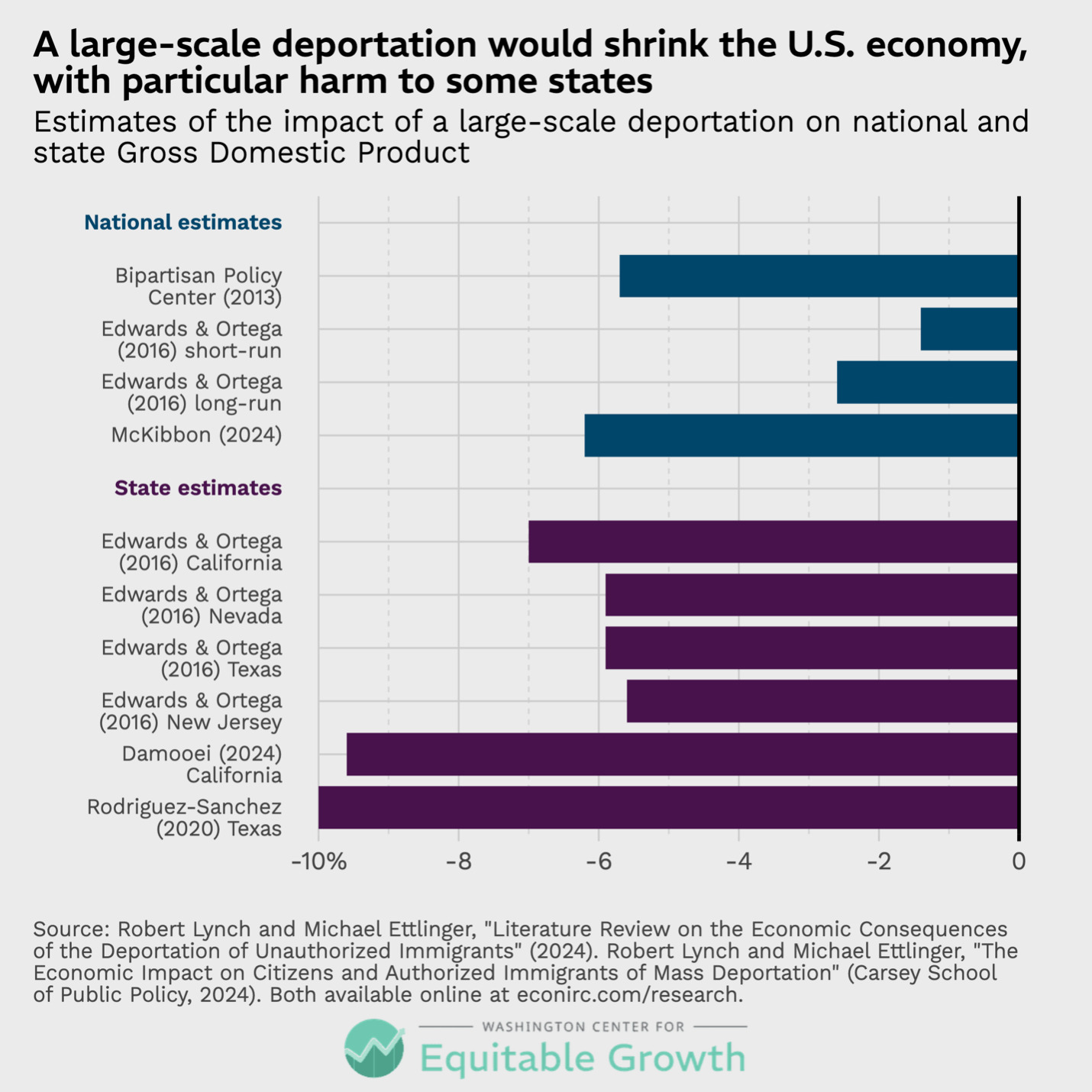
In their 2024 literature review, Lynch and Ettlinger cite a recent report by the nonpartisan Congressional Budget Office that increased its official projections of long-run GDP growth by $7 trillion to account for an estimated increase in immigration. Conversely, a mass deportation on the scale advocated by the Trump administration could permanently shrink the U.S. economy by as much as 6 percent by contracting labor markets, weakening consumer demand, and reducing the supply of goods and services from immigrant-dependent industries. (See Figure 1.)
Figure 1
U.S. jobs and incomes
Arguments in favor of stringent immigration—that less immigration will mean more opportunities for native-born workers—rely on the faulty premise that immigrants and native-born workers compete for the same jobs as close substitutes for each other’s work. Economic evidence suggests the opposite. Frequently, immigrants work in jobs that are complementary to native-born workers, supporting employment for those workers rather than taking away opportunities.
A native-born engineer, architect, plumber, or electrician would find fewer work opportunities if immigrant construction laborers were deported, and fewer construction projects mean fewer jobs for everyone. High-skilled immigrant workers also fill critical U.S. labor market gaps: roughly one-in-four medical doctors in the United States is foreign-born, and for some specializations such as geriatrics they constitute more than half of workers. Indeed, H-1B visa fees and country-specific travel bans pose risks to the health care sector, which has been one of the only sectors posting job growth since the start of the Trump administration.
This phenomenon of complementary work has been well-documented in economic research. One 2014 paper, for example, found that both low- and high-skilled native-born workers saw higher employment rates due to an immigration influx in the 2000s. And a 2024 paper found firms employing immigrants increased productivity, investments, and profits in nonagricultural industries, with positive impacts on native-born employment in rural areas.
Other papers examining the effects of deportations found negative impacts on native-born employment. The deportations of Mexican immigrants and U.S. citizens of Mexican descent during the Great Depression, for example, were found to decrease native-born employment, particularly among workers who held higher-skilled jobs that were previously complemented by their deported colleagues. Relatedly, the “bracero exclusion” in 1964, which removed nearly half-a-million Mexican agricultural workers, did not result in the promised boost to native-born farm wages and employment. Instead, jobs that had been previously filled by seasonal immigrant workers were either replaced by machines or eliminated entirely due to decreased domestic production.
Furthermore, because farm worker wages did not increase as expected, the remaining jobs were filled by undocumented immigrant workers, many of whom were connected to jobs through old Bracero Program networks, but without the protection of a legal pathway. A program for seasonal agricultural workers wasn’t replaced until H2-A in 1986 when the visa class was coupled with strict border controls, trapping many of the undocumented immigrant workers who had followed circular migration paths to fill agricultural jobs in the United States.
That same dynamic later made sectors reliant on immigrant labor targets of the so called Secure Communities immigration enforcement policies, which deported roughly 454,000 undocumented immigrants between 2008 and 2014. This enforcement surge was found to reduce the employment share of native-born workers, with harms concentrated among workers in sectors that relied on immigrant labor.
Economic studies in the 1990s and 2000s with a narrow regional or industry focus found some negative impacts on employment for particular subgroups of workers, including established incumbent immigrants who had been working in the United States for some time and native-born teenage workers. But on average, economic evidence shows immigrants have a null or even positive impact on native-born employment, even for low-skilled native-born workers. A seminal 1990 study by the economist David Card (now at the University of California, Berkeley) found no impact on unskilled native-born workers in Miami due to the arrival of a large Cuban refugee population during the Mariel boatlift between 1980 and 1985.
Another study by Card and economist Joseph Altonji (now at Yale University) found increases in the share of jobs held by immigrants across different cities resulted in higher job turnover for less-skilled native-born workers, but no reduction in the number of weeks worked. A separate 2015 estimate by economists Andri Chassamboulli at the University of Cyprus and Giovanni Peri (now at the University of California, Davis) suggested that decreasing the undocumented immigrant population by half through deportations would reduce employment for native-born workers of all skill levels, but especially for unskilled workers.
Similarly, evidence from Arizona found that harsh anti-immigrant laws reduced the state’s undocumented worker population by 40 percent between 2007 and 2012, resulting in decreased economic output and a 2 percentage point increase in the unemployment rate for low-skilled native-born White men in the state.
The wage effects of immigration are similar to employment effects. A reduction in immigration is associated not only with a reduction in native-born employment but also a reduction in wages for native-born and incumbent immigrant workers alike. The paper examining the Secure Communities policies, for example, found not only a reduction in native-born employment but also a decline in hourly wages and earnings for all U.S. citizens, including foreign-born residents. Another 2020 paper estimated that native-born Texans would stand to lose a total of $28.4 billion in earnings if the state were to deport all its undocumented workers.
Several papers study the earnings benefits of immigration for native-born workers, finding higher immigration contributed to wage growth for both skilled and unskilled native-born workers. A 2009 paper found that large immigration inflows pushed a significant number of lower-skilled native-born workers into higher-paying jobs that were complementary to work performed by new immigrants. A 2024 paper calculated that immigration in the first two decades of the century raised wages for less educated native workers by as much as 2.6 percent, with no effect on wages for college-educated native workers. Other papers highlighted how immigrant employment in household services freed up high-skilled native-born women to work more hours and boost their earnings, and in turn, contribute to wider U.S. economic growth.
Lynch and Ettlinger argue that, for native-born workers and the U.S. economy, the harms of deporting undocumented immigrants already in the country are likely to be greater than the harms of blocking an equal number of new immigrants. This is because while new immigrants can contribute to the economy by boosting demand, paying into public services, starting businesses, and finding work complementary to native workers, undocumented immigrants are already making those contributions, and are highly integrated into companies and workflows such that widespread deportations could cause significant disruptions in industries reliant on immigrant labor.
Indeed, early evidence discussed later in this column suggests that labor supply constraints in deportation-impacted industries is contributing to soaring prices for some products and services. In other words, halting immigration is economically harmful but deportations are even more economically harmful. While halting immigration slows growth rates and attenuates opportunity for native-born workers, widespread deportations are actively contractionary and lead to native-born job losses and supply chain snarls.
U.S. fiscal effects
Contrary to the claims of anti-immigration proponents, undocumented immigrants probably pay much more in taxes than they receive in government services, propping up public finances and extending solvency of some of the programs relied on by both native-born and naturalized U.S. citizens, as well as some documented immigrant workers and retirees who reside in the United States legally. A 2024 paper finds that undocumented immigrants pay nearly $100 billion in federal, state, and local taxes annually, with a majority going to the federal government. A 2020 paper estimated undocumented workers pay more than $140 billion in taxes annually.
Social Security and Medicare also benefit from undocumented immigration. A 2014 Social Security report found undocumented immigrants had contributed $100 billion to the program over the prior decade, even though none of those workers would likely be eligible for Social Security benefits in the future. Other papers produced similar estimates for undocumented immigrant contributions to the Medicare Trust Fund, for which undocumented workers are also ineligible to receive benefits.
A 2016 paper estimated that deporting all undocumented immigrants would cause the federal government to lose $860 billion over 10 years due to lower tax revenue as the economy contracted. Similarly, a 2022 paper finds that reductions in arrivals of refugees and asylum-seekers during the first Trump administration resulted in $2 billion lower net revenues across all levels of government. In addition to the indirect fiscal costs of deportations, enforcing a mass deportation policy would result in direct costs to taxpayers of as much as $300 billion, funds that could otherwise be spent on programs with proven returns to public investments.
Inflation and supply
Labor shortages in key industries including health care and construction have plagued the U.S. economy since the COVID-19 pandemic of 2020–2023, in large part due to a decline in immigration during the pandemic. Federal Reserve officials, including former Chair Jerome Powell, pointed to the slowdown in immigration as a partial explanation for persistent inflation in the U.S. economy immediately following the pandemic. Academic research substantiates this view: a 2024 paper estimated that a large-scale deportation effort would result in years of elevated inflation, peaking at an additional 3.1 percentage points.
Recent work by Lynch and Ettlinger highlights these same inflation dynamics in the currently ongoing immigration enforcement surge, showing declining employment and production in industries and regions reliant on immigrant labor. Undocumented workers account for large shares of employment in U.S. agriculture, which saw a steep drop off in employment in the March-July period in 2025 before the Trump Administration largely halted farm raids.
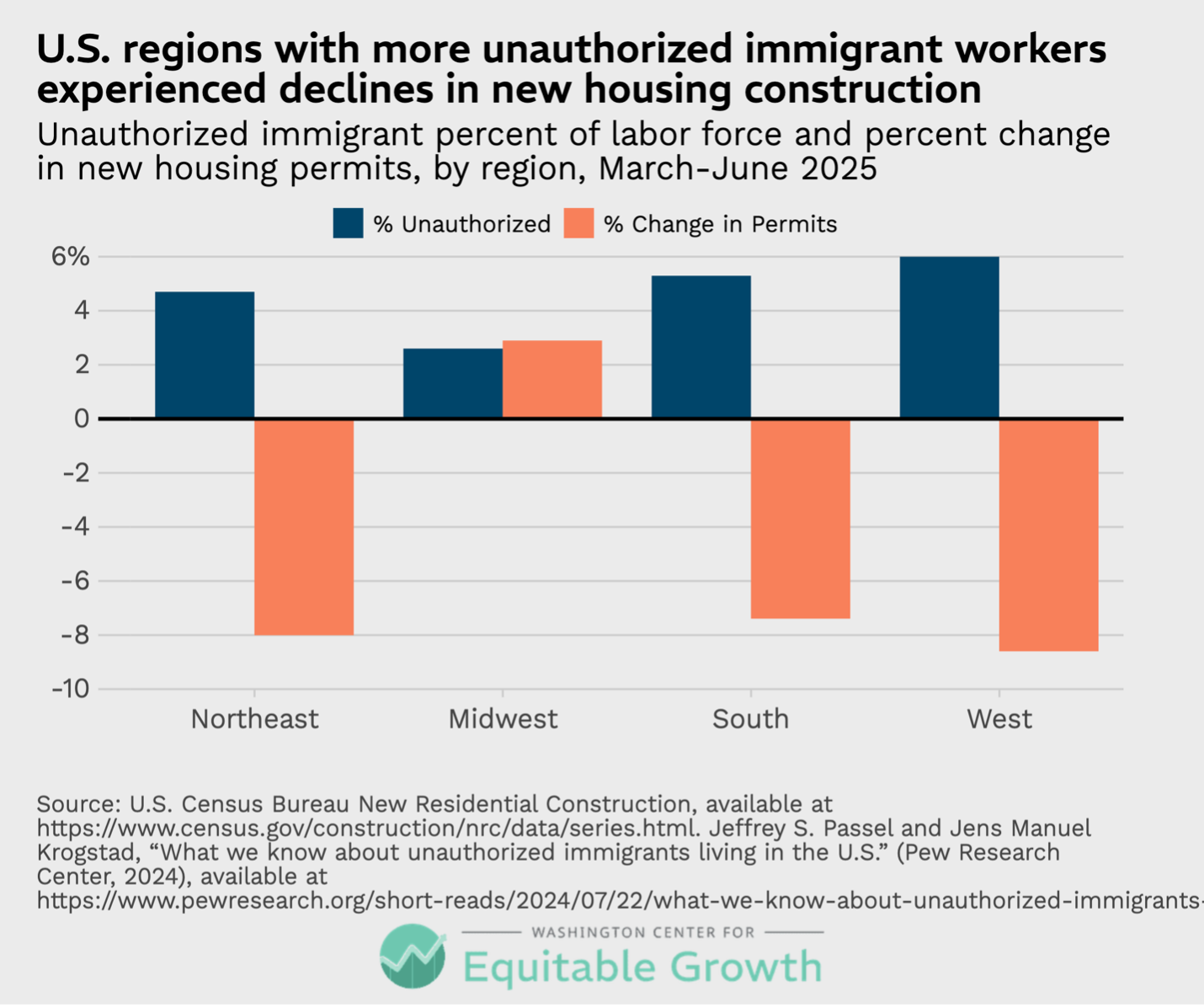
Similarly, states with the highest shares of undocumented immigrants experienced slower employment growth in the leisure and hospitality and food services sectors compared to states with lower shares. Zooming out to the regional level, U.S. residential housing permits declined significantly in the first half of 2025, but not in the Midwest where a comparatively smaller share of the total workforce is undocumented. (See Figure 2.)
Figure 2
In a July 2026 paper, Lynch and Ettlinger document rising consumer prices in industries hit hardest by expanded immigration enforcement, including gardening and lawn care services, home health care, and food production. Price increases for certain categories of domestically produced food have been accelerating far beyond baseline inflation, with lettuce surging to a 32.1 percent year-over-year increase. Apples, canned fruits and vegetables, and fresh milk have also seen far above-average price increases.
Their most recent paper also documents an increase in home health care prices of 10.7 percent in the past year alone. With immigrants comprising nearly 40 percent of the home health care workforce, any large-scale deportation effort would tighten labor supply for a service that is becoming increasingly necessary as the U.S. population ages. The recent U.S. Supreme Court decision allowing the Trump administration to end Temporary Protected Status for Haitians and Syrians could have deeply harmful impacts on this industry. Of the 1.3 million workers with Temporary Protected Status in the United States, more than 18,000 are home health care workers, including 10,000 Haitians.
A number of media reports complement the academic research, illustrating how the often- violent immigration enforcement actions have resulted in declining business activity and fewer workers for key industries. Such labor shortages contribute to price inflation as output in these industries slows without a commensurate reduction in demand. Contrary to claims that immigration restrictions and deportations would lessen price pressures, the enforcement surge, as Lynch and Ettlinger put it, is “contributing significantly to the national challenge of rising costs and decreased affordability.”
Conclusion
Years of economic research show immigration has benefitted the U.S. economy and its native-born workers, contrary to claims made by supporters of expanded immigration enforcement in the Trump administration. Increased immigration has historically supported stronger economic growth by expanding the U.S. labor force, boosting productivity for both immigrant and native-born workers, increasing profitability for domestic businesses, and strengthening consumer demand.
Conversely, deportations of immigrants have contributed to job losses among native-born workers and prompted declines in business activity and profitability. These deportations also drive losses in tax dollars for federal, state, and local governments and rising consumer prices in some key sectors of the U.S. economy. Continued indiscriminate immigration enforcement will hurt the U.S. economy, including the native-born workers such a surge is purported to benefit.
Did you find this content informative and engaging?
Get updates and stay in tune with U.S. economic inequality and growth!






Stay updated on our latest research