Must-Read: Dan Nexon: The Trump Administration: It’s as Bad as it Looks

Must-Read: Dan Nexon: The Trump Administration: It’s as Bad as it Looks: “It will take about six minutes to watch Colin Kahl…

…former Deputy Assistant to the President and National Security Advisor to the Vice President, explain why:

Sean Spicer lied in his attempt to shift culpability onto the Obama Administration for the US raid in Yemen that killed an American serviceman and multiple civilians, as well as destroyed an MV-22 Osprey; and The conditions under which Trump authorized that raid—a dinner conversation with his son-in-law, the Defense Secretary, the Chairman of the Joint Chiefs of Staff, and a few others—was, shall we say, unusual for a major escalation in American military operations.

That six minutes is worth your time. There are real costs to having a President who is temperamentally, intellectually, and otherwise completely unqualified for his position. Those costs are magnified when his core advisors are total amateurs mainly interested in power, profit, or pushing extreme ideological agendas…

Must-Read: Jeff Engel: Robots Might Eat Your Job, But Being Human Could Get You A New One

Must-Read: But, unfortunately, teaching “creativity, empathy, teamwork, planning, problem solving, leadership, and so on” is very hard. And evaluating whether it is being successfully taught–whether the teaching of social engineering is any good–is even harder, in all likelihood because it may be easier to motivate the evaluators to give the teachers good scores than to motivate the students to learn…

Jeff Engel: Robots Might Eat Your Job, But Being Human Could Get You A New One: “Erik Brynjolfsson… ‘Will Robots Eat Your Job?’…

…The short answer is yes…. Automation has been transforming factories for years. But now, with advances in artificial intelligence technologies, automation is starting to also creep into fields that require less repetitive manual labor and perhaps seemed immune to this shift, such as law, healthcare, and journalism. “Machines are getting a lot better at many of these things,” Brynjolfsson said. “This a challenge we’re going to have to face, but I don’t think it’s a problem we have to face today…. There’s no shortage of work that can be done [only by humans] in the next 10 to 15 years.”… Educational institutions should focus instruction on areas where humans still have the advantage over machines. The examples he gave are mostly intangible characteristics and interpersonal skills: creativity, empathy, teamwork, planning, problem solving, leadership, and so on. “If we do that, I think we’ll have more people prepared to work alongside machines,” Brynjolfsson said. “Machines can help with a lot of that as well. There are educational technologies that can help identify the relative strengths and weaknesses of students and personalize things.”…

“We will get to a world where machines can do almost everything.” If handled in the right way, that “should be one of the best things that has happened to humanity”…. But it will require massive changes in how society operates… universal basic income or related programs so that people can sustain themselves. For now, Brynjolfsson wants to see leaders put more energy into solving more immediate issues, such as ensuring a skilled workforce and addressing stagnating wages…. “The most important thing we can do to address that is reinvent education and invest more in education.”

Should-Read: Sean Blanda: Medium, and The Reason You Can’t Stand the News Anymore

Should-Read: Sean Blanda: Medium, and The Reason You Can’t Stand the News Anymore: “We get sliced and sliced into smaller and smaller groups, each with its own group of pundits, publications, and Facebook memes…

…And as advertising mixes with propaganda mixes with actual reporting we can’t tell the difference anymore. It’s a never-ending scorched earth campaign, made possible because harming trust and encouraging tribalism is economically rewarded. In other words, the economic incentives of news directly contribute to the divisiveness of our country…. Facebook, Twitter, Google, and Medium ALSO have no economic incentive to solve these problems….

I know I’ll sound like some kind of pollyanna to suggest that if the American people demand more of their media outlets, advertisers, and social networks everything will work itself out. But I’d guess, regardless of your politics, you and everyone you know is tired of the current climate…. Tired of charlatans playing to the worse instincts of their tribe and getting rewarded…. Any solution is complicated and I have no illusions that it would happen in the next few years, if ever. But the first step is admitting we have a problem. Not one just one “side” or one outlet. But all players, news outlets, readers, advertisers, social media companies need to admit what we all know deep inside: Nobody is happy with this, and it’s time to try something new.

Should-Read: Pedro da Costa: Why the Trump Economic Boom Will Never Come

Should-Read: Pedro da Costa: Why the Trump Economic Boom Will Never Come: “Equity markets… [have] focused on Trump’s promises while ignoring his threats…

…But Trump has also shown he’s not likely to back away from his anti-trade agenda, which carries a high risk of retaliation from major trading partners like China and Mexico, and could devolve into a damaging all-out trade war…. Wall Street’s excitement over tax cuts is not tough to grasp—the rich stand to benefit overwhelmingly…. However, salivation over the prospect of a broader fiscal stimulus impact from Trump’s policy measures is likely misguided. If anything, the last two decades of economic policy have reaffirmed the failure of the sort of trickle-down economics that Trump and his advisors are espousing….

So far, Trump’s outlined proposals sound more like private sector giveaways of the sort that underpinned his deal with air-conditioner manufacturer Carrier in Indiana than any deeper program able to address the steep job losses experienced in many parts of the country that helped Trump win the election…. Then there’s the less tangible but potentially more important social impact of an ideology that contains strong elements of anti-immigrant, anti-Muslim, and anti-Semitic racism… not only anathema to American history but also widely seen as detrimental to economic growth….

Rich people will get tax cuts, and they own a lot of stock. So that’s good for the Dow, for now. But good luck to the investor trying to time the jump from that runaway train.

Should-Read: Larry Summers: A Telling Moment for Business Leaders

Should-Read: Business leaders are, in general, not the people to look to to take the lead in the public good operations of civil society at the nation state or the global level. They are enmeshed in networks of obligations. They thus respond to pressure that threatens the interests of those to whom they are obligated. But they do not take the lead that their take-charge within-the-firm personas would lead one to expect.

They can be–and very often are–powerfully influential and effective. But as a rule they are so only when their views and ideas are channeled through intermediary institutions with both funding and voice: the Republican Party, the Rubin wing of the Democratic Party, the Conference Board, the Business Roundtable, etc. It is the effective collapse of the first of these intermediary institutions as anything more than a lobby for tax cuts for the rich that is, I think, at the root of this Summers discontent. But while other forms of civil society mobilization produce crowds and argument in the streets, I think Summers will wait in vain for crowds and argument in the suites. That’s not how they do:

Larry Summers: A Telling Moment for Business Leaders: “I got a chance to spell out my views on the role of business leaders in influencing public policy…

…It is a complex issue given chief executives’ obligations to their shareholders, desire to be effective, fears of retaliation and much else. Just before the inauguration I expressed strongly the fear that American business leaders in Davos were legitimising the excessively problematic policy approaches of the new president, Donald Trump. Events since the inauguration have confirmed my fears. Policy has gone further than I expected in threatening an open global system and provoking key partners. It has undercut Statue of Liberty values and the rule of law more than I anticipated. Especially in foreign policy, words are deeds. It takes decades for a nation to build credibility and trust that can be sacrificed in a matter of hours. There are signs that quite a few business leaders are waking up to the dangers to their companies inherent in current trends. So maybe the business community, whose approval the administration craves, will start to pressure the administration rather than simply cheering on tax cuts and deregulation.

The Friday meeting of corporate leaders and the president will be very revealing. Will the group let themselves be used to legitimise policy trends? Will they focus on near-term parochial regulatory and tax issues? Or, as I hope, will they express real concern about the long-term impact if the US continues to embrace protectionism, undercut European integration, challenge China over Taiwan and prevent Muslims from entering the country? For those who argue that business should focus on the long-term and stress how closely American economic and business success are related, this will be a telling moment.

Should-Read: Joe Coscarelli: The ‘Bowling Green Massacre’

Should-Read: That this mistake could have been made is already a huge problem:

Joe Coscarelli: The ‘Bowling Green Massacre’: “Kellyanne Conway, the adviser to President Trump who coined the phrase ‘alternative facts’…

…falsely spoke of a “Bowling Green massacre” by Iraqi refugees… during an appearance on MSNBC’s “Hardball” on Thursday night as she discussed with the host, Chris Matthews, the executive order by Mr. Trump that suspended immigration from seven Muslim-majority countries: “I bet it’s brand new information to people that President Obama had a six-month ban on the Iraqi refugee program after two Iraqis came here to this country, were radicalized and were the masterminds behind the Bowling Green massacre. Most people don’t know that because it didn’t get covered.” In fact, no “Bowling Green massacre” ever happened…. Not long after Ms. Conway’s comments were debunked Thursday night, a clip of her interview went viral online, leading to ridicule and some humorous suggestions as to what she could have been referring to (namely, sports)….

On Friday morning, Ms. Conway admitted she had made an error: “Honest mistakes abound,” she wrote…. As for her overshadowed assertion that President Obama had instituted a six-month ban on the Iraqi refugee program after the Bowling Green arrests, that’s not quite true either: While the Obama administration slowed the visa process, some Iraqi refugees were admitted to the United States in every month of 2011. Ms. Conway did clarify that, yes, she had been referring to the case of Mr. Hammadi and Mr. Alwan. Yet, by pointing to an ABC News article from November 2013, she undermined her claim that the story “didn’t get covered.” It did.

Should-Read: FT Alphaville: Thought for the Weekend

Should-Read: Unhealthy food is at least tasty and fun to eat. Financial vehicles that would not be recommended to you by an advisor with a fiduciary duty to look after your interests are neither tasty nor fun to buy, as a rule. Gary Cohn’s analogy is false:

FT Alphaville: Thought for the Weekend: “President Donald Trump has begun killing off an Obama-era retirement-savings rule…

…unpopular with Republicans and some financial-industry executives who say it would harm consumers more than help… “We think it is a bad rule. It is a bad rule for consumers,” said White House National Economic Council Director Gary Cohn in an interview with The Wall Street Journal on Thursday. “This is like putting only healthy food on the menu, because unhealthy food tastes good but you still shouldn’t eat it because you might die younger.”

Weekend reading: “adjusted for (ball) inflation” edition

This is a weekly post we publish on Fridays with links to articles that touch on economic inequality and growth. The first section is a round-up of what Equitable Growth published this week and the second is the work we’re highlighting from elsewhere. We won’t be the first to share these articles, but we hope by taking a look back at the whole week, we can put them in context.

Equitable Growth round-up

Nisha Chikhale looks at how tax code policies that promote homeownership are expensive and heavily favor high-earning households.

Women have less wealth than men, but black women are hit especially hard. We take a closer look at a new report that finds a glaring wealth gap between black and white women.

Nick Bunker writes about how, with the start of a new year and a new presidential administration, a great deal of uncertainty hangs over the Federal Reserve.

It’s jobs day today! The numbers show that while the labor market recovery continues apace, it’s got a ways to go until it reaches full employment

Links from around the web

Politicians claim that hosting a Super Bowl can boost the local economy, according to Les Carpenter, but economists aren’t so sure. [the guardian]

The gender pay gap is even larger for graduates of Ivy League schools, according to Caroline Kitchener. Demanding jobs that require long hours, and work-life conflict these jobs create, may be partly to blame [the atlantic]

Even if more factory jobs returned to the United States, a high school degree is no longer good enough. Jeffrey J. Selingo writes about how many well-paying factory jobs now require advanced math and comprehension skills—and a college degree. [new york times]

The border adjustment aspect of the proposed tax reforms from House Republicans would disproportionately burden teh lowest-income households, according to Kadee Russ, an associate professor of economics at University of California Davis. [econbrowser]

Anna Nicolaou writes about how the U.S. telecoms sector is preparing for a “Big Bang consolidation” in the coming year. The Trump administration has indicated that it will usher in an era marked by fewer regulations around mergers and megadeals. [financial times]

Is Germany a currency manipulator? Jeromin Zettelmeyer takes a closer look after National Trade Council head, Peter Navarro, claimed that Germany is using a “grossly Undervalued euro to “exploit” the United States. [peterson institute for international economics]

Friday figure
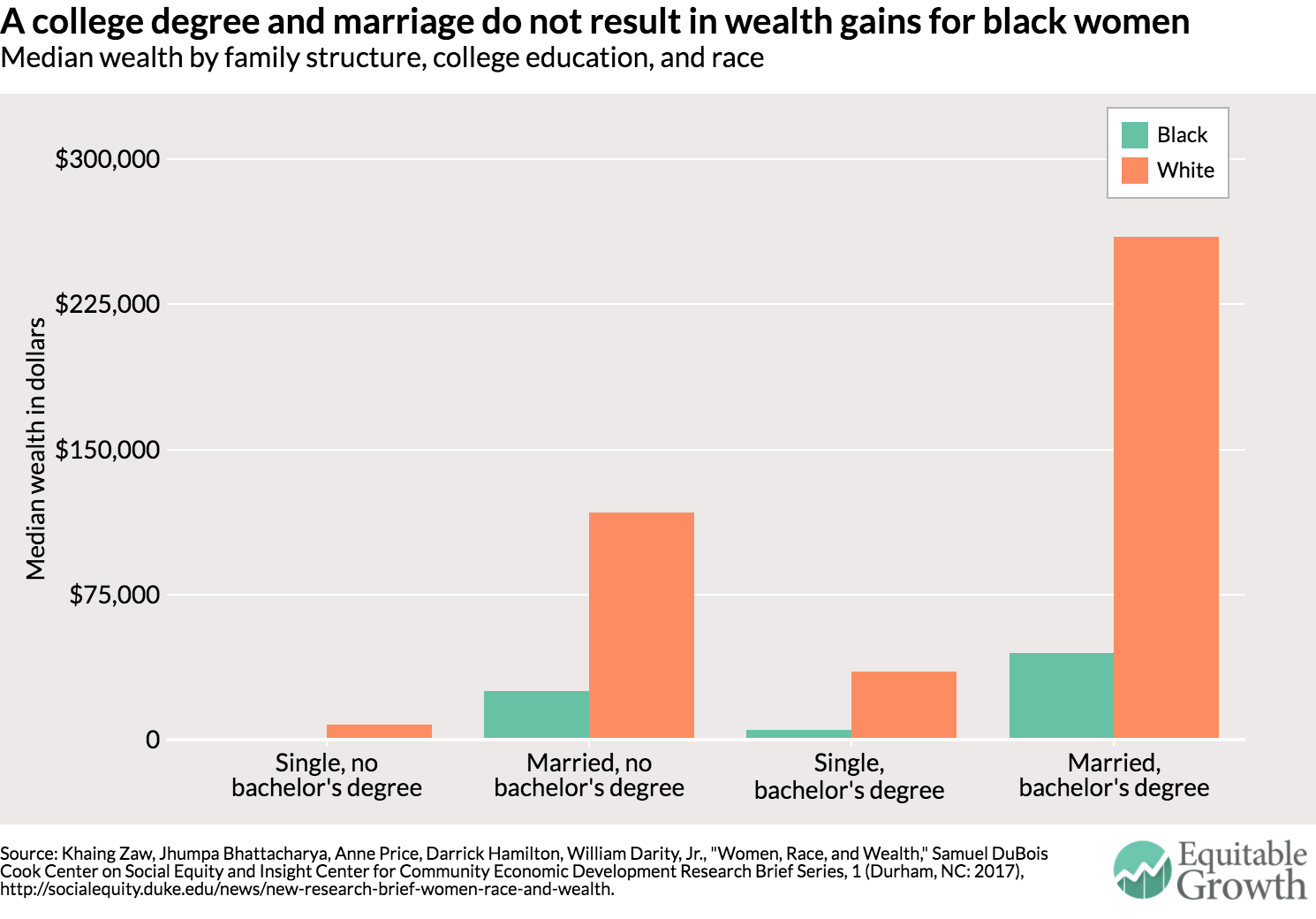
Figure from “The vast wealth gap between black and white women in the United States” by Bridget Ansel
Must- and Should-Reads: February 3, 2017


Interesting Reads:

Equitable Growth’s Jobs Day Graphs: January 2017 Report Edition

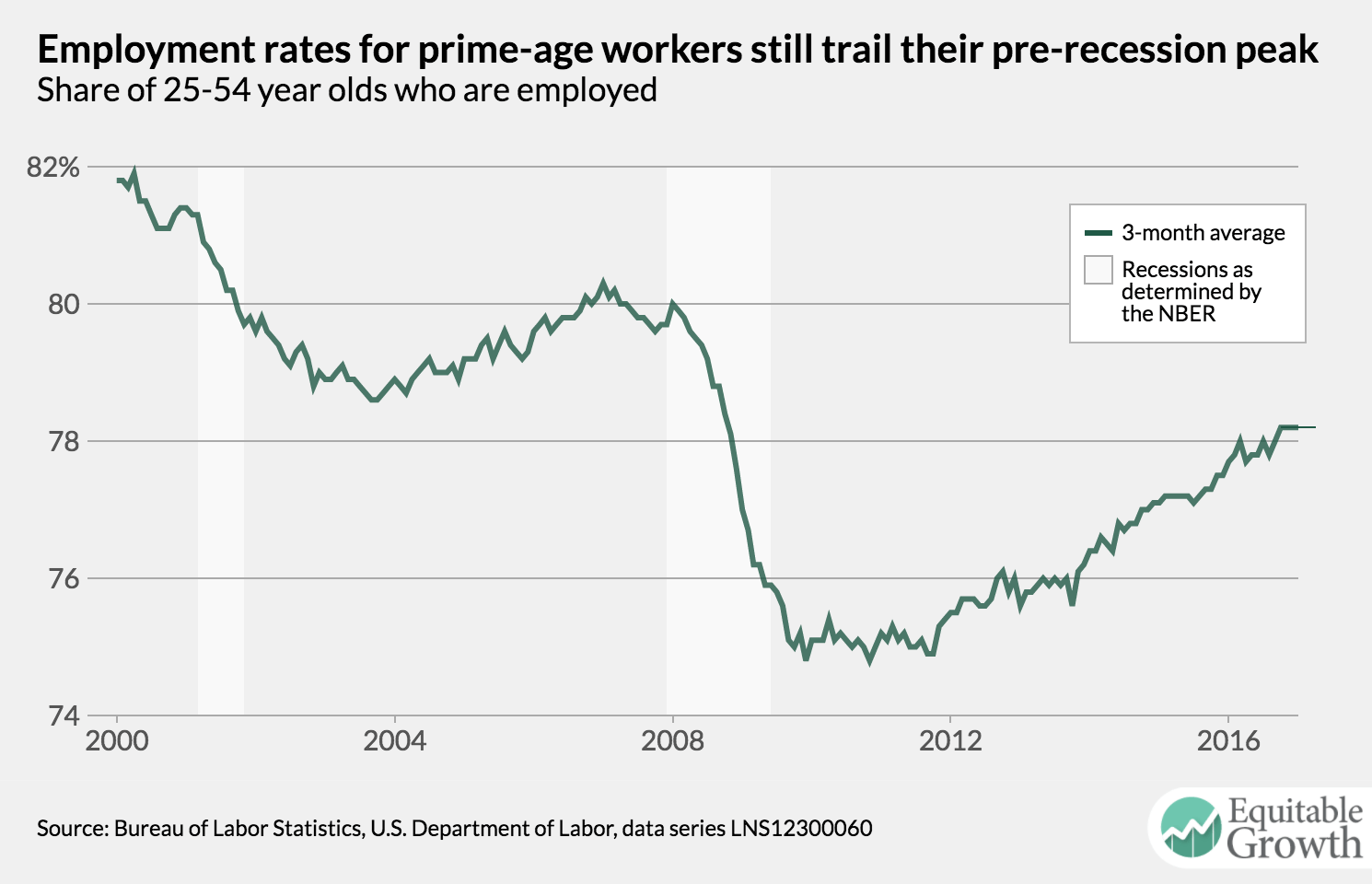
Earlier this morning, The U.S. Bureau of Labor Statistics released new data on the U.S. labor market during the month of January. Below are five graphs compiled by Equitable Growth staff highlighting important trends in the data.

1.

The share of prime-age workers with a job has been at the same level for the past four months.

a

2.

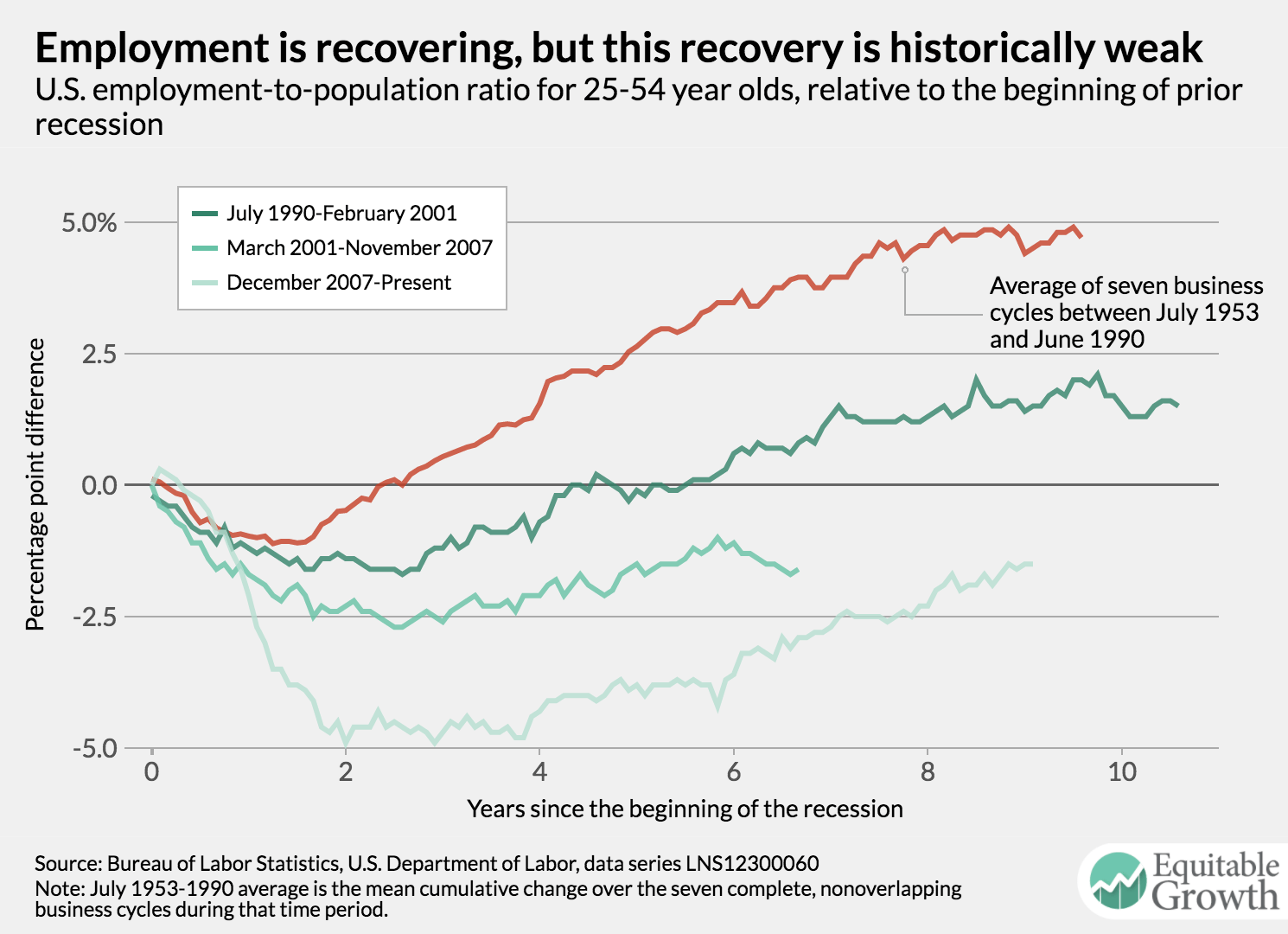
Looking at the prime-age employment rate, this labor market recovery is historically weak.

a

3.

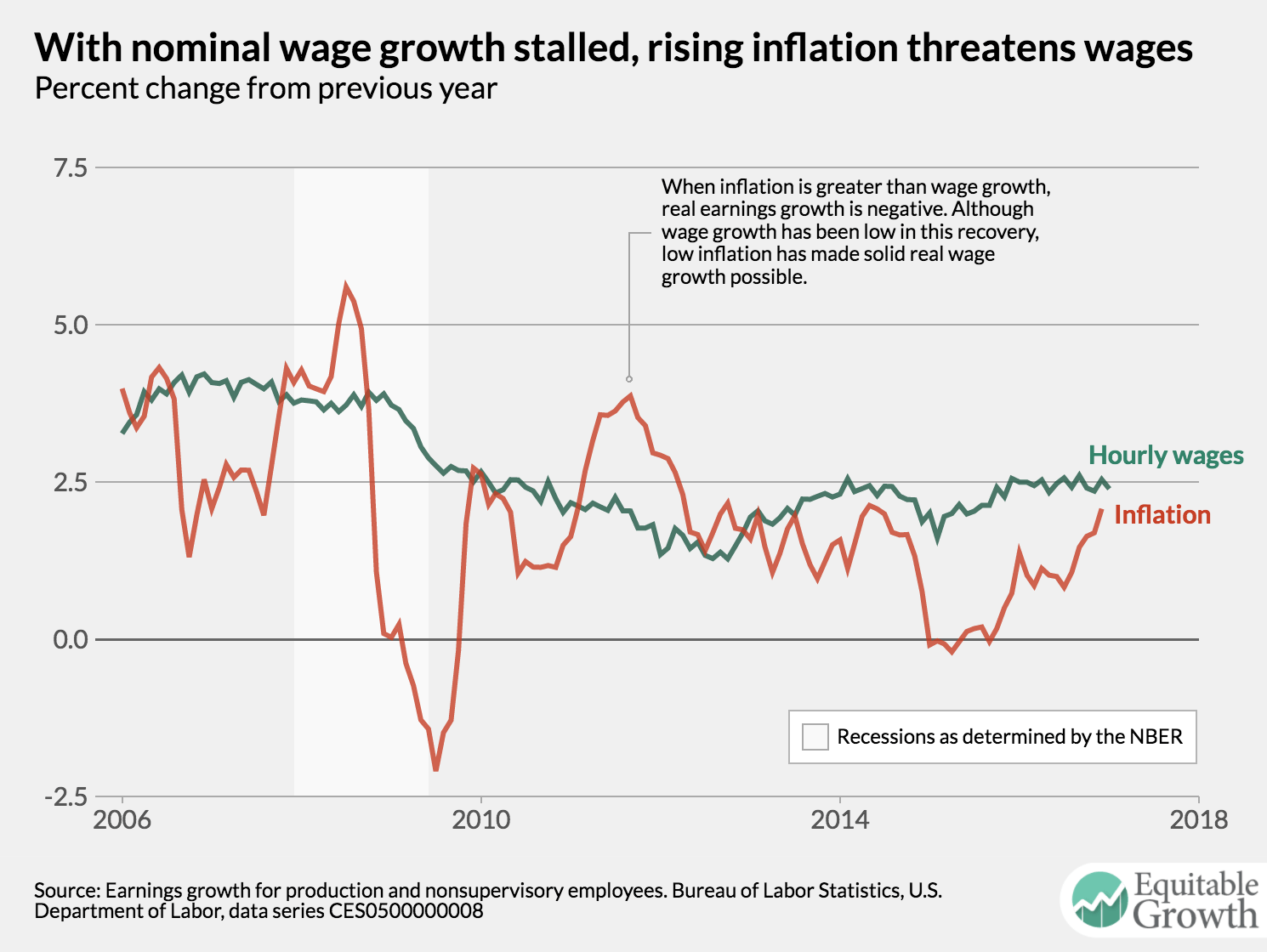
Nonaccelerating nominal wage growth plus rising inflation means that real wage growth is on the decline.

a

4.

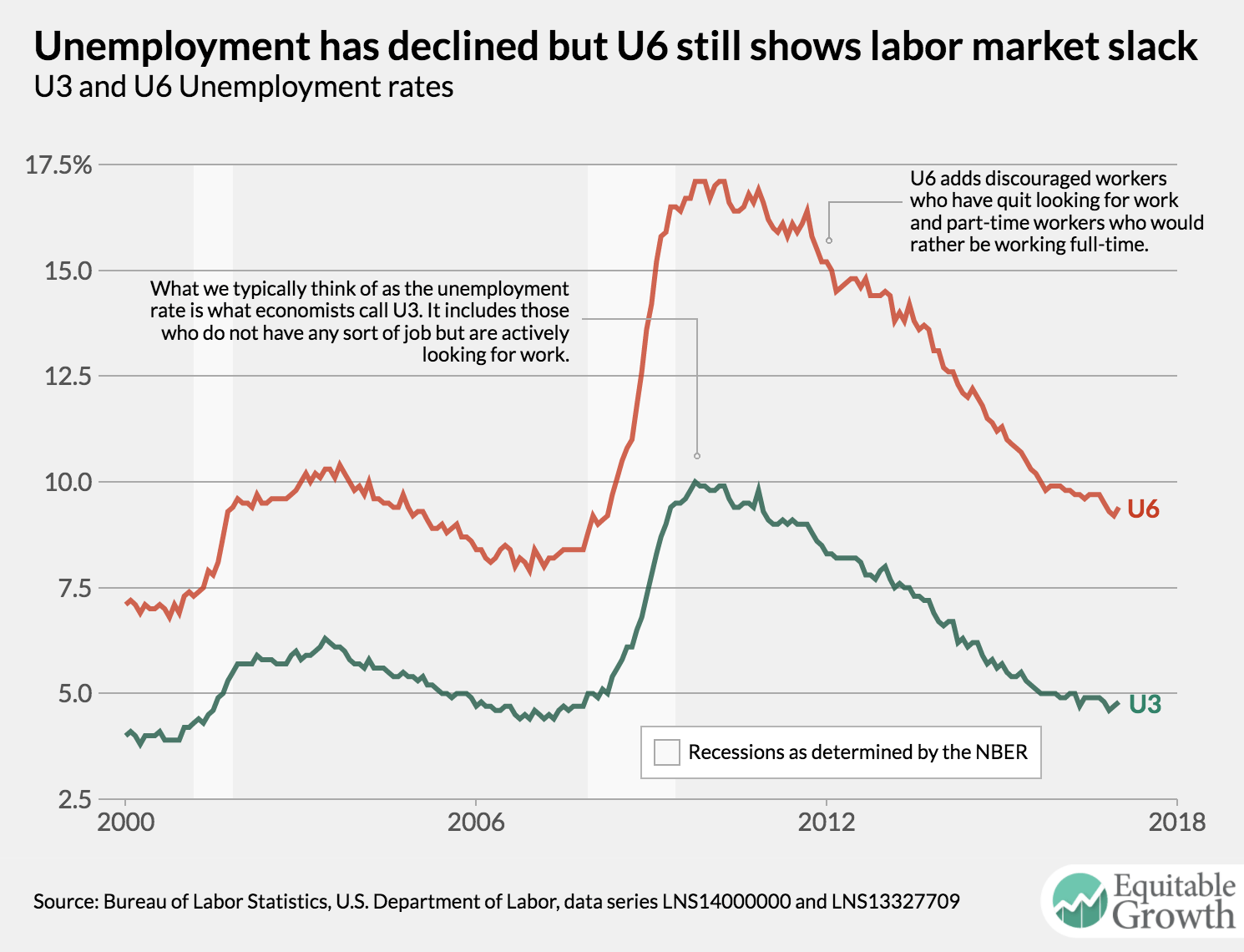
Broader measures of labor slack might have ticked up in January, but all measures show a decline in recent years.

a

5.

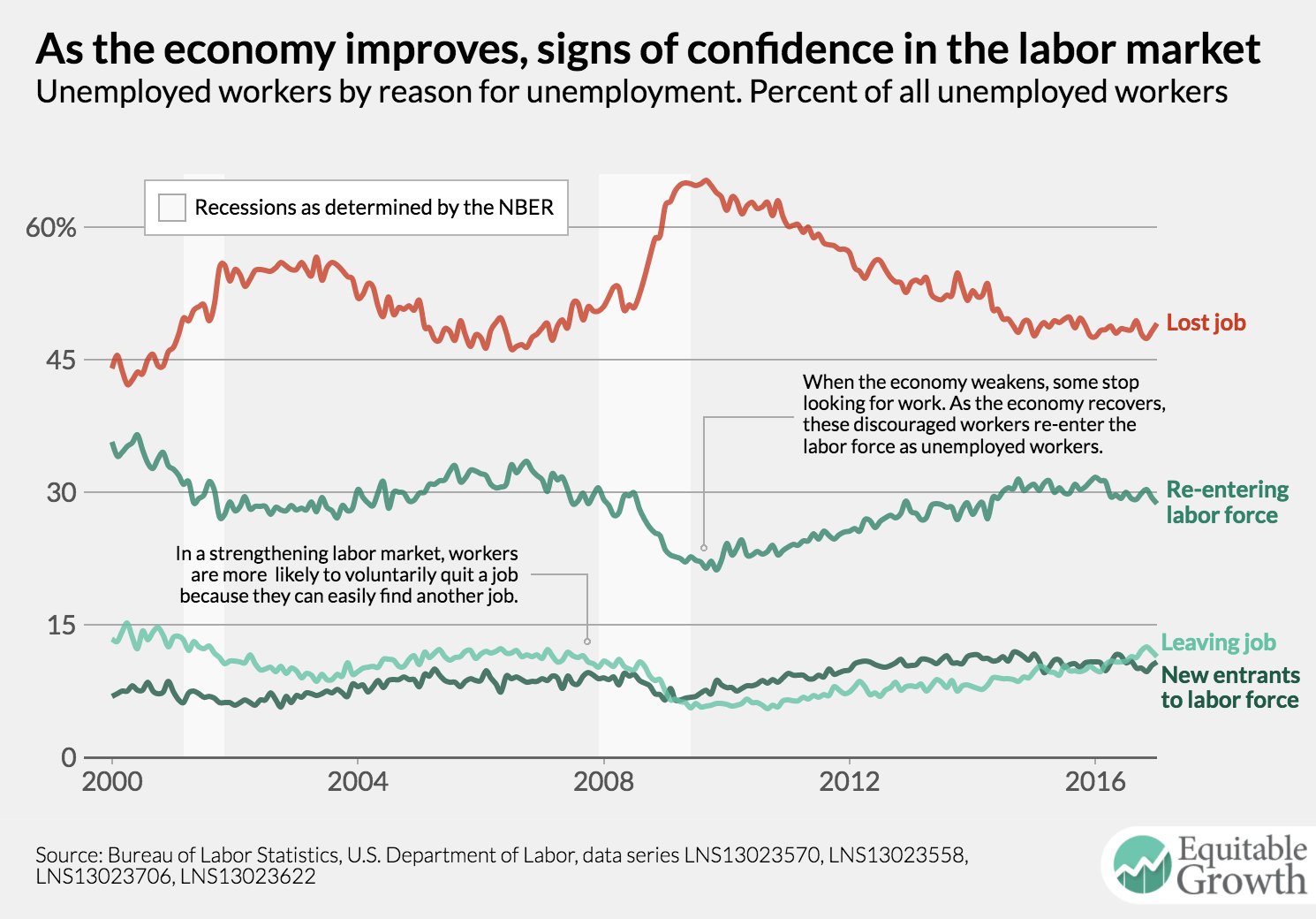
Looking at the reasons why workers are unemployed can help us understand the health of the labor market.

a