Must- and Should-Reads: August 17, 2017


Interesting Reads:

In defense of the statutory U.S. corporate tax rate

It is increasingly apparent that many policymakers and commentators believe that business tax reform means reducing the statutory corporate tax rate. This fixation on the corporate tax rate is unfortunate and misguided. Business tax reform should be primarily about the tax base, not the tax rate. Treating the statutory rate as the key element of reform will inevitably result in a more expensive, more regressive, and less economically beneficial (if not actively harmful) reform than one that focuses on the tax base. By focusing on the base, it is possible to design reforms that achieve a given set of economic objectives at a far more modest cost. Focusing on the base therefore also makes it much easier to meet the minimum standard that tax reform should not decrease government revenues.

Download File
In defense of the statutory U.S. corporate tax rate

Read the full PDF in your browser

The focus on the rate is apparent in the evolution of public statements about tax reform from congressional Republicans and Trump administration officials. Modifications of the tax base were an important part of the blueprint for tax reform put out by Republicans in the House of Representatives in 2016. The blueprint contained three major proposed changes to the corporate tax: a reduction in the statutory rate; full expensing of capital investment combined with repeal of interest deductibility; and the imposition of a border adjustment that would tax imports and rebate tax on exports. But the joint statement on tax reform from six leading Republicans representing both Congress and the administration at the end of July expressed less enthusiasm for expensing and rejected outright the border adjustment, leaving the reduction in the statutory corporate rate the only element unscathed. More recently, National Economic Council Director Gary Cohn reiterated the administration’s focus on the statutory corporate rate, saying that the administration will seek the lowest statutory rate possible.

Recent research indicates that the overwhelming majority of the corporate tax base consists of excess returns, meaning returns above the risk-free rate such as those due to monopoly pricing power, and income attributable to labor that was not paid out as wages. Cutting the corporate tax rate is inefficient and regressive because these types of income are relatively efficient to tax and accrue to business owners, who are disproportionately high-income and high-wealth.

Consistent with these findings, the corporate-level tax rate on the marginal investment—the tax rate paid on a hypothetical investment in tangible or intangible capital that yields the minimum return necessary to attract financing in capital markets—is far lower than the statutory tax rate: only 6 percent, according to recent estimates from the Congressional Research Service. This rate is lower than the statutory tax rate due to provisions of the corporate tax system such as accelerated depreciation and interest deductibility that allow a substantial portion of the return on corporate investment to avoid corporate tax. Proposals for business tax reform that focus on the base rather than the rate can achieve a much more attractive combination of benefits and costs than reforms that focus on cutting the statutory tax rate because they aim to keep as large a share of excess returns and disguised labor income in the tax base as possible.

The advantages of focusing on the tax base rather than the corporate tax rate are usefully illustrated by two proposals recently put forward by the tax policy community, both of which achieve the economic objectives of their proponents at far lower cost than reducing the statutory rate in isolation.

First, consider the destination-based cash flow tax. Adopting this proposed tax would effectively repeal the corporate income tax without reducing the statutory tax rate at all. The proposal would change the tax base—allowing full expensing of capital investment, repealing interest deductibility, taxing imports, and rebating tax on exports—in such a way that it would convert the corporate income tax into another type of tax entirely: an approximation to the business cash flow tax that is part of a consumption tax system. In other words, even if one adopts the view that corporate income taxes are uniquely distortionary and should be eliminated, it is possible to do so without reducing the rate. (The policies listed above do not yield a pure destination-based cash flow tax, as they would still tax certain corporate financial income, including interest, dividends, and capital gains.)

Next, consider the proposal for corporate tax reform put forward by Eric Toder at the Tax Policy Center and Alan Viard at the American Enterprise Institute. This proposal would reduce the corporate tax rate to 15 percent while taxing investors on the change in the value of their shares in publicly traded companies on an annual basis (and providing credit for corporate taxes paid to taxable investors). The proposal also would impose tax on interest income received by nonprofit organizations and by individuals in their retirement accounts, such as 401(k)s and individual retirement accounts.

The proposal by Toder and Viard includes a reduction in the statutory rate, but it is more usefully understood as a redefinition and reallocation of the tax base across entities. By taxing investors on the change in the value of their shares, a substantial fraction of the corporate tax base is effectively shifted from the corporate level to the investor level. The new taxes applied to certain interest payments offset the exclusion of interest payments from the corporate tax base, thus achieving a more consistent treatment of investments financed in different ways. The major changes in the tax base in this proposal are the implicit partial exclusion of corporate income attributable to foreign investors and the use of market valuations rather than measuring income directly.

The common theme of these two proposals is a reform that modifies the tax base to achieve clear economic objectives at a more modest cost than simply cutting the corporate tax rate. The destination-based cash flow tax proposal shows that it is possible to completely repeal the corporate income tax in an economic sense without reducing the statutory corporate tax rate to zero. The Toder-Viard proposal highlights that full or partial integration proposals can achieve similar economic aims by shifting the tax base between firm-level taxes and investor-level taxes, provided that the investor-level taxes are appropriately reformed.

Estimates from the Tax Policy Center suggest that both the Toder-Viard proposal and the not-quite-pure destination-based cash flow tax could be implemented on a roughly revenue-neutral basis in the first decade, including the cost of providing expensing for noncorporate businesses in the cost of the latter proposal. Although both proposals have important weaknesses, either one would offer a far more attractive combination of costs and benefits than a simple reduction in the statutory corporate tax rate.

A key implication of the existence of these proposals is that simple arguments against corporate income taxation or capital taxation, even if true, are inadequate to make the case for statutory corporate rate cuts as the centerpiece of reform. Arguing for statutory rate cuts requires first rejecting superior and far cheaper policy alternatives.

Indeed, the variants of these two plans that have achieved political traction highlight the problems of focusing on the statutory tax rate. The House Republican blueprint draws heavily from the destination-based cash flow tax but adds a large cut in the statutory corporate tax rate. This rate cut would come at great cost, would be a key contributor to the higher federal budget deficits that would cause the blueprint to harm economic growth, would provide little or no economic benefit even if financed by other tax increases or spending cuts, and would be severely regressive. In effect, the blueprint shifts the United States toward a consumption tax but then adds a partial exemption for consumption by business owners (via the rate cut) with no justification.

Similarly, there has been some congressional interest in increasing tax rates on capital gains and dividends as a potential offset for statutory corporate rate cuts, but little apparent interest in the more fundamental reforms to taxation at the investor level that are core to the Toder-Viard proposal. The focus on offsets for a statutory rate cut rather than a focus on the appropriate base for taxation ultimately undermines any economic merits the proposal might otherwise have.

Regardless of one’s views on the relative merits of consumption taxation and income taxation, on the economic and fiscal costs of the erosion of the corporate tax base, or on the harm resulting from corporate inversions, business tax reform should be about reforming the tax base, not cutting the rate. Cutting the rate is an expensive and regressive substitute for other superior reforms.

Many arguments for reducing the corporate tax rate are in large part arguments for increased reliance on consumption taxes. Plausible tax legislation, however, looks quite different from reforms that would move the United States toward a consumption tax. (In the interest of disclosure, this author is not an advocate of converting the income tax into a consumption tax.) The idealized consumption tax would tax labor and excess returns while exempting from tax the risk-free return to capital. Thus, relative to current law, legislation would focus on exempting the risk-free return and leave the taxation of excess returns unaffected to the extent possible. But with the apparent focus in Congress and within the Trump administration on reducing the statutory corporate tax rate, plausible tax legislation is more likely to reverse those outcomes, reducing taxes on excess returns to the maximum extent possible and leaving the taxation of risk-free returns relatively unaffected. This approach is not the path to equitable growth.

Should-Read: Drew Conway: The Data Science Venn Diagram

Should-Read: Drew Conway: The Data Science Venn Diagram http://www.dataists.com/2010/09/the-data-science-venn-diagram/: “The primary colors of data: hacking skills, math and stats knowledge, and substantive expertise…

…each… very valuable, but when combined with only one other are at best simply not data science, or at worst downright dangerous…. Being able to manipulate text files at the command-line, understanding vectorized operations, thinking algorithmically… the hacking skills… apply[ing] appropriate math and statistics methods… [but] data plus math and statistics only gets you machine learning, which is great if that is what you are interested in, but not if you are doing data science… [which] is about discovery and building knowledge….

The hacking skills plus substantive expertise danger zone… people who “know enough to be dangerous”… capable of extracting and structuring data… related to a field they know quite a bit about and… run a linear regression… lack[ing] any understanding of what those coefficients mean. It is from this part of the diagram that the phrase “lies, damned lies, and statistics” emanates, because either through ignorance or malice this overlap of skills gives people the ability to create what appears to be a legitimate analysis without any understanding of how they got there or what they have created.

Fortunately, it requires near willful ignorance to acquire hacking skills and substantive expertise without also learning some math and statistics along the way. As such, the danger zone is sparsely populated, however, it does not take many to produce a lot of damage…

A Very Short History Of Data Science

There is more to equal access to a good education than sound school budgets

Children born into poor and wealthy families alike should have an equal chance of achieving their dreams. But this is not the reality in practice. The income of a child’s parents is strongly correlated with the child’s life outcomes—such as educational attainment, occupational choice, or earnings—in adulthood. Opportunity is far from equal.

Recent research shows that the strength of the association between the child’s parents’ income and her own adult income—a useful measure of inequality of opportunity—varies a great deal between different places across the United States. In some areas, such as Salt Lake City and Los Angeles, the intergenerational association is small, which means the chances for children from low-income families to get ahead are close to those of children from high-income families, so opportunity is relatively equal.


New Working Paper
Inequality of educational opportunity? Schools as mediators of the intergenerational transmission of income


In other areas, however, such as Cincinnati and Memphis, intergenerational associations are strong, meaning differences in life outcomes between children from low-income versus high-income families are large and that opportunity is far from equally distributed. Children from low-income families are less likely to do better than their parents, while children of high-income parents will stay in the upper income brackets.

What explains the geographic variation in this intergenerational transmission of economic status? What is going right in Los Angeles and Salt Lake City but going wrong in Cincinnati and Memphis? A natural hypothesis is that these differences have to do with the quality of the local schools. Schools should be an engine of economic mobility, allowing bright, hardworking children to advance regardless of their family backgrounds. But schools are themselves often unequally distributed, and many schools serving poor children are poorly funded and low-performing.

So perhaps some low-transmission, high-economic-equality cities such as Salt Lake City and Los Angeles simply have better, more equal school systems that produce better and more equal educational outcomes and thus more equal incomes as adults. Or perhaps the differences have nothing to do with schools and instead relate to differences in labor markets in these cities—perhaps when job opportunities are more plentiful and pay is more equal, it does not matter as much whether a child had access to good schools.

In a recent paper, I assess the contributions of education and labor markets to differences across regional labor markets—commuting zones—in the United States in the intergenerational transmission of economic status. To do this, I ask whether parental income matters more for children’s educational outcomes, such as test scores and college completion, in local areas where there is stronger transmission of parental income to children’s incomes, as would be expected if the school system were a key link in this transmission.

I find that there is a great deal of variation in educational transmission across the country. Some areas do much better than others at producing closer-to-equal test scores for children from poor and rich families. Yet areas with small test-score gaps do not have lower-than-average income transmission. In other words, differences in access to high-quality elementary and secondary schools are not a key channel driving the strength of the association between parents’ incomes and their children’s incomes when they reach adulthood.

There is a bit more evidence that higher education is an important part of the story. Gaps in college enrollment and graduation are associated with intergenerational income transmission, though even here, the association is too small to account for much of the variation between regions in income transmission.

The upshot: There is little evidence that differences in the quality of primary, secondary, or postsecondary schools, or in the distribution of access to good schools, are a key mechanism driving variation in intergenerational mobility. The evidence instead points toward other factors influencing income inequality. In particular, labor markets seem to be quite important. Even when children’s test scores and educational attainment are held constant, children from poor families have higher adult earnings when they grow up in low-transmission (greater-opportunity) areas than when they are from low-opportunity, high-transmission areas. This is in part because the high-transmission areas have unusually large returns to human capital, or stronger relationships between education and earnings. Children from wealthy families do better in school than children from poor families everywhere, so a labor market that puts inordinate weight on skill will be unusually favorable to the wealthy children.

Marriage patterns also seem to matter. In cities and regions where income transmission is weaker, the “marriage gap” between those in their mid-20s from low- and high-income families is much smaller, implying that children from low-income families are more likely to have spouses contributing toward the family budget.

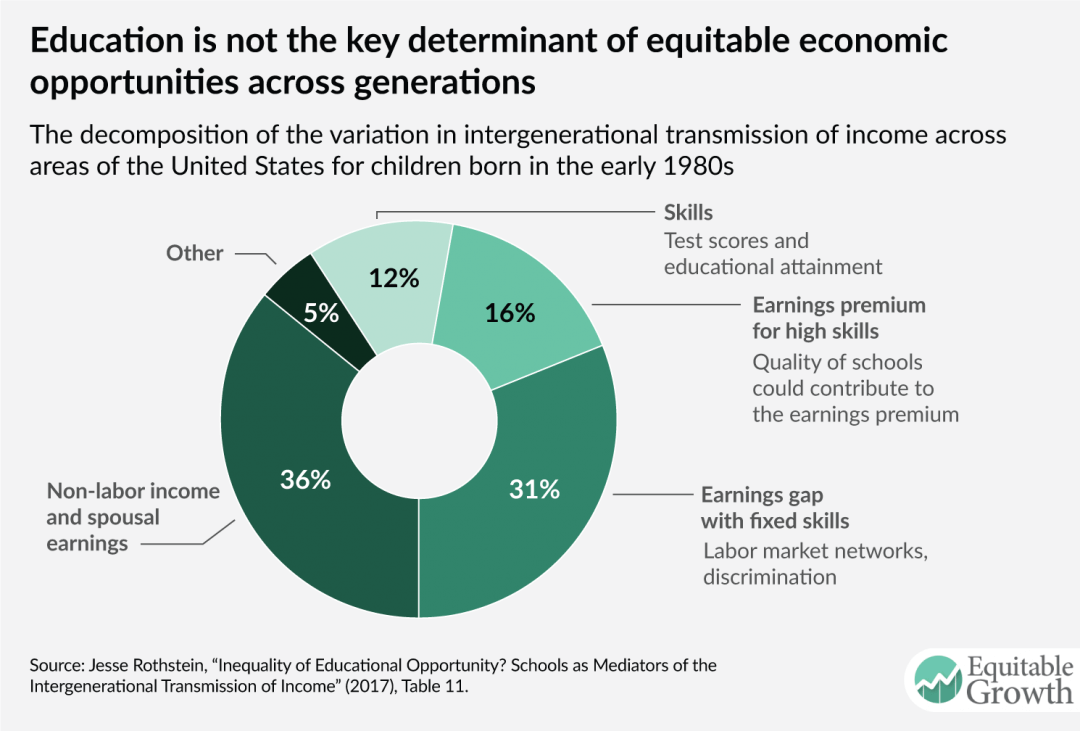
Together, differences in labor markets and marriage patterns account for the great majority of variation in intergenerational mobility across cities and regions in the United States. Variation in relative skill accumulation—the only portion plausibly related to schools—accounts for only 12 percent of the differences between high- and low-opportunity areas, with the rest due to marriage patterns (about one-third) and differences in labor market outcomes operating through channels other than skill accumulation, such as the return to skill in the labor market, discrimination, or referral networks that offer advantaged children a leg up in the job market (about half). (See Figure 1.)

Figure 1

Understanding better how policymakers can promote equality of opportunity in education as well as in the economy overall should remain a top priority. Educational quality is certainly a key tool to improve opportunity, yet my research indicates that it is far from the whole story. The educational system plays only a small role in explaining differences between high- and low-opportunity areas. Labor market institutions—such as minimum wages, the ability to form and join unions, the career structures of local industries, and other determinants of earnings inequality—are likely to play much larger roles and are also likely to be more powerful levers with which to promote equality of opportunity.

The principle of equal access to the pursuit of happiness is deeply rooted in American history and society. We have never accomplished it, but it remains our country’s highest aspiration. The best measure of the progress we have made toward this goal is the extent to which the circumstances of a child’s birth do or do not predict his or her life outcomes. By this measure, as by others, we have very far to travel. To do better, we need to examine all of the different ways that our society and economy work to erect hurdles in front of children from disadvantaged families—whether those hurdles are limiting access to educational opportunity or ensuring that the children will do worse in the labor market than their more advantaged peers even if they do well in school.

—Jesse Rothstein is a professor of public policy and economics at the University of California, Berkeley, and director of the Institute for Research on Labor and Employment at the University of California, Berkeley.

Issue brief: Alleviating financial distress and its economic consequences in the United States

Debt-stressed workers and consumers contribute more to U.S. economic growth when offered delayed but long-term debt write-downs instead of short-term debt relief

Overview

Financial distress is extraordinarily common in the United States. More than one-third of Americans at one time or another must deal with debt collectors, and more than 1 in 10 will file for bankruptcy protection at some point during their lives. One reason is that approximately one-quarter of U.S. households are unable to come up with $2,000 to cope with an unexpected crisis such as an accident, medical emergency, or the loss of a job in the household. As a result, there is a widespread view among lenders and policymakers alike that these households’ liquidity constraints are the most important driver of financial distress, and that debt relief will be most effective if it targets these short-run cash constraints faced by workers and consumers.


New Working Paper
Targeted debt relief and the origins of financial distress: Experimental evidence from distressed credit card borrowers


But in a recent working paper published by the Washington Center for Equitable Growth—“Targeted Debt Relief and the Origins of Financial Distress”—Princeton University economist Will Dobbie and Jae Song of the Social Security Administration find that there are no positive effects for distressed borrowers from immediate payment reductions. Instead, they find that the benefits of debt relief targeting longer-term debt write-downs enable borrowers to cope with unsustainable “debt overhangs” and significantly improve their financial health and labor market outcomes even when they do not take effect for three to five years.

Download File
Issue brief: Alleviating financial distress and its economic consequences in the U.S.

Read the full PDF in your browser

These findings have important implications for understanding both the growing levels of financial distress in the United States and the optimal design of debt relief programs such as those in place to avoid consumer bankruptcy filings. The co-authors’ findings also are germane to the health of the U.S. labor market and the overall U.S. economy. The reason: consumer debt relief programs that are better designed to help distressed borrowers get back on their financial feet over time help ensure that those workers are better able to contribute positively in the labor market over the long term and participate more actively in the U.S. economy as consumers and investors.

The co-authors find that debt write-downs significantly improved both financial and labor market outcomes despite not taking effect for three to five years. The most indebted borrowers who availed themselves of this option were about 12 percent more likely to finish a repayment program than the average borrower and 9 percent less likely to file for bankruptcy. They also were about 3 percent more likely to avoid debt collectors and about 2 percent more likely to remain employed. The positive effects of long-term debt write-downs were also evident to a lesser degree in these borrowers’ improved credit scores, their long-term earnings, and their retirement savings via 401(k) defined-contribution pension plans.

In sharp contrast, the authors find no positive effects for heavily indebted borrowers from minimum debt payment reductions that took effect immediately. In fact, the chances of them meeting a debt collector at their doors increased by more than 3.5 percent and having to file for bankruptcy increased by nearly 7 percent. There also were no detectable positive effects of minimum payment reductions on these borrowers’ credit scores, employment, earnings, or 401(k) contributions. In sum, there is no evidence that these borrowers benefited from minimum payment reductions; there is even some evidence that borrowers seem to have been hurt by the payment reductions.

Study design

Estimating the effects of targeted debt relief is challenging because most debt relief programs are designed to address both short- and long-run financial constraints at the same time. Consumer protection rules and regulations, for example, offer both lower minimum payments (to address short-run, cash-on-hand liquidity constraints) and generous debt write-downs (to address longer-run debt overhangs). As a result, it is very difficult for researchers to predict the effects of specific types of targeted debt relief or to understand the relative importance of addressing short- or long-run financial constraints alone.

The new working paper by Dobbie and Song overcomes these challenges by using information from an actual randomized field experiment matched to administrative tax, bankruptcy, and credit records. The experiment was designed and implemented by a large nonprofit credit counseling organization, Money Management International—the largest nonprofit credit counseling agency in the United States—in the context of an important but understudied debt relief program called the Debt Management Plan.

Each year, Money Management International administers more than 75,000 Debt Management Plans that result in the repayment of nearly $600 million in unsecured debt. Overall, Debt Management Plans enable more than 600,000 individuals to repay credit card issuers between $1.5 billion and $2.5 billion through these repayment programs each year. The debt relief program is one of the most important alternatives to consumer bankruptcy in the United States. (See sidebar.)

Sidebar

To help ensure that creditors benefit from their participation in this repayment program, the counseling agency screens potential clients to assess whether the borrower has sufficient cash flow to repay his or her debts over the three- to five-year period of the repayment program but not enough to reasonably repay his or her debts without the repayment program. In practice, potential clients who pass this screening process have similar credit scores and financial outcomes as bankruptcy filers but more adverse outcomes than the typical credit user in the United States.

The participation of the credit card issuers in a Debt Management Plan is voluntary, and card issuers may choose to participate for only a subset of those borrowers proposed by the credit counseling agencies. In principle, a credit card issuer will only participate in a repayment program if doing so increases the expected repayment rate, presumably because the borrower is less likely to default or file for bankruptcy. Consistent with this view, individuals enrolled in a Debt Management Plan are less likely to file for bankruptcy and less likely to report financial distress than observably similar individuals who are not enrolled in such a plan.

Credit card issuers also can directly refer borrowers to a credit counseling agency if the risk of default or bankruptcy is particularly high. In the study conducted by Dobbie and Song, approximately 15.5 percent of the borrowers learned about Money Management International from a credit card issuer. In comparison, 33.7 percent learned about the firm from an Internet search, 19.8 percent from a family member or friend, and 20 percent from a paid advertisement.

During the experiment, the two researchers evaluated offers by Money Management International to borrowers in both the treatment and control groups of a different repayment program. Borrowers in the control group were offered the status quo repayment program that had been offered to all borrowers prior to the randomized trial. Borrowers in the treatment groups were offered a much more generous repayment program that included a combination of two different types of targeted debt relief:

  • Immediate minimum payment reductions meant to address short-run liquidity constraints
  • Delayed debt write-downs meant to address longer-run debt overhang

The additional debt relief provided to the treatment group was substantial. The typical minimum payment reduction for the treatment group was more than $26—6.15 percent—larger per month than that in the status quo program, while the typical debt write-down in the treatment group was $1,712—49.17 percent—larger than that in the status quo program. The economic magnitudes of the payment reductions and debt write-downs in the treatment group were also relatively similar as measured by the so-called net present costs to the lender of approximately $440 for the typical borrower.

The live, randomized experiment enabled the two researchers to examine the effects on repayment, bankruptcy, collections debt, credit scores, employment, and savings for borrowers who were able to write down their debts, compared with those who were able to take immediate minimum payment reductions. The researchers find that the debt write-downs significantly improved both financial and labor market outcomes for those borrowers despite not taking effect until three to five years after the experiment. For the most indebted borrowers, the probability of:

  • Finishing a repayment program increased by 11.89 percent
  • Filing for bankruptcy decreased by 9.36 percent
  • Facing a debt collector decreased by 3.19 percent
  • Being employed increased by 2.12 percent

The estimated effects of the debt write-downs for credit scores, earnings, and 401(k) savings contributions are smaller but identifiable in the data.

In sharp contrast, the experiment found no positive effects for heavily indebted borrowers from minimum debt payment reductions that took effect immediately. In fact, for these borrowers, the probability of:

  • Filing for bankruptcy increased by 6.76 percent
  • Facing a debt collector increased by 3.56 percent

There also were no detectable positive effects for borrowers who had immediate minimum payment reductions on credit scores, employment, earnings, or 401(k) contributions for any of the borrowers in the authors’ sample.

In sum, there is no evidence that borrowers benefited from the minimum payment reductions, and even some evidence that borrowers seem to have been hurt by the payment reductions.

For further details, please see:

“Targeted Debt Relief and the Origins of Financial Distress: Experimental Evidence from Distressed Credit Card Borrowers,” by Princeton University economist Will Dobbie and Jae Song of the Social Security Administration, in the working paper series at the Washington Center for Equitable Growth.

Should-Read: Fardels Bear: Was James Buchanan a Racist? Libertarians and Historical Research

Should-Read: Fardels Bear: Was James Buchanan a Racist? Libertarians and Historical Research: “Today’s libertarians face a similar problem that Morley faced half a decade ago… https://altrightorigins.com/2017/07/13/was-james-buchanan-a-racist-libertarians-and-historical-research/

…Morley obviously adored Calhoun’s anti-democratic political philosophy, but obviously could not defend slavery; thus slavery simply disappears as a topic in his treatment of Calhoun’s thought. Today’s libertarians admire Calhoun and Buchanan, but they cannot possibly admit that those figures were involved in racial segregation; thus segregation disappears as a topic. We saw the same thing with Constitutional originalists: That the theory was used for decades to defend racial segregation is simply ignored. MacLean has shown how Buchanan did work in an alliance with segregationists. Public choice theorists must face up to this fact as a flaw in their system of thought or admit that they have no answer to her case. They have not yet done so…

Should-Read: Sarah Kliff: Top Democratic, Republican health experts agree on this plan to fix Obamacare

Should-Read: Sarah Kliff: Top Democratic, Republican health experts agree on this plan to fix Obamacare: “‘This package is no one’s conception of what is perfect health reform’, says Ron Pollack… of… Families USA, an ardent defender of the ACA… https://www.vox.com/policy-and-politics/2017/8/9/16119244/bipartisan-plan-fix-obamacare

None of the signatories, if acting alone, would offer this precise package. But that is the whole process of bipartisanship. As a composite, we think this is constructive and has the best opportunity to move forward in Congress….

Continued funding of the cost-sharing reduction subsidies…. “Reassessing” certain health law policies that are meant to stabilize the individual market…. Continue to encourage all Americans to sign up for coverage…. Let states do more experimentation within the health care law…. Allow a “judicious expansion” of health savings accounts…. Ensure funding for the Children’s Health Insurance Program (CHIP)….

The policy ideas here aren’t the big deal. The coalition is.
Wilensky began organizing the bipartisan group back in January in partnership with Pollack… Chen, who has defended the House’s Obamacare repeal bill; Stuart Butler, a vice president at conservative Heritage Foundation, which supports Obamacare repeal; and Grace-Marie Turner, who was part of John McCain’s 2008 policy advisory team…. John McDonough, a Harvard professor who advised Sen. Ted Kennedy during the health reform debate in 2009, and Vikki Wachino, who ran the Children’s Health Insurance Program under President Barack Obama….. Conservative advisers that I’d expect Sen. Lamar Alexander (R-TN), who chairs the HELP committee, to reach out to—and the liberal Obamacare advocate that Sen. Patty Murray (D-WA), the committee’s ranking member, would call for advice on fixing the health law… now backing the same plan to fix Obamacare—a promising step toward possible success in the bipartisan effort to fix Obamacare.

Information Technology and the Future of Society (Hoisted from 2001)

Hoisted from 2001: Information Technology and the Future of Society (My Bekeley CITRIS Kickoff Talk) http://www.j-bradford-delong.net/TotW/citris_kickoff.html: For perhaps 9000 years after the beginnings of agriculture the overwhelming proportion of human work lives were spent making things: growing crops, shearing sheep, spinning yarn, weaving cloth, throwing pots, cutting down trees, copying books, and so on, and so forth.

Technology did improve enormously over those 9000 years: contrast the clothes-making technology at the disposal of Henry VIII of England with that of Rameses II of Egypt three thousand years before; contrast the triple-crop paddy-irrigated rice- and water-control-based agriculture of the Yangtze Delta in eighteenth-century China with the scratch-the-soil-with-a-hoe agriculture of two thousand years before.

But as Thomas Robert Malthus first wrote in the 1790s, rising populations had put enough pressure on scarce natural resources to offset the benefits of better technology and keep living standards nearly constant for the people if not for the elite: American President Thomas Jefferson in 1803 A.D. certainly enjoyed a higher standard of living than Roman Consul Marcus Tullius Cicero in 63 B.C. But did Jefferson’s slaves enjoy a higher standard of living than Cicero’s? A large amount of archeological evidence has not yet found significant differences.

For the past two hundred and fifty years, since the start of the Industrial Revolution, the productivity of those workers who make things has exploded. Hand-spinners in the eighteenth century took 50,000 hours–20 full work-years–to spin 100 lbs of cotton into thread (Freeman and Louca (2001), and spinning of one sort or another took up perhaps 5% of total labor-time. Today it takes 40 work hours to spin 100 lbs. of cotton: a more than thousand-fold amplification of productivity in this one task.

As our productivity at growing crops and making things has exploded, demand for the things we make has grown too, but not fast enough to keep the crop-growing, food-cooking, mineral-extracting, clothes-making, box-carrying, and other goods-producing share of our economy’s labor force from falling. Today those who in any earlier age would be classified as “production workers”–and would have been the overwhelming majority of the labor force–are perhaps 20% of our economy, and the bulk of them are better characterized as machine-watchers and machine-fixers. According to Stanford’s Robert Hall, as early as 1980 there were twice as many salesmen in Ford-selling auto dealerships as there were assembly-line workers employed by Ford Motor Company.

So what are the rest of us–the other 80%–doing? In a sense, we all–from U.C. professors to chief technical officers to xerox operators, Ford Salesmen, cashiers, and parking-lot attendants–are and have long been information workers: people whose jobs are, if we examine them closely, largely concerned with determining what exactly the goods-producing sectors should make, how it should be made, where it should go, and to whom it should be distributed–and that is leaving aside the large chunk of our economy that is symbolic communication as an end in itself.

Today we see–not yet sharply, not yet clearly, but no longer dimly–the prospect that the ongoing technological revolutions in data processing and data communications will do for the “information” sectors of the economy something like what the Industrial Revolution did for goods-producing sectors like cotton spinning. As Steve Cohen over in the City Planning department here likes to say, you are now building the equivalent of the industrial-age tools for shaping and handling matter, but you are building tools for thought (Cohen, DeLong, and Zysman (2001)). And if we can figure out how to make these tools for thought fulfill their promise, they should produce a quantum jump in our technological power, economic productivity, and–we hope–quality of life of as many energy levels as the jump of the Industrial Revolution itself.

But there are major problems of social engineering and organizational design that stand in our way. A century or so ago, at the height of the Industrial Revolution, the market economy turned out to have an extraordinarily good fit with the developing industrial technologies of goods-making. It provided a framework of social organization that was extraordinarily effective in providing people with incentives to carry on activities that generated rapid technological development, capital accumulation, and economic growth.

An effective form of social organization faces decision makers with incentives that mirror the impacts of their actions on society as a whole.

Because the goods produced by industrial technologies were rival–that is, could only be of use to one person at one time–each person’s use of such a good diminished the supply available to the rest of society. Thus it made sense from the viewpoint of efficient distribution to require that users pay a price–diminish their ability to acquire and use other resources–for commodities. And those prices paid then gave producing organizations the resources to carry on and expand their activities.

Because the goods produced were excludable–that is, it was by-and-large straightforward to limit control over use to those authorized–it was easy and straightforward to push decision-making outward from the clueless bureaucratic center to the periphery where people on the ground might actually have a good sense of the situation, and of what should be done.

These three advantages–earmarking additional resources for successful and efficient production organizations, providing users with incentives for economically-efficient distribution, and decentralization of decision-making to where the knowledge was likely to be–were delivered by accident by the trade-and-market economic structure of Adam Smith.

But now as we try to realize the technological promise of information technologies, the old forms of economic organization no longer have a natural fit with the requirements of technological development and economic growth. Once an “information good” has been produced, sharing it with another person doesn’t reduce the rest of society’s resources and opportunities. So there is no efficient-distribution reason to charge a price for it.

But where then does the flow of signals to assess which production organizations are efficient come from?

In an earlier age we would be more inclined to rely on government funding, but these days we have a keen awareness of the advantages in applied development at least of semi-Darwinian competitive mechanisms, where investigators are responsible to investors seeking profits and not to committees seeking whatever committees seek.

Moreover, it is only with difficulty that information goods are excludable. But if their use can’t be restricted to authorized users, then the entire market-as-a-social-calculating-and-signalling mechanism simply breaks down. Unfortunately, attempts to make information goods “excludable” by various forms of use protection waste valuable time and energy: I shudder at the memory of having spent two hours on hold during three phone calls, and having spent another two hours of my time rebooting and reading installation error messages the last time I tried to upgrade one of the Adobe programs–GoLive–on this laptop. I doubt I’ll ever be able to face the prospect of buying another Adobe program again.

Two things, however, are clear. First, caught between “government failures” in applied research and the ever-larger “market failures” that will be created as the characteristics of information-age goods clash with the requirements for market efficiency, intermediate forms of organization–like large publicly-funded research universities–need to play an even larger role in research and development in the future than they have in the past.

Projects like CITRIS promise the benefits of government research–the wide distribution of knowledge and the acceleration of cumulative research–and the benefits of private entrepreneurship–the willingness to take risks and investigate large numbers of potential development projects rather than just those that have won the stamp of approval of a single central committee. It is the task of chancellors and deans, of course, to make sure that projects like CITRIS don’t wind up producing the drawbacks of both forms of organization: the strangulation by bureaucratic red-tape and committee infighting of government, combined with the restrictions on the distribution of information and the use of products that make a large share of private-sector development work duplicative of what has already been done.

Second, realizing the promise of the Societal-Scale Information Systems that are the Holy Grails of this quest will turn out to be a problem of social engineering as well as computer science. I have long wondered just why it was that the first half of the 1980s were the era of the IBM PC rather than of the DEC VAX–when the hardware cost of a VAX was, as best as I can guess, no more than 1/5 that of the equivalent number of 8086 machines, and when thanks largely to Berkeley UNIX there was no comparison at all in software. The answer lies somewhere in social engineering–that somehow paying out five times as much for inferior software was worth not having to wrestle with established MIS bureaucracies. But what the answer is I am not sure.

So let me turn this into a sales pitch for the social scientists at Berkeley interested in information technology–from Manuel Castells in sociology to Pam Samuelson and Mark Lemley at the law school to John Zysman and Steve Weber in political science to Hal Varian and his simians to Suzanne Scotchmer at public policy to the industrial organization and antitrust barons of the business school and the economics department–Glenn Woroch, Rich Gilbert, Dan Rubinfeld, Mike Katz, Carl Shapiro–and a host of others. I do not know of a place with a more vibrant and smarter community of scholars interested in the social engineering aspects of information technology.

And I do not know of a better place than this to assemble the resources to build the Societal-Scale Information Systems that can make information technologies realize their promise.

Should-Read: Barry Eichengreen: Hyperglobalization Is Over, But Globalization Is Still with Us

Should-Read: Barry Eichengreen: Hyperglobalization Is Over, But Globalization Is Still with Us: “Hyperglobalization is over… international trade… growing faster than the world economy… has drawn to a close… https://neo.ubs.com/shared/d1JfrUS5WO79UD/9e9d7589-d888-4435-98fc-4792ff141323.pdf

…The era when cross-border financial flows were growing faster than the world economy has drawn to a close as well. And the era when international migration was growing faster than the world economy is probably over too. Trade is slowing because Chinese growth has slowed down from 10% to 6% or so, and its export growth has slowed down commensurately. And global supply chains cannot be made more and more elaborate forever. Cross-border financial flows are no longer growing faster than everything else because regulators have wisely cracked down on cross-border bank lending…. But I see no reason in principle why trade and GDP cannot now expand in tandem…. And I see no reason why financial flows cannot grow in tandem….

Hyperglobalization may be over, but globalization is still with us. US business is deeply invested in globalization and would push back hard against anything the Trump administration did that seriously jeopardized NAFTA or globalization more broadly. And other parts of the world remain committed to openness, even if they are concerned about managing openness in a way that benefits everyone and limits stability risks that openness creates…

Should-Read: Chris Dillow: Stumbling and Mumbling: Reinventing the wheel

Should-Read: I have never found “power” to be an illuminating and useful word in economics: “threat points”, “default outcomes”, “bargaining strategies”, etc., IMHO, are much more useful ways of thinking about issues. You get somewhere if you ask the question: Why aren’t employers today finding that they must offer higher wage increases to retain and attract the workforce they need? You don’t get much of anywhere if you say: Workers just don’t have the power to make big wage demands.

Chris Dillow: Stumbling and Mumbling: Reinventing the wheel: “In both the UK and US, wage inflation has stayed low despite apparently low unemployment–to the puzzlement of believers in the Philips curve… http://stumblingandmumbling.typepad.com/stumbling_and_mumbling/2017/07/reinventing-the-wheel.html

…Felix Martin in the FT says there’s a reason for this. The “dirty secret of economics,” he says, is “the central importance of power.” Inflation, he says, is “society’s default method of reconciling, at least for a while, irreconcilable demands.” And because workers don’t have the power to make big demands, we haven’t got serious inflation. What’s depressing about this isn’t just that it’s right, but that it needs saying at all. Economists of my age were raised to see that inflation was a matter of power. The very idea of the Nairu arose from a paper (pdf) written by Bob Rowthorn in 1977 (He didn’t actually coin the phrase “Nairu”, but the idea is there). “Conflict over the distribution of income affects the general level of prices in advanced capitalist economies” he wrote. “Power plays a central role in the determination of wages and prices.”

His insight was taken up. In a textbook that grew from some of the few lectures I actually attended in the mid-80s, Wendy Carlin and David Soskice wrote:

In an economy in which both workers and firms have market power…each group will attempt to get hold of particular share of the economy’s product…Suppose that the competing claims are inconsistent ie that the claims of workers to real wages and firms to real profits sum to more than is available in output per head. The each side will attempt to secure its claim by using its market power – workers will secure higher money wages and firms will put their prices up. The result is rising inflation (Macroeconomics and the Wage Bargain, p6)…. The Nairu is the unemployment rate necessary to secure peace in “the battle of the mark-ups”.

Anyone who knows anything about the genealogy of the Nairu would therefore know that insofar as it is a useful idea at all, power is indeed central to it. And yet Felix has a point; this fact has been glossed over by later fancier theories. This is yet another example of something I’ve said before–that technocrats have a blindspot about power…