Should-Read: Guillermo Gallacher: Manufacturing employment, trade and structural change

Should-Read: Guillermo Gallacher:: Manufacturing employment, trade and structural change: “Calls for a return of manufacturing jobs… how feasible is such a goal in light of structural changes in the U.S. economy?… https://equitablegrowth.org/person/guillermo-gallacher/

…This project will try to answer this question by developing a model that will decompose the total decline in manufacturing into decline due to structural change and decline due to increased international trade. It also aims to put the decline of manufacturing in a global perspective. It proposes to study cross-country patterns of structural change by studying 25 Organisation for Economic Co-operation and Development countries, offering a new look at the current controversy of trade versus technology in employment….

Should-Read: Daniel Davies: From a logical point of view…

Should-Read: Daniel Davies: From a logical point of view…: “I have now read that ‘google manifesto’… out of a desire to forestall people saying ‘but have you ACTUALLY READ IT?’… http://crookedtimber.org/2017/08/11/from-a-logical-point-of-view/

… [and not] out of any expectation that it would contain new or unfamiliar information…. Indeed it was your fairly standard evo-psych “just asking questions”… mulberry bush…. I have changed in my old age; I used to be depressed at the generally very poor level of statistical education, now I’m depressed at the extent to which people with an excellent education in statistics still don’t really understand anything about the subject. I’m beginning to think that mathematical training in many cases is actually damaging; simple and robust metrics, usually drawn from the early days of industrial quality control, are what people need to understand. Let’s talk about distributions of programming ability….

The male/female ratio at Google is… a variable under Google’s control. And when you think of the male/female ratio as an input rather than an output, you can start thinking about recruitment as a quality control process and everything becomes much simpler…. Recruitment… [is] a production process… to produce an output of employees of adequate quality…. Its failure mode is to recruit inadequate employees…. If the Google Manifesto was correct, then you would expect to see that Google was full of mediocre female employees, who had been hired by a process biased in their favour despite being inadequate to the task. Whatever the author of the manifesto thinks, Google does not believe this to be the case and as far as I can tell from industry blogs, it isn’t–female employees in tech are generally very good. This would, of course, be consistent with the hypothesis that the current selection process is biased against them.

I’d note that this argument could also be extended to one of the author’s other concerns about “ideological diversity” (mentioned in the context of Google, but most usually seen in discussions of university professors). If there were a genuine problem with a biased recruitment process, you would expect to see that the small minority of conservative professors were startlingly good and universally recognised as being so intelligent and productive of the best scholarship that they had got through the discriminatory process. One might call it the “Jackie Robinson Effect”. If, on the other hand, one had a situation where the writers of windy conservative manifestoes about not getting fair treatment were in fact mediocre whiners who inflated their CVs, then that would be evidence that there wasn’t a bias in the recruitment and retention system, and that in fact there was probably an inefficiency caused by the extent to which mediocrities were able to bump along because their face fitted in a homogeneous techbro culture…. The progress of gender equality in the workplace ought to be measured by the extent to which women can get into the ranks of time-serving dead-wood middle management roles….

marcel proust 08.11.17 at 4:59 pm: “On the veldt, all (surviving) programmers were mediocre because the star programmers couldn’t outrun the sabre-toothed tigers. Welcome back Daniel. If I may speak for my fellow bent timbers, we have missed you…

Weekend reading: “Jolting news this week!” edition

This is a weekly post we publish on Fridays with links to articles that touch on economic inequality and growth. The first section is a round-up of what Equitable Growth published this week and the second is the work we’re highlighting from elsewhere. We won’t be the first to share these articles, but we hope by taking a look back at the whole week, we can put them in context.

Equitable Growth round-up

In the years since the beginning of the Great Recession nearly a decade ago, estimates of the potential growth rate of U.S. gross domestic product have declined. Does this mean productivity growth has slowed down? Not so, argues a new paper.

The newest data from the Job Openings and Labor Turnover Survey for the month of June were released this week. Check out some useful graphs on the state of the labor market that use data from the latest JOLTS report.

Many employers will ask for a workers’ previous salaries before decided upon the starting wage for new hires, potentially increasing wage gaps for women and workers of color. Bridget Ansel discusses recent research that looks at the effects of new policies to prevent salary history disclosure.

With U.S. tax reform on the congressional docket this fall, policymakers would be well-served to look at the relationship between business income and preferential tax rates. Nisha Chikhale highlights a paper looking at the shift of business income away from corporations and wages and toward so called pass-through entities and toward profits.

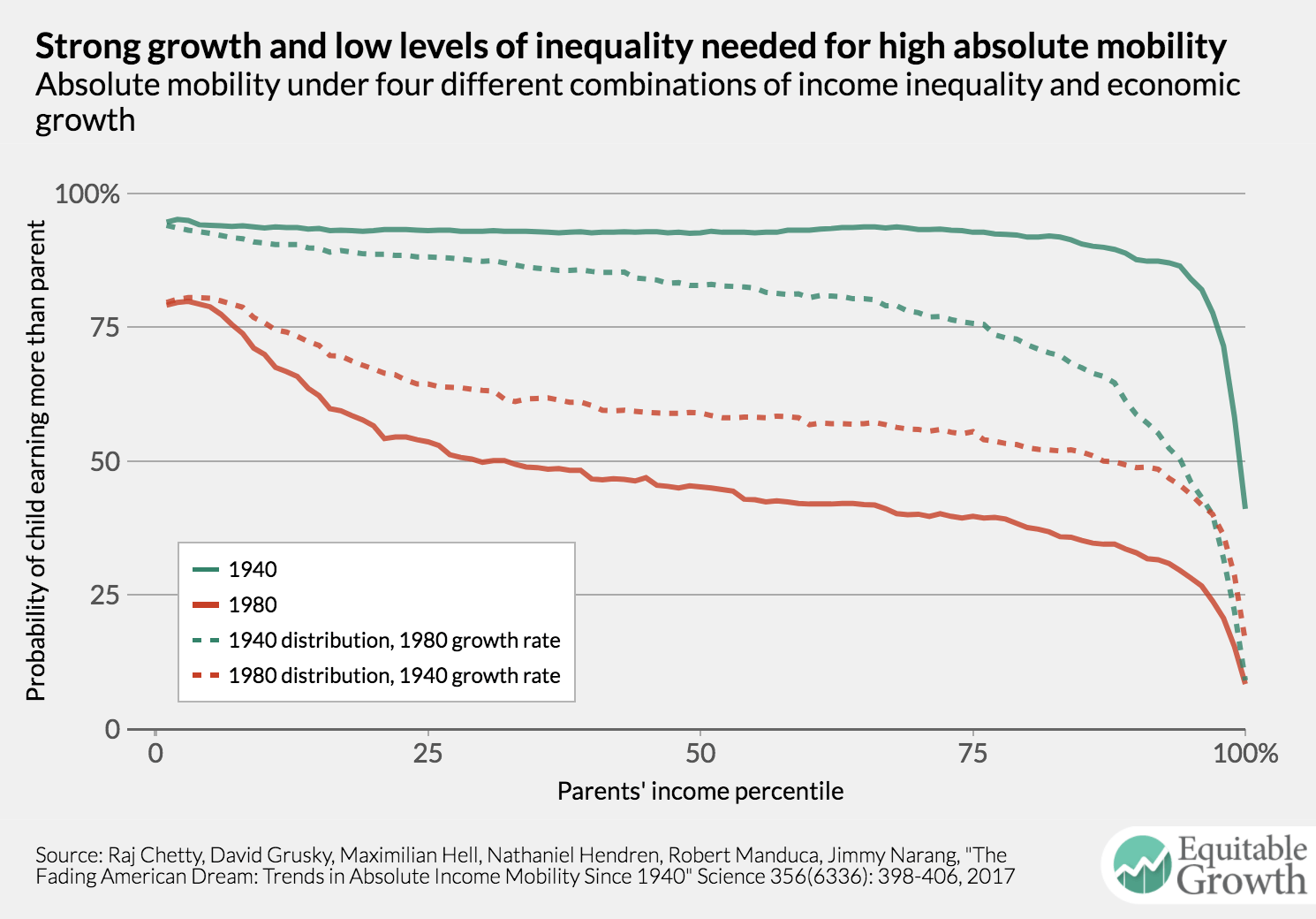
What’s the best way to boost absolute mobility for the next generation of Americans? Faster growth? A more equal distribution of income? Both help, but more equitable growth will do most of the work.

Links from around the web

Index funds are perhaps the best way for everyday investors to get a good return in the stock market. Yet they might have nefarious unintended consequences. Frank Partnoy looks at the rise of the idea of “common ownership.” [the atlantic]

“Gig economy” companies such as Uber Technologies Inc. and Instacart Inc. were founded during a weak labor market when workers’ time was relatively cheap. Kelsey Gee writes about how these companies are adapting as the labor market tightens. [wsj]

The Humphrey-Hawkins Full Employment Act is not very well-known by the general public, yet it provides the Federal Reserve with its full employment mandate—an important tool to redress racial inequities in the labor market, argues David Stein. [wapo]

Restaurant employment in the United States is on track to soon overtake the number of workers in the emblematic industry of the mid-20th century, manufacturing. Jeff Spross writes about how this shift is a sign of other changes in the U.S. economy. [the week]

The American people aren’t all that worried about the U.S. trade deficit. Well, at least not as much as they used to be. Justin Fox argues that perhaps we should at least keep an eye on this deficit. [bloomberg view]

Friday figure

Figure is from “The importance of equitable growth for future mobility in the United States,” by Nick Bunker

Should-Read: Economist: Who will be the next chair of the Federal Reserve?

Should-Read: Economist: Who will be the next chair of the Federal Reserve?: “The interest-rate opinions of the favourite to succeed her are less clear. Mr Cohn… https://www.economist.com/news/finance-and-economics/21726081-gary-cohn-leading-candidate-replace-janet-yellen-who-will-be-next

…thinks that monetary policy is a global endeavour, and that central banks may have been playing beggar-thy-neighbour. In March 2016 he told a conference that if every central bank suddenly raised interest rates by three percentage points, “the world would be a better place”. Yet he also said he was not sure Ms Yellen had been right to raise rates three months earlier. And he criticised the Fed’s recent forward guidance as confusing for the markets. He said it should worry more about what it does than what it says.

The Fed is not only responsible for monetary policy. It is also the biggest regulator of banks. Here Mr Cohn is more in sync with Mr Trump’s deregulatory agenda. However, that may not matter much. The president recently nominated Randal Quarles, another critic of recent regulation, to be vice-chairman for supervision, a post left empty since it was created in 2010 (though in practice the job was done by Daniel Tarullo, who left the Fed in April). Whoever heads the Fed, Mr Quarles will probably take the lead on regulation.

Other candidates are in the frame. Kevin Warsh (pictured on the right), a former banker who was a Fed policymaker from 2006 to 2011, appears to be manoeuvring for the job. Republicans in Congress may favour John Taylor (in glasses), a Stanford academic who devised a mathematical rule that describes central banks’ actions and, like many Republicans, wants the Fed to follow such an algorithm.

The two outsiders have contrasting skills. Mr Warsh is a smooth-talking politician who may lack the intellectual firepower of past Fed chairs. Nobody can doubt Mr Taylor’s braininess. But he did not leave much of a mark on Washington during previous stints there, most recently at the Treasury during George W. Bush’s first presidential term. So he may lack the political nous the job demands. In any case, Mr Warsh and Mr Taylor may well both be too hawkish for Mr Trump. After the financial crisis, both opposed the Fed’s quantitative easing (QE)—ie, purchases of securities using newly created money—warning of a surge in inflation. In fact, inflation has mostly been too low since then.

No names spring to mind, but Mr Trump still has time to find a trained economist who is a Republican and yet tends towards Ms Yellen’s views on interest rates…

Should-Read: Fabio Ghironi: Micro Needs Macro

Should-Read: Fabio Ghironi: Micro Needs Macro: “An emerging consensus on the future of macroeconomics views the incorporation of a role for financial intermediation, labor market frictions, and household heterogeneity in the presence of uninsurable unemployment risk as key needed extensions to the benchmark macro framework… http://faculty.washington.edu/ghiro/GhiroFuture.pdf

…I argue that this is welcome, but not sufficient for macro and international macro to tackle the menu of issues that have been facing policymakers since the recent global crisis. For this purpose, macro needs more micro than the benchmark setup has been incorporating so far. Specifically, artificial separations between business cycle analysis, the study of stabilization policies, and growth macro, as well as between international macroeconomics and international trade, must be overcome. I review selected literature contributions that took steps in this direction; outline a number of important, promising directions for future research; and discuss methodological issues in the development of this agenda…

Should-Read: Nancy MacLean: Democracy in Chains: The Deep History of the Radical Right’s Stealth Plan for America

Should-Read: Nancy MacLean: Democracy in Chains: The Deep History of the Radical Right’s Stealth Plan for America http://amzn.to/2voi3qD: “As 1956 drew to a close, Colgate Whitehead Darden Jr., the president of the University of Virginia, feared…

…second Brown v. Board of Education ruling, calling for the dismantling of segregation in public schools with “all deliberate speed.” In Virginia, outraged state officials responded with legislation to force the closure of any school that planned to comply…. Darden… could barely stand to contemplate the damage…. Even the name of this plan, “massive resistance,” made his gentlemanly Virginia sound like Mississippi.

On his desk was a proposal, written by the… chair of the economics department… James McGill Buchanan [who] liked to call himself a Tennessee country boy. But Darden knew better…. Without mentioning the crisis at hand, Buchanan’s proposal put in writing what Darden was thinking: Virginia needed to find a better way to deal with the incursion on states’ rights represented by Brown.

To most Americans living in the North, Brown was a ruling to end segregated schools—nothing more, nothing less. And Virginia’s response was about race. But to men like Darden and Buchanan, two well-educated sons of the South who were deeply committed to its model of political economy, Brown boded a sea change on much more…. Federal courts could no longer be counted on to defer reflexively to states’ rights…. The high court would be more willing to intervene when presented with compelling evidence that a state action was in violation of the Fourteenth Amendment’s guarantee of “equal protection”…. States’ rights… were yielding in preeminence to individual rights. It was not difficult for either Darden or Buchanan to imagine how [the Warren] court might now rule if presented with evidence of the state of Virginia’s archaic labor relations, its measures to suppress voting, or its efforts to buttress the power of reactionary rural whites by underrepresenting the moderate voters of the cities and suburbs of Northern Virginia. Federal meddling could rise to levels once unimaginable.

James McGill Buchanan was not a member of the Virginia elite. Nor is there any explicit evidence to suggest that for a white southerner of his day, he was uniquely racist or insensitive to the concept of equal treatment. And yet, somehow, all he saw in the Brown decision was coercion. And not just in the abstract. What the court ruling represented to him was personal. Northern liberals… who looked down upon southern whites like him,… were now going to tell his people how to run their society. And… he and people like him with property were no doubt going to be taxed more…. What about his rights? Where did the federal government get the authority to engineer society to its liking and then send him and those like him the bill? Who represented their interests in all of this?

I can fight this, he concluded. I want to fight this. Find the resources, he proposed to Darden, for me to create a new center on the campus of the University of Virginia, and I will use this center to create a new school of political economy and social philosophy… an academic center… with a… political agenda: to defeat the “perverted form” of liberalism that sought to destroy their way of life, “a social order,” as he described it, “built on individual liberty,” a term with its own coded meaning but one that Darden surely understood. The center, Buchanan promised, would train “a line of new thinkers” in how to argue against those seeking to impose an “increasing role of government in economic and social life.” He could win this war, and he would do it with ideas.

While it is hard for most of us today to imagine how Buchanan or Darden or any other reasonable, rational human being saw the racially segregated Virginia of the 1950s as a society built on “the rights of the individual,” no matter how that term was defined, it is not hard to see why the Brown decision created a sense of grave risk among those who did. Buchanan fully understood the scale of the challenge he was undertaking and promised no immediate results. But he made clear that he would devote himself passionately to this cause.

Some may argue that while Darden fulfilled his part—he found the money to establish this center—he never got much in return. Buchanan’s team had no discernible success in decreasing the federal government’s pressure on the South all the way through the 1960s and ’70s. But take a longer view… a different picture… a testament to Buchanan’s intellectual powers and… the ideological origins of the single most powerful and least understood threat to democracy today: the attempt by the billionaire-backed radical right to undo democratic governance…. A quest that began as a quiet attempt to prevent the state of Virginia from having to meet national democratic standards of fair treatment and equal protection… would, some sixty years later, become… a stealth bid to reverse-engineer all of America, at both the state and the national levels, back to the political economy and oligarchic governance of midcentury Virginia, minus the segregation…

Must- and Should-Reads: August 12, 2017


Interesting Reads:

Preferential pass-through tax rates and the declining share of labor income in the United States

A new working paper underscores the importance of pass-through businesses, such as sole proprietorships, S corporations, and partnerships, in the forthcoming debate on U.S. tax reform in Congress. The reason: The shift in business activity into pass-through form in recent decades, and a corresponding shift in income reported for tax purposes from wages to business profits, underscores just how consequential the compliance problems would be if Congress were to enact a preferential rate for income from pass-through businesses.

Nearly all of the rise in top incomes since 2000 in the United States has come in the form of business income, according to the new working paper by Matthew Smith of the U.S. Treasury Department; Danny Yagan of the University of California, Berkeley, and the National Bureau of Economic Research; and Owen Zidar and Eric Zwick, both of the University of Chicago Booth School of Business and the National Bureau of Economic Research. Business income now accounts for a larger fraction of the income of the top 0.1 percent of income earners than either nonbusiness capital income, such as interest, or wage income. Most of this business income growth comes from pass-through businesses, which do not pay the corporate income tax. Instead, owners of these businesses pay taxes on their share of their firm’s profits on their individual income tax returns. In general, business income is a combination of capital income and labor income, and distinguishing the relative shares can be difficult. Moreover, the line between business income and nonbusiness capital income is itself ambiguous.

There are many interesting findings in the paper worthy of discussion, but one for policymakers to consider is that business owners show a substantial ability to reclassify income by type, such as from business profits to wages, when there are tax advantages to doing so. The magnitude of this response, even for businesses currently subject to rules intended to discourage such behavior, highlights the potential for compliance problems under a preferential rate for pass-through income—an idea included in several recent tax reform proposals.

The shift of business activity from C corporations—traditional corporations subject to U.S. corporate taxes—to pass-throughs began in earnest after the Tax Reform Act of 1986, which reduced the top personal income tax rate below the top corporate income tax rate. Today, C corporations no longer earn the vast majority of business income, earning less than half of business income as pass-throughs grow in importance. By 2011, 54.2 percent of all U.S. business income was earned by pass-throughs, compared with just 20.7 percent in 1980.

Under current law, active business owners typically face the lowest statutory tax rate on their profits if they conduct business activities in S corporation form. (Other tax considerations, however, may also affect the relative advantages of the choice of form, such as flexibility in allocating income and losses.) If owners “materially participate” in a firm’s operation, then their business income faces only the ordinary income tax—at a maximum rate of 39.6 percent. In contrast, C corporations pay a 35 percent tax on profits, and owners pay additional taxes at the investor level when earnings are distributed—at a maximum rate of 23.8 percent. Wage payments are deducted from business income and taxed at a maximum rate of 43.4 percent at the individual level regardless of the type of business.

Thus, owners of a closely held C corporation would realize tax advantages from paying higher wages and realizing lower profits, while owners of a closely held S corporation would realize tax advantages from realizing income in the form of business profits rather than wages. Both C corporations and S corporations are subject to requirements that wage compensation paid to owner-employees must be reasonable, thus—in theory—limiting the ability of C corporation owner-employees to overstate wages and the ability of S corporation owner-employees to understate wages.

Nonetheless, the data show exactly these kinds of shifts in the 21st century. Studying firms that switch from C corporations to S corporations, authors Smith, Yagan, Zidar, and Zwick observe a substantial reallocation between wages and profits. On average, wage payments fell by 1.95 percent relative to sales during the year of the switch, and profits grew by 1.76 percent relative to sales. (see Figure 1) For dentists’ and physicians’ offices, the swings were more dramatic, with profits increasing 7.81 percent and wages falling 6.36 percent. There was no discernible difference among firms with sales of more than $50 million, but firms with sales of less than $5 million acted much like the full sample of companies surveyed, with wages declining about 2 percent and profits increasing 1.75 percent. Firms with sales of less than $5 million account for the overwhelming majority of the firms in the analysis.

Figure 1
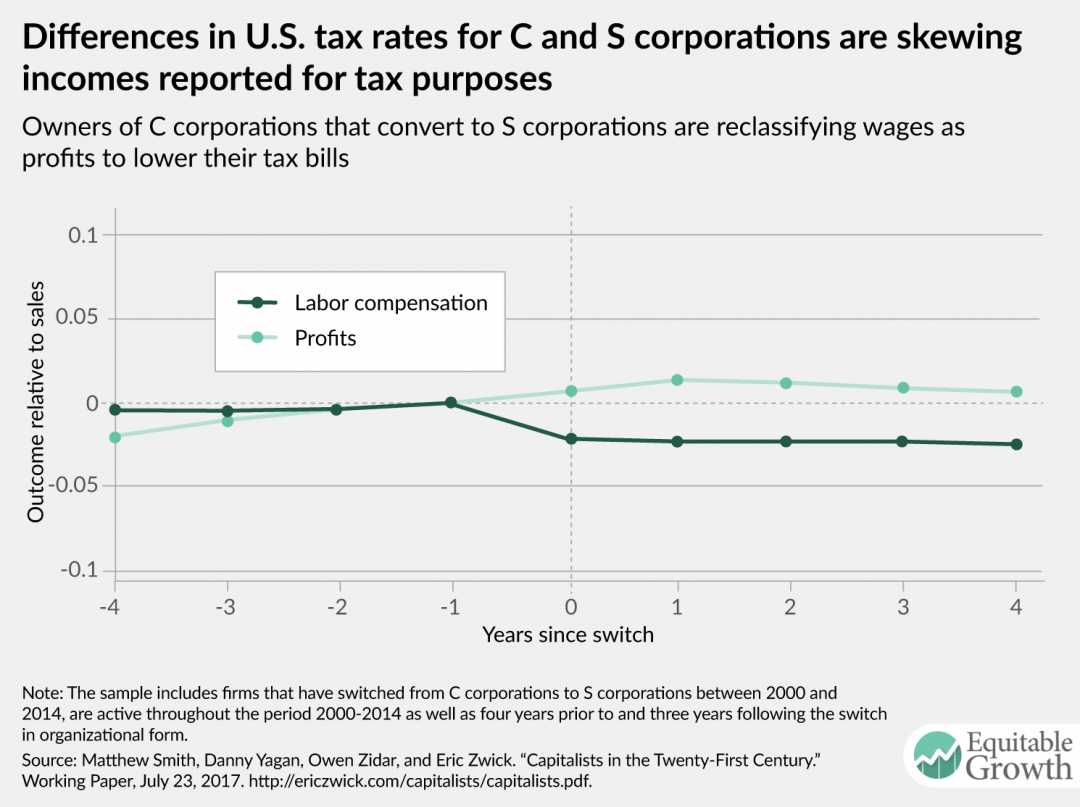
The analysis by the four researchers also finds that the shift of business activity from C corporations to S corporations since the 1980s has reduced the measured share of labor income. The growth in S corporations, and the corresponding shift from wages to profits, skews the measurement of the labor share of income in the corporate sector. The researchers estimate that the decline in the corporate labor share is overstated by 19 percent, as earned income has increasingly taken the form of S corporation profits. Policymakers may soon have to decide if they want to further incentivize this shift through a preferential rate for pass-through businesses.

Should-Read: Barry Eichengreen: Revenge of the Experts

Should-Read: Barry Eichengreen: Revenge of the Experts: “The Brexit debate is an endless source of mirth for anyone with a dark sense of humor… https://www.project-syndicate.org/commentary/economists-right-about-brexit-impact-by-barry-eichengreen-2017-08

…My own favorite quote is from Michael Gove, currently Britain’s environment secretary…. “People in this country have had enough of experts,” Gove testily explained…. Indeed, we economists have had little success at reliably predicting when and why uncertainty spikes. And there is little agreement on the severity of its impact. Maybe we would be better off placing less weight on the effects of uncertainty when making forecasts in general, and in the case of Brexit in particular. But this view looks rather less compelling with the passage of a couple of additional quarters….

The drop in confidence, some might object, reflects an inconclusive general election and a hung parliament, not the Brexit vote. Or worsening conditions can be blamed on the government’s less-than-stellar negotiating strategy and the appearance that it is entering discussions with its EU partners unprepared. But the inconclusive election reflects the schizophrenia of both the Conservative and Labour parties…. Some argue that if the government adopted a more coherent negotiating strategy the damage would be less. But the fact is that there is no coherent negotiating strategy. May’s objectives–restriction of immigration from the EU while maintaining full access to the European single market–are fundamentally incompatible. The only surprise is that it took so long for the consequences to materialize….

What the late, great MIT economist Rudi Dornbusch–that most expert of experts–said about Mexico’s peso crisis in the 1990s applies to the damage from Brexit as well. A crisis, Dornbusch noted, “takes a much longer time coming than you think, and then it happens much faster than you would have thought.”

Should-Read: Dean Baker: Opposition to Trade Deals: Brad DeLong’s “Socialism of Fools” Might Look Like Common Sense to Those Outside the Fraternity

Should-Read: A well-argued smackdown from the smart Dean Baker:

Dean Baker: Opposition to Trade Deals: Brad DeLong’s “Socialism of Fools” Might Look Like Common Sense to Those Outside the Fraternity: “First, Brad is well aware that the economy has operated well below full employment… http://cepr.net/blogs/beat-the-press/opposition-to-trade-deals-brad-delong-s-socialism-of-fools-might-look-like-common-sense-to-those-outside-the-fraternity

…I would argue this has been the case for almost all of the period since the collapse of the stock bubble in 2001. But he attributes this to a simple failure of the government to run full employment policies, rather than the large trade deficits we saw develop following the East Asian financial crisis in 1997. While… the government could maintain full employment by running much larger budget deficits… that does not appear to be politically feasible. Even among Democrats, very few are willing to say that we should have larger budget deficits to bring the economy to full employment….

The costs of being below full employment are disproportionately borne by disadvantaged groups in the labor market, especially African Americans and Hispanics.

Anyhow, if the political reality is that we will not have full employment fiscal policies, does it take a “fool” to argue that big trade deficits are a real problem? The cost of the shortfall in demand that we have seen over the last decade almost certainly exceeds $10 trillion by now and it is enduring, as we have seen lasting reductions in capacity, as Brad has written about himself. And millions have seen their lives and families disrupted by long periods of unemployment. Should we not worry about this damage from the demand shortfall created by trade deficits because there is in principle an economic fix, even though everyone knows it is not politically feasible?…

The loss of manufacturing jobs, which offered relatively good paying employment for people without college degrees (roughly two-thirds of the labor force), had a large effect on the wages of this group of workers. There was both the immediate effect on the displaced workers and their communities, which has been well-documented by David Autor and his various co-authors, and also the longer term effect from the reduced demand for less-educated workers…

I really have no good answer to his first and second points—they are good ones, and my only practical out for the future is a hope that the Federal Reserve will move to and then achieve a higher inflation target. The third I would push back against—the “loss of manufacturing jobs” is overwhelmingly not a trade phenomenon, and the net factor content of our exports and of activities financed by capital inflows is not that different from the net factor content displaced from employment by imports. We should be focusing on policies to achieve equitable growth, not less-inequitable stagnation…