
The importance of equitable growth for future mobility in the United States

A father watches television with his daughters in Denver.

New York Times columnist David Leonhardt made an excellent point in a column yesterday about the pace of U.S. economic growth and where the gains of that growth have accrued. Commenting on a graph made using data from a distributional national accounts data set, Leonhardt notes that the growth of the past several decades hasn’t resulted in most families getting much in the way of raises. It may be all but impossible to get back to the levels of aggregate growth levels of the postwar era, he argues, but “there is nothing natural about the distribution of today’s growth.”

The consequences of such inequitable growth don’t just weigh on the living standards of one generation. They also affect the course of growth for future generations. Stanford University economist Raj Chetty and a group of researchers recently looked at the state of absolute mobility in the United States, or the likelihood that a child would earn the same amount of money or more than their parents at the same age. They found that the American dream, defined by levels of absolute mobility, is fading. A child born in 1940 had an almost 92 percent chance of earning more than their parents. Forty years later, someone born in 1980 would only have a 50 percent chance of outearning their parents.

The two big differences between the 1940–1970 period of high mobility and the 1980–2010 period of low mobility is that the second period had higher levels of income inequality and a lower rate of economic growth. Boosting both would almost certainly increase absolute mobility, but is one factor more significant than the other?

Chetty and his co-authors help answer this question by calculating how absolute mobility would change if they changed the income distribution and/or the level of growth. Figure 1 below shows four different scenarios. Two are easy enough to understand—the actual trends in mobility for the cohorts born in 1940 (the solid green line) and 1980 (the solid red line). But the other two lines are counterfactual trends. One line (the red dashed line) imagines a world where we keep the trends of high income inequality for the 1980 cohort but manage to boost growth from 1980 to 2010 to the fast pace that the U.S. economy experienced from 1940 to 1970. The other line (the green dashed line) imagines that we keep the slower growth of 1980 to 2010, but the growth ended up being distributed like the growth during 1940 to 1970. (See Figure 1.)

Figure 1
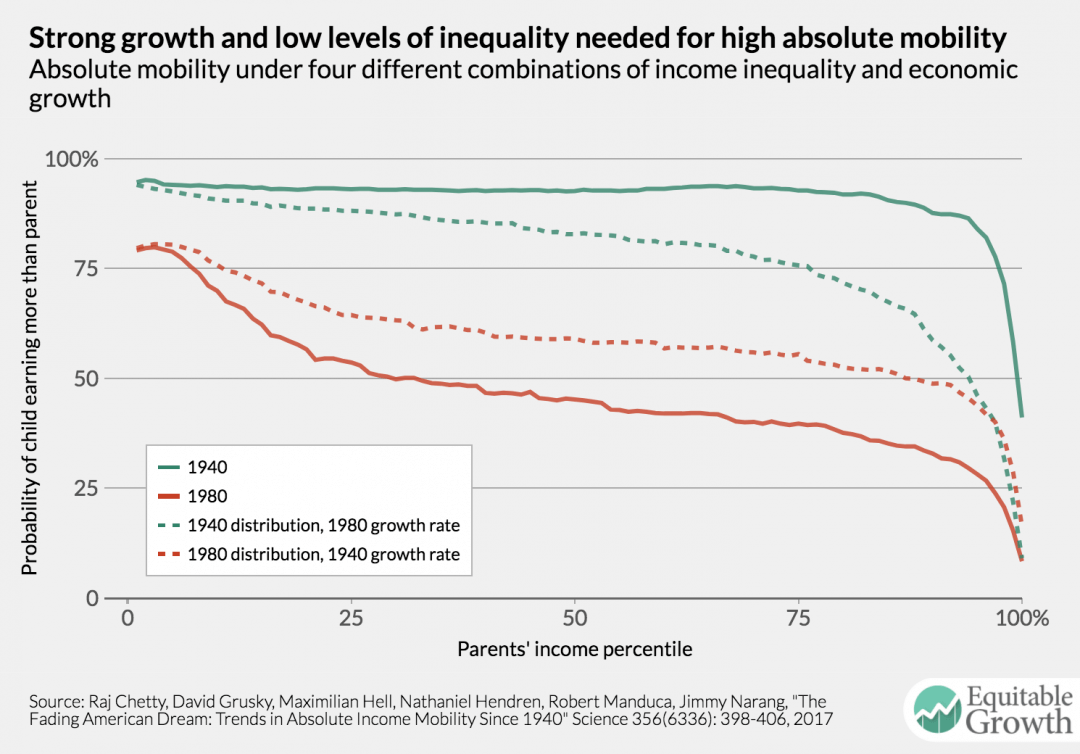
What the graph shows is that a faster-growing economy, but one that is still highly unequal, boosts mobility, but the increase in mobility is much higher when the distribution of slower growth is more equitable. The average rate of mobility when inequality and growth are both high would have been about 62 percent, compared with the average rate of about 80 percent when inequality and growth were both low.

Of course, absolute mobility is highest—an average of about 92 percent—when growth is both strong and equitably distributed. If we want to boost the living standard of future generations, policymakers need to take steps to boost economic growth and ensure that its benefits are broadly distributed.

Should-Read: PGL: The Output Gap per the Gerald Friedman Defenders

Should-Read: IMHO, the smart PGL does good here…

And, J.W. Mason, please don’t say that Coibion et al.’s state-of-the-art potential output estimate “gives a very similar estimate for the output gap as simply looking at the pre-2008 forecasts or extrapolating from the pre-2008 trend”. That’s not the way to gain a reputation—at least, not they way to get any reputation that you would like to have.

The Blanchard-Quah concept potential output estimates being made by Coibion, Gorodnichenko, and Ulate http://delong.typepad.com/w23580.pdf do not look to me “very similar estimate for the output gap as simply looking at the pre-2008 forecasts or extrapolating from the pre-2008 trend”. Look at the gap between the current estimate—the purple line—and the red or dot-dash green line that are the 2007 and 2009 vintage BQ forecasts. Look at the thick blue line that is (my drawing) of the upper hull of real output in this millennium a la Menzie Chinn:

Papers nber org tmp 51391 w23580 pdf

Yes, BQ gives a large current output gap. No, BQ as applied by Coibion et al. does not give a “very similar estimate for the output gap as simply looking at the pre-2008 forecasts or extrapolating from the pre-2008 trend”. You should not say it does.

PGL: The Output Gap per the Gerald Friedman Defenders: “Menzie Chinn back on February 20, 2016 had some fun with the defenders of that awful paper by Gerald Friedman… http://econospeak.blogspot.com.br/2017/08/the-output-gap-per-gerald-friedman.html

…the trend line extrapolated from 1984-2007 implies that the output gap as of 2015Q4 is… -18%… I want to stress that estimating potential GDP and the output gap is a difficult task…

It is a difficult task and perhaps the CBO estimate of the gap is understating it. But to pretend the potential GDP would continue to grow by something akin to 3.4% from 2000 to 2015 is just absurd. Well it seems this crowd has “updated” their trend line analysis. J. W. Mason writes:

This alternative measure [from Coibion et al.] gives a very similar estimate for the output gap as simply looking at the pre-2008 forecasts or extrapolating from the pre-2008 trend…

The ‘alternative measure’ comes from an interesting new paper… [that] suggests that the output gap may be as large as 10%. [But] Mason’s back flip is not justified…

My view as to how much slack there is and the desirability of expanding aggregate demand is and always has been: we don’t know how much slack there is, expanding aggregate demand to see is good policy.

My guess? That BQ produces estimated output gaps that are larger than the real thing. Applying Okun’s Law to the prime-age employment-to-population ratio gives us 4%-points of slack. That’s the hill I would die on. But my real answer is: “we don’t know, and we should pursue expansionary policies to find out”.

We shouldn’t promise unicorns and rainbows: it’s highly unprofessional to say that we have even some confidence that sufficient demand expansion would get us back to the pre-2008 trend; and it’s wrong to cite Coibion et al. in support of that claim. And CBO’s current forecast of potential output growth is a reasonable one in the absence of a major policy shift to major aggregate demand expansion.

And: Mason: don’t write: “I don’t really want to engage with this guy… but if there’s a lone crank in this discussion it ain’t me…”

And don’t write that your claim that potential output today is well estimated by “simply looking at the pre-2008 forecasts or extrapolating from the pre-2008 trend” has been “reviewed by Obama CEA chair Jason Furman and Laurence Ball… presented… to a group including Furman, Dean Baker, Josh Bivens, Lawrence Mishel and a number of other people with solid macro credentials… [with a] positive response…”

Your Roosevelt paper http://rooseveltinstitute.org/wp-content/uploads/2017/07/Monetary-Policy-Report-070617-2.pdf is much better than your blog post http://jwmason.org/slackwire/what-recovery-the-conversation-continues/ or your comment http://econospeak.blogspot.com/2017/08/the-output-gap-per-gerald-friedman.html?showComment=1501729914146#c1316241742813017907. Stick to the Roosevelt paper.

Disclosing salary history perpetuates past discrimination

Job seekers and recruiters meet during a job fair in Philadelphia, June 2014.

 Two people working for the same employer do the exact same job, have the exact same qualifications, and are equal in output and productivity. The only difference? One gets paid more than the other. Perhaps one of them successfully negotiated a better salary, which is much more likely for men. Or perhaps one of them is a woman or person of color, which suggests that discrimination may be at play.

 Or maybe it’s simply that one worker was underpaid at her last job, while the other was not. When workers apply for jobs, they often receive a salary offer based on what they earned at previous jobs. This kind of situation is not uncommon, as employers frequently evaluate or make job offers to job candidates based on their previous salary history. In fact, half of all workers report that their current employer learned about their previous wage level during the application process. But in doing so, these employers may be unwittingly perpetuating even a single instance of pay discrimination that happened early on in a worker’s career—and impeding wage growth throughout his or her lifetime.

 That is why a growing number of states and cities such as Massachusetts, New York City , Philadelphia, and Delaware are passing legislation banning employers from asking about salary history during the job application process. These bills are aimed at trying to close long-standing gender and racial pay gaps. Even when controlling for factors such as education, occupation, labor force experience, and union status, women and people of color still get paid less than white men, and researchers attribute this to discrimination. Having a salary that is too low also may shut people out of jobs altogether. Because some employers use an applicant’s prior compensation to evaluate that worker’s productivity, a salary that is too low may, in the case of discrimination, erroneously signal a lack of ability and result in the employer not making an offer.

 These state- and city-level policies were enacted relatively recently, so economists and policymakers are still unable to evaluate their effects fully. But a recent field experiment by Moshe A. Barach of Georgetown University and John J. Horton of New York University gives us some hope that the reforms may be effective. They find that employers who could not see applicants’ previous salaries responded by evaluating more workers, asking more questions, and arranging more in-person interviews. These employers also interviewed and hired workers with relatively lower past wages when compared with employers who did have access to applicants’ compensation history. Not having to reveal previous wages also gave workers more bargaining power, and they were offered higher initial salaries compared with those who did have to reveal their pay history.

 This is just a single study, and more research needs to be done to discern the full effects of this policy. But these initial results are promising and have implications for other groups as well. Banning salary history could help workers recover from an economic downturn, when they may have had to take a lower-paying job. It could also help older workers who were laid off at the peak of their careers but cannot find a job because potential employers view them as too expensive. Without applicants’ salary history, applicants may have more leverage to bargain for higher pay. It also means that employers must evaluate applicants’ concrete skills and experience—what they should have been evaluating in the first place.

Must-Read: Peter Conti-Brown: Health Care, the Congressional Budget Office, and “Audit the Fed”

Must-Read: Is “Audit the Fed” like creating the CBO, or like trying to destroy the CBO? Does the Federal Reserve need more oversight from the Congress, or less?

Shades of the Mytilene and Syracuse debates: with respect to the Federal Reserve, is Congress best seen as (a) a useful oversight body, or (b) a source of chaos and policy disaster that should be kept far away from a closed guild of hermetic monetary technocrats?

The very smart Peter Conti-Brown weighs in, tentatively, in favor of (b):

Peter Conti-Brown: Health Care, the Congressional Budget Office, and “Audit the Fed”: “One of the most intriguing institutional players… was the Congressional Budget Office… http://yalejreg.com/nc/health-care-the-congressional-budget-office-and-audit-the-fed/

…[its] verdict on the nature of cuts to Medicaid and the increased number of the uninsured became a rallying cry for those opposed to the Republicans’ efforts…. The CBO’s role… led to deep criticisms…. The White House cast aspersions on the credibility of past CBO analysis. President Trump’s budget director, former Republican Congressman Mick Mulvaney, offered an even more existential critique, saying that the CBO’s role providing independent analysis has “probably come and gone.” And the House Freedom Caucus, that group of legislators who pride themselves on their fiscal conservatism, would essentially gut the CBO… [which] was created toward the end of the Nixon Administration as a means of asserting Congress’s role in the budgetary process….

Its role also extended to creating a common ground for legislators to understand the consequences of any proposed legislative change. It’s not a very old office, but its role is about resolving a conflict of interest: when the president asks Congress to exercise its power of the purse, Congress, through the CBO, has a means of checking the math behind these requests…. I have an informed citizen’s level of expertise and opinion on health care policy, not more. But the CBO’s role in the health care debate and especially its treatment by the Republican critics remind me of a similar debate about the Federal Reserve. The so-called “Audit the Fed” bill…. Their pitch is simple…. We don’t need to eliminate the central bank altogether, but we need to make it more answerable to the common citizen through her representatives in Congress….

First is the misleading use of accounting jargon to accomplish a task that has nothing to do with accounting…. The strongest argument in favor of increasing Congress’s ability to oversee the Fed through the GAO has always been the CBO argument…. Congress has a few dozen overstretched staffers trying to make sure the Fed is doing the work it is designed to do. The “Audit the Fed” bill is designed, its proponents say, to even the playing field by harnessing the expertise and resources of the GAO. Republican hostility to the CBO’s inconvenient analysis of the health care bills should call into question the sincerity of this view….

The overlap between those who support Audit the Fed and those who would repeal the ACA is extensive. If the resource mismatch argument were really motivating Fed reformers—that is, if the motivation for the political audit of the Fed is about institutional credibility and congressional oversight—we should’ve seen many, many more Republicans calling foul on CBO criticism. Instead, we see fouls called on the CBO itself. The Republican reaction to the CBO provides strong evidence that the “resource mismatch” argument is part of a marketing campaign to give partisans more tools to accomplish partisan ends. I would expect that under an Audit the Fed regime the first time the GAO reaches a conclusion about Fed policy that is inconvenient for partisans, we will see the CBO criticisms redux. At that point, the whole exercise of Audit the Fed will be worse than pointless: we will have also damaged the Fed, the GAO, and congressional oversight in the process.

Should-Read: Fardels Bear: Was James Buchanan a Racist? Libertarians and Historical Research

Should-Read: Fardels Bear: Was James Buchanan a Racist? Libertarians and Historical Research: “‘Eschewing overt racial appeals, but not at all concerned with the impact of black citizens, they framed the South’s fight as resistance to federal coercion in a noble quest to preserve states’ rights and economic liberty'” (MacLean, p. 50)… https://altrightorigins.com/2017/07/13/was-james-buchanan-a-racist-libertarians-and-historical-research/

…This perfectly summarizes both the segregationist and libertarian lines in the 1950s. Chodorov’s writing at the time backed up the segregationist position right down the line…. It is not [so much] that libertarians were racists, [as] it was they they did not care about black people. One simply cannot find in libertarian literature of the time ANY concern about the special problems faced by black citizens. And, libertarians somehow convinced themselves that the problem of race would disappear if only we embrace every policy position recommended by the racists…

Should-Read: Ben Friedman: Has Economics Failed Us?: The Search for New Assumptions

Should-Read: This by he wise Ben Friedman seems to me to be partly wrong. It was a failure of politics, but a failure of politics enabled by what Paul Romer calls post-real-macroeconomics:

Ben Friedman: HAS ECONOMICS FAILED US?: The Search for New Assumptions: “Democracy doesn’t always deliver what the technical experts recommend…http://democracyjournal.org/magazine/45/the-search-for-new-assumptions/

…and the package that became law was presumably the best on which Congress and the President could agree. And if it wasn’t, the failing was a matter of politics, not economics…

Must-Read: Martin Sandbu: Ten years on: Anatomy of the global financial meltdown

Must-Read: It still boggles my mind that the Federal Reserve did not move ten years ago today to set up a Subprime Mortgage and Home Equity Resolution Authority. Ben Bernanke! If there were one person who ought to have understood the need to be prepared, it would have been Ben Bernanke! And yet he showed no signs of understanding what the fan of possible futures he was then facing happened to be.

And, no, it is not appropriate for a central bank to wait for the political branches to act before it undertakes its lender-of-last-resort mission…

Martin Sandbu: Ten years on: Anatomy of the global financial meltdown: “August 9 2007 was the day when BNP Paribas, the French bank, froze three investment funds… https://www.ft.com/content/a7547254-7c37-11e7-9108-edda0bcbc928

Investors whose money was placed in suddenly toxic securities linked to US real estate, were no longer permitted to cash out their investments…. As my colleagues John Authers and Alan Smith point out… the summer months of 2007 saw a rapid deterioration of the market values of many financial products—a sign that the Bear Stearns episode raised broader fears…. Bear Stearns’ move was the first clear admission that the assets its funds had invested in were worth much less than almost everyone had thought. It was the first clear sign of unrealised losses in the US and, by extension, the global financial system. In short, it was the first clear exposure of a solvency problem.

The August 9 event marked the next phase, where doubts about solvency turned into a liquidity problem. As Stephen Cecchetti and Kermit Schoenholtz nicely show, BNP’s halting of redemptions was followed by an immediate tightening of lending between financial institutions…. The June 22 solvency event can thus be seen as the forerunner of Bear Stearns’ total collapse in March 2008. The August 9 liquidity event can be seen as the forerunner of the bank run on Northern Rock in the UK a month later. And together they presage the demise of Lehman Brothers and Washington Mutual in September 2008….

The essentials of a crisis… are twofold. First is the readjustment of expectations about how much economic value there is to go around, and in particular the realisation by market participants that it is insufficient to honour all the claims racked up in the boom. Second is the proliferation of uncertainty through the web of short-term liquid funds that financial institutions provide one another….

There is also an inkling here of what it takes to handle a crisis well…. The sooner losses can be crystallised in full, the better. That requires difficult political decisions—but as the past 10 years have surely shown, indecision ultimately imposes a much greater cost.

Must- and Should-Reads: August 8, 2017


Interesting Reads:

Must-Read: Paul Romer (2016): The Trouble With Macroeconomics

Must-Read: Paul Romer (2016): The Trouble With Macroeconomics: “For more than three decades, macroeconomics has gone backwards… https://paulromer.net/wp-content/uploads/2016/09/WP-Trouble.pdf

…The treatment of identification now is no more credible than in the early 1970s but escapes challenge because it is so much more opaque. Macroeconomic theorists dismiss mere facts by feigning an obtuse ignorance about such simple assertions as “tight monetary policy can cause a recession.” Their models attribute fluctuations in aggregate variables to imaginary causal forces that are not influenced by the action that any person takes. A parallel with string theory from physics hints at a general failure mode of science that is triggered when respect for highly regarded leaders evolves into a deference to authority that displaces objective fact from its position as the ultimate determinant of scientific truth….

Must-Read: Jared Bernstein: ‘Why Did Nobody Notice It?’

Must-Read: Jared Bernstein: ‘Why Did Nobody Notice It?’: “Paul Romer… gave a lecture… ‘The Trouble with Macroeconomics’… tore contemporary macro a new one… http://democracyjournal.org/magazine/45/why-did-nobody-notice-it/

…His essay argued that the discipline has been sliding backwards for three decades, smitten with mathematical models that have little to do with reality. And every time reality reared its head in contradiction to the models, the profession repeatedly chose to reject reality, leading to Romer’s label: “post-real macroeconomics”… assuming away the impact of monetary policy, bubbles, persistent irrationality, and most damningly, actual data. As… Narayana Kocherlakota efficiently summarized Romer’s critique: “Macroeconomists are pretty comfortable with non-evidence-based approaches to modeling.”… Many of the macroeconomists pilloried by Romer won Nobel prizes for these theories, and people and policymakers listen to them.

As Dean Baker stresses… post-real macro does not take place in a political vacuum…. [Dean] Baker… is the most pessimistic about economists’ ongoing contributions…. I fear he may be right. [Ben] Friedman… [Jason] and Furman make the case that missing the housing bubble and financial crisis, while a “spectacular miss” (Furman’s phrase), just confirms what we should already have known…. If your model ignores financial markets and excludes debt instruments (in post-real macro, money matters, mortgages don’t), your economics will be “unequipped to anticipate, or to address… the phenomena at the root of what happened.” If your model, like Greenspan’s, assumes rational behavior, then you will be blind to systemic irrationality, like the persistent underpricing of risk….

Furman doesn’t disagree with any of that. He just views it as one unfortunate corner of macro, a bad neighborhood in an otherwise vibrant city…. The crisis, which forecasters missed because they’re bad at forecasting, led to “good neighborhood” economists doubling down on the big questions of the day, from slow productivity growth, to the “zero lower bound” problem in monetary policy, to a sort of enlightened, contemporary Keynesian approach to fiscal policy. In his view, if there’s a problem in current macro, it’s that policymakers “are… insufficiently attentive to that research in crafting their policies.”…

I’m sorry to say I think Baker’s view is most correct in the broadest sense…. That some economists are breaking useful ground is… important…. Yet… Furman himself admits that too few actual purveyors of fiscal policy show any interest in, much less subscribe to, this “new view.” He fails, however, to ask the pressing question: Why not?… Baker… stresses the ways in which post-real economics remains highly influential, as it interacts with politics to give policymakers and their funders the information and “evidence” they need—and to suppress inconvenient facts—to press the case that continues to redistribute income their way…. A forecast error calls for recalibrating a model. Missing the housing bubble calls for rethinking, if not rejecting, the model…. Furman and especially Friedman argue for recalibrating, pressing for more realistic assumptions, less “model-gazing” (Furman), more evidence-based economics. These are great suggestions, but do they go far enough?…

Since the late Ken Arrow’s 1963 essay, pre-post-real economists knew that the health-care market was not, by a long shot, a regular market. Even Greenspan, to his credit, admitted, albeit after the fact, that self-regulation doesn’t work in financial markets. As for the alleged growth effects of trickle-down tax cuts, it’s remarkable we’re still even arguing about them…. [Yet] post-real economists provide support for these ideas. And this, to me, is how economics continues to fail us. Every good, progressive idea… runs into some version of post-real critiques, amped up by simple greed and money in politics…. The problem with post-real, non-evidence-based macro is… the way it so effectively and damagingly interacts with the unrepresentative politics and crushing inequities that characterize our contemporary economy.