Should-Read: Pro-Growth Liberal: EconoSpeak: Paul Ryan’s Two-Faced Comments on Auerbach’s Tax

Should-Read: Pro-Growth Liberal: Paul Ryan’s Two-Faced Comments on Auerbach’s Tax: “Page 15 of the tax portion of A Better Way…

…This Blueprint does not include a value-added tax (VAT), a sales tax, or any other tax as an addition to the fundamental reforms of the current income tax system….

A few lines later….

The focus on business cash flow… is a move toward a consumption-based approach to taxation….

So is the Destination-Based Cash Flow Tax an income tax or a consumption tax? And why is Speaker Ryan contradicting himself within the same page?… Reuven Avi-Yonah and Kimberly Clausing… wondered why Speaker Ryan does not simply call this a consumption tax with a labor subsidy. The answer might be simply politics—Speaker Ryan has always wanted to get rid of the corporate profits tax replacing it with a consumption tax. But of course Speaker Ryan does not have the political courage to just say so. No wonder President Trump finds this too confusing. The tax’s main political proponent has never been exactly honest about what his agenda is…

Demographics, robots, and global economic growth

The world’s population is getting older. The share of the global population that is more than 50 years old is becoming larger and larger, presenting several economic challenges, the most troubling being the possibility of much slower economic growth. Several economists have raised the alarm that an older population will slow growth due to lower productivity, less labor force participation, and less investment growth. If this hypothesis is true, then the global economy could be in store for a sustainable period of weak growth. But are these fears about the future overblown?

In a new working paper, economists Daron Acemoglu of the Massachusetts Institute of Technology and Pascual Restrepo of Boston University look at the relationship between an aging population and aggregate economic growth. After running several regression analyses that account for initial GDP levels, they find that there isn’t a negative relationship between an older population and GDP growth. In fact, some of the results indicate a positive relationship between aging and economic growth, though this relationship is weaker when they look at only high-income countries of the Organisation for Economic Co-operation and Development.

Given the expectations that an aging population should stifle growth, what could explain this lack of a negative relationship? The answer that Acemoglu and Restrepo offer is technology. The economists hypothesize that as populations age businesses are more likely to adopt technology that helps boost productivity. They show preliminary results from upcoming work that shows a relationship between aging and the adoption of robots.

In other words, they believe there is an endogenous response to aging as the economy reacts to these demographic changes. They argue that as the population ages, the number of working-age people declines relative to demand, which in turn increases wages. Higher wages then give firms an incentive to invest in technologies that make labor more productive. This boost in productivity offsets the reduction in economic growth from an older population or might overwhelm it and increase overall economic growth.

The key factor here is that the two economists find that aging and the reduction in the supply of prime-age workers will necessarily lead to an increase in wages. Demographics may be very important for understanding economic trends, but they are not destiny. Higher wages might be an important and necessary trend for a boosting growth in a future where workers are increasingly older, but we should be skeptical that such a change will happen on its own. Policy might have to contribute as well.

What have we learned about geographic cross-sectional fiscal multipliers?

The limits of monetary policy during the Great Recession pushed fiscal policy back to the forefront of macroeconomic policy discussions in the United States. Yet empirical estimates of the effects of fiscal policy vary. Two main challenges dominate economic thinking. First, fiscal policy can respond to a changing economic trajectory, as when the American Recovery and Reinvestment Act of 2009 increased spending precisely because unemployment was already rising. Second, changes in spending often coincide with changes in taxes or other policies. Both challenges mean that the naïve relationship between government spending and subsequent outcomes may not measure the true causal impact.

The past several years delivered up a wave of new research using geographic variation in spending to better understand the employment and output effects of fiscal policy. By definition, a geographic cross-sectional fiscal multiplier uses variation in fiscal policy across distinct geographic areas within a single period of time to measure the effect of an increase in spending in one region in a monetary union. This cross-sectional approach has the advantage of identifying much greater variation in policy across space than over time, and variation more plausibly exogenous with respect to the no-intervention paths of outcome variables.

In a new review paper, I assess what we have learned from this research wave. I conclude the cross-sectional evidence implies a national multiplier of about 1.7 or above when monetary policy is constrained. This magnitude falls at the upper end of the range suggested by earlier studies using time series variation only, and suggests that fiscal policy can play an important role in the management of business cycles when monetary policy has reached its limits. (See Figure 1.)

Figure 1
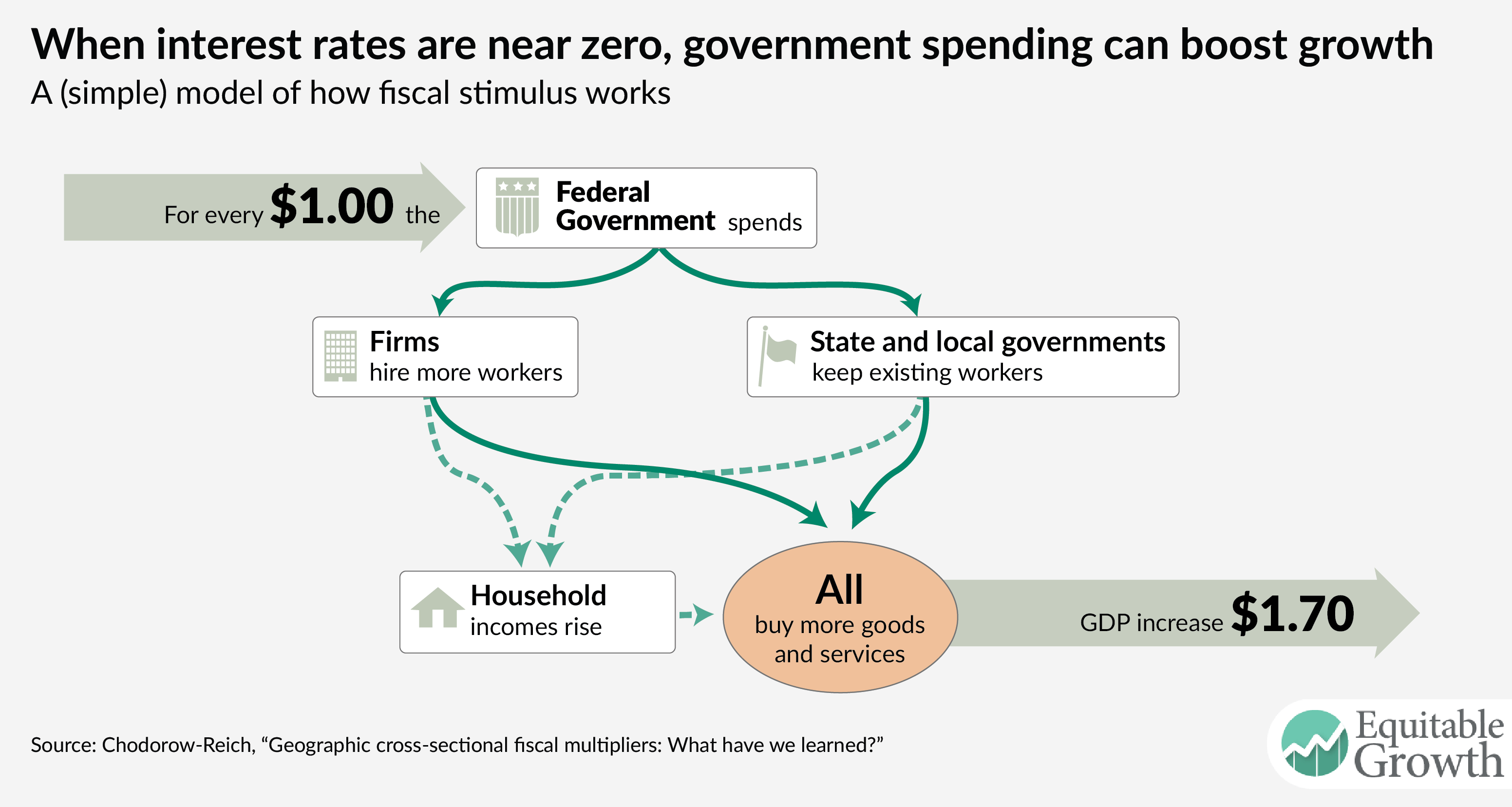
An example based on three papers studying the effects of the Recovery and Reinvestment Act makes clear the meaning of a cross-sectional multiplier. These papers exploit variation in the non-discretionary, formulaic component of the distribution of ARRA funds, due to factors such as pre-recession Medicaid spending or the number of lane miles of federal highway. I combine the spending variation in the three studies and use updated employment data and new state output data to estimate cross-sectional instrumental variable regressions of the cumulative increase in employment and output during 2009 and 2010 as a function of ARRA spending in a state. I find a cross-sectional “cost per job” of roughly $50,000 and output multiplier of roughly 1.75.

A review of the recent empirical literature broadly confirms the lessons from this example. One strand of this literature examines various components of the Recovery Act. The cost-per-job across these studies ranges from roughly $25,000 to $125,000, with around $50,000 emerging as a preferred number. Using a production-function approach, this magnitude translates loosely into an output multiplier of about 2. Another set of recent papers uses variation from historical episodes or other countries, many quite creatively. The diversity of outcome variables and policy experiments makes reaching a synthesized conclusion across these studies harder. Nonetheless, those papers that estimate a cost-per-job find numbers of around $30,000, and (with one or two notable exceptions) those which estimate income or output multipliers find numbers in the range of 1.0 to 2.5.

Research into the mapping between cross-sectional multipliers and national multipliers also has advanced. Three main differences can arise, depending on who pays for the spending, what monetary policy does, and the different openness of regions and the country as a whole.

Starting with the first, in many cross-sectional multiplier studies the spending does not affect the present value of local tax burdens, for example, because the spending is paid for by the federal government. Standard economic theory, however, suggests that such outside financing can have a small effect on local output. Fully rational, forward-looking, liquidity unconstrained households (sometimes denoted as so called “Ricardian agents”) will increase their private spending by only the annuity value of the outside transfer, which for transitory spending implies a small increase relative to the direct change in government purchases, while spending by fully “rule-of-thumb” or “liquidity-constrained” agents does not depend at all on the present value of the tax burden. In either case, the fact that the financing of the spending comes from outside the region adds little to the local private-spending response.

Monetary tightening in response to higher spending may reduce the output impact. Therefore, cross-sectional multipliers best help to characterize national multipliers when monetary policy is constrained, for example, by a zero lower bound on interest rates. Finally, expenditure switching and import leakage exert a downward influence on regional multipliers relative to the aggregate multiplier.

Combining these three arguments, the cross-sectional multiplier offers a rough lower bound for a national multiplier as long as the spending is relatively transient and monetary policy is constrained. These conditions appear likely to hold in many empirical settings, including during the implementation of the Recovery Act.

Combining the empirical evidence and the recent theory, the cross-sectional studies suggest a closed economy, constrained monetary policy, deficit-financed multiplier of about 1.7 or above.  This magnitude falls at the upper end of the range suggested by earlier studies using time series variation only.

The cross-sectional literature and my review essay have focused their attention most on understanding what cross-sectional multipliers imply about national multipliers. Other lessons also emerge. Foremost, many of the cross-sectional studies test for and find evidence of higher multipliers or less crowd-out in regions and periods with more unused resources. These results suggest multipliers may be larger during downturns and for reasons beyond constraints on monetary policy.

I conclude this summary with a comment on research practices. In the wake of the Great Recession of 2007-09, many have criticized the economics profession and macroeconomists in particular. The foray into cross-sectional multipliers offers a positive example of economists directing their research toward understanding newly relevant policy levers. Necessarily, the effort involved both empirical and theoretical advances. As a result, I believe we have a better grasp of the efficacy of fiscal policy than we did before the Great Recession started.

— Gabriel Chodorow-Reich is an assistant professor of economics at Harvard University. His research focuses on macroeconomics, finance, and labor markets. His working paper upon which this column is drawn can be found here.


hould-Read: Walt Mossberg: Lousy ads are ruining the online experience

Should-Read: Walt Mossberg: Lousy ads are ruining the online experience: “I left the Journal in 2013 and co-founded Recode…

…About a week after our launch, I was seated at a dinner next to a major advertising executive. He complimented me on our new site’s quality and on that of a predecessor site we had created and run, AllThingsD.com. I asked him if that meant he’d be placing ads on our fledgling site. He said yes, he’d do that for a little while. And then, after the cookies he placed on Recode helped him to track our desirable audience around the web, his agency would begin removing the ads and placing them on cheaper sites our readers also happened to visit. In other words, our quality journalism was, to him, nothing more than a lead generator for target-rich readers, and would ultimately benefit sites that might care less about quality…

When recessions happen, who’s most at risk?

According to a new study, low-earning individuals, men, and workers in construction and manufacturing are more at risk during a recession.


Recessions are risky affairs. When the overall economy starts to shrink, the likelihood a person’s own income is about to drop rises. But by how much? In other words, how much are the earnings of individuals tied to the risk of the overall economy? And given that it’s unlikely that everyone is going to face the same risk in the event of an economic downturn, how does this risk vary across the population? A new study takes a look at such questions for the United States.

The paper, by economists Fatih Guvenen of the University of Minnesota, Sam Schulhofer-Wohl of the Federal Reserve Bank of Chicago, Jae Song of the Social Security Administration, and Motohiro Yogo of Princeton University, looks at this question in the United States from 1978 to 2013. The dataset is the Master Earnings File from the Social Security Administration, which qualifies as “big data” to say the least. The data cover all the earnings for workers whose employers reported to the Social Security Administration—essentially the entirety of legal earnings in the U.S. economy.

Using these data, the authors can see how much the income of individuals fluctuates with changes in gross domestic product. They calculate how correlated the changes in GDP are to changes in an individual income. The higher this correlation, or “beta,”is, the more a person’s income will respond to changes in GDP. The riskier someone’s income, the higher their beta is.

Looking at risk by income level, the economists find a U-shaped relationship. Risk is higher for individuals with low earnings and declines as individuals move up the earnings distribution. Then, at around the 80th percentile, risk starts to increase a bit and then really picks up at the 90th percentile. It’s worth noting here that the earnings measured by the Social Security data includes capital gains, which are more volatile than labor earnings and could explain some of the increased risk faced by those at the top of the income distribution.

This same U-shaped relationship also holds up when you break out the relationship by gender. But at every percentile in the income distribution, men have a higher beta and more income risk than women. At the same time, earnings risk is not evenly distributed among workers in different industries. Earnings for workers at the 50th percentile are more volatile in the construction and durable manufacturing sectors and less volatile in health and education. Given the gender make-up of those industries—the manufacturing sectors are typically comprised mostly of men, while health and education are staffed more by women—this might explain some of the difference in risk between the two genders.

The variation in these risks has implications for how we think about social insurance programs and other efforts to smooth risk. As the authors note, while policies that help fight recessions – fiscal and monetary policy – wouldn’t eliminate all the risks documented in the paper, it could help reduce many of the worst effects of the recession for quite a few U.S. workers.

Must- and Should-Reads: January 23, 2017

  • Nicholas Bagley: Patching Obamacare at the State Level: “If Congress zeroes out the individual mandate—and my hunch is that it will—it’s game over for the exchanges…
  • Xavier Jaravel: The Unequal Gains from Product Innovations: Evidence from the US Retail Sector: “From 2004 to 2013 higher-income households systematically experienced a larger increase in product variety and a lower inflation rate for continuing products…
  • Larry Summers: Disillusioned in Davos: “I am disturbed by (i) the spectacle of financiers who three months ago were telling anyone who would listen that they would never do business with a Trump company…
  • Charles Stross: Why Scifi Matters More When the Future Looks So Dangerous: “Near-future scifi is not a predictive medium: it doesn’t directly reflect reality so much as it presents us with a funhouse mirror view of the world around us…
  • Robert Allen (2004): Progress and Poverty in Early Modern Europe: “At the end of the middle ages, the urban, manufacturing core of Europe was on the Mediterranean with an important offshoot in Flanders…
  • Michael Klein, Edward Schumacher-Matos, and Miriam Wasserman: Econofact: About: “EconoFact is… to bring key facts and incisive analysis to the national debate on economic and social policies…

Interesting Reads:

Must-Read: Michael Klein, Edward Schumacher-Matos, and Miriam Wasserman: Econofact: About

Must-Read: Talking Points!

Michael Klein, Edward Schumacher-Matos, and Miriam Wasserman: Econofact: About: “EconoFact is… to bring key facts and incisive analysis to the national debate on economic and social policies…

…It is written by leading academic economists from across the country who belong to the EconoFact Network, and published by the Edward R. Murrow Center for a Digital World at The Fletcher School at Tufts University…. Our mission at EconoFact is to provide data, analysis and historical experience in a dispassionate manner. The presentation is in short memo form and written in everyday language, free of jargon, and where appropriate, accompanied by visuals illustrating the main point. We are committed to presenting even complex economic analysis in a way that is accessible to all. Our guiding ethos is a belief that well meaning people emphasizing different values can arrive at different policy conclusions. However, if in the debate we as a society can’t agree on the relevant facts, then the nation itself loses a common base for constructive debate and policy will suffer…

Should-Read: Robert Allen: Progress and Poverty in Early Modern Europe

Should-Read: Robert Allen (2004): Progress and Poverty in Early Modern Europe: “At the end of the middle ages, the urban, manufacturing core of Europe was on the Mediterranean with an important offshoot in Flanders…

…The Netherlands was thinly populated, and England was an agrarian periphery. By 1800, the situation was largely reversed. First, the Netherlands and, then, Britain emerged as commercial and manufacturing powerhouses with the largest urban economies in Europe. Italy and Spain slipped behind. Only present-day Belgium managed to remained near the leaders, perhaps because of proximity to the Netherlands. Explaining this reversal in fortunes has been a central problem of social science, and the literature includes many conflicting hypotheses. This paper attempts to give an integrated assessment of six….

The intercontinental trade boom was a key
development that propelled northwestern Europe forward…. Northwestern Europe’s ascent began in the century before the American and Asian trades become important…. Yhe commercial revolution began… [as] an intra-European reorganization in which northwestern Europeans out competed Mediterranean producers in woolen textiles…. Northwestern Europe’s success was based on a two step advance–the first within Europe, the second in America and Asia. This success, it might be noted, marked the first steps out of the Malthusian trap…

Has Protectionism Ever Worked?

Q: Has protectionism ever worked? Are there examples of countries throughout history that have embraced protectionist policies, and did that yield positive results? And what do these examples, if there are any, tell us about the economic plans of Mr. Trump?

A: If I were you, I would go grab Robert Allen’s Global Economic History: A Very Short Introduction <http://amzn.to/2kgt8pj>, and immediately read chapters 8 and 9.

First, chapter 8: Briefly, tariffs–but on the manufacturing goods of the first and early second industrial revolution where learning-by-doing and developing effective communities of engineering practice–is a piece but only a piece of the standard nineteenth century industrialization package: subsidizing railways, schools, banks, and (the right kind of tariffs). They don’t work without the other three components. They do work for a while–for the mid- and late-nineteenth centuries and into the twentieth, with diminishing effectiveness–if the entire package is successfully implemented.

(Note that the British dominions–Canada, Australia, New Zealand–do fine without the tariffs. They become rich in the late nineteenth century. But in the 20th they do fall behind to some degree because they are not strong in the industries where twentieth century productivity growth is initially most rapid. And note that for countries that already have dominant positions in leading edge high tech communities of engineering practice, tariffs are simply a drag.)

Second, chapter 9: After the standard nineteenth-century package is played out, successful rapid development requires a “big push” and a successfully implemented big push: Japan, South Korea, Taiwan, and now China. (The Soviet Union is an interesting case–I am not sure Allen has gotten it right.) And a great many other countries have tried for “big pushes”, and failed. Tariffs on the goods in which your economy is going to have a comparative advantage in a generation are useful, but only those tariffs…

Trump’s plans–whatever they may be, and nobody knows what they are, not even, or perhaps especially, not him–have nothing to do with past successful episodes of the right kind of tariffs as part of a pro-growth or pro-opportunity industrial policy mix.

Sincerely yours,

Brad DeLong

Professor of Economics J. Bradford DeLong
U.C. Berkeley
delong@econ.berkeley.edu
925 708 0467
@delong

Should-Read: Charles Stross: Why Scifi Matters More When the Future Looks So Dangerous

Should-Read: We are narrative-loving animals. It’s how we think. We are jumped-up East African Plains Apes, only 3000 generations removed from those who first developed language, trying to understand the world as monkeys with, as Winnie-the-Pooh would say, “very little brain”. We are lousy at remembering lists—that is why we need to write them down. We are not much good at retaining sets of information—unless we can, somehow, turn them into a journey or a memory palace. We are excellent, however, at remembering landscapes. And we are fabulous at stories: human characters with believable motivations; beginnings, middles, and endings; hubris and nemesis; cause and effect; villains and heroes. To place ideas and lessons in the context of a story is a mighty aid to our thinking:

Charles Stross: Why Scifi Matters More When the Future Looks So Dangerous: “Near-future scifi is not a predictive medium: it doesn’t directly reflect reality so much as it presents us with a funhouse mirror view of the world around us…

…But in a post-truth world, it may be that only by contemplating deliberate un-truths can we retain our sense of what it is plausible to believe in the collage the media surround us with. State surveillance with overt goals that differ from actual, unadmitted motivations? Check. Intelligence bureaucracies that have their own agendas, focussed on institutional stability rather than carrying out their official mission? Check. Other groups infiltrating government agencies and using them for their own purposes, like parasitic wasps laying their eggs inside a paralyzed caterpillar? Check. This is what near-future science fiction can do for us: it glues convenient handles—explanations we can grasp—on models of phenomena that mimic the patterns of the real world, and gives us the chance to infer the intentions of the hidden manipulators. And that’s why near-future SF remains relevant—and dangerous—in the “post-truth” era…