>Should-Read: Larry Summers: Disillusioned in Davos

Should-Read: Larry Summers: Disillusioned in Davos: “I am disturbed by (i) the spectacle of financiers who three months ago were telling anyone who would listen that they would never do business with a Trump company…

…rushing to praise the new administration; (ii) the unwillingness of business leaders who rightly take pride in their corporate efforts to promote women and minorities to say anything about presidentially sanctioned intolerance; (iii) the failure of the leaders of global companies to say a critical word about US efforts to encourage the breakup of European unity and more generally to step away from underwriting an open global system; (iv) the reluctance of business leaders who have a huge stake in the current global order to criticise provocative rhetoric with regard to China, Mexico or the Middle East; (v) the willingness of too many to praise Trump nominees who advocate blatant protection merely because they have a business background…. My objection is not to disagreements over economic policy. It is to enabling if not encouraging immoral and reckless policies in other spheres that ultimately bear on our prosperity. Burke was right. It is a lesson of human experience whether the issue is playground bullying, Enron or Europe in the 1930s that the worst outcomes occur when good people find reasons to accommodate themselves to what they know is wrong. That is what I think happened much too often in Davos this week…

Should-Read: Xavier Jaravel: The Unequal Gains from Product Innovations: Evidence from the US Retail Sector

Should-Read: Xavier Jaravel: : The Unequal Gains from Product Innovations: Evidence from the US Retail Sector: “From 2004 to 2013 higher-income households systematically experienced a larger increase in product variety and a lower inflation rate for continuing products…

…Annual inflation was 0.65 percentage points lower for households earning above $100,000 a year, relative to households making less than $30,000 a year…. The relative demand for products consumed by high-income households increased because of growth and rising inequality; (B) in response, firms introduced more new products catering to such households; (C) as a result, continuing products in these market segments lowered their price due to increased competitive pressure…. Increasing relative demand leads to more new products and lower inflation for continuing products, implying that the long-term supply curve is downward-sloping…

Must-Read: Nicholas Bagley: Patching Obamacare at the State Level

Must-Read: Looking forward at the Trump administration, it now seems very clear that under the Trump administration policy will be:

  • random
  • unmotivated by technocratic effectiveness
  • very interested in cutting taxes for the rich
  • very interested in entrenching the economic position of the rich who have Trump’s ear
  • likely to produce a number of disasters–think Bush 43, only more so.

Therefore, it seems important that as much as possible should be done to encourage:

  • the neutralization of Trumpism at the state level.
  • the promising of future reimbursement of states that undertake said neutralization.
  • the highlighting–as a yardstick against which to measure policy–of what the plans were had the woman who won the majority of votes become president.

Nicholas Bagley has the ObamaCare front on this:

Nicholas Bagley: Patching Obamacare at the State Level: “If Congress zeroes out the individual mandate—and my hunch is that it will—it’s game over for the exchanges…

…Congress may try to devise an alternative—a continuous-coverage requirement, perhaps, or maybe auto-enrollment. But those alternatives probably can’t be passed in a reconciliation bill because they don’t involve revenues or outlays. Even if one or the other is adopted, it’s unlikely to be effective enough to forestall huge premium spikes for 2018 coverage. So unless Republicans opt to retain the mandate for several years, the states should brace themselves for the collapse of their individual insurance markets. It’s that simple.

But… nothing prevents state legislatures from adopting their own individual mandates…. Insurers might still head for the hills…. But the California exchange is healthy and, if a mandate replacement is in place by mid-2017, the economic picture for insurers in 2018 and 2019 won’t look all that different than it does today. There’s a chance that California could save 1.6 million people from losing coverage. The strategy[s]… prospects… in blue states like New York, Connecticut, Washington, and Oregon. Why not give it a shot? Republicans say they want to replace Obamacare with something that gives more power to the states to chart their own path. Maybe states should take them at their word.

Should-Reads for January 20, 2017

Over at Equitable Growth: Must- and Should-Reads:


Interesting Reads:

Should-Read: N. Gregory Mankiw and Lawrence H. Summers (1984): Are Tax Cuts Really Expansionary?

Should-Read: N. Gregory Mankiw and Lawrence H. Summers (1984): Are Tax Cuts Really Expansionary?: “If consumer spending generates more money demand than other components of GNP…

…then tax cuts may… increasing the demand for money, [may] depress aggregate demand. We examine a variety of evidence and conclude that the necessary condition for contractionary tax cuts is probably satisfied for the U.S. economy.

Mankiw, N. Gregory Mankiw and Lawrence H. Summers. “Money Demand and the Effects of Fiscal Policies,” Journal of Money, Credit and Banking, Vol. 18 (November 1986): 415-429.

Money Demand a Function of Private Consumption Spending, Not Income

Note to Self: I alway find it interesting that Friedman and the monetarists formulated money demand as a function of income rather than of private spending, or even of private consumption spending. You don’t need or want money when your income is high, unless you want to spend it.

And it seems highly likely that the ratio of desired money holdings to planned spending is much higher for consumption than investment. Money demand should therefore be a function of private sector consumption spending–and nominal interest rates–not a function of income. We thus have:

C = MV(i)/P

Y = C + I + G + (X-M)

And from this accounting framework it is very difficult indeed to make strong monetarist conclusions appear obvious facts of nature rather than weird and tendentious claims. Mankiw and Summers made this point back in 1982. And they were totally ignored—even though it was and is a very smart point…

Should-Read: Nick Rowe: AD/AS: A Suggested Interpretation

Should-Read: A (mostly) smart piece by Nick Rowe. But it is not wrong to start with Knut Wicksell, as long as you get to Irving Fisher. And C+I+G+(X-M)=Y is a way of starting with Wicksell–that’s why John Hicks called it the “IS Curve”. Many might find it clearer to start with Fisher (I certainly do), but experience has taught me that that is really a matter of taste.

The rest of this, however, is excellent:

Nick Rowe: AD/AS: A Suggested Interpretation: “Many macroeconomists don’t like the Aggregate Demand/Aggregate Supply framework…. So I am going to explain it…

…You will see that it portrays a deep and realistic understanding of macroeconomics that is lost in more “sophisticated” models. If you don’t start with the AD/AS framework you are doing it wrong. The AD/AS framework is useful for thinking about monetary exchange economies…. There are two ways an individual can increase the stock of money in his pocket… he can increase the flow in; or he can decrease the flow out. But what is possible for each individual may not be possible for all individuals, because one person’s flow out is another person’s flow in. Because there are… a flow out and a flow in… two equilibrium conditions…. The economy… on the AD curve when the actual flow out equals the desired flow out [given prices, incomes, fiscal policy, and the monetary policy rule]. The economy is at a point on the AS curve when the actual flow in equals the desired flow in [given wages and the difficulties of job hunting]….

Exchange is voluntary, so that actual quantity traded is whichever is less… Y=min{Yd(on the AD curve);Ys(on the AS curve)}. And… prices are sticky, so if one of the curves shifts quickly the economy will be at a point off (at least) one of the two curves. And you might want to draw a third curve that illustrates price stickiness…. And remember that whether the economy ever actually approaches the AD/AS intersection (“full-employment equilibrium”) is an open question… and the answer to that question will depend on many things, the most important of which is the monetary system or monetary policy regime…. It is easy to imagine a monetary policy regime which makes the AD curve never cross the AS curve, or slope the wrong way….

Start… with MV=PY…. Then go on to make M and V endogenous, if you wish…. And if you don’t start with money, monetary exchange, and AD and AS, you are doing macro wrong. Because the only thing that makes macro different from micro general equilibrium theory is the fact that macro incorporates the fact of monetary exchange, which microeconomists ignore…

Weekend Reading: “Stop, children, what’s that sound?” edition

This is a weekly post we publish on Fridays with links to articles that touch on economic inequality and growth. The first section is a round-up of what Equitable Growth published this week and the second is the work we’re highlighting from elsewhere. We won’t be the first to share these articles, but we hope by taking a look back at the whole week, we can put them in context.

Equitable Growth round-up

A new report put out late last month by the White House Council of Economic Advisors that finds national spending levels on children are lowest for children under five. This is a major problem considering the growing body of research that clearly shows children’s future contributions to the U.S. economy are largely shaped by their early environment.

Nick Bunker writes about a study that looks at how the increase in domestic outsourcing and the use of independent contractors in the United States and Germany has affected wages and the wage distribution.

A new working paper finds that family policies, especially investment in childcare and early learning programs, boosts women’s employment outcomes in the leading developed economies.

The Upshot looked at the extent of wealth concentrated within certain elite colleges. They found that some colleges have more students from the top 1 percent than the bottom 60 percent. The feature was based on research done by a group of economists, including Equitable Growth Steering Committee members, Raj Chetty of Stanford University and Emmanuel Saez of University of California-Berkeley, as well as Equitable Growth grantee Danny Yagan of University of California-Berkeley.

Links from around the web

Dean Baker gives a good overview of the economics of Obamacare, arguing that those who want a replacement plan will have to deal with the same structural imbalances in the health care economy that the Affordable Care Act’s original authors faced. [inet economics]

Dhruv Khullar, a resident physician at Massachusetts General Hospital and Harvard Medical School, writes about the extent to which our health system is sustained by “overworked and underappreciated” family caregivers. New research finds that our reliance on this unpaid “workforce” is unsustainable, and lays out ways we can better support caregivers. [the upshot]

It’s not black and Latino people who are self-segregating into neighborhoods. Instead, sociologists find that it’s white residents, many of whom claim to want more diversity but end up looking for homes in less diverse neighborhoods, according to Alvin Chang. [vox]

With the new Trump administration being critical of certain labor regulations, Bourree Lam writes about how more people are looking to the states to protect employees from wage theft and other illegal practices. [the atlantic]

Rebecca Vallas and Katherine Gallagher Robbins give an overview of many scholars’ critical response to the controversial New York Times story claiming that soda is the No. 1 purchase by households that receive supplemental nutrition benefits. [talk poverty]

Friday figure
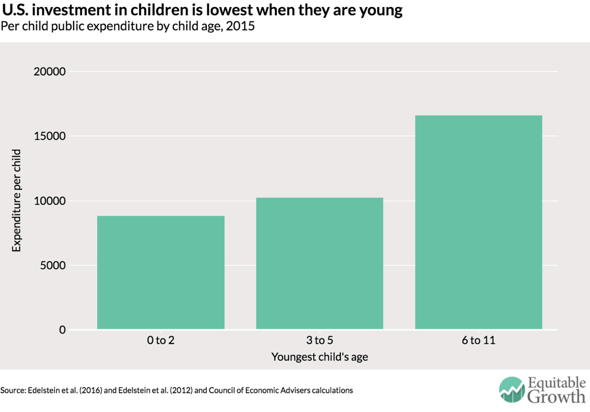
Figure from “Failing to invest in young kids is damaging the U.S. economy,” by Bridget Ansel.
Should-Read: Kevin Drum: Why Do Republicans Hate Obamacare?

Should-Read: Kevin Drum: Why Do Republicans Hate Obamacare?: “Why the continued rabid opposition to Obamacare?…

…It’s not because the government has taken over the health care market. On the contrary, Obamacare affects only a tiny part of the health insurance market and mostly relies on taking advantage of existing market forces. It’s not because the benefits are too stingy. That’s because Democrats kept funding at modest levels, something Republicans approve of. It’s not because premiums are out of control. Republicans know perfectly well that premiums have simply caught up to CBO projections this year—and federal subsidies protect most people from increases anyway. It’s not because everyone hates what Obamacare does. Even Republicans mostly like it. The GOP leadership in Congress could pass a virtually identical bill under a different name and it would be wildly popular.

In the end, somehow, this really seems to be the answer:

Charles P. Pierce: @kdrum @CitizenCohn I watched it close up for a week. Sheer spite is a bigger part of it than I would’ve believed.

Republicans hate the idea that we’re spending money on the working class and the poor. They hate the idea that Barack Obama is responsible for a pretty successful program. They hate the idea that taxes on the wealthy went up a bit. They hate the idea that a social welfare program can do a lot of good for a lot of people at a fairly modest price.

What kind of person hates all these things?

Should-Read: Duncan Black: Conservative Health Care Plan

Should-Read: Duncan Black: Conservative Health Care Plan: “Liberal Trump fanfic scenarios aside…

…the conservative plan for health care is “if you can’t pay for it, you suffer and then die.” This could be modified slightly to setting up a system by which your income is garnished for the rest of your life… or with a system that forces you to buy s—- health care insurance that you can’t afford and which won’t cover treatment anyway (ACA does this to some)…. That’s how it is, and anyone who pretends otherwise is stupid or lying. I suppose there’s some slight chance they’ll blackmail Democrats into supporting some plan which is only 90% as bad as this sounds, so that Republicans don’t get blamed for it, but otherwise that’s the only template for “replacement.