Must- and Should-Reads: January 19, 2017


Interesting Reads:

Across developed countries, family policies help women

The rise of the female workforce alongside women’s increased education in high-income nations marks one of the most stunning economic transformations in recent history. Over the past 40 years, many of these countries have responded by implementing a host of family policies that make it easier for women to balance work and family life. But how effective have these policies been in narrowing the gender gap in wages and employment?

A new working paper by Claudia Olivetti of Boston College and Barbara Petrongolo of the London School of Economics examines family policy across Western, high-income European countries, the United States, and Canada to try and establish whether there is a cause-and-effect relationship between family polices, such as paid parental leave after the birth of a child and increased spending on childcare and early learning programs, and women’s employment outcomes.

Olivetti and Petrongolo show that spending on childcare and early childhood learning, whether through subsidized childcare or in-work benefits (such as the Earned Income Tax Credit in the United States), has a negative correlation with the employment gap between men and women and an even larger effect on the gender wage gap. They find that “by this same logic, this implies that wage gaps are predicted to shrink with childhood spending.” This research should be considered in light of the fact that in 2012, the United States ranked 33rd out of 36 nations in the terms of investing in early childhood care and education relative to their overall income, according to the Organisation for Economic Cooperation and Development.

The authors also look at how maternity leave policies affect women’s outcomes. Though the median combined paid and unpaid parental leave was 60 weeks for the countries in the analysis, Olivetti and Petrongolo find that maternity leave has a small, but positive, effect on women’s employment and earnings for up to 50 weeks. Leave that goes beyond 50 weeks can have a negative effect on women’s earnings and career trajectories. Considering that U.S. policymakers are considering a bill that would provide families with only 12 weeks paid leave, that means American women would see a benefit according to the author’s results.

Olivetti and Petrongolo note that once the results are broken down by education level, there is a much larger benefit for low-skilled workers, while paid leave may even be “detrimental” for college-educated women. This may be because many high-skilled jobs tend to require more face time and longer hours. Taking more than a year out of the workforce to care for a new child, as many women in some European countries do, could signal a lack of commitment in certain environments, and women may be “mommy tracked” or pushed out altogether.

It’s also important to consider that the study encompasses a time when paid leave policies were usually confined to women. The authors do admit that while many countries have begun implementing leave for fathers, albeit on a more modest scale compared to what is allotted for women, the recent time frame makes it hard to evaluate. Research shows, however, that policies that are limited to or only used by women can backfire, which may explain why the Olivetti and Petrongolo’s results are so modest.

The reason? Maternity leave policies, if not accompanied by leave for men, can lead to discrimination against young women and also lock-in gender norms within heterosexual couples trying to balance their work and home life. A carefully-designed, gender-neutral paid leave policy, however, can socialize men to help more at home and create a “large and persistent” impact on gender dynamics even years after the leave period has ended.

The extent to which the United States is an outlier in the adoption of family friendly work-life policies is remarkable. While U.S. women have caught up to men in terms of educational attainment and show high levels of labor force participation in their 20s, that number begins to drop off once they reach their 30s and 40s because of childcare responsibilities. That’s because, despite being wealthier than many of the countries in this study, the United States, as mentioned earlier, is the only country without any kind of paid leave policy and spends very little on young children, meaning that parents must pick up the slack. Many women do so by cutting back at work or dropping out altogether, to the detriment of their long-term financial security and the potential future growth of our national economy.


Outsourcing and rising wage inequality in the United States and Germany

Ayesha Tully, left, responds to call while Larryll Emerson, 20, waits for information pertaining to his next work assignment at the Staffmark temp agency in Cypress, Calif.

Talking or writing about the outsourcing of jobs can conjure up images of jobs moving abroad. Increasingly, however, economists are demonstrating the importance of the domestic outsourcing of jobs in the U.S. labor market. A recent paper by Lawrence Katz of Harvard University and Alan Krueger of Princeton University highlights the importance of the “offline” gig economy, such as the rise of independent contractors in the years since 2005, rather than the more talked about role of the online gig economy (think Uber) in domestic outsourcing. A book by David Weil, the outgoing Department of Labor Wage and Hour Administrator, also documents the “fissuring” of the U.S workplace as more and more work is outsourced by firms within the United States.

But how much is the increased domestic outsourcing of jobs affecting the wages of workers?

A recent paper offers an answer, at least for German workers. Deborah Goldschmidt and Johannes Schmeider of Boston University look at how the increase in domestic outsourcing has affected wages and the wage distribution in Germany. The two economists take data that records not just information about workers (wages, education level, age) but also information about the employers they work for (by industry, the wages of other workers at the firm, and other factors) These data allow Goldschmidt and Schmeider to see what happens to the wages of workers after outsourcing occurs.

The data don’t directly show when an individual worker is moved to a contractor firm despite doing the same work, so the authors of the paper create measures that let them determine if a worker has been outsourced. They then compare the wages of a worker who has been outsourced to a similar worker who stayed inside the original firm. Goldschmidt and Schmeider find that domestic outsourcing leads to wage reductions of about 10 percent.

What’s behind this decline in wages? Well, workers who get outsourced are missing out on the “rent” (essentially excess profits) that the firm is sharing with the rest of the workers. Work on the rise of wage inequality in both Germany and the United States points to the importance of inequality within firms. By siphoning off “non-core” workers into contracted firms, management at the original firm is denying access to the wage benefits of working at the firm. Such a firm effect is a good sign that firms have the power to set wages—rather than the commonplace belief that wages are set by perfectly competitive labor markets.

Godlschmidt and Schmeider’s results are specific to the German experience and can’t directly speak to the U.S. labor market. But research on outsourcing in the United States also finds significant declines in wages for outsourced workers. An analysis similar to the German one could be done for the United States by accessing data from sources such as Longitudinal Employer-House Dynamics program or the Social Security Administration. Research on inequality in the United States using social security data points toward increasing “wage segregation” as a source of rising interfirm inequality. Yet given the rising attention toward outsourcing it would be good to have more concrete estimates of its impact on affected workers’ wages by tapping both data sets.

Failing to invest in young kids is damaging the U.S. economy

Eric Grant takes his three-year-old daughter Makayla to preschool in Philadelphia, Friday, Jan. 6, 2017.

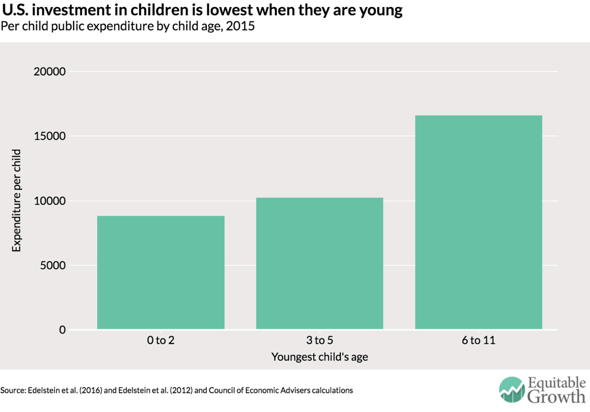
Over the past 200 years, the federal government and individual states developed a slate of programs to improve the education and care for children. These investments, most notably Kindergarten-through-12th grade education as well as pre- and after-school care, nutrition, and health aimed at helping children, were designed not only to boost individual welfare but also create a higher-skilled workforce and thus a stronger economy. But historically, our spending has focused on older children. And this continues to be true: A new report put out late last month by the White House Council of Economic Advisors finds that national spending levels are lowest for children under the age of five. This is a major problem considering that a growing body of research clearly shows that children’s future contributions to the U.S. economy are largely shaped by their early environments.

Today, federal, state, and local governments combined spend a average of $14,000 annually per child on education, care, nutrition, and health, among other things. But that average masks the upward trajectory of spending as children get older. Government spending is about $16,600 annually for children ages 6 to 11 (and slightly less for kids ages 12 to 18), but only $10,220 for 3- to 5-year-olds, and a meager $8820 for 0- to 2-year-olds. (See Figure 1.)

Figure 1

The lack of focus on early childhood education and care is due in part to an outdated system built on the assumption that mothers still stay home with a young child while fathers go to work—even though this post-WWII ideal was never the reality for many women, especially women of color. What’s more, other countries among the nation’s developed and rapidly developing peers have caught up. The United States today spends less than almost every other of these nations on early childhood education and care. In 2012, the United States ranked 33rd out of 36 nations in terms of investment in early childhood education relative to their overall income, according to the Organization for Economic Cooperation and Development.

Unlike the United States, these other OECD countries are reaping the benefits shown by the large body of research showing the benefits of high-quality early childhood care and education programs. Studies show these programs are one of the best ways to reduce economic inequality and improve individual outcomes later in life. That’s because the brain is more “flexible” and responds to its environment more than that of older kids. When investment in younger children is implemented on a national scale, research shows that helps create a more productive workforce and provides a boost to the overall economy.

The lack of investment in young kids is compounded by the fact that it occurs at a time when most families lack the means to invest as heavily as they should in their young children’s education. Compared to parents of older children and teenagers, those who have young children in the United States tend to have lower-than-average salaries, savings levels, and less access to credit compared to European countries, where incomes actually go up at this period in families’ lives. On top of that, the financial burden of childcare and early-education programs in the United States is well documented, largely due to the need of younger kids for more attention. That means public funds in the United States that are available may not go as far in terms of hours in a care or a good educational setting.

The report by the Council of Economic Advisers finds that 47 percent of children under the age of five are in some kind of publicly financed program (compared to 89 percent of 12-year-old children), yet these programs only amount to about five hours a week, which means that working parents have to make other arrangements for the rest of the time. The report focuses on the longer-term economic effects of increasing investment in young children, but there also would be more immediate benefits. Investing more in early childhood programs could free up time for parents to work, increasing household income and also spurring demand.

Because of the short- and long-run effects of investing in young kids, there is a very good argument that early childcare and early education programs should be included in our definition of infrastructure. Just as investing in the bridges, roads, and ports that make up our physical infrastructure produces an economic return, so too does investing in a greater “care infrastructure,” as this report highlights.  As the debate over infrastructure comes before Congress as a new presidential administration comes to power, policymakers should keep this research in mind as they think about ways to best strengthen and grow the U.S. economy over the next few years and over the long term.

Should-Read: Equitable Growth: Third Annual Class of Grantees

Should-Read: Equitable Growth: Third Annual Class of Grantees: “Research on how economic inequality affects macroeconomic growth and stability…

…Jess Benhabib, Alberto Bisin, and Mi Luo…. Gauti Eggertsson and Neil Mehrotra…. Adriana Kugler and Ammar Farooq…. Further research on the macroeconomy: Alexander Bartik… John Coglianese… Andrew Elrod…. How economic inequality affects the development of human capital…. Christopher Jencks and Beth Truesdale…. Marta Murray-Close and Joya Misra…. Sydnee Caldwell… Mariana Zerpa…. Research on how economic inequality affects the quantity and quality of innovation…. Kyle Herkenhoff… Heidi Williams… Patrick Kline… Neviana Petkova… and Owen Zidar…. Two doctoral grants will support further research on innovation: Xavier Jaravel… Hannah Rubinton…. Research on how levels and trends in economic inequality affect the quality of social and political institutions…. Manasi Deshpande… Tal Gross… and Jialan Wang… Jane Waldfogel and Ann Bartel… Maya Rossin-Slater… and Christopher Ruhm…. Joan Williams… Susan Lambert… and Saravanan Kesavan…. One doctoral grant will support further research on governance and institutions: Ellora Derenoncourt…

Should-Read: João Amador and Sónia Cabral: Networks of Value-Added Trade

Should-Read: João Amador and Sónia Cabral: Networks of Value-Added Trade: “Global Value Chains have become the paradigm…

…Bilateral gross trade flows no longer accurately represent interconnections among countries…. Examine… the profile of Germany, the US, China and Russia as suppliers of value added…. We took the World Input-Output Database (Timmer et al. 2015) and used network analysis…. Domestic and foreign value added are combined to produce exports…. In each year, the GVC is represented as a directed network of nodes (40 countries) and edges (value-added flows between them)…

Posted in Uncategorized

Should-Read: JEC: The Next New Macro

Should-Read: JEC: The Next New Macro: “The seeds of disaster… lay…

…in how easily New Classical-style models could be tweaked to get Keynesian behavior…. The mess in macro did not come about because some economists committed to a modelling style which turns out to yield little insight. The mess is a consequence of the… macro-mono-culture…. The fact is that, right now, we do not know the way forward, and no approach, no matter how promising (or how congenial to our pre-conceptions and policy preferences) should be allowed to dominate the field until it has proven itself empirically successful…. Why, then, did the entire discipline latch on to the New Classical approach? In a word: panic. Whatever the flaws in the New Classicals’ positive program, their negative critique of existing econometric practice was both true and devastating…

Must- and Should-Reads: January 17, 2017


Interesting Reads:

Must-Read: Guido Alfani: Europe’s Rich since 1300

Must-Read: Guido Alfani: Europe’s Rich since 1300: “Throughout this time, the only significant declines in inequality were the result of the Black Death and the World Wars…

…EINITE http://www.dondena.unibocconi.it/EINITE… has collected, systematically and with a uniform methodology, information about long-term trends in wealth inequality, and in the share of the richest, for many ancient Italian states as well as for a few other areas of Europe… from around 1300 to 1800…. Figure 1 shows the share of wealth of the top 10% between 1300 and 2010, using Piketty (2014) for the post-1800 period…. Remarkably, Piketty’s series for 1810-1910 shows the share of the richest growing at almost exactly the same pace as the I calculated for the series between 1550 and 1800….

Europe s rich since 1300 VOX CEPR s Policy Portal

In the seven centuries… we find only two phases of significant inequality decline. Both were triggered by catastrophic events: The Black Death…. Shocks occurred between 1915 and 1945 related to the two World Wars, as argued by Piketty 2014, pp. 368-370)…. The share of the richest 10% today is about the same as that in Europe (or at least, Italy) immediately before the Black Death…. The long-term perspective of recent research requires us to move beyond the characterisation of inequality time dynamics provided by Kuznets….

During the early modern period (from around 1600) the prevalence of the rich grew almost continuously until the onset of the Industrial Revolution. The rich made up no more than 5% of the overall population during the Middle Ages and the first part of the early modern period…

Europe s rich since 1300 VOX CEPR s Policy Portal

Must-Read: Kenneth Arrow et al.: Are We Consuming Too Much?

Must-Read: Kenneth Arrow et a.: (2004): Are We Consuming Too Much?: “We consider two criteria for the possible excessiveness (or insufficiency) of current consumption…

…One is an intertemporal utility-maximization criterion: actual current consumption is deemed excessive if it is higher than the level of current consumption on the consumption path that maximizes the present discounted value of utility. The other is a sustainability criterion, which requires that current consumption be consistent with non-declining living standards over time. We extend previous theoretical approaches by offering a formula for the sustainability criterion that accounts for population growth and technological change. In applying this formula, we find that some poor regions of the world are failing to meet the sustainability criterion: in these regions, genuine wealth per capita is falling as investments in human and manufactured capital are not sufficient to offset the depletion of natural capital.