Falling behind the rest of the world: Childcare in the United States

(Sara D. Davis/AP Images for Reading is Fundamental)

We’ve all heard the stories: Mothers who return to work less than two weeks after giving birth. Parents scrimping and saving in order to afford childcare, which now costs more than in-state college tuition or even rent in some places. Workers without sick leave who are forced to forgo pay to take care of a sick child. Such is the reality for millions of families in the United States.

Many policymakers don’t think to address this lack of support for children and working parents, assuming it is an individual responsibility. But once we look at other wealthy countries it’s clear that the United States is alone in this sentiment, spending less than almost all other developed countries.

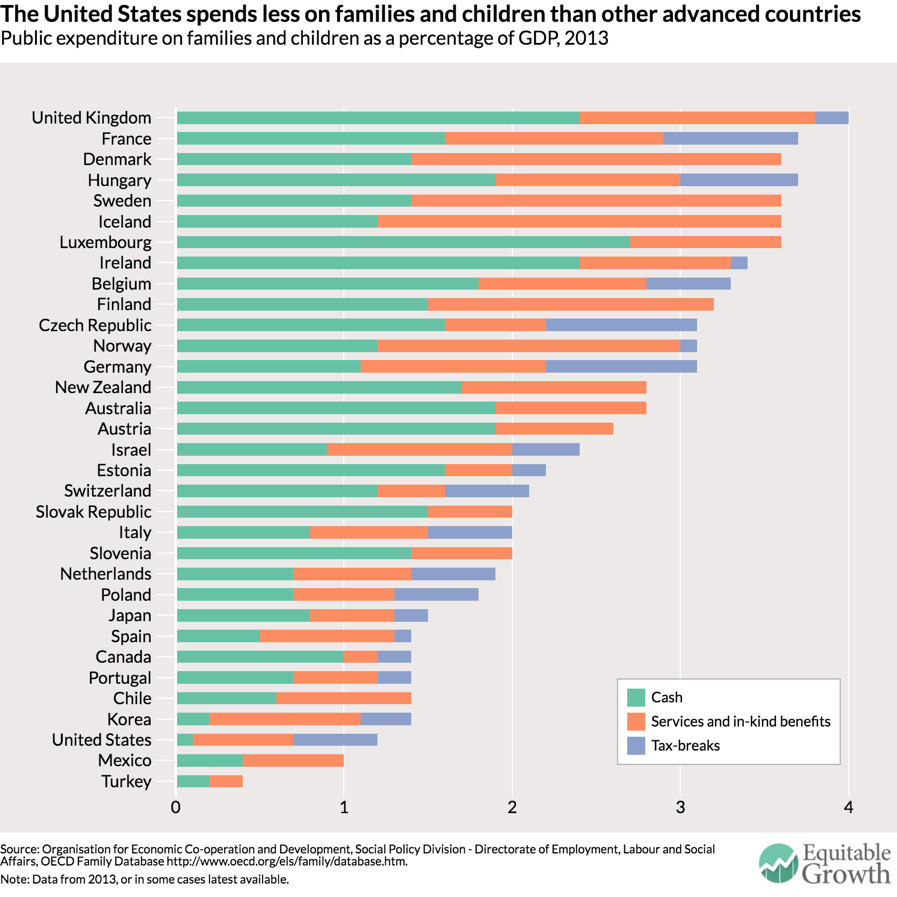
The United States ranks 30th out of 33 member nations of the Organisation for Economic Co-operation and Development in public spending on families and children, which includes policies such as child payments and allowances, parental leave benefits, and childcare support. Within the U.S., most spending comes in the form of services and in-kind benefits as well as tax breaks. In terms of cash benefits, which provides parents the most flexibility in how to provide for their children, the United States ranks last. Forty-two percent of what we spend on childcare benefits is administered through the tax code, a more complicated and less efficient form of benefit delivery. (See Figure 1.)

Figure 1

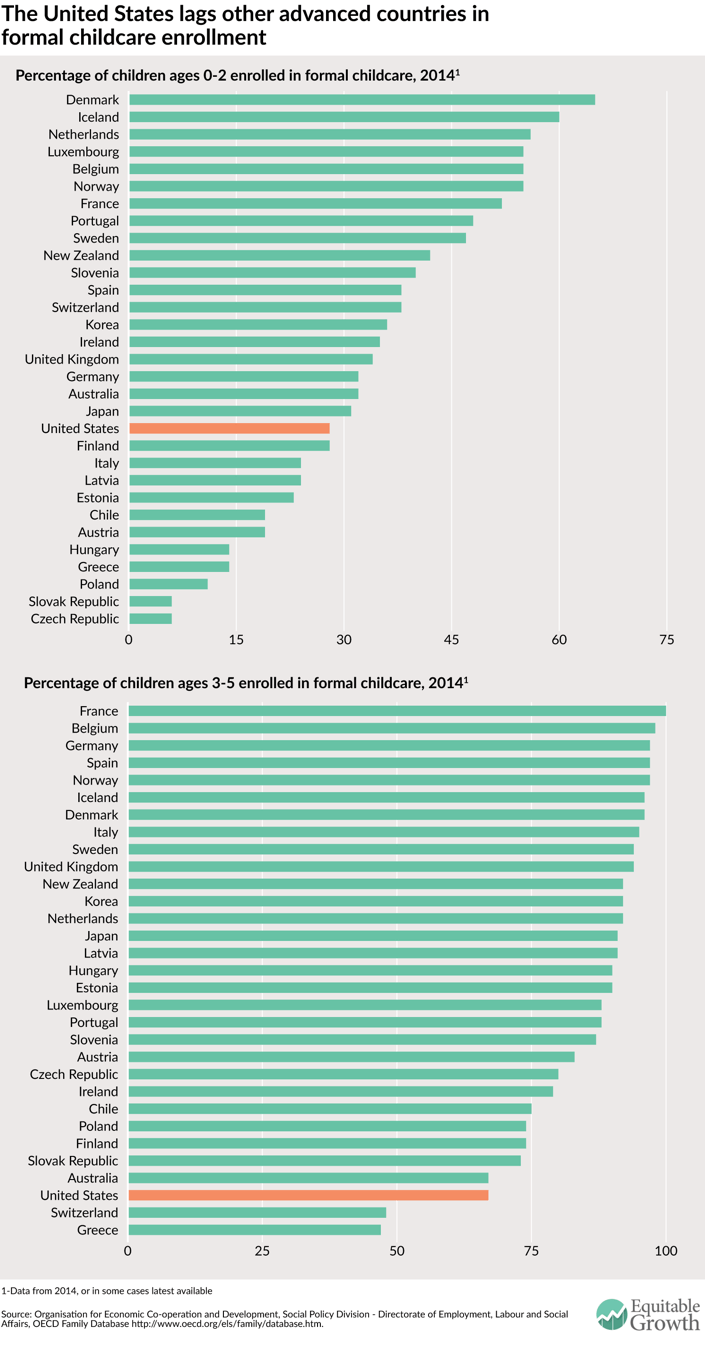
As for childcare, the United States ranks 20th out of 31 OECD countries (for which we have data) in percentage of children ages 0-2 who are enrolled in formal childcare and 29th out of 31 countries in percentage of children ages 3-5 who are enrolled in formal childcare. Only 28 percent of children ages 0-2 in the United States are enrolled in formal care, far behind most other advanced economies. (See Figure 2.)

Figure 2

The stark differences between childcare enrollments the United States and most other OECD nations comes down to policy differences. Most European countries invest heavily in high-quality education-based care and prekindergarten programs that serve all children. In contrast, the United States largely targets low-income families through programs that are subsets of larger policy initiatives and exist in three separate administrative structures: Head Start, Pre-K programs, and childcare vouchers for families with earnings less than 200 percent of the federal poverty line (funded through the Child Care and Development Block Grant and Temporary Assistance for Needy Family programs). And while middle- and professional-class families do have access to the Child Tax Credit, it is insufficient to meet the needs of most families considering the current cost.

The quality of U.S. early care and learning programs also is much lower than their European counterparts. And a significant amount of children who are eligible for assistance never receive it because of long waiting lists a lack of availability. A report put out by the U.S. Department of Health and Human Services finds that only 17 percent of children eligible for subsidies through the Child Care and Development Fund and other related federal programs received them.

Recent research shows the promise and tragedy of childcare in the United States. Not only is prohibitively expensive, it is one of the most effective policy interventions for children, families, and the economy. Investing in high-quality childhood care and education programs has been shown to be one of the best ways to improve individual outcomes for children and reduce inequality overall. It also keeps parents in the labor force—particularly new mothers—and promotes equal pay among men and women over the lifecycle of their careers, which means that families have more income. These factors, along with the substantial long-run returns on investment in early childhood programs, mean that while our own kids will always be an individual responsibility, their well-being should also be re-framed as a national economic and social priority.


Should-Read: Paul Krugman: Donald the Unready

Should-Read: Paul Krugman: Donald the Unready: “Betsy DeVos… doesn’t know basic education terms, doesn’t know about federal statutes governing special education…

…but thinks school officials should carry guns to defend against grizzly bears. Monica Crowley… withdrew after it was revealed that much of her past writing was plagiarized. Many other national security positions remain unfilled…. Rex Tillerson… [was] apparently unaware that he was in effect threatening to go to war if China called his bluff. Do you see a pattern here? It was obvious to anyone paying attention that the incoming administration would be blatantly corrupt. But would it at least be efficient in its corruption?…

The typical Trump nominee, in everything from economics to diplomacy to national security, is ethically challenged, ignorant about the area of policy he or she is supposed to manage and deeply incurious. Some… are even as addicted as their boss to internet conspiracy theories. This isn’t a team that will compensate for the commander in chief’s weaknesses; on the contrary, it’s a team that will amplify them. Why does this matter? If you want a model for how the Trump-Putin administration is likely to function (or malfunction), it’s helpful to recall what happened during… Bush-Cheney….

The last Republican administration was also characterized by cronyism, the appointment of unqualified but well-connected people to key positions…. Consider the botched occupation of Iraq…. And what will happen when we face a crisis? Remember, Katrina was the event that finally revealed the costs of Bush-era cronyism to all…. Real crises need real solutions. They can’t be resolved with a killer tweet, or by having your friends in the F.B.I. or the Kremlin feed the media stories that take your problems off the front page…. An administration unprecedented in its corruption, but also completely unprepared to govern. It’s going to be terrific, let me tell you.

Should-Read: Charles Stross: Insufficient Data

Should-Read: Charles Stross (2010): Insufficient Data: “So. I ask: how many people does it take, as a minimum, to maintain our current level of technological civilization?…

…I’d put a lower bound of 100 million on the range…. The specialities required for a civil aviation sector alone may well run to half a million people; let’s not underestimate the needs of raw material extraction and processing (from crude oil to yttrium and lanthanum), of a higher education/research sector to keep training the people we need in order to replenish small pools of working expertise, and so on. Hypothetically, we may only need 500 people in one particular niche, but that means training 20 of them a year to keep the pool going, plus future trainers….

You can’t simplify a complex society that runs on just-in-time delivery and a host of specialities. You need a huge training back-end to provide for the thousands of skilled graduate-entry niche occupations. You need an efficient just-in-time delivery system to keep everyone supplied with food, water, power, shelter and whatever else they need — it’s that, or accept huge inefficiencies in your supply chain that wipe out the gains produced elsewhere…. Seemingly similar artefacts (cars, phones, airliners) have invisibly accreted complexity… [that] makes them better (safer, more economical, more luxurious)… but vastly more difficult to engineer; stuff that used to be fixable by shade-tree mechanics and jobbing electricians has receded over the horizon. Back in the early 19th century, the complement of a sailing ship could expect to maintain the ship in every significant way using tools and expertise that they could carry aboard the ship. Today in the early 21st century, that’s not an option with airliners or probably even automobiles….

Space colonization? Get back to me when you’ve tracked down how many people it takes to design and build a space suit. (The number is in the hundreds, if not the thousands.) More realistically, we won’t have autonomous off-world colonies unless and until they can cover all the numerous specialities of the complex civilization that spawned the non-autonomous, dependent-on-resupply space program. Or, to put it another way: colonizing Mars might well be practical, but only if we can start out by plonking a hundred million people down there.

Must- and Should-Reads: January 24, 2017


Interesting Reads:

Should-Read: Gideon Rachman: Truth, Lies and the Trump Administration

Should-Read: Gideon Rachman: Truth, Lies and the Trump Administration: “Having a liar [like Donald Trump] in the White House is a disaster…

…not just for global security but also for the cause of democracy all over the world. Until now, dissidents in Russia, China or other authoritarian regimes could wage a lonely and dangerous fight for the truth, and point to the west to show that a better way existed. They could argue that lies are not the norm and that “the truth will set us free”. But the word freedom barely figured in Mr Trump’s inaugural address. And the US president is clearly indifferent to the truth…. Where else can the world turn? The German government, led by Angela Merkel, cannot do it alone. The British may be too desperate to do a trade deal with the US to take any chances with its relationship with Mr Trump….

The European democracies could still set an example, by demonstrating that most western countries do not practise the debased discourse of Trumpism. But the biggest role in protecting the truth—and therefore democracy itself—will fall to Americans. The press will need to be robust and courageous…. American institutions from the media to Congress and the courts have demonstrated their independence from the White House in the past. They are about to be tested as never before…

NAFTA and Other Trade Deals Have Not Gutted American Manufacturing—Period: Live at Vox.com

NewImage

Live at Vox.com: NAFTA and Other Trade Deals Have Not Gutted American Manufacturing—Period: Politically speaking, there was no debate on United States international trade agreements in 2016: All politicians seeking to win a national election, or even to create a party-spanning political coalition, agree that our trade agreements are bad things…. From the left… Bernie Sanders…. From the right—I do not think it’s wrong but it’s not quite correct to call it “right,” at least not as Americans have hitherto understood what “right” is—but from somewhere… now-President Donald Trump…. From the center establishment… popular vote–winning (but Electoral College–losing)… Hillary Rodham Clinton…. “I will stop any trade deal that kills jobs or holds down wages, including the Trans-Pacific Partnership. I oppose it now, I’ll oppose it after the election, and I’ll oppose it as president.…” The rhetoric of all three candidates resonates with the criticism of trade agreements that we heard way back when NAFTA was on the table as a proposal—not, as today, something to blame all our current economic woes on… Read MOAR at http://vox.com


This piece actually does only a third of what I wanted to do:

  1. Lay out how our trade agreements have not decimated manufacturing.
  2. Lay out what a properly-nurturing macroeconomic and industrial policy to increase the health of our important and valuable communities of engineering practice would be–but stress that such policies would not bring back mass manufacturing jobs.
  3. Account for the political mishegas.

But I only got through (1). And it is 8000 words. And I had to drop the extended notes and digressions that will go into the bibliographic essay…

Must-Read: Simon Wren-Lewis: Attacking Economics is a Diversionary Tactic

Must-Read: Simon Wren-Lewis: Attacking Economics is a Diversionary Tactic: “The financial crisis in the UK was the result of losses by banks on overseas assets, originating from the collapse in the US subprime market…

…UK macroeconomists failed to pick up the impending crisis [because] they did [not] routinely monitor… bank leverage. Macroeconomists generally acknowledge that they were at fault in ignoring the crucial role that financial sector leverage can play…. Admati and Hellweg have written persuasively that we need a huge increase in bank capital requirements to bring the ‘too big to fail’ problem to an end and avoid a future banking crisis, and the work of David Miles in the UK has a similar message. I have not come across an academic economist who seriously dissents from this analysis, but it has no impact on policy at all. The power of the banking lobby is just too strong.

So the response of economists to the financial crisis has been as it should be…. Economists have come up with clear proposals about how to avoid the crisis happening again. And these proposals have been pretty well ignored. In terms of conventional monetary and fiscal policy, academic economists got the response to the crisis right, and policymakers got it very wrong….

So given all this, why do some continue to attack economists? On the left there are heterodox economists who want nothing less than… the overthrow of mainstream economics…. The right on the other hand is uncomfortable when evidence based economics conflicts with their politics. Their response is to attack economists. This is not a new phenomenon, as I showed in connection with the famous letter from 364 economists…. The media did the rest of the job for them by hardly ever talking about the majority of economists who did not support austerity….

Attacking economists over Brexit is designed to discredit those who point out awkward and uncomfortable truths. Continuing to attack economists over not predicting the financial crisis, but failing to ignore their successes, has the effect of distracting people from the group who actually caused this crisis, and the fact that very little has been done to prevent a similar crisis happening in the future.

Should-Read: Lars Svensson: Leaning against the wind: Re-evaluating the evidence

Should-Read: Lars Svensson: Leaning against the wind: Re-evaluating the evidence: “‘Leaning against the wind’ refers to conducting, for financial-stability purposes…

…a tighter monetary policy (i.e. setting a higher policy interest rate) than would be justified by standard flexible inflation targeting if policymakers disregarded the possibility of a financial crisis. It has been promoted by the Bank for International Settlements (BIS 2014). Regarding the costs and benefits of leaning against the wind, an IMF Staff Report concluded that, “based on current knowledge, the case for leaning against the wind is limited, as in most circumstances costs outweigh benefits” (IMF 2015)…

Will Competition in Health Insurance Survive? The Odds Are Better After Yesterday

Guest Post from Michael DeLong: Will Competition in Health Insurance Survive? The Odds Are Better After Yesterday

Will competition in health insurance survive?

The answer after yesterday is “perhaps”.

The federal courts, at their lowest district court level, have just weighed in on the side of more competition and fewer behemoth health insurance companies; on the side of more competition and fewer monopolies and near monopolies. This matters for consumers: monopolies are bad news, and monopolies where what is being sold is a very expensive necessity—which health insurance coverage is—very bad news for consumers, and so for societal well-being. If we are to retain a market-based health insurance system, people need effective options. A market in which there is only one insurance company, or two companies that collude to match each other’s prices, has all the bureaucratic drawbacks of a single-payer system plus all the drawbacks of a monopoly.

The federal courts have weighed in because two health insurance companies, Aetna and Humana, decided to attempt a merger to form a behemoth company. President Obama’s Department of Justice decided to challenge the merger. The case went to trial. Last December 21st the Department of Justice wrapped up its case against the $37 billion Aetna-Humana health insurance merger, arguing that it should be blocked. Why? Harm to consumers: the merger would be anticompetitive in that it would harm consumers by making them pay higher premiums and offering them fewer choices. George W. Bush-appointed federal Judge John Bates pondered how to decide this case for a month.

This case and decision is very important for the health, the well being, and the pocketbooks of all Americans who participate or will participate in Medicare. It is most immediately important for the seventeen million senior Americans who have chosen Medicare Advantage plans, which are offered by private companies and in which Medicare pays these companies to cover their benefits. The merger would create Medicare Advantage monopolies in 70 counties and harm competition in 364 counties, where Medicare Advantage serves about 1.6 million seniors, of which almost 980,000 are enrolled with Aetna or Humana. In these areas the resulting MA market would have too few insurance companies for there to be any credible curb to prices by competition.

The merger would also eliminate competition between Aetna and Humana on the public exchanges in at least Florida, Georgia, and Missouri, which would greatly reduce choice for over 700,000 people. This reduction of choice would severely impact people with low or moderate incomes, who make up a disproportionate share of the exchanges.

Judges Bates decided to block the Aetna-Humana merger. He wrote that “the Court is unpersuaded that the efficiencies generated by the merger will be sufficient to mitigate the transaction’s anticompetitive effects for consumers.” In short, he agreed with the Department of Justice’s argument that if Aetna were to acquire Humana, competition in Medicare Advantage would be greatly harmed. The Department successfully argued that people choose Medicare Advantage because it offers them (given their particular circumstances) a much better deal than traditional Medicare. Medicare Advantage plans, like normal Medicare, cover doctor and hospital visits. But they sweeten the deal by offering things like dental, vision, and hearing benefits in exchange for limiting the network of doctors and hospitals patients can go to. For those who don’t place a high value on choice-of-doctor—or those who positively do not want the hassle but want to be steered—this is not much of a sacrifice. And if you have bad teeth, the dental coverage is worth a great deal. The Justice Department lawyers pointed out that even when Medicare Advantage prices spike, 85% of seniors that change their plans switch to other Medicare Advantage plans, and very few of them switch out into traditional Medicare. Thus they had substantial evidence for their claim that the merger will hurt competition and consumers.

An important part of the background to this case is that Aetna dropped out of the Affordable Care Act’s health exchange in eleven states after the government sued to block the merger. Aetna claimed this was an independent business decision, but the Justice Department said otherwise. It implied that Aetna was attempting to pressure the Obama administration into dropping its opposition to a harmful merger by threatening to weaken Barack Obama’s signature initiative. Lawyers during the case showed exchanges where Aetna CEO Mark Bertolini referred to Obama administration’s decision to block the merger and said that the administration had “a short memory, no loyalty, and very thin skin.” The Justice Department concluded by posing the question: can Aetna evade antitrust scrutiny by just withdrawing temporarily from markets?

Aetna and Humana argued that there would still be effective competition after the merger because they would sell 290,000 Medicare Advantage accounts to Molina—a health insurance company that primarily focuses on Medicaid. Molina has tried in the past to branch out and gain a share of the Medicare Advantage market. It has twice failed, and currently has only 424 Medicare Advantage members! In internal documents produced during the trial, Molina admitted “we do not have the same level of administrative expertise…we are woefully unresourced to take this [divestitures] on.” And 290,000 is a very small share of the 3.1 million Medicare Advantage patients currently covered by Humana. Odds are those 290,000 would soon flow back out of Molina’s coverage.

Past divestitures, most notably in the 2012 Humana-Arcadian merger, have failed to preserve competition. For Aetna-Humana’s claims about preserving competition to be credible, it would have had to propose divestitures orders of magnitude greater—millions of insurance policies—and made them to another insurance company with successful experience in running Medicare Advantage. The Department of Justice’s complaint proposed divesting insurance plans in a total of 364 counties in 21 states to meet antitrust requirements for preserving competition.

The trial could have gone the other way.

Aetna and Humana strenuously argued at the trial that Medicare Advantage and standard Medicare are really very close to each other. They claimed that Aetna-Humana’s market power to raise prices would be sharply curbed by the ability of patients to vote with their feet for traditional Medicare in response. And they claimed that Aetna’s withdrawal from the exchanges—no matter whether it was an independent business decision or a threat—was simply not relevant to the case.

If it had gone the other way, it would have been a substantial defeat for consumers. Past evidence is overwhelmingly clear that health insurance mergers lead to higher premiums. Little if any savings are ever passed on to consumers. Aetna-Humana would have become one of the nation’s largest insurance companies, able to wield substantial market power. The Aetna-Humana behemoth would have been dominant in Medicare Advantage in 364 counties across 21 states with 1.6 million seniors being served. In some counties the merged company would have wielded incredible power—in Polk County, Iowa, Aetna-Humana would have 79% of the Medicare Advantage market; in Shawnee County, Kansas, 100%. That would have been bad news for consumers. But it would have been very good news for investors in and executives of health insurance companies. Aetna-Humana’s profits would have likely jumped way up.

Moreover, a decision the other way would have been a starting gun for a new wave of additional health insurance mergers to further decimate competition.

Therefore Judge Bates’s disapproval of the Aetna-Humana merger is a substantial victory for consumers, for affordable health care, and for the continued survival of a market-based health insurance system. The health insurance merger frenzy over the past decade is likely stopped. Competition in Medicare Advantage going forward will be much stronger than had the merger gone through.

In addition, this outcome to the trial means that the ACA exchanges will also be stronger going forward. Fewer of them will likely fail due to insufficient competition. The danger for the exchanges is that health insurance companies raise prices, and then find that only the expensive-to-treat sign up for policies. Competition that forces health insurance companies to earn profits through efficiency rather than price increases makes the ACA exchanges healthier as well. Some of the exchanges do have their problems. But the solution should be to promote competition between insurers to benefit consumers, not to consolidate health insurance markets into one gargantuan entity. And the more options on the federal and state exchanges, the better the deals available to consumers.

Aetna has withdrawn from several state exchanges. But it has kept its options open so it can return and compete on the markets again if it seems profitable. In some exchanges Aetna lost money. In others it made substantial profits, most notably in Florida: $36 million in 2016.

Our health care and health insurance systems here in America are drastically underperforming: we spend more than twice as much money and resources on doctors, nurses, hospitals, and pharmaceuticals as the typical rich North Atlantic country, and yet on average our health is worse. Unless we want to accept our current broken system, our options are either to disrupt the entire health sector and move to a single-payer system or find ways to make health insurance markets competitive and functional. The ACA was one attempt to do that. The encouragement of competition for Medicare patients via offering government subsidies to insurance companies that would enter the Medicare Advantage market was another. The success of each of these still hangs in the balance. But things look a little brighter now than the looked last falls.


Michael M. DeLong is a community organizer, and was Director of the Coalition to Protect Patient Choice http://www.thecppc.com. Read the CPPC’s coverage of the Aetna-Humana trial at http://www.thecppc.com/cppc-blog/date/2016-12