Should-Read: Jim Acosta: On Twitter: “Talked to a former Trump campaign staffer…

Should-Read: Jim Acosta: On Twitter: “Talked to a former Trump campaign staffer: who has hired attorney in Russia probe and feels Trump himself should help pay for legal costs… https://twitter.com/Acosta/status/865762200757170176

…A few thoughts from this staffer:

In many ways, the Trump Associates are the real victims here. The world going after them and Trump leaving them abandoned on the battlefield. Yet many lives will be ruined in the process. At a minimum political careers dead and damaged ability to work in DC… (WH not commenting)

Posted in Uncategorized

Should-Read: John Gruber: Announcing JSON Feed

Should-Read: John Gruber: Announcing JSON Feed https://jsonfeed.org/version/1: “Brent Simmons and Manton Reece… https://daringfireball.net/linked/2017/05/17/json-feed

…We—Manton Reece and Brent Simmons—have noticed that JSON has become the developers’ choice for APIs, and that developers will often go out of their way to avoid XML. JSON is simpler to read and write, and it’s less prone to bugs. So we developed JSON Feed, a format similar to RSS and Atom but in JSON. It reflects the lessons learned from our years of work reading and publishing feeds.

I think this is a great idea, and a good spec…. Daring Fireball has a JSON Feed. I’ve got a good feeling about this project—the same sort of feeling I had about Markdown back in the day…

Posted in Uncategorized

Must-Attend: Berkeley Behaviorial Economics Initiative: Celebration of 30 Years of Behavioral Economics at Berkeley

Must-Attend: But, alas!, I will not—I have to miss it. It is really a shame…

Berkeley Behaviorial Economics Initiative: Celebration of 30 Years of Behavioral Economics at Berkeley: May 20, 2017 :: Wells Fargo Room at U.C. Berkeley:

  • 12:00 noon: Lunch On Site in Haas Courtyard, with Gelato on the cone from Caravaggio Gelato
  • 1:00 PM: Introduction: Carla Hesse (Dean of Social Sciences, Berkeley)
  • 1:10 PM: Behavioral Economics On the Field: Farhan Zaidi (General Manager, LA Dodgers), introduced by Stefano DellaVigna (Co-Director of Behavioral Initiative)
  • 2:00 PM: Back to 1987: Some Ideas for the Future: George Akerlof and Daniel Kahneman (Instructors of 1987 PhD Class in Berkeley on “Psychology and Economics”)
  • 3:00 PM: Becoming Behavioral Economists at Berkeley: Saurabh Bhargava (CMU), Zack Grossman (UCSB), Devin Pope (University of Chicago), Gautam Rao (Harvard), Paige Skiba (Vanderbilt), Justin Sydnor (University of Wisconsin)
  • 3:30 PM: Coffee Break
  • 4:00 PM: Roundtable on Behavioral Economics in Berkeley: The Past and the Next 30 Years Matthew Rabin (Harvard). “Behavioral Models for the Future”
  • 4:20 PM: Roundtable: Five-Minute Takes: “Witnessing the Rise”: Daniel McFadden (Berkeley), Hal Varian (Berkeley and Google); “Training in Behavioral in the Early Years”: Gary Charness (UCSB), Ted O’Donoghue (Cornell), Terry Odean (Berkeley); “Behavioral Faculty at Berkeley”: Shachar Kariv (Berkeley), Botond Koszegi (CEU)
  • 5:00 PM: Round Table: Open Discussion
  • 5:35 PM: Closing Reflections: Rich Lyons (Dean of Berkeley Haas)

Economics 296 and Psychology 290Q :: Spring 1987

University of California :: Professors Akerlof and Kahneman :: Departments of Economics and Psychology

1. Violations of Assumptions of Economic Theory

  • W. Bazerman: JUDGMENT IN MANAGERIAL DECISION-MAKING (Wiley, 1986), chs. 1-3, pp. 1-66.

2. Situations in Which Violations Make No Difference

  • M. Miller and F. Modigliania: The Cost of Capital, Corporation Finance, and the Theory of Investment: AMERICAN ECONOMIC REVIEW (June 1958), pp. 261-97.
  • G. Becker: THE ECONOMICS OF DISCRIMINATION, Introduction, chs. 1-3, pp. 1-54.
  • R. Nisbett and L. Ross: HUMAN INFERENCE: STRATEGIES AND SHORTCOMINGS OF SOCIAL JUDGMENT, chs 11.

3. Models Where Violations of Assumptions Make a Difference

  • S. Salop and J. Stiglitz: Bargains and Ripoffs: A Model of Monopolistically Competitive Price Dispersion: REVIEW OF ECONOMIC STUDIES (1977) pp. 493-510.
  • G. Akerlof and W. Dickens: The Economic Consequence of Cognitive Dissonance: AMERICAN ECONOMIC REVIEW 72 (June 1982), pp. 307-19.
  • J. Haltiwanger and M. Waldman: Rational Expectations and the Limits of Rationality: An Analysis of Heterogeneity: AMERICAN ECONOMIC REVIEW (June 1985), pp. 326-40.
  • T. Russell and R. Thaler: The Relevance of Quasi-Rationality in Competitive Markets: AMERICAN ECONOMIC REVIEW (December 1985), pp. 1071-82.

4. Near Rationality Theory

  • G. Akerlof and J. Yellen: A Near Rational Model of the Business Cycle with Wage and Price Inertia: AMERICAN ECONOMIC REVIEW
  • G. Akerlof and J. Yellen: Can Small Deviations from Rationality Make Significant Differences to Economic Equilibrium?: QUARTERLY JOURNAL OF ECONOMICS (September 1985), pp. 708-820.
  • G. Akerlof and J. Yellen: A Dynamic Envelope Theorem (1986).

5. Detailed Discussion of Assumptions

  • Bazerman, chs. 6-9, pp. 67-169.
  • A. Tversky and D. Kahneman: Rational Choice and the Framing of Decision: JOURNAL OF BUSINESS (October 1986), pt. 2,= pp. S251-76.
  • D. Kahneman and A. Tversky: Prospect Theory: An Analysis of Decision Under Risk: ECONOMETRICA (March 1979), pp. 263-91.
  • H. Arkes and C. Blumer: The Psychology of Sunk Cost: ORGANIZATIONAL BEHAVIOR AND HUMAN DECISION (1985), pp, 124-40.
  • R. Thaler: Toward a Positive Theory of Consumer Choice: JOURNAL OF ECONOMIC BEHAVIOR AND ORGANIZATION (March 1980), pp. 39-60.
  • E. Hoffman and M. Spitzer: The Coase Theorem: Some Experimental Tests: JOURNAL OF LAW AN ECONOMICS (1982), pp. 73-98.
  • D. Kahneman, J. Knetsch, and R. Thaler: Fairness and the Assumptions of Economics: JOURNAL OF BUSINESS (October 1986), pt. 2 pp. S285-300.
  • J. Knetsch and Sinden: Willingness to Pay and Compensation Demanded: QUARTERLY JOURNAL OF ECONOMICS (August 1984), pp. 507-21.
  • J. Kagel and D. Levin: The Winner’s Curse and Public Information in Common Value Auctions: AMERICAN ECONOMIC REVIEW (December 1986), pp. 894-921.
  • R. Bishop and T. Heberlein: Measuring Values of Extra-Market Goods: Are Indirect Measures Biased?: AMERICAN JOURNAL OF AGRICULTURAL ECONOMICS (1979), pp. 926-30.
  • B. McNeil, S. Parker, H.. Sox, and A. Tversky: On the Elicitation of Preferences for Alternative Therapies: NEW ENGLAND JOURNAL OF MEDICINE no. 306 (1982), pp 1259-62.

6. Applications to Markets

  • R. Frank: Are Workers Paid Their Marginal Products?: AMERICAN ECONOMIC REVIEW (September 1984), pp. 549-71.
  • D Kahneman, J. Knetsh, and R. Thaler: Fairness as a Constraint on Profit Seeking: Entitlements in the Market: AMERICAN ECONOMIC REVIEW (September 1986), pp. 728-41.
  • G. Akerlof: Labor Contracts as Partial Gift Exchange: QUARTERLY JOURNAL OF ECONOMICS (November 1982), pp. 543-69.
  • M. Weitzman: The Simple Macroeconomics of Profit Sharing: AMERICAN ECONOMIC REVIEW (December 1985), pp. 937-53.
  • R. Shiller: Stock Prices and Social Dynamics: BROOKINGS PAPERS ON ECONOMIC ACTIVITY 1984:2 (1984), pp. 457-510.
  • W. De Bondt and R. Thaler: Does the Stock Market Overreact?: JOURNAL OF FINANCE (July 1985), pp. 793-808.
  • K. Arrow: Risk Perception in Psychology and Economics: ECONOMIC ENQUIRY (1982), pp. 1-9.

Weekend reading: “mind the gap” edition

Equitable Growth round-up

Research has documented how the gender pay gap widens over a lifetime, but where does it come from? Is it because men are more likely to get promoted or secure higher wages? Or do men go out and finds jobs at a higher rate, and secure better salaries when they do? New research digs into these questions.

Nick Bunker takes a look at the mortgage interest deduction, the benefits of which flow disproportionately to those near the top of the income spectrum.

Despite the growing interest from policymakers, the data show that the online gig economy may not be as big as many people think. But there should be concern about the rise of other types of “alternative work arrangements” created by companies’ increasing contracting out labor.

As central bankers prepare to reduce the amount of assets held by the Federal Reserve in an attempt to “normalize” monetary policy, Nick Bunker argues that a return to normalcy might not be the best option.

Links from around the web

As manufacturing jobs have vanished in many regions within the United States, Alana Semuels reports that a growing number of men are turning towards jobs that are traditionally dominated by women, especially within the healthcare sector. [the atlantic]

Despite a growing use of seemingly productivity-enhancing technologies, the U.S. has experienced a slowdown in productivity growth in recent years. Noah Smith argues that it’s possible that we actually are getting things done in a more efficient manner—but are using the extra time to goof off at work. [bloomberg view]

Tanvi Misra writes about new research finding that between 1880 and 2010, black Americans had much lower rates of upward mobility compared to their white counterparts that started from the same economic position. [city lab]

Even with an improved economy and a stronger housing market, homeowners are moving less. Conor Dougherty looks at how a steady rise in interest rates are deterring people from buying new homes, which could have an impact throughout the economy. [new york times]

The rich are living longer than the poor, which has implications beyond our physical well-being. Michael Hiltzik writes about how the growing disparities in life expectancy is making Social Security less progressive: Originally designed to help lower-income Americans, Social Security is now paying higher-income Americans more than those that are less well-off. [los angeles times]

Friday figure
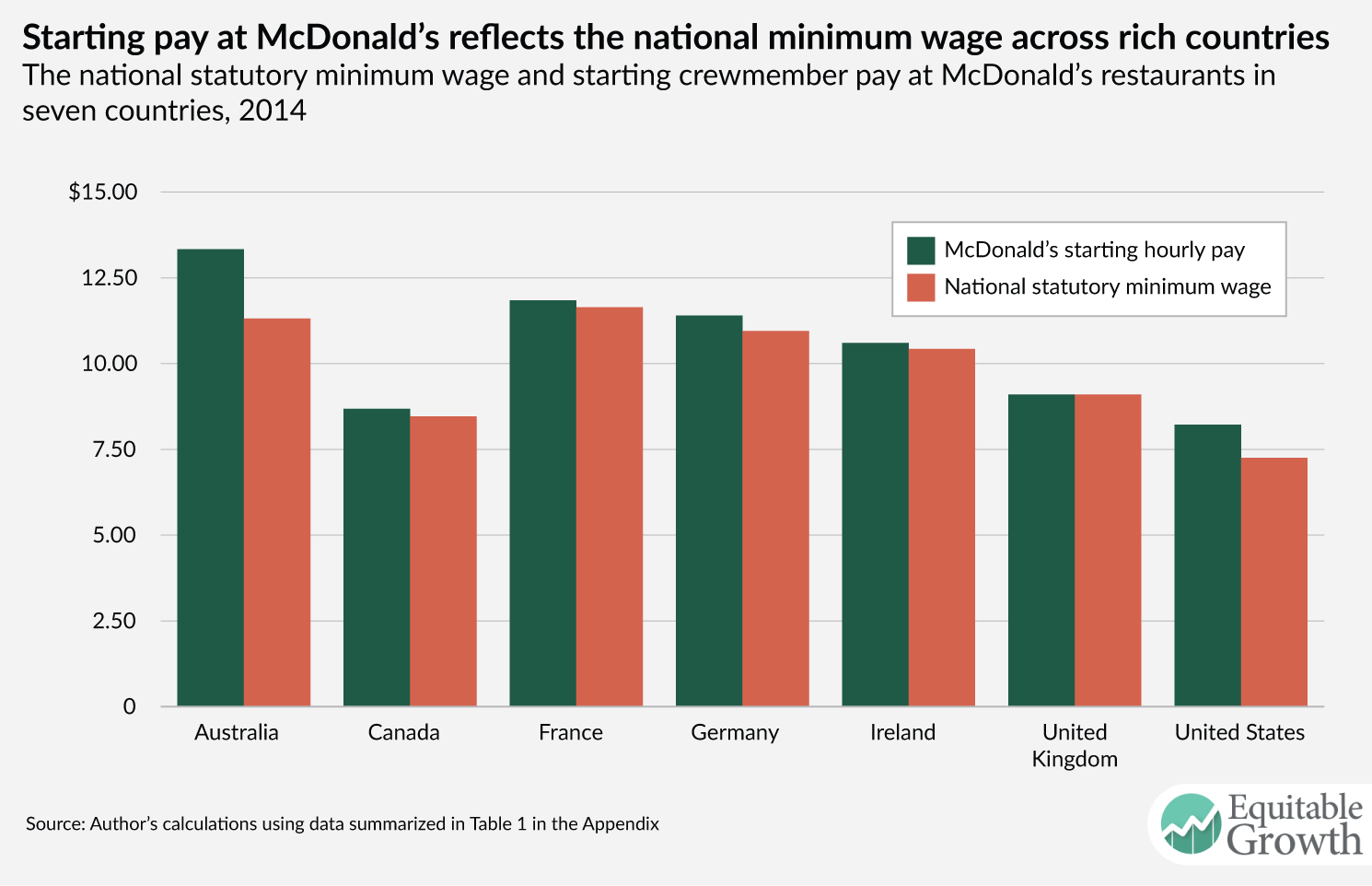
From “The importance of raising the minimum wage to boost broad-based U.S. economic growth.”
Must- and Should-Reads: May 19, 2017


Interesting Reads:

Must-Read: Ryan Avent: Free exchange: A new anthology of essays

Must-Read: Ryan Avent: Free exchange: A new anthology of essays http://amzn.to/2pYyN2A reconsiders Thomas Piketty’s “Capital”: “The book explores arguments left undeveloped in Mr Piketty’s masterwork… http://www.economist.com/news/finance-and-economics/21722166-book-explores-arguments-left-undeveloped-mr-pikettys-masterwork-new

The Economist… Thomas Piketty… Capital in the Twenty-First Century… advi[sed] to take the analysis seriously, yet to treat the policy recommendations with caution. The book’s striking warning of the creeping dominance of the very wealthy, looks as relevant as ever: as Donald Trump’s heirs mind his business empire, he works to repeal inheritance tax. But “Capital” changed the agenda of academic economics far less than it seemed it might.

A new volume of essays reflecting on Mr Piketty’s book, published this month, prods economists to do better. It is not clear they can. After Piketty: The Agenda for Economics and Inequality, edited by Heather Boushey, Bradford DeLong and Marshall Steinbaum, is a book by economists, for economists…. Piketty argued that wealth naturally accumulates and concentrates, so that familial riches are ever more critical to determining an individual’s success or failure in life. The extravagant inequality of the Gilded Age could return if no preventive action is taken…. Despite its 700-odd pages, “Capital” gave important details short shrift. “After Piketty” takes these lacunae in turn, pointing out, essay by essay, how Mr Piketty might have devoted more space to the role of human capital and technological change, the structure of the firm and the rise in outsourcing, sexual inequality, geography and so on….

[The] damning critique [of Piketty]… treats the elasticity of substitution as a meaningful parameter in a well-behaved economy. It may not be. In the most incisive essay in “After Piketty”, Suresh Naidu describes a “domesticated Piketty” who communicates in the language of economics and whose argument hinges on things like the elasticity of substitution… [and] a “wild Piketty” who pays attention to social norms, political institutions and the exercise of raw power. He suggests that r > g is not a theory to be disproved but a historical fact to be explained. And he suggests that the wealthy use their influence to shape laws and society in order to guarantee themselves a better return on their wealth….

Politics is “everywhere and nowhere” in Mr Piketty’s book, as Elisabeth Jacobs notes in her essay. What “After Piketty” reveals is the message lurking within all the undeveloped arguments in “Capital” about politics and ideology. It is that economists set themselves too easy, too useless a task if they can describe how capitalism works only when politics is unchanging…

Should-Read: Rick Levin: Toward Sustainable Financing of Higher Education

Should-Read: The problem is that nobody really knows—yet—how to accomplish the successful “scaling [of] faculty productivity through online education”. The people who can successfully take MOOCs—at least as they are currently organized and envisioned—are people who could perfectly well learn via sustained interaction with the Turing-class virtual instantiation of the thinker they could construct and run on their wetware—in other words, by reading and thinking about the book.

The fact that the lecture survived Gutenberg strongly suggests that that slice of the population—the successful MOOC-takers—is a relatively small fraction of even those who excel and strongly benefit from our current system of higher education.

Rick Levin: Toward Sustainable Financing of Higher Education: “In the face of rising costs of attendance and an escalating burden of student debt… http://www.cshe.berkeley.edu/events/toward-sustainable-financing-higher-education-0

…universities are under pressure to increase productivity and control costs.  This lecture offers three suggestions: (1) a novel framing of the argument for public support of universities, (2) conserving capital expenditures by proper accounting for the cost of facilities, and (3) scaling faculty productivity through online education…

Must-Read: Paul Krugman: Calling Literatures From The Vasty Deep

Must-Read: My two—three—macro papers would be: Krugman (1998) https://www.gc.cuny.edu/CUNY_GC/media/LISCenter/pkrugman/1998b_bpea_krugman_dominquez_rogoff.pdf, Blanchard-Leigh (2013) https://www.aeaweb.org/articles?id=10.1257/aer.103.3.117, and Mian-Sufi (2011) https://www.aeaweb.org/articles?id=10.1257/aer.101.5.2132

Paul Krugman: Calling Literatures From The Vasty Deep: “Noah [Smith’s]… Two Paper Rule…

…Give me two papers in this vast literature that are “exemplars and paragons” of the literature. If you can’t, the whole literature is probably a waste of time. Which… sets some of us to work trying to think of the two papers…. My examples. [While] Noah is generally very down on macroeconomics… I believe that we’ve learned a lot… since… 2008…. Fiscal policy: before the crisis there was strikingly little solid evidence… because history gave us so few natural experiments…. I’d point to Blanchard and Leigh https://www.aeaweb.org/articles?id=10.1257/aer.103.3.117, using austerity as an experiment, and Nakamura-Steinsson http://www.columbia.edu/~en2198/papers/fiscal.pdf, exploiting regional shocks from defense spending. Not saying these are the only fine papers, but they’re enough to show that there’s a real there there…. Dramatic confirmation of what some of us thought we knew about monetary policy at the zero lower bound. I can think, for example, of a 1998 paper https://www.gc.cuny.edu/CUNY_GC/media/LISCenter/pkrugman/1998b_bpea_krugman_dominquez_rogoff.pdf that has held up really well…. Trade? Autor/Dorn/Hanson https://www.aeaweb.org/articles?id=10.1257/aer.103.6.2121 on the China shock may not be the last word, but surely a revelatory approach…. Subramanian and Kessler https://piie.com/publications/wp/wp13-6.pdf… realizing that this globalization is different….

I’m pushing back against Noah’s nihilism (noahlism?) even while endorsing his method…

Should-Read: Matt O’Brien: How Japan proved printing money can be a great idea

How Japan proved printing money can be a great idea The Washington Post

Should-Read: Matt O’Brien: How Japan proved printing money can be a great idea: “Falling prices would mean falling wages, but not falling debts, so they would become harder to pay back… http://www.nzherald.co.nz/business/news/article.cfm?c_id=3&objectid=11857507

…In the best case, the economy would get stuck in a cycle of low consumer spending leading to low business investment leading to low hiring, and then even lower consumer spending. And in the worst, everyone would go bankrupt. That’s why Japan has put so much emphasis on getting its inflation rate back above zero. It wants to get into the opposite cycle of higher prices leading to higher wages leading to lower debt burdens leading to more consumer spending and then more business investment…. That has been the whole point of “Abenomics”…. Although there have been stops and starts, and debates and doubts, the reality is that it is working, emphasis on those last three letters…. The best way to tell isn’t its super-low unemployment rate, but rather its super-high employment rate… 83.5 per cent, making our own 78.3 per cent rate look downright measly in comparison…. Japan’s unemployment rate hasn’t fallen for the bad reason that people have given up looking for work, but for the good one that almost everyone who isn’t drawing a pension has found one. It’s what unfinished progress looks like…