U.S. workers need sectoral bargaining now more than ever

Key takeaways:
- Sectoral bargaining—a negotiating framework that empowers workers and their representatives within an entire industry, not just at one worksite, to bargain for common standards—would help boost union coverage in the United States amid historically high public support for the labor movement, reversing decades of decline and ensuring broad access to the material benefits of collective bargaining.
- The degradation of worker and environmental standards would be mitigated by a level playing field established through sectoral standards.
- Sectoral bargaining is particularly important amid the rise of artificial intelligence and the need for an equitable transition to a green economy. Unions have proven to be effective negotiators in periods of technological change; a sectoral framework would strengthen unions’ negotiating positions on AI and the move to a clean energy economy.
- What this means for growth: Sectoral bargaining could boost U.S. economic growth, as higher incomes drive consumption and greater macroeconomic resiliency improves investment conditions.
Overview
U.S. union membership and coverage rates have declined for decades, fueled in part by legal barriers to new organizing, including the limiting of collective bargaining to specific workplaces or employers and misclassifying certain groups of workers so they legally cannot unionize. Indeed, worksite-level bargaining enshrined in U.S. labor law is important, but it lacks a dedicated mechanism to build solidarity within broad economic industries, siloing organizing campaigns by employers or locations. Legal decisions undermining the National Labor Relations Act mean that workers face obstacles in forming unions just as the U.S. labor movement is enjoying a historic revival in public support. Perhaps most perniciously, independent contractors—including millions of misclassified workers—face an uphill battle to win the right to form a union.
Despite a brief interruption during the COVID-19 recession in 2020, when unionized workers were laid off at a less rapid pace than their unionized counterparts, union coverage rates have continued their decline in the past decade. In fact, the U.S. private sector has added more than 20 million jobs since the Great Recession of 2007–2009, an almost 20 percent increase in total private employment, while the number of workers covered by a union contract rose by only about half a million, or just a 7 percent increase.
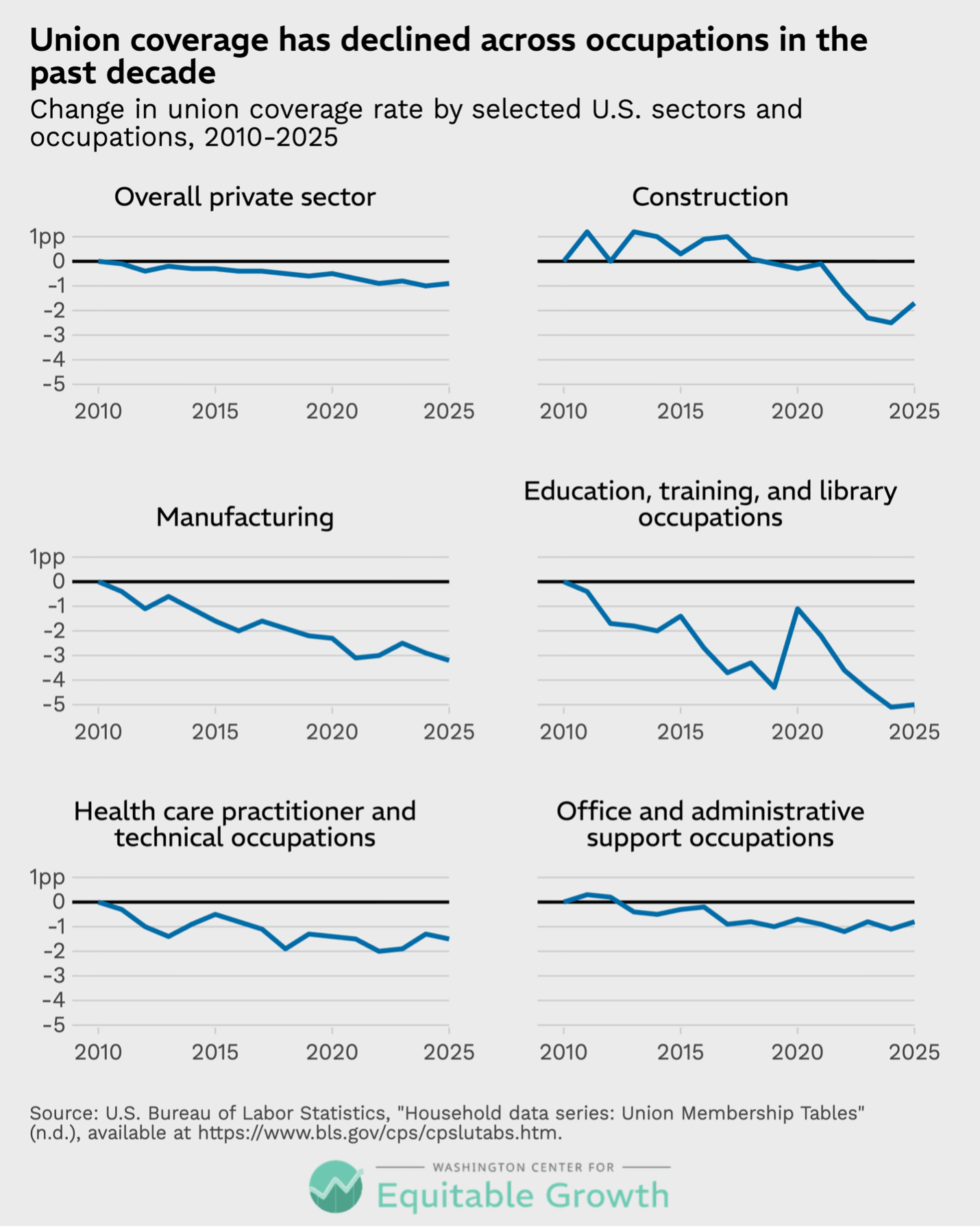
The picture is even worse for union membership, which has been effectively flat since the Great Recession. As a fraction of total employment, union coverage and membership rates have eroded significantly across both occupations and sectors of the U.S. economy. (See Figure 1.)
Figure 1
U.S. labor advocates have suggested policy reforms to stymie this decline in union coverage, including the Protecting the Right to Organize Act, which would rebalance power between employers and employees during organizing campaigns. Specifically, the law would:
- Ban captive audience meetings, when an employer requires workers to attend gatherings where the employer expresses its views on unionization
- Empower the National Labor Relations Board to protect workers from retaliation for attempting to form a union
- Open up employers and corporate officers to civil penalties for general violations of labor law
- Reform how independent contractors and franchise workers are classified
This is not an exhaustive list of the PRO Act’s fixes to U.S. labor law to increase unionization and improve outcomes for workers; the law covers a broad range of issues. But there are other strategies that can significantly expand organizing alongside the PRO Act.
One reform not included in the PRO Act that would likely have a huge impact is sectoral bargaining. A sectoral bargaining framework empowers workers and their representatives within an entire industry—not just at one worksite—to bargain for common standards, including a wage floor, workplace benefits, just-cause firing, and other protections.
Sectoral bargaining would be a novel approach to union organizing in the United States outside of certain narrow industries, but it is common in other advanced and developing economies. It would complement worksite-level bargaining, ensuring a foundation across an industry without precluding workers at particular worksites from negotiating additional standards merited by specific worksite needs. And new research from the Center for American Progress that builds on years of work suggests that complementing the PRO Act and other policies with sectoral bargaining could more than double the number of U.S. workers covered by a union contract.
Various forms of sectoral bargaining have been implemented across advanced economies in Europe to great success, with union coverage ranging from a little less than 50 percent in Germany to effectively 100 percent in Belgium and Italy. This approach not only improves material conditions for workers, but also supports businesses by reducing negotiation-transaction costs, slowing employee turnover, and mitigating costly workplace conflict. A recent European Union directive seeks to further boost sectoral coverage and country-level minimum wages.
The path to sectoral bargaining in the United States is marked by outstanding legal questions, but the fundamental economic benefits are clear. Sectorwide standards would boost union coverage and improve workers’ material conditions, dissuade employers and policymakers from a race-to-the-bottom approach to new investments, and improve macroeconomic stability amid potentially seismic changes ushered in by the rise of artificial intelligence. This economic stability comes via reduced inequality and greater financial resilience among workers, and by inducing union employers to make less risky borrowing decisions.
Taken together, the benefits of broader union coverage could have positive effects on overall U.S. economic growth, as macroeconomic stability ensured through sectoral contracts smooths the path for business investment, hiring, and human capital accumulation.
Sectoral bargaining benefits workers and communities
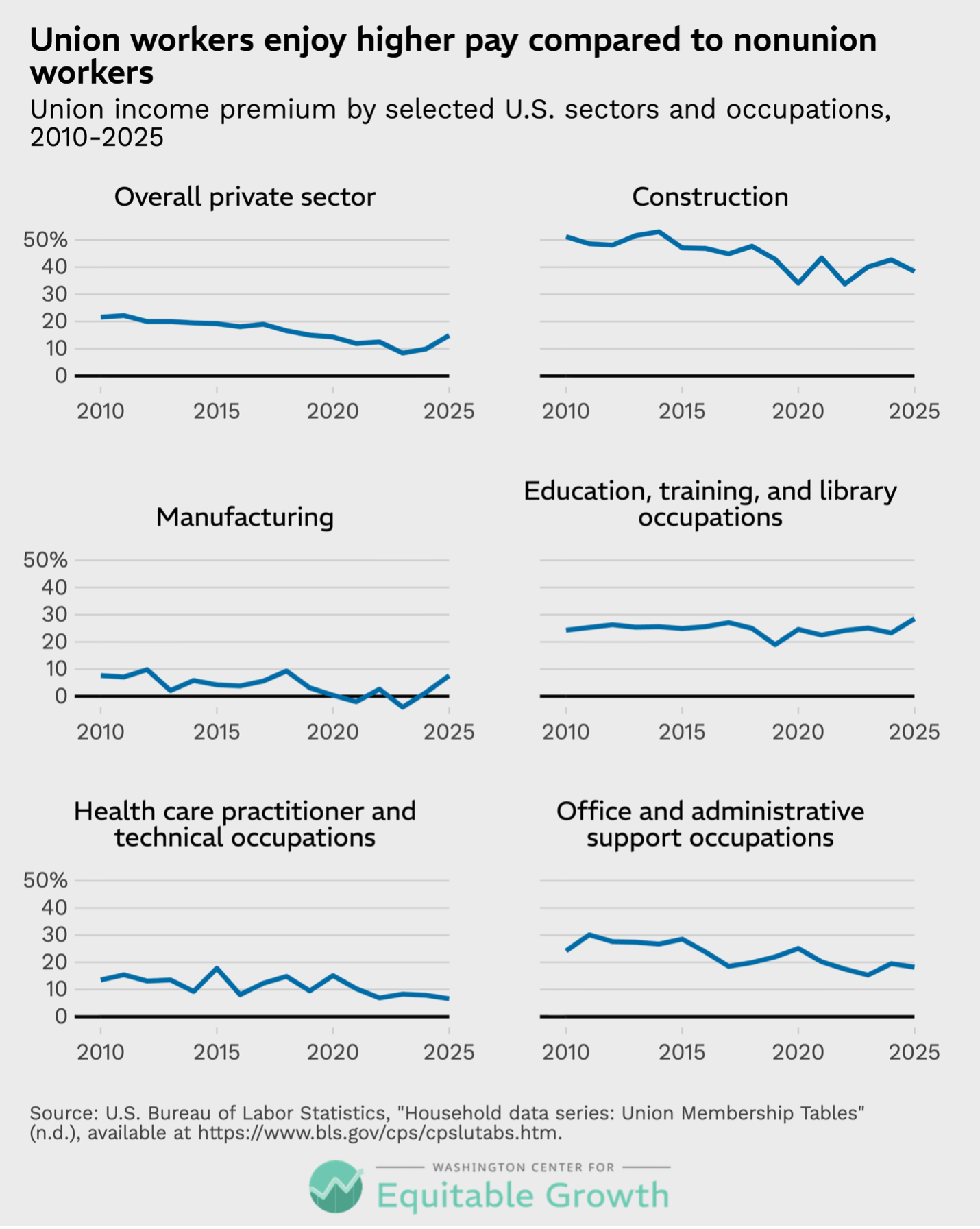
In addition to improving macroeconomic stability and reducing overall inequality, the benefit of unions specifically to their members is clear. Across most major industries and occupational groups, earnings for workers covered by a union contract are larger than earnings for nonunion workers. This so-called union income premium varies over time and across sectors and occupations but is economically meaningful. In education, training, and library occupations, for example, workers covered by a union contract earned more than 20 percent more than nonunion workers, on average, over the past decade. (See Figure 2.)
Figure 2
Indeed, a union worker is expected to earn at least $1.3 million more than a nonunion worker over their lifetime—a premium more substantial than the average boost to income from a college education. Sectoral bargaining, by definition, would boost union coverage within industries, ensuring that more U.S. workers enjoy these material gains associated with being in a union.
Importantly, the expected boost to union coverage from sectoral bargaining would not necessarily translate into growth in union membership because workers covered by sectoral standards may not necessarily join and pay dues to a union. Traditional worksite or enterprise-level bargaining could complement sectoral bargaining by ensuring worksite-specific matters are addressed in collective agreements and union membership grows alongside coverage.
Additionally, the social benefits of union membership extend beyond higher incomes to improve broader health and civic outcomes. Research shows, for example, that lifetime union membership improves worker health and well-being, particularly the physical health of mothers. Evidence also suggests union membership can operate as a buffer against authoritarian populist ideologies. And extending union coverage through sectoral bargaining could empower workers and their unions to advocate for public interest and broader worker protection legislation, including for outdoor heat standards that research has shown saves workers’ lives.
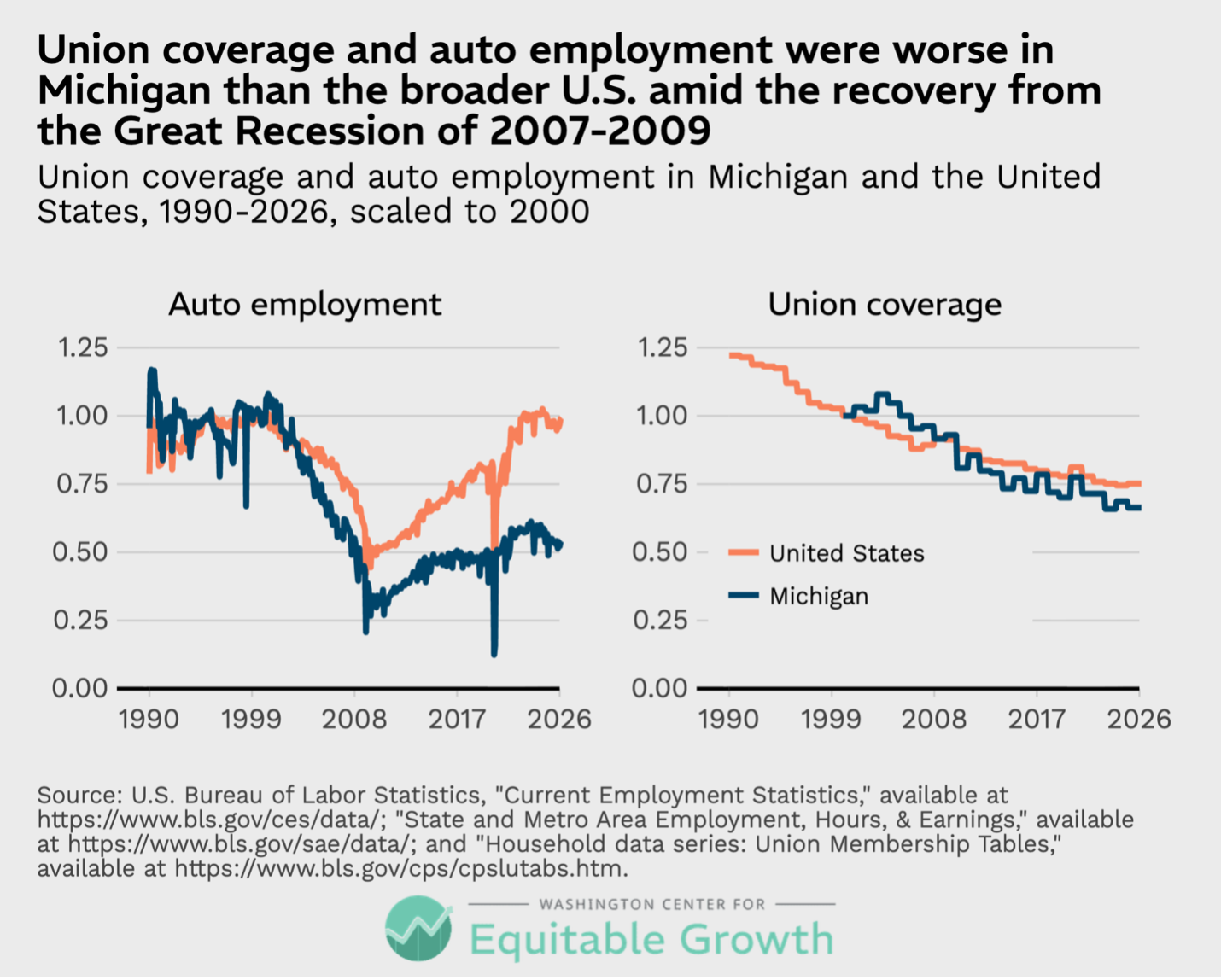
Standards set through sectoral bargaining also could mitigate a race to the bottom in which employers shift operations to jurisdictions with looser safety standards, lower wages, and fewer protections for workers seeking to form a union. U.S. auto manufacturing, for instance, has over time shifted away from traditionally union-dense production centers in Michigan to right-to-work states in the American South, where workers face lower average wages and greater barriers to forming unions.
Indeed, since the beginning of the 21st century, the U.S. Midwest has lost more than 200,000 auto jobs, while auto employment in the South increased by more than 60,000. In compositional terms, the Midwest’s share of national auto employment dropped from more than 62 percent to only 52 percent, while the South’s share increased by roughly the same amount, to more than 36 percent. Unions have attempted to organize auto workers at newer facilities in the South, with mixed success.
An established sectoral bargaining framework could have mitigated this shift away from well-paid union jobs by ensuring a level playing field for all auto workers, reducing the incentive for employers to shift operations elsewhere. This would directly benefit incumbent auto workers themselves, as well as the local communities in which auto manufacturing is situated. The economic erosion of Detroit and other urban centers in Michigan can be directly tied to the loss of auto jobs and employment, with widespread consequences, including depletion of the local tax base. (See Figure 3.)
Figure 3
The efficacy of sectoral bargaining could largely be determined by its geographic reach. The National Labor Relations Act preempts states from enacting sectoral bargaining that cover workers protected by the law, but even so, any approach that relied upon state-level sectoral legislation, for example, could be effective if states band together to ensure a level playing field across their jurisdictions.
In the case of auto manufacturing, a state-by-state sectoral approach would require legislators in Michigan to coordinate with leaders in southern states on key policy questions beyond the sectoral legislation itself, such as minimum wages, tax breaks for business investment, and labor law, including right-to-work policy. Such an approach faces clear political and legal hurdles but could be a viable strategy to ensure a level playing field across states.
Conclusion
Workers and their unions must be the driving force behind sectoral bargaining. If workers participate in the creation of a sectoral legislative framework, they would then better understand how to navigate its rules and be able to organize across worksites to find common cause, be it higher wages, better benefits, or more say in workplace decision-making.
Even apart from legislation, organizing for sectoral bargaining approaches now is important not only because it would materially benefit workers, their families, and local communities after decades of stagnant wages, but also because unions could become less effective at accessing the sectoral framework if union density and coverage continue their decades-long decline. Indeed, auto unions have recognized the existential threat of declining membership and have been effective at organizing for a well-paid union jobs for workers shifting from combustion engine production to electric vehicle manufacturing.
This kind of proactive organizing is testament to the ability of unions to adopt a sectorwide approach to bargaining even in the absence of sectoral bargaining legislation. But a sectoral approach still should be enacted before union coverage degrades further.
The rise of artificial intelligence also underscores the value of a sectoral approach to bargaining for ensuring equitable outcomes from the widespread deployment and embedding of AI technologies. Although history suggests revolutionary new technologies can boost economic growth and standards of living, some workers will be displaced and disproportionate shares of the adjustment costs will be placed on individual workers and communities—much like the “China Shock” in the first two decades of the 21st century devastated manufacturing communities.
The impacts of AI are still largely uncertain and highly dependent on the policies governing its development, adoption, and use in the workplace—where and when it will be labor-replacing or labor-augmenting. Sectoral bargaining would create a platform for workers to exercise their voice on AI directly with employers and producers of AI, as an important complement to state and federal policymaking. Negotiations also could encompass the potentially displacing effects of AI, ensuring continuity in pay and retraining services for workers whose jobs are automated.
Enacting sectoral bargaining at any level—local, state, or federal—would face significant legal and political challenges, but the benefits to workers and communities make such an endeavor worthwhile. Extending the coverage of sectoral agreements would materially improve the lives of newly covered workers and their families, while strengthening broader measures of social health and mitigating extreme political ideologies.
Additional protections for traditional worksite-level bargaining could complement sectoral agreements and boost union membership alongside union coverage. Local communities would benefit as sectorwide standards blunt the incentives for businesses to move operations to other jurisdictions with weaker environmental and worker protections. And unions would be empowered to build on their track records of negotiating for fair transitions during times of technological upheaval.
Sectoral bargaining, as evidenced by its successful implementation in other advanced economies, improves living standards for workers in normal times. But such an approach to collective bargaining is especially important now, as U.S. workers confront potential shocks to the U.S. economy, such as the threat of displacement by artificial intelligence or climate-induced market disruptions.
Did you find this content informative and engaging?
Get updates and stay in tune with U.S. economic inequality and growth!






Stay updated on our latest research