Research shows unions dampen support for right-wing populism and help workers navigate technological transitions

Key takeaways
- Evidence shows unions can mitigate the economic alienation underpinning the U.S. and global political drift toward populist authoritarianism. In other words, workplace democracy can strengthen political democracy.
- Research also shows that unions help workers manage technological transitions, which is especially important as artificial intelligence evolves and impacts work and workers differently in the coming years.
- The decline of unions threatens U.S. political and economic stability, but renewed organizing efforts combined with labor-friendly policy choices could stoke a revival.
Overview
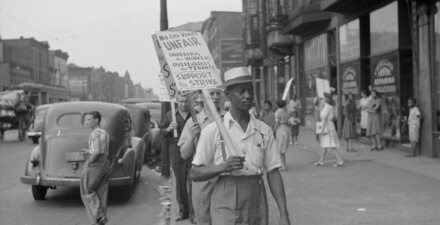
On May 1, much of the world—though not the United States—celebrates International Workers Day to honor the social and economic contributions of workers and labor unions. The May Day holiday began in large part to mark the anniversary of the 1886 Haymarket rebellion in Chicago, the bloody culmination of a general strike in the United States in which a bomb explosion and ensuing gunfire killed several police officers and civilians. The subsequent crackdown on union activity resulted in dozens of union leaders being arrested, as well as some employers reneging on agreements they had made to shorten work hours.
While the U.S. labor movement today does not face nearly the level of violent suppression it did generations ago, unions and workers still face incredible headwinds. Anti-union activity by employers and governments has pushed the union coverage rate down to 10 percent overall and just 5.9 percent in the private sector, despite historically high popular support for unions. This is down from unionization’s peak at nearly 35 percent of the U.S. workforce in 1945. The proliferation of so-called right-to-work laws—allowing workers to opt out of paying dues or agency fees while still enjoying the benefits of union representation—has drained unions of members and funding, while trade shocks and automation pressures have whittled away at employment levels in traditional union strongholds in the manufacturing sector.
Many unions also have sounded the alarm over the threat of artificial intelligence to workers and labor markets, and one recent Equitable Growth study finds that unionized workers are better protected against potential threats from AI than nonunionized workers. Other research produced by Equitable Growth scholars over the past year has highlighted these challenges and opportunities facing workers and the labor movement, including the ability to dampen support for right-wing populism, which we will turn to first.
Countering the rise of right-wing populism
In 2025, Equitable Growth published a series of essays exploring the political economy of right-wing populism. Several papers in that series touched on the power and potential of unions to counter populism’s rise by shaping economic and social outcomes for workers, raising wages, and improving job quality.
George Washington University’s Adam Dean and Jamie McCallum of Middlebury College explained how the decline in U.S. job quality, in large part due to the deterioration of unions’ bargaining power, is associated with political alienation among workers and increased support for right-wing populist policies and candidates. Dean and McCallum noted the benefits that unions accrue to members, including lower injury rates and higher salaries by an average of more than 11 percent compared to nonunion workers in the same industry. Improved material conditions and the inclusion of “workers’ lives in a collective social fabric” erects barriers to the alienation driving many workers toward right-wing populism.
A related essay from Erin Kelly of the Massachusetts Institute of Technology further highlighted the material benefits of unions, including workers’ improved physical health, a narrower racial wealth gap, and an average of $1.3 million in additional lifetime earnings for union workers compared to their nonunion counterparts. Kelly argued that worker voice on the job should be considered an aspect of job quality that improves workers’ social standing by affirming perceived “dignity and worth” among union members.
Unions not only directly benefit members, but also can engage in “bargaining for the common good” that supports broader community goals around housing, climate, and education, Kelly continued. Altogether, the social and economic benefits of unions to workers and their communities can foster solidarity between people from different backgrounds and buffer the move toward right-wing populism. Importantly, Kelly proposed greater innovation in state and local labor policies to strengthen the ability of unions to bargain—particularly through sectorwide standard-setting, in contrast to the fragmented worksite-by-worksite approach currently enshrined in U.S. labor law.
Another essay in the series focused on a novel arena for collective bargaining: tenant unions. Jamila Michener of Cornell University echoed the arguments made by other authors in the series that collective action “confronts and diffuses cleavages” along racial and social lines, disrupting the alienation that produces support for right-wing populism. Tenant organizing, similar to traditional workplace organizing, improves material conditions for people “within the context of a community that makes those wins more legible and politically meaningful.”
University of Massachusetts Amherst’s Lenore Palladino connected the decline of labor union bargaining power with increased shareholder power in corporate decision-making. The policy prescriptions suggested by Palladino—curbing stock buybacks and excessive executive compensation, including worker voice in corporate leadership, and reorienting financial services away from extraction and toward productivity—would improve worker bargaining power and represent areas of opportunity for unions to flex their policy-influencing muscle. Such policies would improve job quality and inject democratic principles into the workplace, helping mitigate the drift toward right-wing populism among disaffected workers.
Lastly, MIT’s David Autor, David Dorn of the University of Zurich, and Gordon Hanson at Harvard University discussed the impact of the China trade shock of the early 2000s on U.S. workers, showing how incumbent workers in manufacturing communities suffered widespread job loss, eroding incomes and producing social alienation among the largely White male workforce. The essay cited research showing growth in support for right-wing populist policies and politicians in the areas most harmed by the trade shock and suggested place-based policies to temper the impacts of economic dislocation. While Autor and his co-authors did not explicitly address the labor movement, the implications are clear: The shock to traditional union strongholds in the manufacturing sector has doubly harmed workers through trade-related job loss and the erosion of the manufacturing unions best equipped to help displaced workers.
Supporting workers as they navigate the era of AI
In 2025, Equitable Growth also supported a series of essays and research grants related to artificial intelligence, with many specifically focused on how AI development and adoption relate to unions and worker bargaining power.
In a seminal essay, Virginia Doellgast of Cornell University and Nell Gieser of the Communications Workers of America explored case studies in Germany and the United States that illustrate how labor unions have effectively organized for equitable and productive use of AI in the workplace.
- In Germany, for example, a major telecommunications union negotiated work agreements restricting management access to individual workers’ performance data, ensuring automation would first be used to reduce subcontracting before impacting employees and producing a path for consultation before management purchased new AI technology.
- In the United States, the authors highlighted recent collective bargaining agreements won by the Writers Guild of America and SAG-AFTRA, which restrict the use of AI-generated writing and digital replicas of actors, protecting jobs in an industry at high risk of AI displacement.
- A separate union contract negotiated by the Communications Workers of America ensured AI monitoring technology would be used primarily for training purposes.
Doellgast and Geiser also offered state-level policy prescriptions to protect workers, including bills limiting the use of electronic monitoring data to discipline or dismiss workers and others ensuring worker oversight of AI decision-making.
Another Equitable Growth essay by Veena Dubal of the University of California, Irvine and Wilneida Negron at Coworker focused on so-called surveillance pay policies that erode bargaining power by generating individualized wage rates based on “opaque algorithms and artificial intelligence systems.” Such systems make pay unpredictable and allegedly have been used to retaliate against union organizers by lowering their wages. Dubal and Negron argued that algorithmic pay systems can “violate the letter and spirit” of minimum wage laws and advocated for new laws at the federal and state levels to curtail such systems.
In a separate Equitable Growth report, Columbia University’s Alexander Hertel-Fernandez highlighted the results of a national survey he conducted on U.S. union contract protections against AI, finding that as of 2024, a significant fraction of union workers were covered by contracts that had at least one provision on AI management or surveillance. Hertel-Fernandez noted that sectors with a high reported number of these surveillance clauses were not the same sectors with high reported exposure to surveillance technology. This suggests openings for unions to organize new groups of workers who may, on average, be wary of the role of AI in their workplaces. Importantly, Hertel-Fernandez’s work shows that collective bargaining could be a useful tool in reducing racial inequalities in exposure to intrusive workplace AI.
Equitable Growth also released a report from Visiting Fellow Jacob Leibenluft exploring the successes and failures of the Trade Adjustment Assistance program, which was intended to mitigate the job displacement effects of trade shocks. From unions’ perspective, a central flaw of the program was its focus on mitigating the effects of displacement rather than preventing displacement in the first place. Leibenluft also touched upon how future policy addressing job displacement from big economic shifts—such as the move to a clean energy economy or the evolution of AI—could be better constructed to reach impacted workers. He noted how unions play an important role in not only crafting policy such as Trade Adjustment Assistance but also in enacting the provisions and spirit of the policy through workplace-level bargaining.
 The Rise of Populism
 post
post
Boosting U.S. worker power and voice in the AI-enabled workplace
February 19, 2025
 The Rise of Populism
Conclusion
Equitable Growth’s broad body of work holds important implications for unions and the labor movement. In the past year alone, Equitable Growth scholars have produced several valuable lessons from union-related research. Unions improve material conditions for members and their communities, foster a sense of belonging and solidarity across social divisions, and reduce economic gaps along lines of gender, race, and geography. And unions are instrumental in managing economic disruptions to workers and communities, playing a pioneering role in the development, adoption, and response to technological change in the workplace.
Yet union participation has been declining in recent years in the United States, despite unions being broadly popular among Americans and despite the strong evidence of their benefits for workers. Rebuilding the labor movement would mean not only improved material conditions for union members but also a more resilient economy for all. At the same time, labor law is often stacked against workers—for example, blocking union rights for millions of misclassified workers in sectors from construction to ride-hailing.
Significant legal reform, including through the PRO Act and sectoral bargaining approaches, could free unions to capitalize on the potential for new organizing in historically nonunion industries. Revitalizing the labor movement would benefit workers and the economy in normal times and is an imperative in the face of current economic and political turmoil.
Did you find this content informative and engaging?
Get updates and stay in tune with U.S. economic inequality and growth!


Stay updated on our latest research