The U.S. public is angry about economic conditions, and the middle class is losing ground. Are these trends connected?

Key takeaways
- Inflation adjusted income for people in the middle, while growing, has grown more slowly over the past several decades than it did during the decades after World War II.
- Incomes for people at the top today are much higher and further from the middle than they used to be, and the gap is growing.
- What this means for growth: If middle-income people are feeling as though they are “falling behind,” it could be because they are, indeed, falling further away from the top, and their earnings growth is not keeping up with that of earlier generations.
Overview
A random sample of recent headlines likely would yield two fairly common stories about the U.S. economy. One is that the public is angry about the economy and the other is that the middle class is losing ground. These two stories are probably related, but it is worth exploring in further detail.
Measuring public perceptions is easy. Survey after survey reports the same findings: Americans are extremely unhappy with the state of the U.S. economy. Measuring and understanding what is happening to the middle class, however, is more difficult. There are many ways to define the middle class—and even more ways to understand the idea of “losing ground.”
Furthermore, this assertion is the subject of heated debate, with experts pointing to different ways of measuring income, growth, wealth, prices, and much more. Sometimes experts point out that real incomes for those in the middle of the income distribution have been growing and believe that settles the debate.
But it can be true that people in the middle are better off now in terms of inflation-adjusted income than they were in previous decades—and, at the same time, they are falling behind their much richer counterparts. Indeed, Equitable Growth’s Inequality Tracker shows that the share of income held by the middle decile of earners in the United States dropped to 7.3 percent in 2023, while those in the top decile of earners now hold around 40 percent of all U.S. income. Meanwhile, the tracker shows that income growth for the top earners was 1.1 percentage points higher than the average in 2023, while it was 2.3 percentage points lower than the average for those in the middle 50 percent of the distribution.
Perhaps even more importantly, many in the middle class feel that they are falling behind their own expectations of where they should be, which likely shapes current economic perceptions. In April, the University of Michigan reported that consumer sentiment fell to its lowest mark on record in the history of that survey. Consumer sentiment is worse today than it was at the height of the COVID-19 pandemic in 2020, the depths of the Great Recession in 2007–2009, the peak of post-COVID inflation in 2022, or the worst of the early 1980s recession.
In some ways, this seems counterintuitive. Overall economic performance, while middling, has not been dramatically worse than it was last year or the year before, when public sentiment was higher. Moreover, by most economic metrics, the U.S. economy is objectively stronger today than it was during the economically challenging periods mentioned above. The unemployment rate today, for example, is 4.3 percent, which is worse than it was a year or two ago, but much lower than it was in 2010, when it was more than 9 percent.
Many analyses have tried to explain this apparent disconnect. And, indeed, it is likely that there are multiple driving factors and thus no single hypothesis should settle the debate until we better understand how people are experiencing the economy. But there is one thing we can be confident about: It would be a mistake to dismiss Americans as being “wrong” for feeling pessimistic about the economy or to discount these sentiments as misperceptions alone. Instead, let us start from the premise that many Americans have reason to report widespread discontent with the economy.
The middle class is falling behind
It seems possible that one (though not the only) reason that Americans are frustrated with the economy is because they feel, intuitively, that the middle class is falling behind. The American Dream and promise are often tied to the idea that workers with middle incomes can lead a financially secure, reasonably comfortable life and give their children a chance at an even better one than they have. But if it is the case that people in the middle class, and those working toward and aspiring to be in the middle, feel that promise slipping away, then that sense of loss and unfairness may make other economic struggles even more painful.
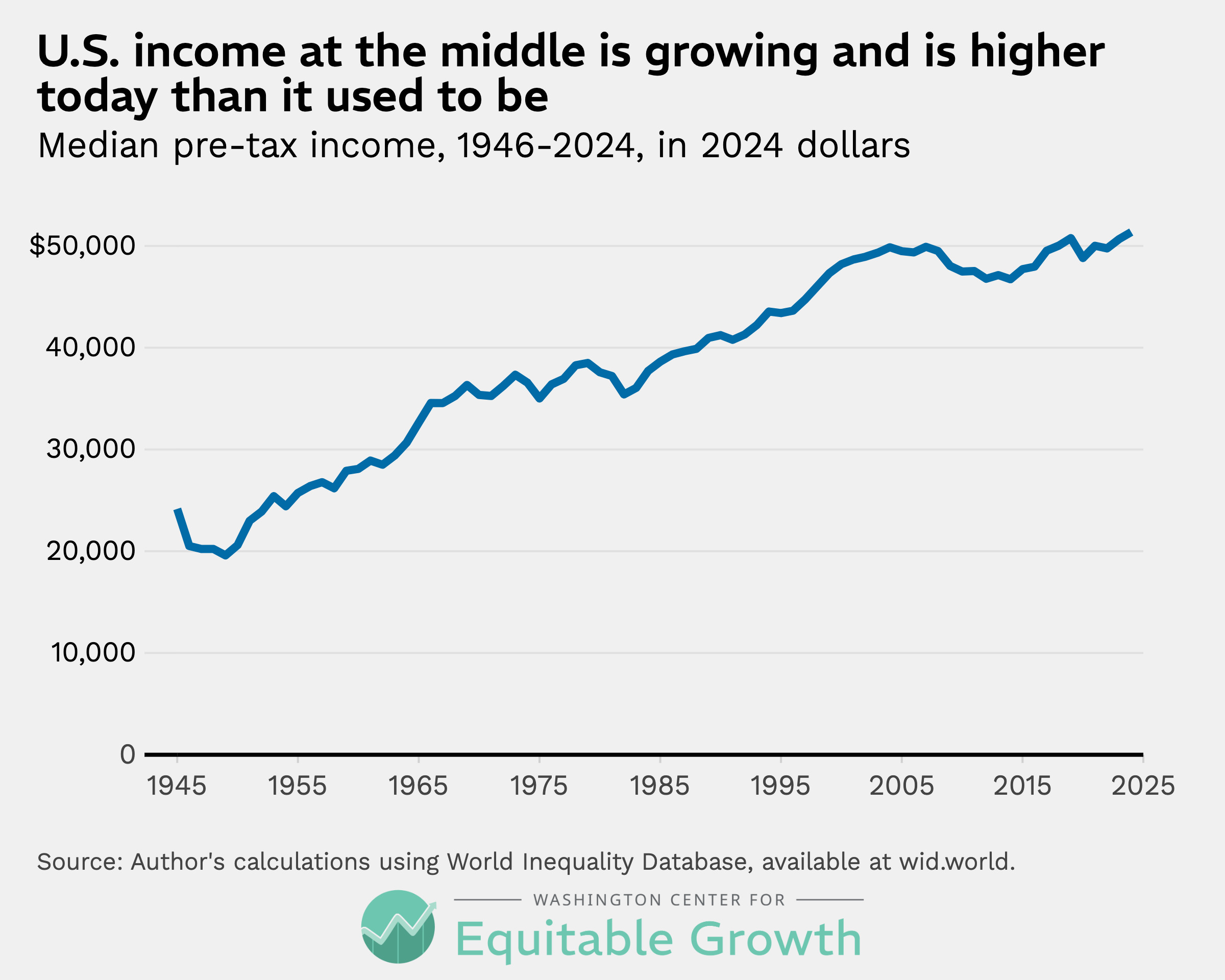
It is important to be as direct as possible as to the data around this sentiment. Indeed, the data are clear that someone in the middle of the income spectrum today has a higher annual income than similarly situated people in previous decades or generations, even after adjusting for inflation. In 2024, for example, someone at the 50th percentile for income earned roughly $51,000 per year (in 2024 dollars), according to the World Inequality Database. In 1994, the income for someone at the 50th percentile was about $43,000 (in 2024 dollars). That means a worker in the middle of the income distribution today takes home about 20 percent more than they did 30 years ago.
Furthermore, they make about 35 percent more today than a similar person did 40 years ago and 40 percent more than a similar person did 50 years ago. (See Figure 1.)
Figure 1
And yet, it is not enough to say that real middle incomes are higher today, and therefore, there is no basis for middle-income earners to feel worse off or left behind. That’s because two other key points are also true.
First, the growth rate of median incomes in the United States has slowed substantially compared to the growth of incomes at the top of the income distribution. That means the middle class has indeed fallen behind—not in absolute terms compared to a previous person in the middle but, rather, relative to others with top incomes today. Second, the growth rates for middle incomes have, in fact, fallen below the growth rates of previous generations.
In other words, while incomes at the middle of the distribution are growing, they are both growing slower than they are for the highest earners, who are capturing a much larger share of national income today than in the past, and they are growing more slowly than they used to. Let’s take each of these in turn.
Median earnings growth has slowed, compared to higher incomes
There has always been a gap between what someone at the top of the income distribution makes and someone in the middle makes. That gap is not new. But over the past several decades, the income gap between someone in the middle and someone at the top has grown substantially. That is, middle income earners really have fallen behind, when compared to their rich counterparts.
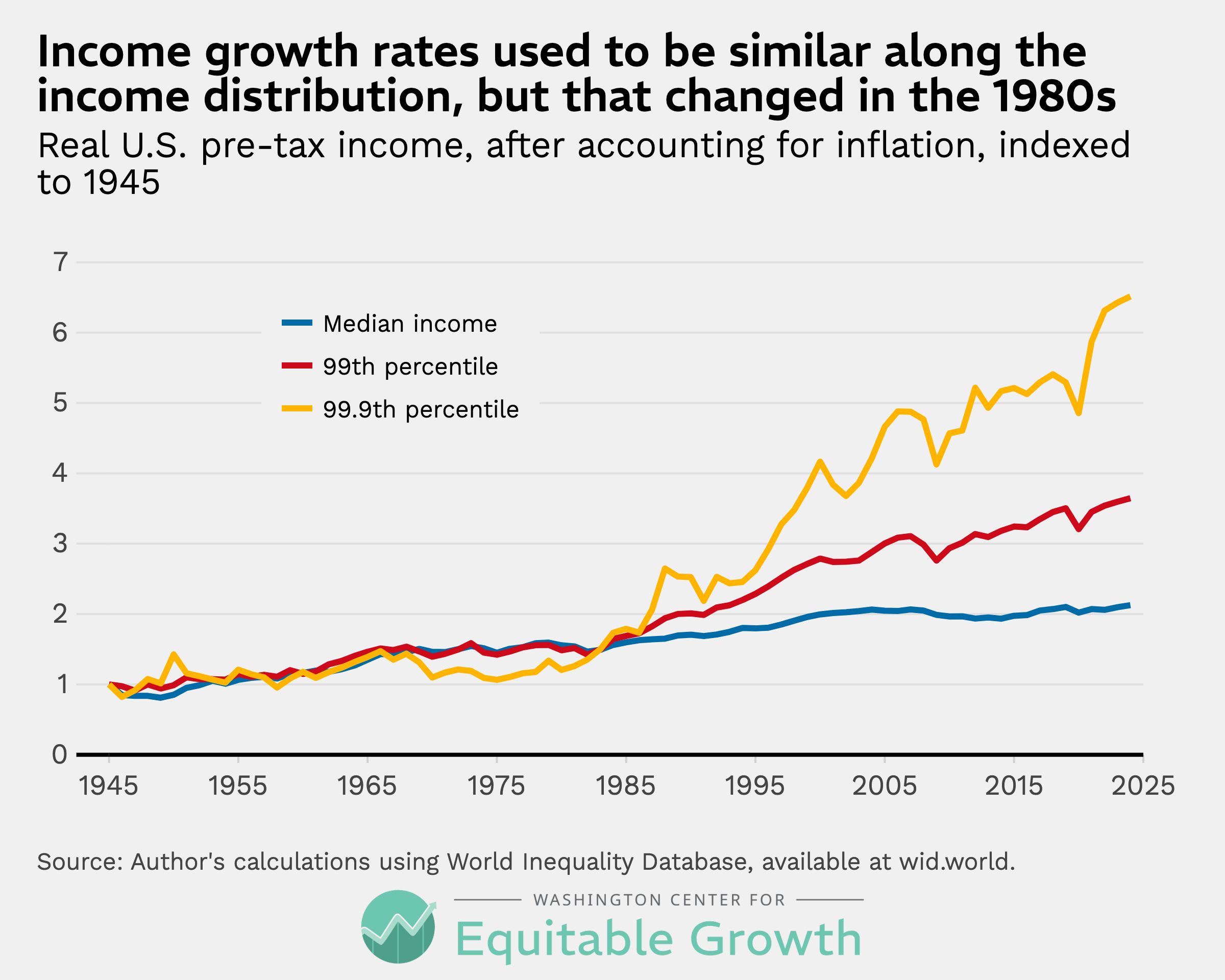
Since 1985, real median income growth averaged about 0.7 percent annually. Over that same period, real average annual income growth for someone at the 99th percentile was about 2 percent, nearly three times faster than someone in the middle of the distribution. That means that while income for someone at the middle grew about 35 percent over that period, income grew by more than 215 percent for an earner in the 99th percentile.
The divergence in growth rates is even starker at the extreme top of the income distribution. For someone with an income at the 99.9th percentile, average annual growth has been 3.4 percent, meaning that their income has grown by more than 360 percent over 40 years.
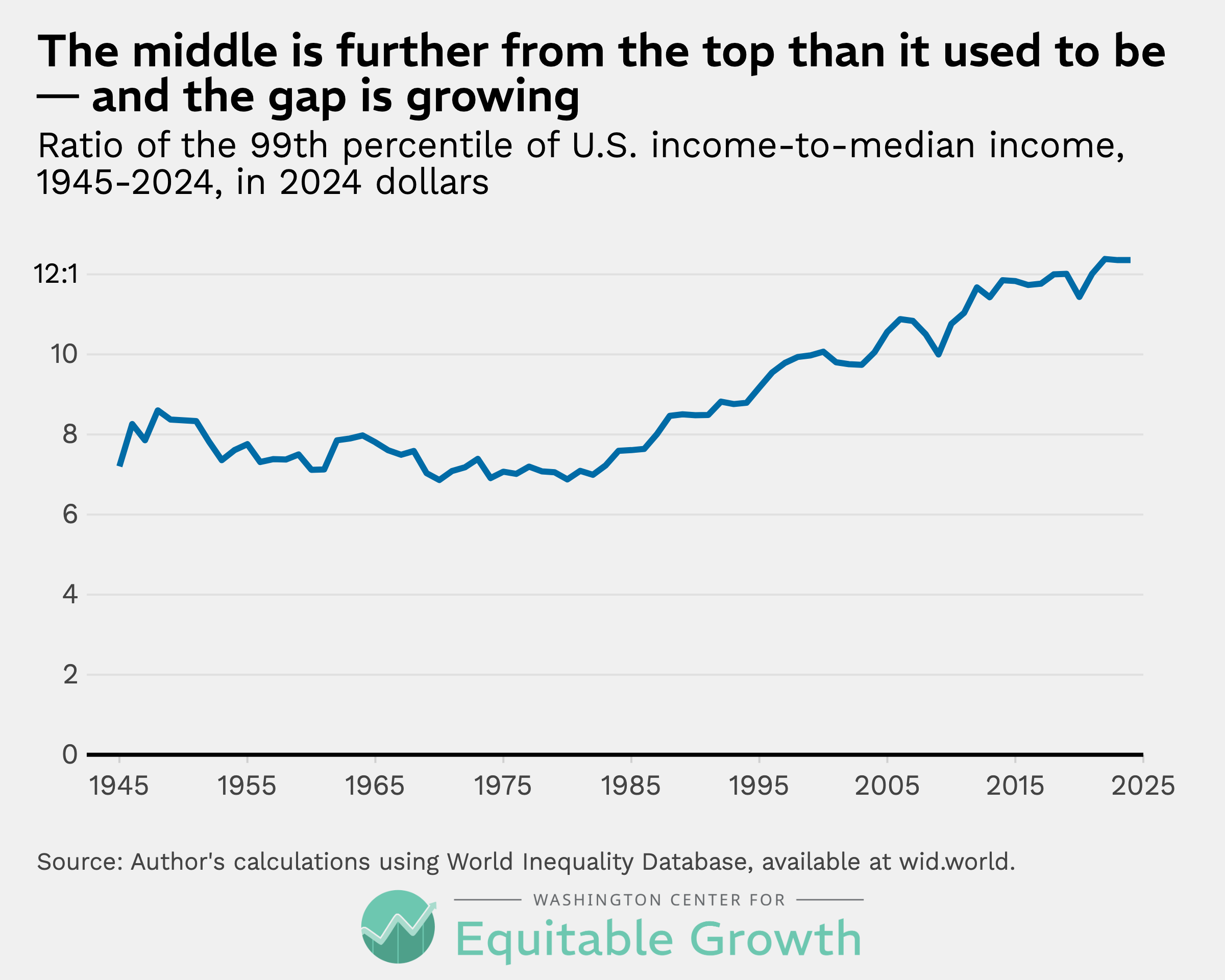
Because of these differential growth rates, the gap between the median and highest incomes has widened noticeably. In 1985, income for someone in the top 1 percent of earners was about 7.5 times larger than the median income, and income at the top 99.9th percent was about 65 times larger than the median. Today, those ratios are 12-to-1 and a whopping 177-to-1, respectively. While U.S. society has become much richer over the past 40 years, earners at the top of the distribution have captured a disproportionate share of that growth, meaning the middle class really did fall further behind them. (See Figure 2.)
Figure 2
This stands in stark contrast with the four decades immediately following World War II, when society was getting richer as a whole and households all along the income distribution shared in that growth at roughly similar rates. From 1946 to 1985, the average annual growth rates for the median income and the income at the 99th percentile were quite similar—within two-tenths of a percent of each other. Indeed, median income growth rates were even slightly faster than the top incomes during that period. But that changed over the subsequent four decades. (See Figure 3.)
Figure 3
It should not be surprising, then, that many middle-income earners feel as though they are falling behind. They arequite literally falling behind higher earners in a way that did not used to be the case. It is possible that some of today’s economic pessimism reflects memories of a time when earning a middle income did not seem quite so far away from being rich as it does today.
Median income growth is lower than it used to be
It is also true that even though median income is higher today than it used to be, median income growth is lower. As noted above, the average annual income growth rate for someone in the middle of the income distribution was about 0.7 percent since 1985. From 1946 to 1985, however, that growth rate was more than twice as fast, at 1.6 percent per year. If income had grown at that earlier rate since 1985, the median U.S. income today would be roughly $20,000 higher—almost 40 percent more than the actual median income today. (See Figure 4.)
Figure 4
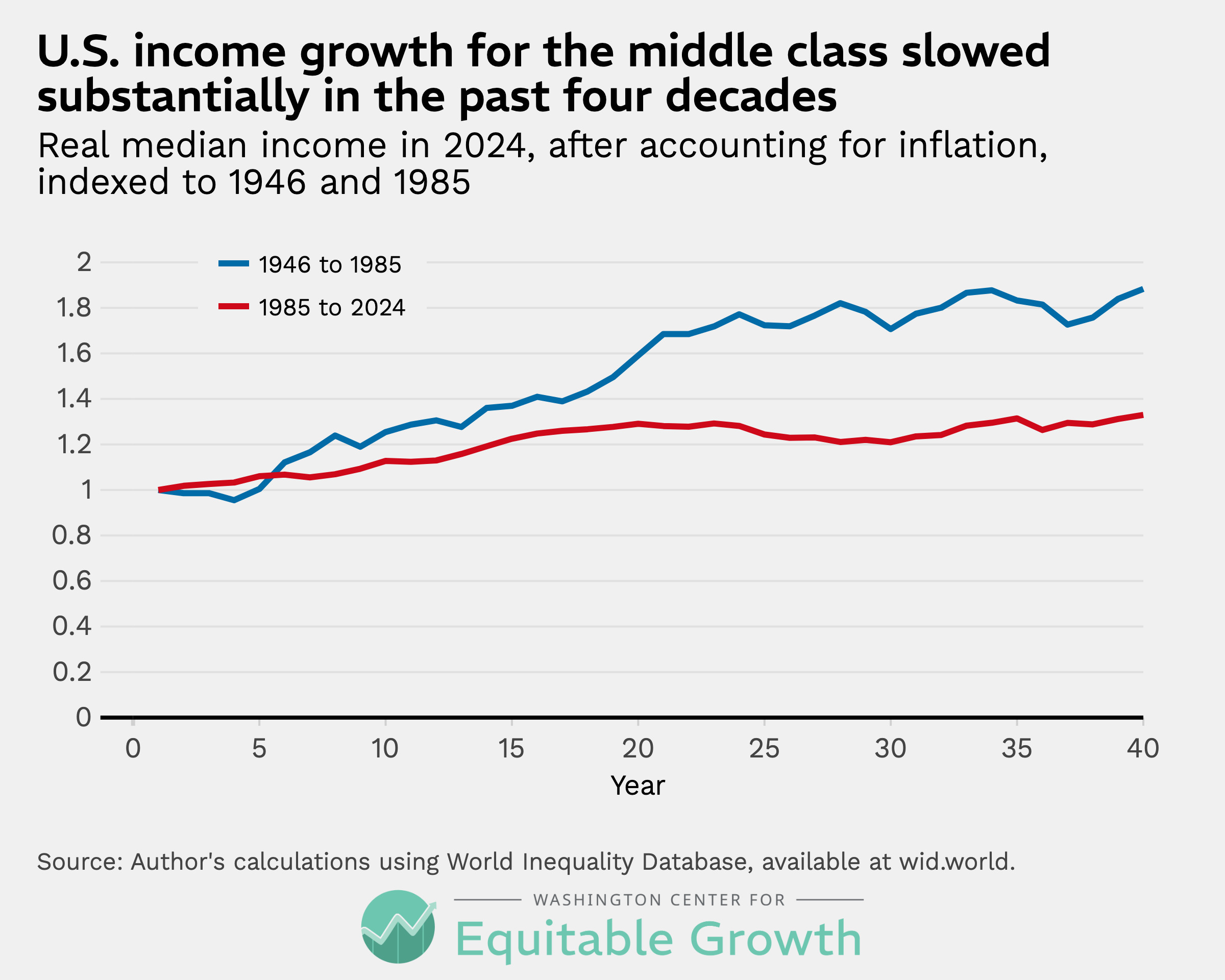
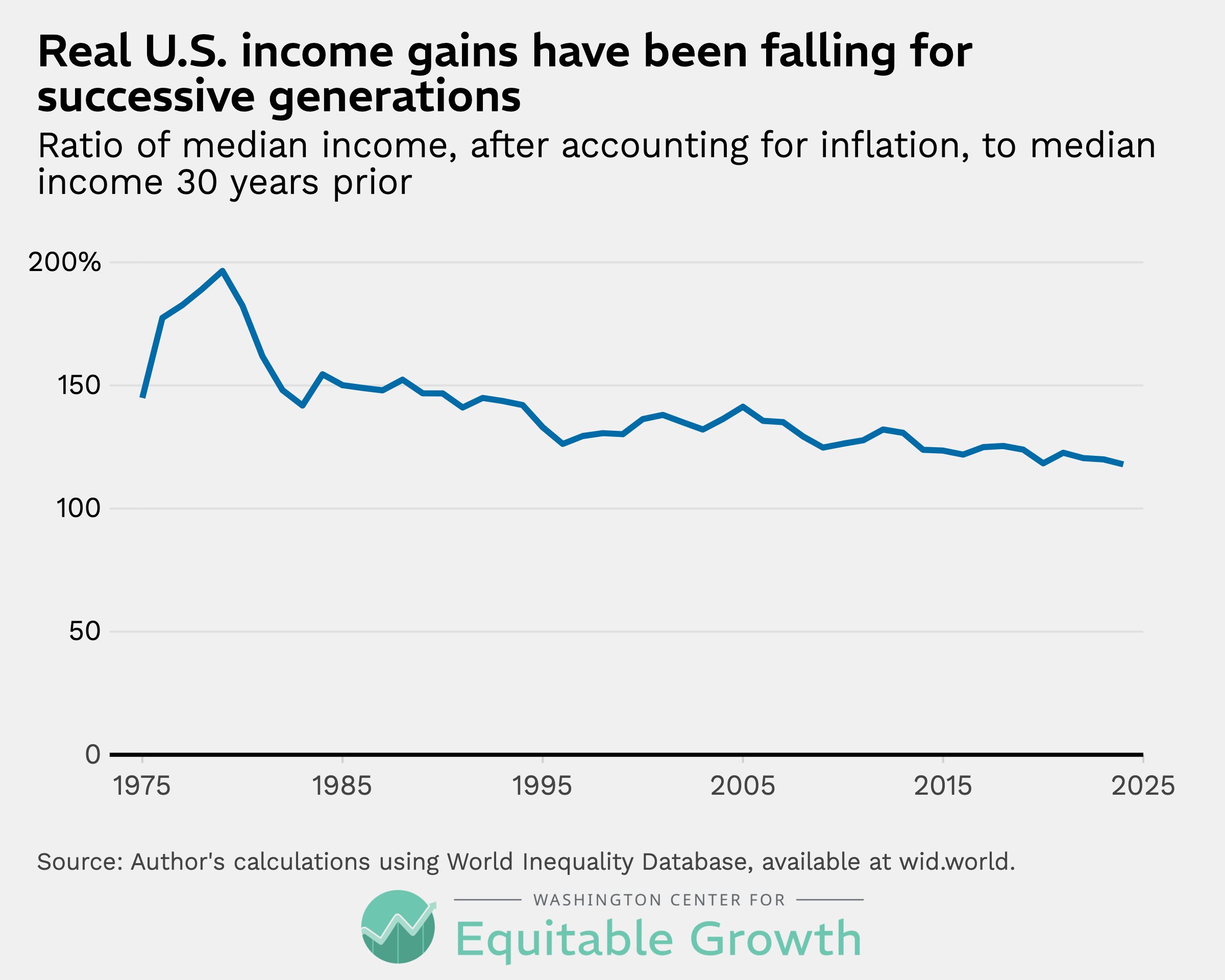
It is unlikely that middle class households are calculating precisely what their income would have been had historical growth rates persisted. But if middle class families are perceiving that their prospects are not improving as much as their parents’ prospects did 30 years before or their grandparents’ 60 years before, then they are right. Yes, the median income today is about 20 percent higher than the median income was 30 years ago. But median income 30 years ago was 40 percent higher than it had been 30 years before that.
The rate of real income growth at the median, measured over rolling 30-year windows, has been declining steadily since the mid-1980s. By this measure, each generation’s middle class is falling further behind the pace set by the one before it. (See Figure 5.)
Figure 5
Conclusion
It is therefore not wrong to say that the U.S. middle class is worse off today. They are indeed worse off in relative (rather than absolute) terms. And it is reasonable for people with middle incomes to compare their progress with prior generations or higher earners.
For one thing, when society becomes much richer overall, the possibilities for overall well-being dramatically improve, and so it is understandable for the American people to measure their own improvements against the overall possibilities. But when it seems—and the data show—that one’s personal conditions are not improving commensurate with the country’s overall growth, then it is fair to be frustrated and upset. The feeling that one is not receiving a fair piece of the pie, even as the pie gets larger, can impact the perceptions of the pie itself.
Furthermore, to the degree that Americans have been promised that each successive generation can match or even exceed the gains of the previous one, that is no longer the reality for those in the middle. It is hard to fault today’s middle class for feeling that the promise of previous generations has not been met in recent decades.
Are these the reasons the American public has been so sour on the U.S. economy over the past few years? Perhaps. Today’s public sentiment likely reflects a confluence of factors, many of which were driven by deliberate policy choices—among them essential costs outpacing inflation, declining job quality, and recent government-inflicted economic uncertainty. But to those who only point out that incomes have risen in absolute terms to support the idea that the frustrations of the middle class are unfounded, it would be best to reconsider. That same data highlight plenty of reasons for the American public to be sour.
Did you find this content informative and engaging?
Get updates and stay in tune with U.S. economic inequality and growth!





Stay updated on our latest research