Key takeaways
As states consider policy action in early childhood care and education, there is an existing—and growing—evidence base from which to draw lessons. This report summarizes the rigorous evidence on program and policy impact, identifying several key themes.
- Demand-side policies. These policies equip U.S. families with the means to access early care and education, or ECE, programs, including subsidies and tax incentives. They are often effective at improving participation in ECE programs, particularly among directly targeted populations, and at supporting parental labor force participation. These approaches, however, are less effective at improving children’s outcomes and are often unable to serve or reach all eligible families. They also do not address the lack of affordable, high-quality care options for many U.S. families.
- Supply-side policies. These policies focus on increasing the availability of ECE programs, over which policymakers can more directly mandate quality provisions. They can be effective at both improving children’s outcomes and facilitating parental employment but are often narrowly targeted and difficult to scale. While direct public provision of child care solves availability issues for those whose children get those newly created slots, the targeting and generally small scale of such programs often means that many children and families, even those who are eligible, do not have access.
- Improving the availability of high-quality early care and education. Supporting children’s development and facilitating parental employment requires attention to both the demand and supply sides of the ECE market. Attention is needed in particular to bolster the care workforce, incentivize provision of care in areas of high need, and ensure high quality in settings families are accessing with public resources.
Overview

Many states and localities have pursued early childhood care and education, or ECE, policies because they recognizing the critical role that the care economy can play in supporting working families, both by facilitating parents’ employment and investing in children’s healthy development. Policymakers in Washington, DC and Iowa, for example, have implemented policies focused on caregiver compensation. New Mexico now provides subsidized child care for families living at up to 400 percent of the federal poverty level. And Vermont has expanded subsidy eligibility for middle-income families while increasing provider reimbursement rates.
Lawmakers in Kentucky and New York, and perhaps other states and localities down the road, will soon consider proposals to support capacity expansions among child care providers. To leverage evidence to inform these state-level efforts, this report synthesizes findings on ECE programs from high-quality research. It answers questions ranging from the most basic—such as what types of policies the existing research investigates—to the more in depth, including diving into the research on how child care subsidies affect working parents’ labor force participation rate.
From a policy perspective, the optimal deployment of public resources in support of early childhood care and education requires knowledge of what form ECE investments should take, including whether they target the demand- or supply-side of the market, what features these programs should have, and toward which children and families these programs should be directed. Importantly, public investment in increasing the provision of and participation in ECE programs could be leveraged to advance children’s outcomes such as skill development and school readiness, as well as parents’ outcomes, including labor force attachment and the allocation of family time and resources. Such investments have important implications for families, businesses, and communities through both channels.
The dual role that early care and education plays in both supporting children’s early learning and facilitating parents’ participation in gainful economic activities highlights the importance of understanding both the quantity of ECE programs(access to and availability of child care slots that meet families’ needs) and the quality of these programs (the effectiveness of ECE investments at improving children’s outcomes), which could be in tension with one another in policy designs. Achieving these goals rests crucially on a stable and qualified workforce such that investments in providers, caregivers, and staff are central in advancing both aims.
What follows is an effort to synthesize what the research says about what works and what does not in the design of ECE policies and to use the evidence base to inform policymaking efforts.
What policies fall under the umbrella of the care economy?
Broadly, the care economy refers to policies that affect individuals with caregiving responsibilities, including those that address:
- Parental and caregiver leave
- Workplace flexibility, including scheduling timing and stability and sick and personal days
- Care for aging and disabled individuals, including home- and community-based services
- Tax credits and in-kind transfers targeting families
- Early childhood care and education
Many policies involve the public financing or provision of ECE programs—often federally funded and locally deployed—that interact with state and local pre-Kindergarten programs and other local ECE policymaking efforts. These include:
- Child care subsidies, such as the Child Care and Development Fund and the Child Care and Development Block Grant, both of which support low-income, working families in paying for child care
- Head Start and Early Head Start, the federally operated programs that primarily provide center-based preschool, in addition to home visitations, parent engagement, and nutrition and health services, for young children from low-income households
- The Preschool Development Grant–Birth through Five, a competitive federal grant program to improve states’ early childhood systems and augment their current investments
- Tax credits and employer-provided benefits that operate through the tax code and reduce the tax burden for individuals and businesses with child care expenses, either for themselves or their employees
What is the structure of the U.S. market for early childhood care and education?
The ECE market in the United States is a mixed delivery system with both formal and informal care provided in homes, centers, and schools, and funded by public and private sources, including parent-paid tuition or fees. Providers range from sole proprietorships with no additional employees to large, multi-site private child care operators.
In addition to the aforementioned federal ECE programs, many states operate public preschool programs. The National Institute for Early Education Research’s most recent State of Preschool Yearbook indicates that 45 U.S. states offered a state-funded, public preschool program, and more than 1.75 million children attended those programs in the 2023–24 school year—an increase of 7 percent over the prior year.1 Current enrollment in state preschool programs accounts for approximately 22 percent of all 3- and 4-year-olds in the United States. Enrollment has been increasing over time, though much of the growth has been among 4-year-old participants.2
The blended, and often fragmented, landscape of provider types and settings, funding sources, and levels of government complicates ECE policymaking. The market for early childhood care and education is also very local in that families seek care that meets their needs in terms of geographic location and commuting time, as well as linguistic and cultural matches and other practical features such as hours of operation and availability of transportation.3 The ECE market is therefore actually composed of many hyper-localized markets with implications for each other. While there are some features of ECE demand and supply that resemble Kindergarten through 12th grade schooling, the latter is predominately characterized by centralized, public provision with compulsory education requirements, ensuring access to the public system for all families.
What does ECE access and affordability look like in the United States over time and across states?
Many families rely on ECE programs in the United States, with about 55 percent of children under age 6 who are not yet attending Kindergarten participating in regular, nonparental care.4 These most recent data reveal a substantial decline of 5 percentage points from pre-pandemic levels of ECE participation, previously measured in the same nationally representative survey in 2019.5 The majority of participating children are in center-based care arrangements, including Head Start, preschool and pre-K programs, and child care centers. Notably, there are gaps in ECE participation by families’ socioeconomic status, with children from low-income families and those with less educated mothers participating less in formal center-based care and relying more on care provided by a relative.6
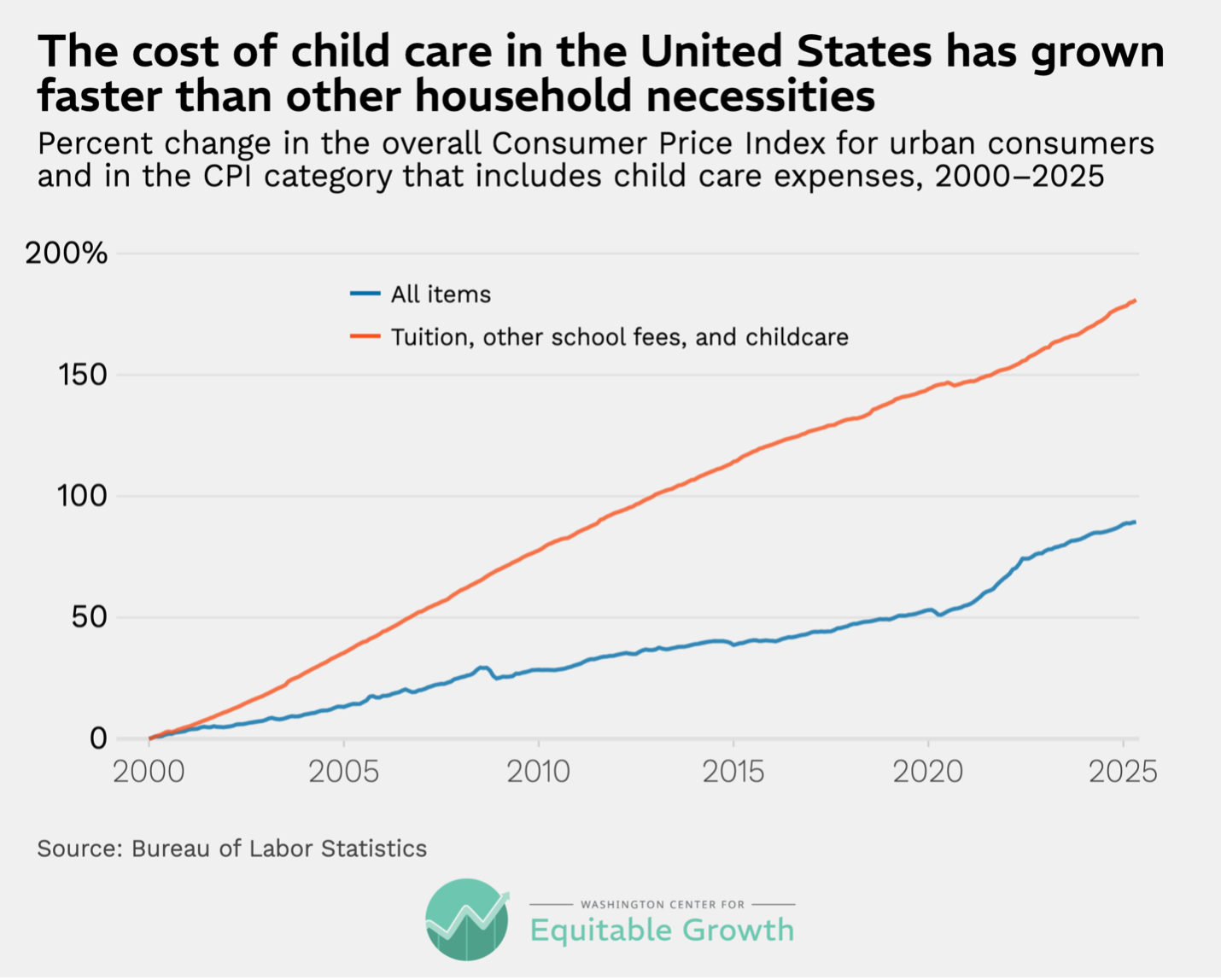
These gaps in ECE participation may be due in part to affordability challenges with child care. It is difficult to characterize child care prices over time and across geography as there are few consistent, comparable measures, though prices in the category of the Consumer Price Index that includes child care expenditures have risen much more rapidly than the overall CPI measures. (See Figure 1.)
Figure 1
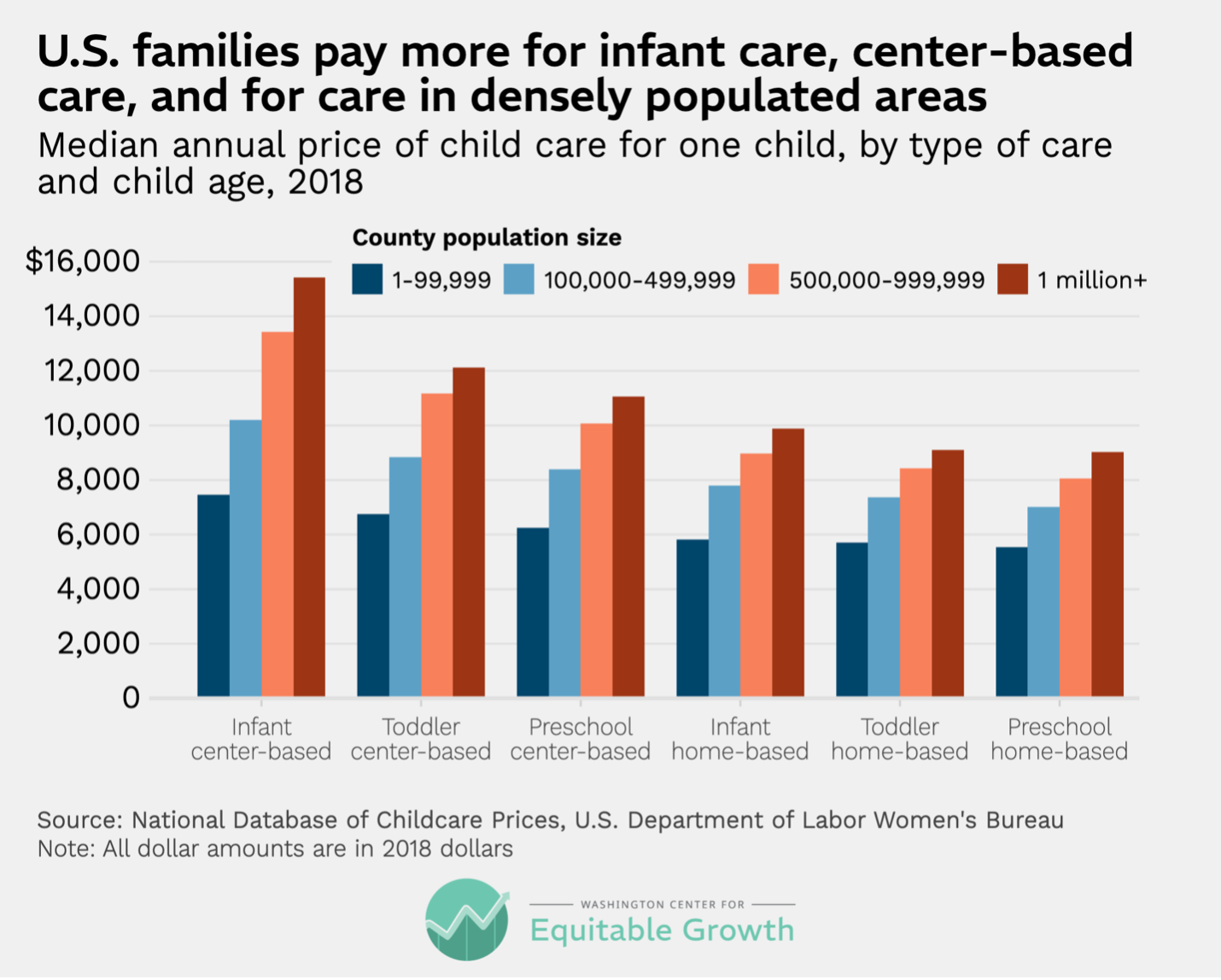
There is considerable geographic variation in child care prices as well. The National Database of Childcare Prices relies on states’ market-rate survey data to construct county-level child care prices. These data suggest that child care prices in the United States for full-time care for just one child account for between 9 percent and 16 percent of families’ annual incomes, with prices in 2022 ranging from $6,500 to $15,600 for annual full-time care. The data show considerable variation based on the age of the child, care settings, and county population. Families face the highest prices for infant care, center-based care (relative to home-based care), and in urban, densely populated areas.7 (See Figure 2.)
Figure 2
Such data from household surveys allows for greater exploration of the variation in child care expenses by family characteristics but contains limited information on type and duration of care. Specifically, data from the 2023 Consumer Expenditure Survey, done annually by the U.S. Bureau of Labor Statistics, suggest that families with young children—those whose oldest child is under 6 years old—who report any child care expenses spend $3,300 annually.8
This average includes various forms of care but is useful in demonstrating variations by family incomes and family structures. Higher-income families, for example, spend considerably more than middle-income families, who spend more than twice as much as low-income families. (See Figure 3.)
Figure 3
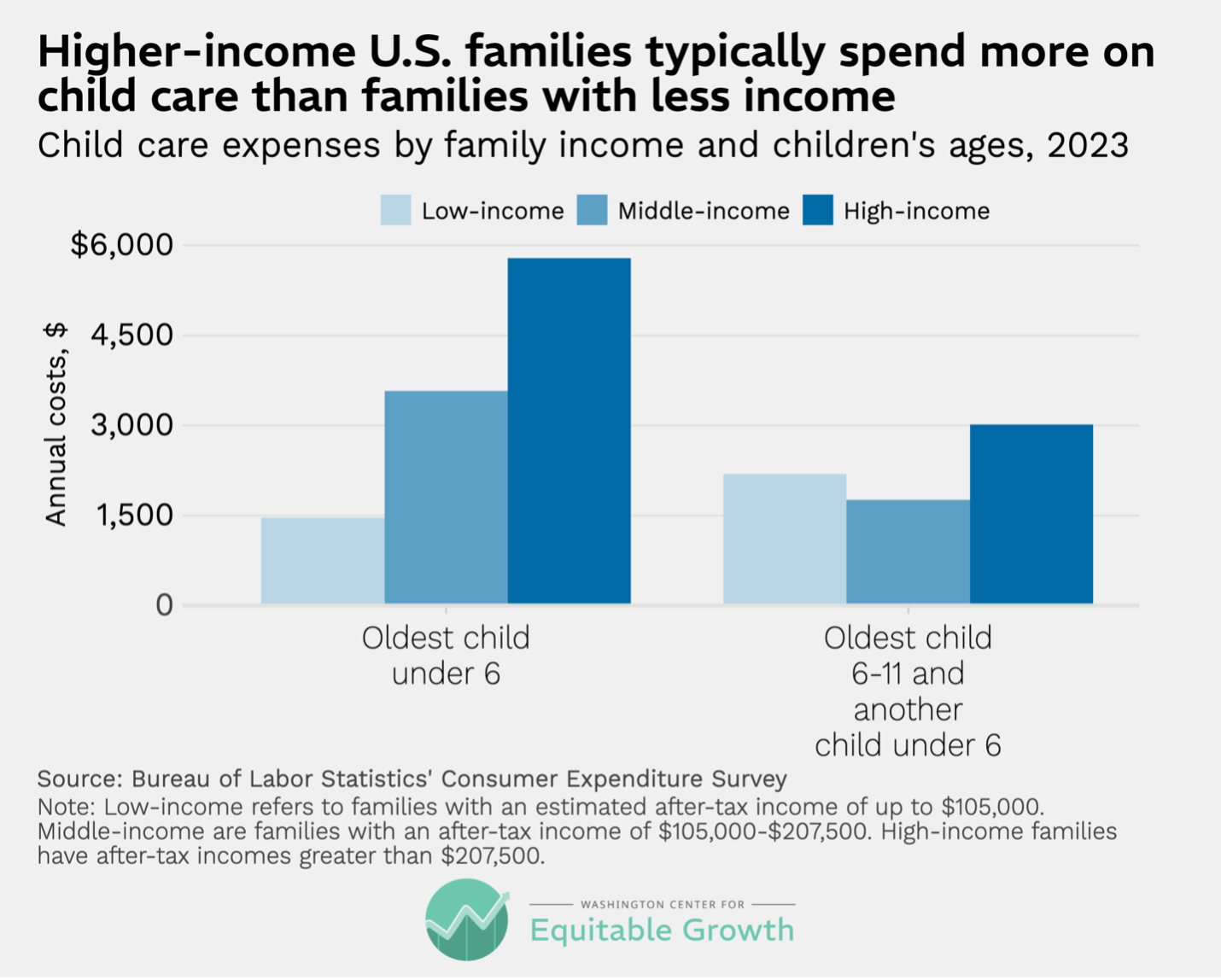
While the income gradient flattens when looking at families who also have school-age children in their households, these data point to frictions in the ECE market for families with fewer resources. Previous analyses suggest that child care expenses as a share of household income are highest (among those paying for care) at the low end of the income distribution.9
What does the research say about demand-side ECE policies such as child care subsidies and tax credits?
The primary federal policy lever for improving families’ access to early care and education has been child care subsidies. Subsidies are targeted to low-income families, yet the data suggest that this support reaches only a fraction of income-eligible families—approximately 15 percent of those eligible based on national rules and 22 percent of those eligible based on state rules.10
There also are tax credits to offset child care expenses, including the Child and Dependent Care Tax Credit for working families and the Employer-Provided Child Care Credit aimed at employers with expenditures related to providing child care services to their employees. The 2025 budget reconciliation bill made some relatively modest changes to these tax provisions, including increasing the Child and Dependent Care Tax Credit for some families, raising the cap on how much of their pretax earnings employees can allocate for dependent care expenses, and bolstering the business tax credit for employers that offer child care.11
Impact of demand-side policies on access to ECE programs
The evidence on the effectiveness of demand-side policies in moving families into ECE coverage is robust. Giving families resources with which to take part in the ECE market is a viable approach to improving access to and expanding participation in ECE programs.
Yet these tools are often deployed in a limited way. Demand-side subsidies have typically not been used at a large enough scale to have a meaningful impact on the broader market for care. Because subsidies are usually targeted to the lowest-income households and do not cover all eligible families, overall coverage is low and their existence in the market does not generate substantial shifts in the behaviors of consumers or providers. Evidence suggests that more robust subsidy coverage would generate responses in the overall market.12
Impact of demand-side policies on parents’ employment
A large literature documents the effects of ECE availability, expansions, and subsidization on parental employment.13 Specifically, studies of the impact of child care subsidies on families generally find positive effects of access to these care “vouchers” on mothers’ employment, with concentrated effects among single and unmarried mothers, who are disproportionately eligible.14
Subsidies are targeted to low-income households and include work or gainful activity requirements. These policy levers can have implications for productivity once parents are in the workplace as well. Research documents that child care subsidies positively affect parents seeking additional education or job training and increase their full-time employment once employed.15 Educational attainment effects are concentrated among mothers with low initial levels of education and those who receive subsidies when their children are young, as infants and toddlers.16
Impact of demand-side policies on child outcomes
The research on the impact of demand-side policies on improving child outcomes over the short- and long-run suggests that these approaches are limited in their ability to improve children’s development and well-being. Studies leveraging longitudinal datasets to explore the effects of care subsidies on children’s early skills finds negative effects on both cognitive and behavioral measures of development, though these effects do not necessarily persist into or beyond the Kindergarten year.17 Additional evidence suggests that these negative effects are driven by differences in the quality of care, concentrated among families who would otherwise be in high-quality preschool, Head Start, and parental care.18
Evidence from Quebec’s child care reform largely mirrors the evidence on child care subsidies in the United States. This work finds pronounced maternal employment effects and negative effects on child outcomes, which correspond to likely declines in the quality of care that children experienced with changes to their care arrangements in the context of a rapid program introduction.19
What does the research say about supply-side ECE policies such as direct provision of slots, provider incentives, and workforce investments?
Supply-side policies typically take the form of the provision of direct preschool programs, such as Head Start, Early Head Start, and many public state and local pre-K programs. Increasingly, though, policymakers are considering targeted investments for providers through supply-side incentives or subsidies, a tool that was leveraged in the deployment of the 2021American Rescue Plan Act’s Child Care Stabilization and Supplemental Grants.20 The evidence base primarily relies on the former type of investment, with newly emerging research on the impact of provider and workforce supports.
Impact of supply-side policies on access to ECE programs
Supply-side policies that provide child care slots directly improve access to ECE programs for families and children who are eligible for or targeted by the particular program of interest. Because these programs are generally small relative to the broader market for early care and education, however, they do little to solve the lack of availability of high-quality care more broadly.
The ECE landscape is a patchwork of settings, providers, and funding streams, so it is important to note that intervention in one area of the market can have important implications for other segments of the market, including ramifications for the broader workforce when credentialing requirements or other qualifications are added or relaxed for a subset of the labor market.
One area in which these spillovers are evident is in the market for infant and toddler care when universal public preschool programs, typically serving 3- and/or 4-year-olds, are introduced or expanded. The introduction of public preschool in New York City, for example, reduced infant and toddler capacity at private child care centers concentrated in high-poverty areas and likely was due to the cross-subsidization of lower-cost preschool care to higher-cost infant and toddler care.21
Impact of supply-side policies on parents’ employment
A large and growing literature uses the introduction of new ECE programs or changes to families’ eligibility for public programs to estimate the impact of new child care slots on parental employment, and particularly among mothers. Evidence from the expansion of Kindergarten programs and the introduction of public preschool programs suggests that maternal labor supply is particularly responsive to increased access to early care and education.22 This literature generally points to more sizable effects among mothers most affected by increased ECE availability or affordability—that is, those whose youngest child is age-eligible under the policy or program and mothers who are unmarried or have lower levels of educational attainment.23 In addition to being more likely to be shifted into employment by a policy change, some programs, such as Head Start, disproportionately serve or directly target less-advantaged mothers.24
Studies of ECE investments in Canada, Germany, and Norway, for example, similarly document that mothers are responsive to such expansions in other countries as well.25 Though prior evidence suggested that mothers’ responsiveness to more recent ECE expansions in the United States had declined relative to earlier interventions and other country contexts,26 recent evidence confirms that parents do indeed remain responsive to these ECE expansions and greater public provision of early childhood programs in the United States.27
In particular, researchers have documented broadly realized increases in U.S. maternal employment concurrent with the introduction of public pre-K programs across states and among mothers of Kindergarten-aged children as full-day Kindergarten expanded across the country over the past 30 years.28 Lottery-based access to a universal public preschool program in New Haven, Connecticut, for example, induced sizable and persistent effects on parents’ earnings.29 And descriptive evidence from the introduction of Washington, DC’s public pre-K program similarly shows increases in mothers’ labor force participation.30
Impact of supply-side policies on child outcomes
Evidence suggests that publicly provided preschool programs can improve children’s outcomes over the short- and long-term, but that positive effects are not guaranteed. In particular, the landscape of alternative care options matters, with children who would not otherwise be in center-based care experiencing the biggest boost.
There are also complicated patterns of short- and long-term effects, with early cognitive test-score advantages often converging in the primary grades. In some instances, in which researchers can observe both short- or medium-term test scores, as well as later-life outcomes, a lack of test-score effects can still be consistent with improvements in long-run outcomes, including educational attainment.31 Recent evidence from Boston’s pre-K program shows large, sustained improvements in children’s outcomes, particularly in improved educational attainment.32
What does the research say about the role of care quality for child outcomes and policies aimed at improving quality in ECE programs?
While there is a body of evidence indicating that ECE policies and programs can improve children’s outcomes over both the short- and long-run, we know far less about the specific features of ECE interventions that drive improved outcomes. Assessing the critical components of effective ECE investments is complicated by three important challenges:
- There is a lack of consistently measured and systematically collected data on the inputs to providing ECE programs and the outcomes of the programs.
- It can be difficult to identify the critical components of program quality in the ECE program bundle.
- Program quality is measured in comparison to the quality of alternative care arrangements in which young children would spend their time, which are quite varied and hard to measure.
With those challenges in mind, there is limited research exploring a few dimensions of quality in ECE programming.33 One area that the research has firmly established as important for children’s development is the quality of relationships and the nature of interactions between children and their caregivers. This body of evidence points to stable, healthy attachments in the child-caregiver relationship as vital to children’s development.34
Conversely, high rates of staff turnover in ECE settings are related to weaker development of language and social skills among children.35 Recent evidence also shows that centers with high turnover exhibited more critical safety violations and lower process quality.36
How effective are child care regulations and states’ quality standards?
Research has not thoroughly established the role of child care regulations in ensuring quality and promoting positive child outcomes. There are foundational safety and security requirements regulated at the state level, as well as comprehensive efforts to improve ECE quality through the Head Start Program Performance Standards and individual states’ accountability systems, known as Quality Rating and Improvement Systems.37 QRIS typically aggregate multiple measures—such as licensure, lead teachers’ educational attainment, and child-caregiver ratios—into a simplified rating system that they then make publicly available.
Rigorous evidence has not established links between QRIS and measurable child outcomes.38 Yet research indicates that receiving a low rating has an impact, leading programs to work to improve the measured dimensions. These scores can also be a factor influencing parents’ choices of ECE programs, with parents moving away from programs with lower ratings, particularly when there are other options available locally.39
Limited work has explored the impact of the regulatory environment on the provision and quality of early care and education.40 The authors document that regulations reduce the number of child care centers, particularly in low-income areas, but that such regulations boost the quality of child care services, with quality improvements concentrated in higher-income areas. This work suggests that improving quality in what has become a bifurcated market for early care and education requires both accountability for quality and targeted investments in high-need areas.
What do the data say about the composition of the ECE workforce and how it has changed over time?
The ECE workforce in the United States consists of approximately 1.5 million caregivers and early educators and is composed of primarily women.41 Relative to the broader workforce, these caregivers are disproportionately women of color.42 While 14 percent of U.S. child care workers are Black and 24 percent are Hispanic, these groups make up 6 percent and 8 percent, respectively, of the overall workforce.
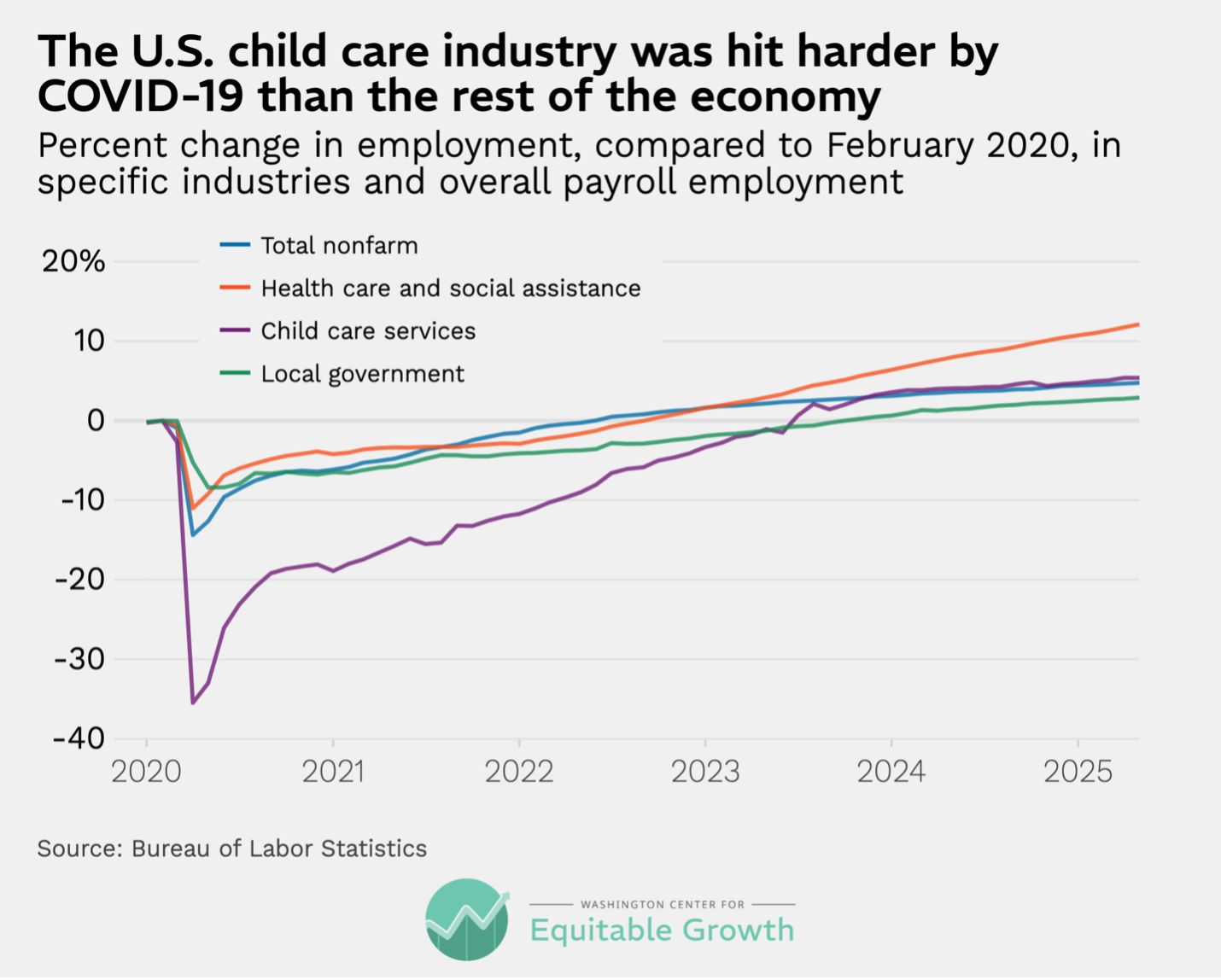
The U.S. child care workforce was severely affected by the COVID-19 pandemic of 2020–2023 and the many care center closures that occurred in the aftermath of its onset. It also took longer to recover than most other segments of the U.S. economy, consistent with evidence that the industry is more exposed to economic downturns than other low-wage industries and that its employment is consistently hit harder.43 (See Figure 4.)
Figure 4
In addition, recent evidence suggests that the quality of the child care workforce—as measured by their wages, educational attainment, and cognitive skills—has declined over time, as outside employment options have improved and workers have left this industry for higher pay and better working conditions.44
What is the evidence on teacher-child or caregiver-child ratios in ECE settings?
All states are required to have regulations about group size and ratios in ECE programs. Notably, there is considerable variation across states. For infant care, ratios range from as low as three children per caregiver to as high as nine children per caregiver. For toddlers, the range is four to 12 children per caregiver, and it ranges from seven to 15 children per caregiver for preschool-aged children.45
While there is limited evidence on the impact of such regulations, evidence from other early childhood contexts demonstrates the importance of small class sizes for the realization of improved child outcomes over the short- and long-run.46
Are strategies to reduce ECE staff turnover through job-quality improvements or higher compensation effective?
ECE providers face challenges in hiring and retaining a qualified workforce, as it is an industry characterized by both its labor intensity and low wages. As mentioned above, the stability and quality of the workforce are essential ingredients in promoting positive child outcomes in ECE settings. Providers’ ability to recruit and retain capable, skilled caregivers is critical to delivering the quality of caregiver-child relationships and interactions that support healthy child development.
Indeed, evidence documents that improvements in compensation and working conditions for caregivers lead to higher-quality care environments and corresponding better child outcomes.47 Relatedly, recent experimental evidence demonstrates that early educators and caregivers respond to bonuses and incentives by staying in their jobs.48
Are there areas of ECE policy design for which we do not have a sufficient evidence base?
There are several important open questions in ECE policy conversations for which the evidence base is currently insufficient. One is the importance of various features of the regulatory environment for the supply and quality of child care provision. Another is the role of private equity in the ECE market.
To the first point, there is limited existing evidence on the importance of particular regulations, or the effects of relaxing those regulations, on the three main outcomes of interest—families’ access to care, parental employment, and children’s development—despite substantial variation across states in the nature and type of regulations affecting the market for early care and education.49 We also know little about the effects of regulation in shaping the workforce through both recruitment and retention channels.
There also has been a popular press focus on private equity in the ECE market, but governance structures and the administration of ECE programming are understudied, so there is a lack of evidence on the impact of such shifts. A larger literature speaks to the impact of private equity acquisitions in health care, specifically with respect to nursing home buyouts, but its application to the market for early childhood care and education is limited.50 The knowledge base would benefit from study of the same phenomenon in the child care industry.
Conclusion
The fragmented ECE landscape in the United States presents challenges for families, providers, and policymakers alike. As states and localities make efforts to improve access, affordability, and quality, existing evidence points to several lessons learned and a path forward in ECE policy designs.
While demand-side policies, such as child care tax incentives and subsidies, often improve participation in ECE programs and facilitate parental employment among those targeted by the benefits, they are often less effective at improving children’s outcomes and too small in scale to affect the overall ECE market. On the supply side, the direct provision of programs, with greater oversight of quality, can generate improvements in access, parents’ labor force participation, and child outcomes. Yet these efforts are also often narrowly targeted, and scaling such efforts has proven difficult. At the same time, investments in the ECE workforce show particular promise, with implications for the availability and quality of care.
In sum, addressing challenges in the market for high-quality early childhood care and education requires public investment in both the demand and supply sides to equip families with resources to access the ECE market, support a stable and qualified caregiving workforce, incentivize the provision of care in underserved areas, and monitor the quality of care in settings operating with public dollars. Smart investments can fill gaps in the currently fragmented ECE system, ensuring that families and caregivers are not falling through the cracks and advancing the dual aims of supporting parents’ careers and children’s development.
About the author
Chloe Gibbs is a senior economist at the W.E. Upjohn Institute for Employment Research, policy fellow at the Stanford Institute for Economic Policy Research, and faculty affiliate of the University of Notre Dame’s Institute for Educational Initiatives, where she directs the Early Childhood Policy Lab. From 2022–2023, she served as a senior economist with the President’s Council of Economic Advisers at the White House. She holds a Ph.D. from the University of Chicago’s Harris School of Public Policy.
End Notes
1. Allison H. Friedman-Krauss and others, “The State of Preschool 2024” (New Brunswick, NJ: National Institute for Early Education Research, 2025), available at https://nieer.org/sites/default/files/2025-04/2024 YB ExecSummary.pdf.
2. Ibid.
3. Daphna Bassok and others, “Are Parents’ Ratings and Satisfaction with Preschools Related to Program Features?” AERA Open 4 (1) (2018), available at https://journals.sagepub.com/doi/10.1177/2332858418759954.
4. Rachel Hanson and John Bobrowski, “Early Childhood Program Participation: 2023” (Washington: National Center for Education Statistics, Institute of Education Sciences, U.S. Department of Education, 2024), available at https://nces.ed.gov/pubs2024/2024112.pdf.
5. Ibid.
6. Sarah Flood and others, “Inequality in Early Care Experienced by US Children,” Journal of Economic Perspectives 36 (2) (2022): 199–222, available at https://www.aeaweb.org/articles?id=10.1257/jep.36.2.199; President’s Council of Economic Advisers, “Improving Access, Affordability, and Quality in the Early Care and Education (ECE) Market,” July 18, 2023, available at https://bidenwhitehouse.archives.gov/cea/written-materials/2023/07/18/improving-access-affordability-and-quality-in-the-early-care-and-education-ece-market/.
7. “National Database of Childcare Prices,” available at https://www.dol.gov/agencies/wb/topics/featured-childcare (last accessed April 2026).
8. “Consumer Expenditure Survey: Public Use Microdata, 2023,” available at https://www.bls.gov/cex/pumd_data.htm (last accessed April 2026).
9. President’s Council of Economic Advisers, “Improving Access, Affordability, and Quality in the Early Care and Education (ECE) Market”; President’s Council of Economic Advisers, “Economic Report of the President: Chapter 4: Investing in Young Children’s Care and Education” (2023), available at https://bidenwhitehouse.archives.gov/wp-content/uploads/2023/03/ERP-2023.pdf#page=130.
10. Nina Chien, “Factsheet: Estimates of Child Care Subsidy Eligibility & Receipt for Fiscal Year 2021”(U.S. Department of Health and Human Services, Office of the Assistant Secretary for Planning and Evaluation, 2024), available at https://aspe.hhs.gov/sites/default/files/documents/a91fd97aa80b53fa52a52d38cd323509/cy2021-child-care-subsidy-eligibility.pdf.
11. First Five Years Fund, “TOPLINES: Child Care in the 2025 Tax Reconciliation Package” (2025), available at https://www.ffyf.org/2025/07/10/toplines-tax-package/.
12. Pierre Bodéré, “Dynamic Spatial Competition in Early Education: An Equilibrium Analysis of the Preschool Market in Pennsylvania.” Working Paper (2023), available at https://pierrebodere.github.io/content/bodere_jmp.pdf; Jonathan Borowsky and others, “An Equilibrium Model of the Impact of Increased Public Investment in Early Childhood Education.” Working Paper No. 30140 (National Bureau of Economic Research, 2022), available at http://doi.org/10.3386/w30140.
13. Chris M. Herbst, “Child Care in the United States: Markets, Policy, and Evidence,” Journal of Policy Analysis and Management 42 (1) (2022): 255–304, available at https://doi.org/10.1002/pam.22436; Taryn W. Morrissey, “Child Care and Parent Labor Force Participation: A Review of the Research Literature,” Review of Economics of the Household 15 (2017): 1–24, available at https://doi.org/10.1007/s11150-016-9331-3.
14. For an overview, see Chris M. Herbst, “Child Care in the United States: Markets, Policy, and Evidence,” Journal of Policy Analysis and Management 42 (1) (2023): 255–304, available at https://onlinelibrary.wiley.com/doi/10.1002/pam.22436; David Blau and Erdal Tekin, “The Determinants and Consequences of Child Care Subsidies for Single Mothers,” Journal of Population Economics 20 (4) (2007): 719–741, available at https://doi.org/10.1007/s00148-005-0022-2; Erdal Tekin, “Child Care Subsidy Receipt, Employment, and Child Care Choices of Single Mothers,” Economics Letters 89 (1) (2005): 1–6, available at https://sciencedirect.com/science/article/abs/pii/S0165176505001394; Erdal Tekin, “Childcare Subsidies, Wages, and Employment of Single Mothers,” Journal of Human Resources 42 (2) (2007): 453–487, available at https://www.jstor.org/stable/40057313.
15. Elizabeth E. Davis and others, “Do Child Care Subsidies Increase Employment Among Low-Income Parents?,” Journal of Family and Economic Issues 39 (2018): 662–82, available at https://doi.org/10.1007/s10834-018-9582-7; Chris M. Herbst and Erdal Tekin, “Do Child Care Subsidies Influence Single Mothers’ Decision to Invest in Human Capital?,” Economics of Education Review 30 (5) (2011): 901–912, available at https://doi.org/10.1016/j.econedurev.2011.03.006.
16. Owen N. Schochet and Anna D. Johnson, “The Impact of Child Care Subsidies on Mothers’ Education Outcomes,” Journal of Family and Economic Issues 40 (2019): 367–389, available at https://doi.org/10.1007/s10834-019-09628-0.
17. Chris M. Herbst and Erdal Tekin, “Child Care Subsidies and Child Development,” Economics of Education Review 29 (4) (2010): 618–638, available at https://doi.org/10.1016/j.econedurev.2010.01.002; Chris M. Herbst and Erdal Tekin, “The Impact of Child-care Subsidies on Child Development: Evidence from Geographic Variation in the Distance to Social Service Agencies,” Journal of Policy Analysis and Management 35 (1) (2016): 94–116, available at https://doi.org/10.1002/pam.21860.
18. Herbst, “Child Care in the United States: Markets, Policy, and Evidence”; Anna D. Johnson, Rebecca M. Ryan, and Jeanne Brooks-Gunn, “Child-Care Subsidies: Do They Impact the Quality of Care Children Experience?,” Child Development 83 (4) (2012): 1444–1461, available at https://doi.org/10.1111/j.1467-8624.2012.1780.x.
19. Michael Baker, Jonathan Gruber, and Kevin Milligan, “Universal Child Care, Maternal Labor Supply, and Family Well‐Being,” Journal of Political Economy 116 (4) (2008): 709–745, available at https://www.journals.uchicago.edu/doi/abs/10.1086/591908.
20. U.S. Department of Health and Human Services, Office of Child Care, “ARP Child Care Stabilization Funding Fact Sheet” (2022), available at https://acf.gov/archive/occ/map/arp-act-stabilization-funding-state-territory-fact-sheets.
21. Jessica H. Brown, “Does Public Pre-K Have Unintended Consequences on the Child Care Market for Infants and Toddlers?” Working Paper (2019), available at https://jessicahbrown.com/wp-content/uploads/2019/12/brownjmp_v12-1.pdf.
22. Elizabeth U. Cascio, “Maternal Labor Supply and the Introduction of Kindergartens into American Public Schools,” Journal of Human Resources 44 (1) (2009): 140–170, available at https://doi.org/10.3368/jhr.44.1.140; Elisabeth U. Cascio and Diane Whitmore Schanzenbach, “The Impacts of Expanding Access to High-Quality Preschool Education.” Working Paper 19735 (National Bureau of Economic Research, 2023), available at https://www.nber.org/papers/w19735; Maria D. Fitzpatrick, “Preschoolers Enrolled and Mothers at Work? The Effects of Universal Prekindergarten,” Journal of Labor Economics 28 (1) (2010): 51–85, available at https://doi.org/10.1086/648666; Maria D. Fitzpatrick, “Revising Our Thinking About the Relationship Between Maternal Labor Supply and Preschool,” Journal of Human Resources 47 (3) (2012): 583–612, available at https://doi.org/10.3368/jhr.47.3.583; Jonah B. Gelbach, “Public Schooling for Young Children and Maternal Labor Supply,” American Economic Review 92 (1) (2002): 307–322, available at https://www.aeaweb.org/articles?id=10.1257/000282802760015748.
23. Elizabeth U. Cascio, “Do Investments in Universal Early Education Pay Off?” Working Paper No. 14985 (National Bureau of Economic Research, 2009), available at https://www.nber.org/system/files/working_papers/w14951/w14951.pdf; Cascio and Schanzenbach, “The Impacts of Expanding Access to High-Quality Preschool Education”; Fitzpatrick, “Preschoolers Enrolled and Mothers at Work?”; Fitzpatrick, “Revising Our Thinking About the Relationship Between Maternal Labor Supply and Preschool.”
24. Jocely Wikle and Riley Wilson, “Access to Head Start and Maternal Labor Supply: Experimental and Quasi-Experimental Evidence,” Journal of Labor Economics 41 (4) (2026): 1081–1127, available at https://doi.org/10.1086/720980.
25. Baker, Gruber, and Milligan, “Universal Child Care, Maternal Labor Supply, and Family Well-Being”; Stephanie Bauernschuster and Martin Schlotter, “Public Child Care and Mothers’ Labor Supply—Evidence from Two Quasi-Experiments,” Journal of Public Economics 123 (2015): 1–16, available at https://doi.org/10.1016/j.jpubeco.2014.12.013; Henning Finseraas, Ingunn Hardoy, and Pål Schøne, “School Enrolment and Mothers’ Labor Supply: Evidence from a Regression Discontinuity Approach,” Review of Economics of the Household 15 (2017): 621–638, available at https://link.springer.com/article/10.1007/s11150-016-9350-0; Pierre Lefebvre and Philip Merrigan, “Child-Care Policy and the Labor Supply of Mothers with Young Children: A Natural Experiment from Canada,” Journal of Labor Economics 26 (3) (2008): 519–548, available at https://doi.org/10.1086/587760.
26. Morrissey, “Child Care and Parent Labor Force Participation: A Review of the Research Literature.”
27. Timothy J. Bartik, “Short-run Economic Effects of Michigan’s State-funded Preschool Program.” Policy Paper 2025-034 (Upjohn Institute, 2025), available at https://research.upjohn.org/cgi/viewcontent.cgi?article=1033&context=up_policypapers; John Eric Humphries and others, “Parents’ Earnings and the Returns to Universal Pre-Kindergarten.” Working Paper No. 33038 (National Bureau of Economic Research, 2024), available at https://www.nber.org/papers/w33038.
28. Elias Ilin, Samantha Shapine, and Ellyn Terry, “Does Access to Free Pre-Kindergarten Increase Maternal Labor Supply?” Working Paper 2022-3 (Atlanta Fed, 2022), available at https://papers.ssrn.com/sol3/papers.cfm?abstract_id=4221532; Chloe Gibbs, Jocelyn S. Wikle, and Riley Wilson, “A Matter of Time? Measuring Effects of Public Schooling Expansions on Families.” Working Paper No. 33948 (National Bureau of Economic Research, 2025), available at https://www.nber.org/papers/w33948.
29. Humphries and others, “Parents’ Earnings and the Returns to Universal Pre-Kindergarten.”
30. Rasheed Malik, “The Effects of Universal Preschool in Washington, D.C.: Children’s Learning and Mothers’ Earnings” (Washington: Center for American Progress, 2018), available at https://www.americanprogress.org/article/effects-universal-preschool-washington-d-c/.
31. Raj Chetty and others, “How Does Your Kindergarten Classroom Affect Your Earnings? Evidence from Project Star,” Quarterly Journal of Economics 126 (4) (2011): 1593–1660, available at https://doi.org/10.1093/qje/qjr041; David Deming, “Early Childhood Intervention and Life-Cycle Skill Development: Evidence from Head Start,” American Economic Journal: Applied Economics 1 (3) (2009): 111–34, available at https://www.aeaweb.org/articles?id=10.1257/app.1.3.111; Chloe Gibbs, Jens Ludwig, and Douglas L. Miller, “Does Head Start Do Any Lasting Good?” Working Paper No. 17452 (National Bureau of Economic Research, 2011), available at https://doi.org/10.3386/w17452.
32. Guthrie Gray-Lobe, Parag A. Pathak, and Christopher R. Walters, “The Long-Term Effects of Universal Preschool in Boston,” Quarterly Journal of Economics 138 (1) (2023): 363–411, available at https://doi.org/10.1093/qje/qjac036.
33. Chris Weiland and Paola Guerrero Rosada, “Quality in ECE.” In Live Handbook of Education Policy Research, Douglas Harris, ed. (Charlottsville, VA: Association for Education Finance and Policy, 2025), available at https://livehandbook.org/early-education/effectiveness-quality/early-education/effectiveness/quality/quality-in-ece/.
34. Bridget E. Hatfield and others, “Thresholds in the Association Between Quality of Teacher–Child Interactions and Preschool Children’s School Readiness Skills,” Early Childhood Research Quarterly 36 (2016): 561–571, available at https://doi.org/10.1016/j.ecresq.2015.09.005; Robert C. Pianta, “Adult–Child Relationship Processes and Early Schooling,” Early Education and Development 8 (1) (1997): 11–26, available at https://doi.org/10.1207/s15566935eed0801_2; Terri J. Sabol and Robert C. Pianta, “Recent Trends in Research on Teacher–Child Relationships,” Attachment & Human Development 14 (3) (2012): 213–231, available at https://doi.org/10.1080/14616734.2012.672262.
35. Meg Caven and others, “Center- and Program-Level Factors Associated with Turnover in the Early Childhood Education Workforce” (Washington: U.S. Department of Education, National Center for Education Evaluation and Regional Assistance, 2021), available at https://ies.ed.gov/use-work/resource-library/report/descriptive-study/center-and-program-level-factors-associated-turnover-early-childhood-education-workforce.
36. Todd Hall, Daphna Bassok, and Justin B. Doromal, “Does Teacher Turnover Relate to Lower Safety and Quality in Child Care Settings?,” Early Childhood Research Quarterly 75 (2026): 157–168, available at https://doi.org/10.1016/j.ecresq.2025.12.010.
37. Kelly L Maxwell and Rebecca Starr, “The Role of Licensing in Supporting Quality Practices in Early Care and Education.” Research Brief #2019-31 (Administration for Children and Families, 2019), available at https://acf.gov/sites/default/files/documents/opre/cceepra_licensing_and_quality_brief_508.pdf.
38. Jill S. Cannon and others, “Quality Rating and Improvement Systems for Early Care and Education Programs: Making the Second Generation Better” (Arlington, VA: Rand Corporation, 2017), available at https://www.rand.org/pubs/perspectives/PE235.html.
39. Daphna Bassok, Thomas S. Dee, and Scott Latham, “The Effects of Accountability Incentives in Early Childhood Education,” Journal of Policy Analysis and Management 38 (4) (2019): 838–866, available at https://doi.org/10.1002/pam.22149.
40. V. Joseph Hotz and Mo Xiao, “The Impact of Regulations on the Supply and Quality of Care in Child Care Markets,” American Economic Review 101 (5) (2011): 1775–1805, available at https://www.aeaweb.org/articles?id=10.1257/aer.101.5.1775.
41. Anna Markowitz and Daphna Bassok,“ECE Workforce.” In Live Handbook of Education Policy Research, Douglas Harris, ed. (Charlottesville, VA: Association for Education Finance and Policy, 2025), available at https://livehandbook.org/early-education/workforce-teachers/ece-workforce/; A. Rupa Datta and others, “Center-Based Early Care and Education Providers in 2012 and 2019: Counts and Characteristics” Report #2021-222 (Administration for Children and Families, 2021), available at https://acf.gov/sites/default/files/documents/opre/cb-counts-and-characteristics-chartbook_508_2.pdf; A. Rupa Datta and others, “Home-Based Early Care and Education Providers in 2012 and 2019: Counts and Characteristics.” Report #2021-85 (Administration for Children and Families, 2021), available at https://acf.gov/sites/default/files/documents/opre/NSECE-chartbook-homebased-may-2021.pdf.
42. President’s Council of Economic Advisers, “Economic Report of the President: Chapter 4: Investing in Young Children’s Care and Education”; Asha Banerjee, Elise Gould, and Marokey Sawo, “Setting Higher Wages for Child Care and Home Health Care Workers Is Long Overdue” (Washington: Economic Policy Institute, 2021), available at https://files.epi.org/uploads/237703.pdf.
43. Jessica H. Brown and Chris M. Herbst, “Childcare over the Business Cycle,” Journal of Labor Economics 40 (1) (2022): 429–468, available at https://doi.org/10.1086/718189.
44. Chris M. Herbst, “The Declining Relative Quality of the Child Care Workforce,” Economics of Education Review 109 (2025), available at https://doi.org/10.1016/j.econedurev.2025.102726.
45. Connor Norris and others, “State Childcare Regulations Database 2025” (Washington: Archbridge Institute, 2025), available at https://www.archbridgeinstitute.org/state-childcare-regulations-database/.
46. Chetty and others, “How Does Your Kindergarten Classroom Affect Your Earnings? Evidence from Project Star.”
47. Rob Grunewald, Ryan Nunn, and Vanessa Palmer, “Examining Teacher Turnover in Early Care and Education” (Minneapolis, MN: Federal Reserve Bank of Minneapolis, 2022), available at https://www.minneapolisfed.org/article/2022/examining-teacher-turnover-in-early-care-and-education.
48. Allison Atteberry and others, “The Impacts of Maryland’s Enhanced Childcare Support and Teacher Retention Award (ECSTRA) and Workforce Survey” (Charlottesville, VA: University of Virginia EdPolicyWorks, 2025), available at https://education.virginia.edu/documents/maryland-ecstra-and-workforce-survey-report; Daphna Bassok and others, “The Effects of Financial Incentives on Teacher Turnover in Early Childhood Settings: Experimental Evidence from Virginia” (Charlottsville, VA: University of Virginia EdPolicyWorks, 2021), available at https://files.elfsightcdn.com/022b8cb9-839c-4bc2-992e-cefccb8e877e/6de6fd54-e921-4c88-a452-ad7cabccc362.pdf.
49. See Hotz and Xiao, “The Impact of Regulations on the Supply and Quality of Care in Child Care Markets,” for an exploration of the impact of changes to regulations regarding staffing ratios and minimum education requirements for staff as states were adopting these requirements. The Archbridge Institute also maintains a database of current child care regulations at the state level; for that, see Norris and others, “State Childcare Regulations Database 2025.”
50. Steven J. Davis and others, “Private Equity, Jobs, and Productivity,” American Economic Review 104 (12) (2014): 3956–90, available at https://www.aeaweb.org/articles?id=10.1257/aer.104.12.3956; Steven J. Davis and others, “The (Heterogenous) Economic Effects of Private Equity Buyouts.” Working Paper No. 26371 (National Bureau of Economic Research, 2019), available at https://doi.org/10.3386/w26371; Ashvin Gandhi, YoungJun Song, and Prabhava Upadrashta,“Private Equity, Consumers, and Competition: Evidence from the Nursing Home Industry.” Working Paper No. 34306 (National Bureau of Economic Research, 2025), available at https://doi.org/10.3386/w34306; Atul Gupta and others, “Owner Incentives and Performance in Healthcare: Private Equity Investment in Nursing Homes,” The Review of Financial Studies 37 (4) (2024): 1029–1077, available at http://doi.org/10.1093/rfs/hhad082.
Related


The child care economy



Explore the Equitable Growth network of experts around the country and get answers to today's most pressing questions!