Weekend reading

This is a weekly post we publish on Fridays with links to articles that touch on economic inequality and growth. The first section is a round-up of what Equitable Growth has published this week and the second is work we’re highlighting from elsewhere. We won’t be the first to share these articles, but we hope by taking a look back at the whole week, we can put them in context.

Equitable Growth round-up

A number of recent studies point toward the importance of “rents”—extra returns above and beyond what’s expected in a competitive market—and market power in the U.S. economy. The chair of the President’s Council of Economic Advisers and the former director of the Office of Management and Budget link the rise of rents to the rise in income inequality.

Whether you think the U.S. government needs more revenue to help deal with balancing the budget or to expand government programs, increasing taxes on the rich seems to be a likely answer. A look at different potential tax rates for those at the top shows that raising their taxes could generate quite a bit of revenue.

Entrepreneurship is widely praised in the United States. But policy trying to spur it isn’t well-targeted. And economists really don’t know what causes it.

Economist Arthur Okun famously asked people to consider how much money they’d be willing to lose as part of the redistribution of income. For most of the past 40 years, it was an interesting thought experiment. Now, thanks to a new paper, we can put some numbers on the amount of leakage.

Links from around the web

“There simply isn’t enough room in the limited financial pipelines flowing into new businesses, to accommodate the immense gusher of cash coming from established ones.” J.W. Mason continues his investigation into what happens to corporate funds paid out as share buybacks. [the slack wire]

The decline in the U.S. labor force participation rate since the beginning of the Great Recession has made some people question what people outside of the labor force are doing. Are they all unemployed? Josh Zumbrun digs into the data and tells us what we know about the 92 million Americans not in the labor force. [wsj]

U.S. short-term interest rates have been at zero for almost seven years now, but when the Federal Reserve starts hiking rates, they might not go up that much. Interest rates have been falling for decades now, and it’s time to get used to it, says Noah Smith. [bloomberg view]

Restaurants in America seem to be having trouble recruiting more chefs. Or at least they’re claiming they are. Like the economy at large, the answer to getting the right talent may simply require raising wages for workers, argues Shane Ferro. [huff post]

Young Americans are less likely to own homes today than previous generations were when they were young. While the housing market is recovering, the trends are ugly for both potential buyers and renters. Jordan Weissmann shows it’s hard out there for a Millennial. [slate]

Friday figure
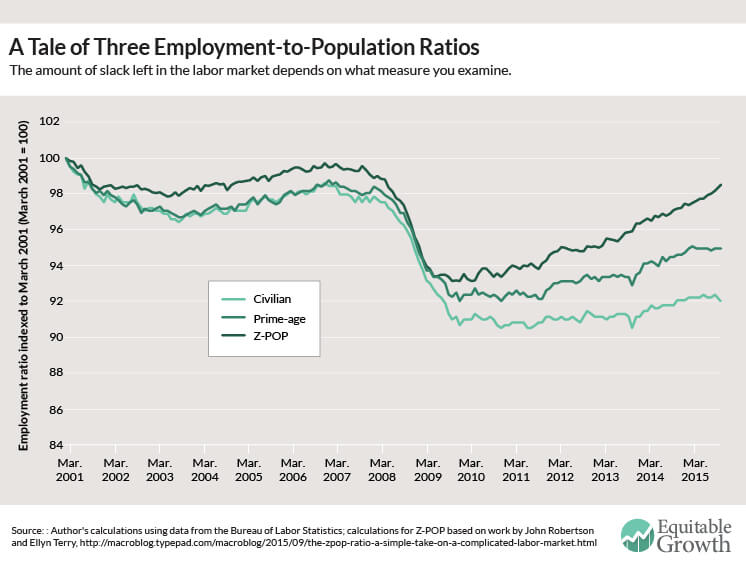
Figure from “A tale of three U.S. employment-to-population ratios” by Nick Bunker.

Noted for the Morning of October 23, 2015

Must- and Should-Reads:

Might Like to Be Aware of:

Must-Read: Michael Clemens: The South Pacific Secret to Breaking the Poverty Cycle

Must-Read: Michael Clemens: The South Pacific Secret to Breaking the Poverty Cycle: “The average Tongan household that participated was earning just NZ$1,400 per year…

…before these jobs. The average worker who participated earned NZ$12,000 for just a few months of work. It multiplied low-income workers’ earnings by a factor of 10. Almost no other antipoverty project you’ve ever heard of can claim that. Imagine what that did to poverty…. This project was ‘among the most effective development policies evaluated to date.’ And it did that not by taking money away from New Zealanders, but by adding value to the New Zealand economy. What’s working against poverty? International labor mobility….

The last time the United Nations set global goals to fight poverty, back in 2000, it completely ignored the power of labor mobility. The Millennium Development Goals, bizarrely, mentioned migration exclusively in negative and harmful terms…. This time… [they] at least mention migration…. But they decline to mention any possibility of actually facilitating migration…. The authors… still think that mobility doesn’t matter much for global poverty. That just does not make sense in a world where remittances to poor countries are several times as large as foreign aid. It does not make sense in a world where barriers to mobility cost the world trillions of dollars every year. What’s working against poverty is international mobility. And it will keep working to help meet the Global Goals for fighting poverty–largely in spite of them.

Must-Read: Martin Wolf: Lunch with Ben Bernanke

Martin Wolf: Lunch with the FT: Ben Bernanke: “Critics complain that the Fed… let ordinary people drown…

…How does he respond? ‘Rising inequality… is a long-term trend that goes back at least to the 1970s. And the notion that the Fed has somehow enriched the rich through increasing asset prices doesn’t really hold up… [because] the Fed basically has returned asset prices… to trend… [and] stock prices are high… because returns are low…. The same people who criticise the Fed for helping the rich also criticise the Fed for hurting savers…. Those two… are inconsistent. But what’s the alternative? Should the Fed not try to support a recovery?… If people are unhappy with the effects of low interest rates, they should pressure Congress to do more on the fiscal side, and so have a less unbalanced monetary-fiscal policy mix. This is the fourth or fifth argument against quantitative easing after all the other ones have been proven to be wrong. And this is certainly not an argument for the Fed to do nothing and let unemployment stay at 10 per cent.’

Other critics argue, I note, that the Fed’s intervention prevented the cathartic effects of a proper depression. He… respond[s]… that I have a remarkable ability to keep a straight face while recounting… crazy opinions. I add that many critics still expect hyperinflation any day now. ‘Well, we were quite confident from the beginning there would be no inflation problem. And, of course, the greater problem has been getting inflation up to target. As for allowing the economy to go into collapse, this is the Andrew Mellon [US Treasury secretary] argument from the 1930s. And I would think that, certainly among mainstream economists, it has no credibility. A Great Depression is not going to promote innovation, growth and prosperity.’ I cannot disagree, since I also consider such arguments mad….

Neither he nor the Fed expected the meltdown. Does the blame for these mistakes lie in pre-crisis monetary policy?… Had interest rates not been kept too low for too long in the early 2000s?… ‘[Was] monetary policy… in fact, a major contributor to the housing bubble[?]…. Serious studies that look at it don’t find that to be the case…. Shiller… who has a lot of credibility… says that: it wasn’t monetary policy at all…. The Fed had some complicity… in not constraining the bad mortgage lending and excessive risk-taking that was permeating the system. This, together with the structural vulnerabilities in the funding markets….’ Thus, lax regulation was to blame. Has the problem been fixed? ‘I think it’s an ongoing project,’ he replies. ‘You can’t hope to identify all the vulnerabilities in advance. And so anything you can do to make the system more resilient is going to be helpful.’…

Some argue that the financial sector is riddled with perverse incentives: limited liability; excessive leverage; ‘too-big-to-fail’ banks; and a range of explicit and implicit guarantees. How far does he agree? ‘I think that there was, for rational or irrational reasons, an upsurge in risk-taking. And if you’re taking risks, then I have to take the same risks, or else I get left behind. There’s two ways to get rid of ‘too-big-to-fail’. One is by having a lot of capital. And the other approach is via the liquidation authority in… Dodd-Frank….’ But, he adds, ‘if you break the firms down to the size of community banks, you lose a lot of functionality. At the same time, you don’t necessarily stop financial panics, because we had financial panics in the 1930s.’… I push a little harder on the costs of financial liberalisation. He agrees that, in light of the economic performance in the 1950s and 1960s, ‘I don’t think you could rule out the possibility that a more repressed financial system would give you a better trade-off of safety and dynamism.’

What about the idea that if the central banks are going to expand their balance sheets so much, it would be more effective just to hand the money directly over to the people rather than operate via asset markets?… A combination of tax cuts and quantitative easing is very close to being the same thing.’ This is theoretically correct, provided the QE is deemed permanent…

Calculating the leak in Okun’s bucket

Large blue bucket with money spilling by 350jb, veer.com

Forty years ago, Arthur Okun proposed an interesting thought experiment in his book Equality and Efficiency: The Big Trade-Off. He imagined the redistribution of income like moving water in a bucket with holes in it, and then posed this question: How much water would you be willing to lose as the water moved from the rich to the poor? In other words, how leaky of a bucket would you tolerate before you would stop redistributing income?

Like most thought experiments, the leaky bucket is supposed to spark thinking rather than be a specific test of policy. That was until a recent paper came up with a way of calculating how leaky our current buckets are.

The paper, by Harvard University economist Nathaniel Hendren, tries to figure out how society values an additional dollar going to a specific person based on the causal effects of policies. By looking at these causal effects, Hendren bridges a bit of a divide in economics between those who rely on a theoretical approach verses those who are driven more by empiricism. Hendren is able to provide a theoretical framework that lets economists use empirical results from analyses of specific policies. In particular, Hendren looks at how policy changes affect the U.S. federal budget.

You might think that raising $1 in government revenue simply requires taking $1 from a person through taxes. But that’s not true—the person from whom you take the $1 reacts to the change in their income, resulting in unintended consequences. A person who has their taxes raised, for example, might work less because their incentive to work—has declined. Getting $1 in government revenue requires taking more than $1 from the person being taxed as they are making less income. This means the cost of raising $1 in additional tax revenue is greater than $1.  At the same time, if less than 100 percent of the value of a program goes to the beneficiary then providing $1 of benefit increases their income by less than $1.

Hendren crunches the numbers on policy changes such as tax increases on those at the top of the income ladder; expansions in the Earned Income Tax Credit, or EITC; the Supplemental Nutrition Assistance Program (formerly known as food stamps); and Section 8 housing vouchers. This model, based on previous empirical research on the causal responses to these programs, gives a number that shows the social value of government money going to each policy. The higher the number, the more money society is willing to take from that person to raise an additional dollar of revenue.

These numbers are interesting on their own, but the really interesting results come when the marginal values of these programs are used to estimate the trade-off between each other. Hendren looks specifically at the hypothetical of increasing top marginal tax rates to finance a larger EITC payment. He figures that increased distribution in this case is “desirable” if we prefer for $0.44 or $0.66 (depending upon which research estimate is used) to go to an EITC recipient over $1.00 going to a person making at least $400,000. To put this in Okun’s terms, are we okay with $0.56 or $0.34 leaking out of the bucket in this case?

Of course, redistribution is just one way to reduce our current levels of income inequality. Growth that flows more to those at the middle and low ends of the income ladder would reduce the need for redistribution through taxes and transfers. On the other hand, policies that affect the distribution of income before taxes and transfers but have little efficiency costs might be used more often.

Hendren’s work depends on the underlying estimates of the causal effects from empirical economics papers, so more of that research will help pin down the specific numbers to think about. This would help clarify our thinking even more about the potential trade-offs.

Must-Read: Adair Turner: Debt Déjà Vu

Must-Read: Not that we know what the right model is, mind you. But Adair Turner believes that it is more likely than not that the model the Federal Reserve is currently using to make its forecasts off of–the model that sees steady non-recessionary U.S. economic growth even with imminent interest-rate lift-off–is the wrong model:

Adair Turner: Debt Déjà Vu: “Financial markets have repeated the same error–predicting that US interest rates will rise within about six months…

…This serial misjudgment is the result… of a failure to grasp the strength and global nature of… deflationary forces…. We are caught in a trap where debt burdens do not fall, but simply shift among sectors and countries, and where monetary policies alone are inadequate to stimulate global demand…. The origin of this malaise lies in the creation of excessive debt to fund real-estate investment and construction… during Japan’s 1980s boom… since the financial crisis of 2008… [a] pattern has been repeated elsewhere… in the United States and several European countries…. Advanced economies’ cumulative private debt-to-GDP ratio has fallen slightly–from 167% to 163%… but public debt has grown from 79% to 105% of GDP. Fiscal austerity has therefore seemed essential; but it has exacerbated the deflationary impact of private deleveraging.

Before 2008, China’s economy was highly dependent on credit expansion, but not within the country itself. Rather, it ran large current-account surpluses…. [Starting] in late 2008… China’s government unleashed a massive credit-fueled construction boom… total credit growing from around 140% of GDP to more than 220%. That boom has now ended, leaving apartment blocks in second- and third-tier cities that will never be occupied, and loans to local governments and state-owned enterprises that will never be repaid….

QE alone cannot stimulate enough demand in a world where other major economies are facing the same challenges. By boosting asset prices, QE is meant to spur investment and consumption. But its effectiveness in stimulating domestic demand remains uncertain…. Central bank governors like the ECB’s Mario Draghi and the BOJ’s Haruhiko Kuroda often emphasize QE’s ability to deliver competitive exchange rates. But that approach simply shifts demand from one economy to another…. Seven years after 2008, global leverage is higher than ever, and aggregate global demand is still insufficient to drive robust growth. More radical policies–such as major debt write-downs or increased fiscal deficits financed by permanent monetization–will be required to increase global demand, rather than simply shift it around.

We need better data on U.S. entrepreneurship

Photo of open sign by Francesco Ocello, veer.com

Entrepreneurs are some of the most heralded figures in American life today. The number of books and movies about the late Steve Jobs alone are testament to that fact. But while our press and our politicians celebrate the act of starting a business, economists don’t really understand the factors underpinning entrepreneurship that well. In fact, pinning down exactly what entrepreneurship is can be difficult at times, especially when moving from economics research to everyday conversations about the topic. That’s startling, given the important role of innovation, productivity, and (potentially) entrepreneurship.

A simple definition of an entrepreneur is just someone who starts a business. But this definition is almost certainly too broad for how we use the term in everyday conversation. This definition, for example, would put a plumber who starts his own firm to work as a contractor in the same category as the founder of a high-growth startup. The implications of each firm, however, are extremely different for the broader economy. At the beginning, they will both be small firms, but their end states are worlds apart.

That’s important given how much of U.S. policy tries to encourage entrepreneurship. Right now, policies target firms by their size—think of all the politicians you’ve heard make positive comments about small businesses. But small businesses aren’t the same as entrepreneurs.

As research by Erik Hurst of the University of Chicago and Benjamin Pugsley of the Federal Reserve Bank of New York shows, the motivations of most small-business owners have nothing to do with expanding the business. In fact, the majority of small-business owners are motivated by “non-pecuniary benefits”—in other words, they don’t do it for the money. Subsidies that only target businesses that happen to be small will end up subsidizing owners who probably will never expand their business and increase employment, let alone spread a new innovation across the economy. Small business might be worth subsidizing for some reasons, but not because they are critical for economic growth.

So what do we know about entrepreneurship? Well, the data about who entrepreneurs are and why they become entrepreneurs is still relatively sparse. A new paper by U.S. Census Bureau economists Christoper Goetz, Henry Hyatt, Erika McEntarfer, and Kristin Sandusky makes a pitch for using new data sets that match up employers and employees. The economists argue that these kinds of data sets can help answer questions about the kinds of people who actually work at start-ups, where they used to work, and also how changing demographics might have affected the start-up rate.

Our economy would benefit from better data and understanding about what causes people to start the kind of high-growth firms that most Americans think of when they think about economic growth and entrepreneurship. We do know enough to disrupt some falsehoods about the importance of all small firms, but the need for even more knowledge to make much better informed policy decisions is certainly there.

Must-Read: Tim Duy: Fed Struggles with the High Water Mark

Must-Read: I continue to fail to understand the apparent thinking of the center of the Federal Reserve. The following argument seems to me to be obviously correct:

  1. Asymmetric risks and the strong desirability of not returning to the zero lower bound after interest-rate lift-off call for raising interest rates not early and slow but late and fast.
  2. That plus the strong desirability of making it clear by actions that show their consequences in the data 2%/year for the PCE chain index–2.4%/year for the core-CPI–is a target and not a ceiling means that optimal risk management is to wait until rising inflation is present in the data before beginning lift-off
  3. The risks of damaging credibility via error are much less if the policy is to delay lift-off until there are signs of rising inflation as opposed to lifting-off as soon as demand plus the shakily-estimated Phillips curve say rising inflation is coming.
  4. Committee harmony is lost, whether there are formal dissents in December or not.

Even if the center of the Federal Reserve has not internalized Staiger, Stock, and Watson and pretends that their estimated Phillips curve is is the eternal truth of The One Who Is–on the grounds that “you need a forecast to make policy”–interest rate increases in December make no sense, and interest rate increases in March make no sense unless core inflation starts trending up right now:

FRED Graph FRED St Louis Fed

Tim Duy: Fed Struggles with the High Water Mark: “If we get two more reports hovering around 200k a month [in employment growth]…

…between now and December, matched with generally consistent data across other indicators, then December is on the table…. If jobs growth slows to 100k a month… we are looking at deep into 2016 before any hike. Around 150k is the gray area…. I suspect that more numbers like the last two will make the December meeting much like September’s. That I fear is my current baseline–another close call in which the Fed concludes to take a pass.

Gavin Davies: Is the US slowdown for real?: “Several investment banks’ economics teams have ruled out a December rise…

…The expected federal funds rate at the end of 2016 implies only two Fed rate hikes in total over that entire period. Clearly, investors increasingly believe that the US economy is now slowing enough to throw the Fed off course. This big change in market opinion is, frankly, surprising. The rise of 142,000 in non-farm payrolls in September was not all that weak…. The US slowdown [is] for real… but it is not yet very severe…. Unless it grows worse in the next few weeks, it is unlikely to dislodge the Fed from the path it has now firmly chosen.

Must-Read: Marshall I. Steinbaum and Bernard A. Weisberger: Economics was Once Radical: Then It Decided Not to Be

Must-Read: Marshall I. Steinbaum and Bernard A. Weisberger: Economics was Once Radical: Then It Decided Not to Be: “When it was first formed in 1885, the AEA was a radical challenge to the orthodoxy of classical, free-market economics…

…A generation of young American economists trained at German research universities in the 1870s returned to find their field dominated by an establishment largely confined to Harvard and Yale…. Richard Ely, an avowedly Christian Heidelberg-trained professor at Johns Hopkins with a calling to make economics a friend of the working man…. As originally drafted, the opening platform of the AEA declared ‘We regard the state as an educational and ethical agency whose positive aid is an indispensable condition of human progress. While we recognize the necessity of individual initiative in industrial life, we hold that the doctrine of laissez-faire is unsafe in politics and unsound in morals,’ and it went on to excoriate ‘the conflict of labor and capital.’ The mission of the new organization was to promulgate empirical economics research, including the nascent concept of peer review, a powerful weapon in asserting the scientific superiority of the new school over the establishment’s dry, unshakable orthodoxy….

[But] university presidents seeking stature for their institutions appealed to rich donors among the period’s Robber Barons, and that appeal was unlikely to be successful when rabble-rousers in the economics department were questioning the foundations of American capitalism…. Economists realized there was much to be gained in terms of professional stature and influence from making themselves appealing to the establishment, so they banished those elements that tainted them by association…. Even Ely himself eventually came around after his own notorious trial before the Wisconsin Board of Regents in 1894…. The economic tracts of that era began to enshrine the perfectly competitive market at the center of the intellectual firmament in economics…. It’s hard to escape the conclusion that in choosing to sideline left-wing elements among their own, economists gave up important if inconvenient empirical insights in favor of intellectual self-promotion, and that left them blind to the realities of inequality…