Today’s economic history: Did the classical liberals believe in constructive statecraft?

Today’s Economic History: Abbott Payson Usher (1934): A Liberal Theory of Constructive Statecraft: Presidential address delivered at the Forty-sixth Annual Meeting of the American Economic Association, Philadelphia, Pennsylvania, December 27, 1933:

Classical and neo-classical economic theory is commonly associated with a form of liberalism that was more largely directed toward the repeal of old laws and regulations than to the constructive development of institutions to meet new social problems. In the past the chief emphasis has been laid upon these destructive accomplishments of economic liberalism. It has therefore been easy to overlook the actual constructive accomplishments of the early nineteenth century, and many are disposed to believe that these positive achievements were inconsistent with the primary postulates of classical and neo-classical theory.

It must be confessed that there is confusion of thought in the writings of the early nineteenth century economists; but a positive theory of constructive statecraft is implicit in the basic liberal concepts. The most characteristic features of classical theory lead directly toward a broad concept of the task of the state.

Classical theory was based upon the concept of an orderly and rational system of nature, and the concept of a contractual society. We need not concern ourselves here with the precise forms in which these concepts were held by the economists of the nineteenth century, because it is more important to direct our attention to the full content of these ideas than to the imperfect and incomplete formulations that have prevented liberal views from achieving their full development.

As people probably told my Great-Great-Uncle Abbott, “most characteristic” is in the eye of the beholder. However, he is certainly right as far as Hume, Smith, Ricardo, Tocqueville… even Bastiat are concerned. With Senior and subsequent epigones, however, “most characteristic” becomes debatable: the parody of classical liberalism comes close to reality–and today we have sub-epigones at Heritage and Cato denouncing Bastiat and Hayek, as Ludwig von Mises did Milton Friedman, as “Communists. You’re just Communists…”
Must-read: Noah Smith: “Don’t Blame ‘Uncertainty’ for the Slow Recovery”

Noah Smith: Don’t Blame “Uncertainty” for the Slow Recovery: “Since Baker, Bloom and Davis came out with their uncertainty hypothesis…

…there has been a large and sustained drop in the index of uncertainty. But the rate of the U.S. economic recovery has remained slow and steady, leading many to question whether uncertainty is just a sideshow…. Sydney Ludvigson… Sai Ma… and Serena Ng…. Their statistical technique requires some bold assumptions, but allows for interpretation of cause and effect. Ludvigson, Ma and Ng find that financial uncertainty seems to cause every other type of economic uncertainty… finance… drive[s] the real economy. 

So what does this result mean for the policy uncertainty hypothesis?… [If] policy [were] to be the cause… it would have to do so through its impact on financial markets. Legal challenges to Obamacare or increased regulation of aircraft manufacturing would be unlikely causes of recessions. So what policies, in 2008, threatened U.S. financial markets? Before the crash, financial regulation… wasn’t a major plank of  Barack Obama’s or John McCain’s presidential campaigns…. When financial regulation actually did come, in 2010 in the form of Dodd-Frank, it did very little to hurt asset markets. Therefore there is good reason to be skeptical of the hypothesis of Baker, Bloom, and Davis. It is difficult to lay blame for the Great Recession, or the slow recovery from that recession, at the feet of either the Obama administration or the Republicans in Congress…. The financial industry imploded all on its own, and that the Great Recession was the result.

Must-read: William Nordhaus: “Schumpeterian Profits in the American Economy: Theory and Measurement”

William Nordhaus (2004): Schumpeterian Profits in the American Economy: Theory and Measurement: “Schumpeterian profits… arise when firms…

…appropriate the returns from innovative activity… We conclude that only a minuscule fraction of the social returns from technological advances over the 1948-2001 period was captured by producers, indicating that most of the benefits of technological change are passed on to consumers rather than captured by producers.

Today’s economic history: Writing is (and other things are) not “naturally” human

Today’s Economic History: For Homer and his audience, writing is unnatural and un-human: “many deadly signs on a folded tablet…”.

What is natural to humans–what we were back in the environment of evolutionary adaptation when we were in biological equilibrium–is grunting bands of 50 or so making their way across the Horn of Africa with their stone tools. Since then, the language Singularity, the agriculture Singularity, the writing Singularity, and perhaps now a fourth have changed human life in many ways beyond all recognition. “What is natural to humans” almost invariably means “what I expect to happen”, which is roughly the same as “what I learned about how things were, were done, and ‘ought’ to be done back when I was a child”.

Homer: Iliad: “Proetus’ wife, the fair Anteia…

…longed madly for Bellerephon, and begged him to lie with her in secret, but wise Bellerephon was a righteous man and could not be persuaded. So she wove a web of deceit, and said to King Proetus: ‘Kill this Bellerephon, who tried to take me by force, or die in the doing of it.’

The king was angered by her words. He would not kill Bellerephon, as his heart shrank from murder, but he packed him off to Lycia, and scratching many deadly signs on a folded tablet, gave him that fatal token, and told him to hand it to the Lycian king, his father-in-law, so to engineer his death.

Bellerephon went to Lycia escorted by peerless gods, and when he reached the streams of Xanthus the king of great Lycia welcomed him with honour, entertaining him for nine days, and sacrificing nine oxen. But when rosy-fingered Dawn lit the tenth day his host questioned him, and asked what token he brought him from his son-in-law Proetus…

Must-read: Roger Farmer: “Global Sunspots and Asset Prices in a Monetary Economy”

Must-Read: Roger E.A. Farmer: Global Sunspots and Asset Prices in a Monetary Economy: “A simple model in which asset price fluctuations are caused by sunspots…

…I construct global sunspot equilibria. My agents are expected utility maximizers with logarithmic utility functions, there are no fundamental shocks and markets are sequentially complete. Despite the simplicity of these assumptions, I am able to go a considerable way towards explaining features of asset pricing data that have presented an obstacle to previous models that adopted similar assumptions. My model generates volatile persistent swings in asset prices, a substantial term premium for long bonds and bursts of conditional volatility in rates of return.

Must-read: Roger Fouquet and Stephen Broadberry: “Seven Centuries of European Economic Growth and Decline”

Must-Read: How rapidly would one anticipate that the Malthusian scissors would work, anyway?

Roger Fouquet and Stephen Broadberry: Seven Centuries of European Economic Growth and Decline, Journal of Economic Perspectives 29:4 (Fall), pp. 227-44: “New annual GDP per capita data for six European countries over the last seven hundred years…

…paint a clearer picture of the history of European economic development…. Numerous periods of economic growth before the nineteenth century—periods of unsustained, but rising GDP per capita…. Many of the economies experienced substantial economic decline. Thus, rather than being stagnant, pre-nineteenth century European economies experienced a great deal of change…

Lessons from Douglass North plus an amazing GDP chart Andrew Batson s Blog

Must-read: Dean Baker: “The Upward Redistribution of Income: Are Rents the Story?”

Must-Read: Contra Dean Baker, I suspect that Thomas Piketty would say that the ability of the rich to manipulate property rights and market power in order to keep the rate of profit high even as the economy becomes more capital-intensive is a feature that is “intrinsic to capitalism.” Thus I think Piketty would say that Baker is wrong here at the end:

Dean Baker: The Upward Redistribution of Income: Are Rents the Story?: “The top one percent of households have seen their income share roughly double…

…from 10 percent in 1980 to 20 percent in the second decade of the 21st century. As a result of this upward redistribution, most workers have seen little improvement in living standards from the productivity gains over this period…. The bulk of this upward redistribution comes from the growth of rents in the economy in four major areas: patent and copyright protection, the financial sector, the pay of CEOs and other top executives, and protectionist measures that have boosted the pay of doctors and other highly educated professionals. The argument on rents is important because, if correct, it means that there is nothing intrinsic to capitalism that led to this rapid rise in inequality, as for example argued by Thomas Piketty.

http://cepr.net/publications/reports/working-paper-the-upward-redistribution-of-income-are-rents-the-story

http://cepr.net/documents/working-paper-upward-distribution-income-rents.pdf

Must-reads: December 28, 2015


A non-exclusive list of interesting graphs from 2015

With 2015 about to end, it’s worth taking a look back at some of the year’s most interesting graphs. Check them out below.

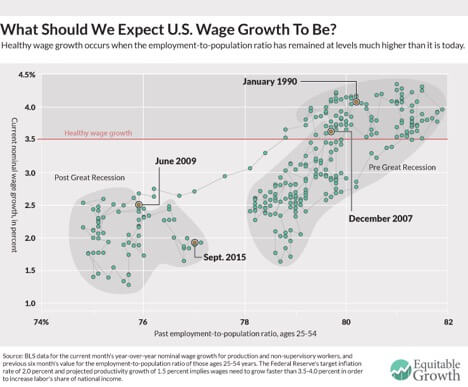
1. Strong wage growth has yet to show up

While the U.S. unemployment rate has reached 5 percent, wage growth hasn’t accelerated. Previous experience shows more workers need to be employed before we get healthy wage growth.

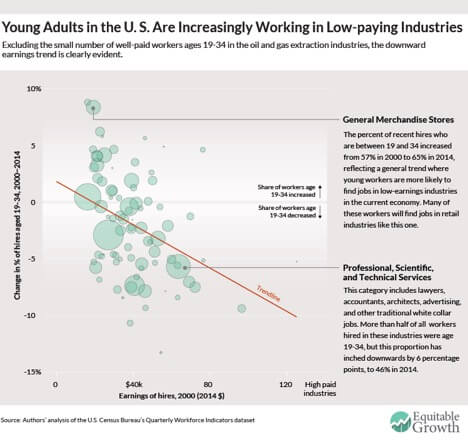
2. The collapse of the U.S. job ladder

The job ladder has been a key way that workers get raises, as they move up to higher-paying jobs. But the job ladder in the United States seems to have collapsed in the 21st century.

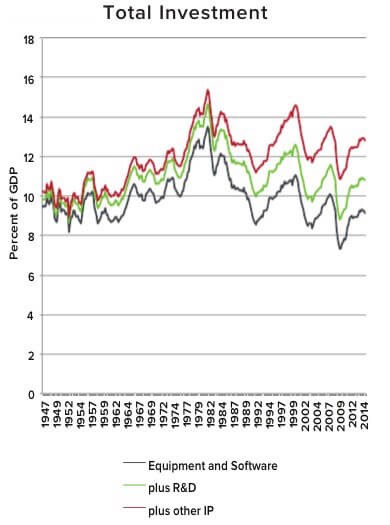
3. The decline in U.S. business investment

(original graph from the Roosevelt Institute)

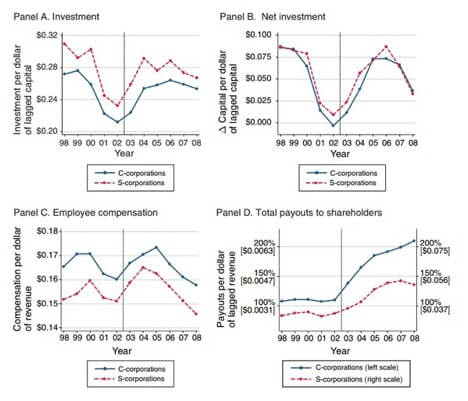
While U.S. investment growth has been weak during the current economic recovery, the weakness is actually a longer-term phenomenon.

(original graphs from the American Economic Review)

Furthermore, the 2003 dividend tax cut was sold as a way to boost U.S. investment. But we should be skeptical that it did anything of the sort.

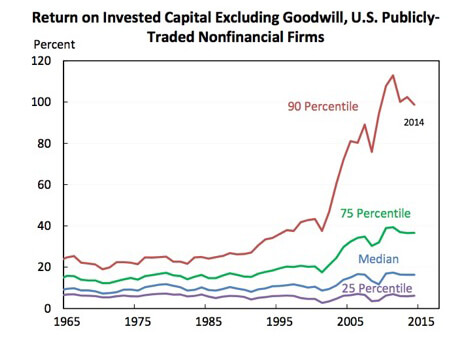
4. The relationship between “rents” and inequality

(original graph from the Council of Economic Advisers)

The role of economic rents—excess returns to an economic actor—is an increasingly popular topic of conversation when it comes to economic inequality. The extraordinary returns some firms have seen is a sign of the importance of rents.

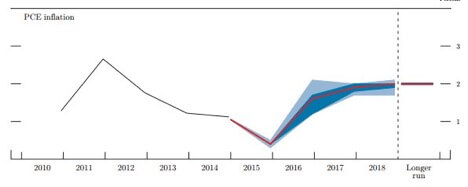
5. The Fed’s 2 percent inflation “target”

(original graph from the Federal Reserve)

As the Federal Reserve recently raised interest rates for the first time in almost a decade, it sees inflation running below its target for the next three years.

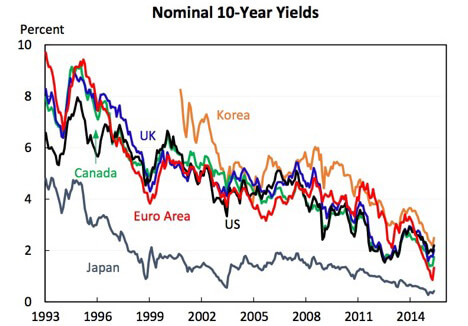
6. The decrease in long-term interest rates

(original graph from the Council of Economic Advisers)

While short-term interest rates may be on the upswing, long-term interest rates have been falling for a while. And they seem set to be that way for a while.

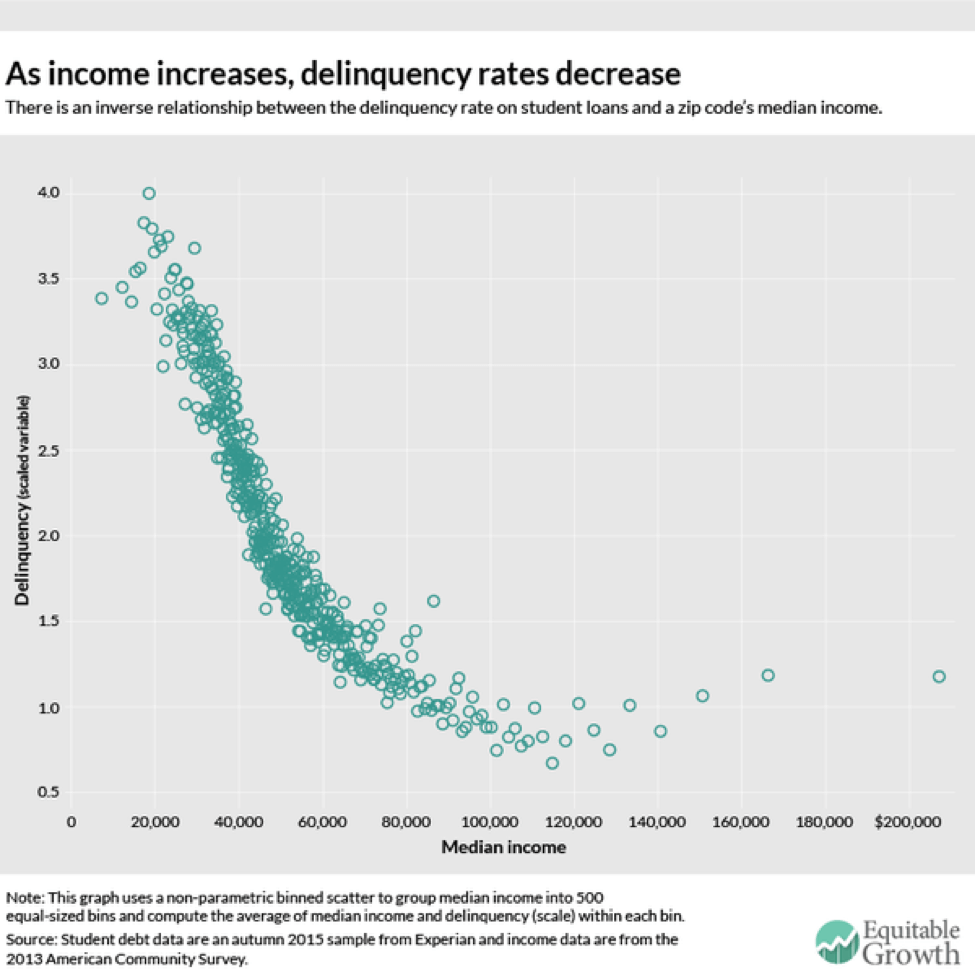
7. The relationship between income and student loan delinquency

The massive increase in student loan debt across the United States has triggered concerns that borrowers with huge debt burdens will default. But borrowers with small balances are actually the most likely to default.

Must-read: Jefferson Cowie and Nick Salvatore: “The Long Exception: Rethinking the Place of the New Deal in American History”

Must-Read: From “The Defining Moment” to “The Long Exception”…

Jefferson Cowie and Nick Salvatore (2008): The Long Exception: Rethinking the Place of the New Deal in American History: “The period from Franklin Roosevelt to the end of the twentieth century… [shows] that the New Deal…

…was more of an historical aberration–a byproduct of the massive crisis of the Great Depression—than the linear triumph of the welfare state. The depth of the Depression undoubtedly forced the realignment of American politics and class relations for decades, but… there is more continuity in American politics between the periods before the New-Deal order and those after its decline than there is between the postwar era and the rest of American history…. While liberals of the seventies and eighties waited for a return to what they regarded as the normality of the New Deal order, they were actually living in the final days of what Paul Krugman later called the “interregnum between Gilded Ages”… [with respect to] race, religion, class, and individualism.