Unemployment insurance might increase unemployment, but only slightly

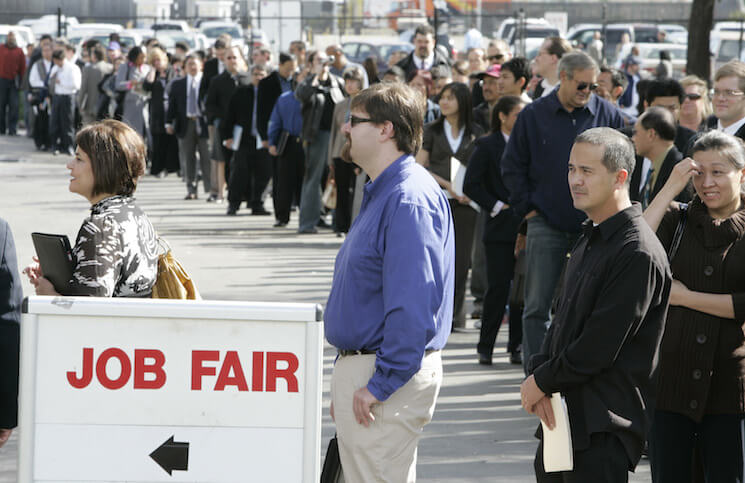
Hundreds of people wait in line at a job fair in San Mateo, California, Wednesday, February 25, 2009.

The damage the U.S. labor market endured during and after the Great Recession was massive. The unemployment rate, after rising for 29 months, spiked at 10 percent in October 2009—a level not seen since the early 1980s. With such a big jump in unemployment, policymakers took steps to significantly expand the unemployment insurance system. They dramatically increased the duration of the program, allowing eligible workers to receive benefits for up to 99 weeks in some cases.

Such a response made sense. With unemployment sharply on the rise and then remaining elevated, it is important for workers looking for a job—and for the aggregate demand in general—to be able to collect benefits if finding a job is difficult. But there’s been some concern that by reducing the incentive to find work, expanding unemployment insurance itself actually increases the unemployment rate. According to a new paper on the subject, that may be true but it also is of minimal importance at most.

But first, let’s put the new paper in context. In studying the effect of unemployment insurance on unemployment, economists have generally gone in two directions. The first is to look at the microeconomic effects and try to understand how the benefits affect the decisions of individual workers. Research in this vein after the Great Recession finds that unemployment insurance does increase the unemployment rate, but that’s because workers remain in the labor force as they look for work.

The second way to look at unemployment insurance is in the macro sense to see how it affects aggregate unemployment when the insurance is extended during a recession. The micro approach only captures what economists call “partial equilibrium” effects, so macro approaches try to see how the unemployment rate is changed after the extension at the macro level, estimating the “general equilibrium” effects. Some of the papers looking at macroeconomic outcomes find a small effect of UI extensions on unemployment, while others find large negative effects.

That’s where the new paper by Gabriel Chodorow-Reich of Harvard University and Loukas Karabarbounis of the University of Chicago fits in. And as you could guess from its title—“The Limited Macroeconomic Effects of Unemployment Benefit Extensions”—the paper finds only a slight macroeconomic effect of increasing the duration of unemployment insurance. How they find this result is quite interesting. A problem with figuring out how much unemployment benefits increase unemployment is that they get extended when unemployment is going up. So it’s hard to figure out which way the causation runs in the relationship: Is the extension causing a rise in the rate or vice versa?

Chodorow-Reich and Karabarbounis figure out a nifty way of untangling the causation. Unemployment benefits “trigger on” once the unemployment rate in a state has been over a defined threshold for a certain amount of time. But sometimes there are measurement issues with state unemployment rates that cause the benefits to trigger on when the underlying economic situation wouldn’t call for it or vice versa. The changes in this measurement error are random, which means the authors can measure the causal impact of the extensions. Their empirical results imply that the increases in the duration of unemployment benefits increased the unemployment rate by 0.3 percentage points.

The unemployment rate increased overall by 5 percentage points during the Great Recession, so the extended unemployment benefits were behind only 6 percent of the overall increase in the unemployment rate between December 2007 and June 2009. Concerns, then, that policies designed to help fight unemployment actually increase it are way overblown. Our concerns about the unemployment insurance system might be better directed toward other areas.

Must-read: Peter Ganong and Daniel Shoag: “Why Has Regional Income Convergence in the U.S. Declined?”

Must-Read: Peter Ganong and Daniel Shoag: Why Has Regional Income Convergence in the U.S. Declined?: “The past thirty years have seen a dramatic decline in the rate of income convergence…

across states and in population flows to wealthy places. These changes coincide with (1) an increase in housing prices in productive areas, (2) a divergence in the skill-specific returns to living in those places, and (3) a redirection of unskilled migration away from productive places. We develop a model in which rising housing prices in wealthy areas deter unskilled migration and slow income convergence. Using a new panel measure of housing supply regulations, we demonstrate the importance of this channel in the data. Income convergence continues in less-regulated places, while it has mostly stopped in places with more regulation.

Must-reads: April 13, 2016


Should-reads:

Must-read: Derek Thompson: “How American Cities Can Make America Great Again”

Must-Read: Derek Thompson: How American Cities Can Make America Great Again: “Even if the federal government were a monarchy…

…some of the most significant policy decisions happen at the local and state level, where federal power holds little sway. The president cannot force richer cities to raise their minimum wages above the national minimum, nor can the executive branch alone force states to spend more money on poor neighborhoods’ public schools. But perhaps the best example is America’s housing policy. As much as tax policy or defense spending can shape the economic fortunes of families and generations, people are not just products of the District’s mandates. They are also products of local geography—which is determined city by city, and block by block….

Several major cities have missed out almost entirely from the recovery. In Detroit, Memphis, and Toledo, the number of businesses declined between 2010 and 2013. In Cleveland and Cincinnati, total employment shrunk as well. In other cities… the recovery has been so frothy that the housing market is back to its pre-crash highs…. Austin, Buffalo, Denver, Honolulu, Nashville, Pittsburgh, [and] San Francisco. In three other metros, prices are within 5 percent of their all-time highs: Durham-Chapel Hill, Houston, [and] San Jose…. The return of record-high home prices in metros rich with new college grads is both an achievement and a warning. It’s an achievement, because there is a strong relationship between long-term growth and cities that assemble smart people…. But it’s a warning, too, because long-term growth requires that those people can afford to stay in the city….

There are some good reasons why expensive cities tend to be on the water. It’s hard to builds apartments on the ocean. But restrictive housing policies—for example, height restrictions and rules prohibiting the construction of new homes or multifamily housing— are a man-made tax on agglomeration, pricing smart people out of places they want to live and the places where they could best work. This, in turn, deprives some cities of the very job multiplier that Moretti hailed…. This isn’t a concern on the level of a city, but of the nation as a whole…

Must-read: Jérémie Cohen-Setton, Joshua K. Hausman, and Johannes F. Wieland: “Supply-Side Policies in the Depression: Evidence from France”

Must-Read: Jérémie Cohen-Setton, Joshua K. Hausman, and Johannes F. Wieland: Supply-Side Policies in the Depression: Evidence from France: “The effects of supply-side policies in depressed economies are controversial…

…We shed light on this debate using evidence from France in the 1930s. In 1936, France departed from the gold standard and implemented mandatory wage increases and hours restrictions. Deflation ended but output stagnated. We present time-series and cross-sectional evidence that these supply-side policies, in particular the 40-hour law, contributed to French stagflation. These results are inconsistent both with the standard one-sector new Keynesian model and with a medium scale, multi-sector model calibrated to match our cross-sectional estimates. We conclude that the new Keynesian model is a poor guide to the effects of supply-side shocks in depressed economies.

The disappearance of monetarism

I just hoisted a piece I wrote 15 years ago1—a follow-up to my “Triumph of Monetarism” that I published in the Journal of Economic Perspectives. I think of it as my equivalent of Olivier Blanchard’s “The state of macro is good” piece…

However, it is, I now recognize, clearly inadequate. It is quite good on how today’s New Keynesians are really Monetarists and how today’s Monetarists are really Keynesians. But it misses completely:

  • How use of the DSGE framework was morphing from (a) a rhetorical step to emphasize that assuming that agents in models behaved “rationally” did not entail any laissez-faire inclusions to (b) an unhelpful methodological straitjacket.
  • How there were about to be no Monetarists—how the right wing of macroeconomics, the Republican Party in the United States, the Tory Party in England, and all of Germany were about to, when confronted with the choice between following Milton Friedman’s well-grounded and empirically based arguments on the one hand and a mindless lemming-like devotion to austerity on the other hand, reject both empirical evidence and coherent thought and plump enthusiastically for the second.

I am still not sure how that happened…

Must-watch: Joe Gagnon et al.: Event: “Macroeconomic Policy Options for the World Today”

Must-Watch: Joe Gagnon et al.: Event: Macroeconomic Policy Options for the World Today: “Joseph E. Gagnon… Jay Shambaugh… Patrick Honohan… Carlo Cottarelli…

…The Peterson Institute will hold an event on April 12, 2016, to discuss the capacity and prospects for macroeconomic stimulus ahead of the spring meetings of the International Monetary Fund (IMF) and World Bank… possible monetary policy options for major central banks… the Obama administration’s perspective on the fiscal space globally and potential stimulus policies…

The importance of income and place in U.S. life expectancy

Over the past year or so, more and better research on the life expectancies of Americans has sparked debate over possible links to rising income inequality. In November, a study by Anne Case and Angus Deaton of Princeton University raised concerns that the life expectancy for middle-aged white Americans was on the decline. While that paper has been contested, a number of other studies and data show that increases in life expectancy are accruing disproportionately to high-income Americans. A new study backs up those results while also showing that increases in the inequality of life expectancy in the United States varies quite a bit by location.

The new study is from a number of researchers, led by Stanford University economist Raj Chetty. The paper uses administrative data from tax records from 1999 to 2014. This large dataset, 1.4 billion tax records, lets the researchers look at how these trends changed not only over time but also within specific geographic areas.

The first big result isn’t a new one: So-called longevity inequality is on the rise. Chetty and his colleagues focus on the life expectancy, conditional on reaching age 40. From 2001 to 2014, the conditional life expectancy of a man in the top 5 percent of the income distribution increased by 2.34 years, and by 2.91 years for a woman. In contrast, for a man and a woman in the bottom 5 percent, the increases were only 0.32 years and 0.04 years, respectively. In other words, a woman at age 40 in the top 5 percent has gained an additional three years over a woman at a bottom, and the increased advantage for a man was about two years.

Looking at the geographic variation in these trends, however, reveals a second big result for the researchers: Life expectancy for those at the top of the income ladder doesn’t vary much across the country, but it varies significantly for those at the bottom. Areas with higher life expectancy for those in the bottom 25 percent by income tend to be the areas with the least amount of longevity inequality. In short, location matters much more for those at the bottom than those at the top.

To be clear, there isn’t any evidence here of causality. We can’t tell from this research if income causes better health outcomes or if better health outcomes affect incomes. Nor do we know whether where one lives has a causal effect on health outcomes for low-income individuals—a finding that other research by Chetty shows is related to upward income mobility. And Deaton, commenting on the paper, also notes that among a number of other factors that researchers should weigh in the balance is the importance of educational differences.

But it’s worth noting the relationship between income and location. The authors actually found a positive relationship between economic segregation and life expectancy at the bottom of the income ladder, but that’s segregation within these areas. Perhaps an inability to access certain areas may be harmful for life expectancy. There’s been increasing attention to the high cost of living in urban areas such as New York City and San Francisco, which are also areas where the life expectancy of low-income individuals is higher.

Increasing access for low-income earners to those areas of the country where life expectancy among low-income residents is high would be an important policy goal if researchers discover a causal effect. But perhaps policymakers should instead examine what factors in the research data are associated with lower longevity inequality in some areas of the country and enact policies that encourage those factors in other areas.

Unsurprisingly, areas where people smoke less, exercise more, and are less obese have higher life expectancies. And those areas tend to be areas with more immigrants, higher home prices, and more workers with college degrees. Areas with higher public expenditures also have higher life expectancies for low-income individuals. Again, these correlations come with the caveat that they are not necessarily signs of causation. For better knowledge about how to increase life expectancy in areas that lag behind, well, we’ll have to wait for more research.

Must-read: Simon Wren-Lewis: “Can Central Banks Make Three Major Mistakes in a Row and Stay Independent?”

Must-Read: Simon Wren-Lewis: Can Central Banks Make Three Major Mistakes in a Row and Stay Independent?: “Mistake 1: If you are going to blame anyone for not seeing the financial crisis coming…

…it would have to be central banks. They had the data that showed a massive increase in financial sector leverage. That should have rung alarm bells, but instead it produced at most muted notes of concern about attitudes to risk. It may have been an honest mistake, but a mistake it clearly was.

Mistake 2: Of course the main culprit for the slow recovery from the Great Recession was austerity, by which I mean premature fiscal consolidation. But the slow recovery also reflects a failure of monetary policy…. Monetary policy makers should have said very clearly… that fiscal stimulus would have helped them do that job….

What could be mistake 3: The third big mistake may be being made right now in the UK and US… supply side pessimism. Central bankers want to ‘normalise’ their situation… writing off the capacity that appears to have been lost as a result of the Great Recession…. In both cases the central bank is treating potential output as something that is independent of its own decisions and the level of actual output. In other words it is simply a coincidence that productivity growth slowed down significantly around the same time as the Great Recession. Or if it is not a coincidence, it represents an inevitable and permanent cost of a financial crisis. Perhaps that is correct, but there has to be a fair chance that it is not…. What central banks should be doing in these circumstances is allowing their economies to run hot for a time….

If we subsequently find out that their supply side pessimism was incorrect (perhaps because inflation continues to spend more time below than above target, or more optimistically growth in some countries exceed current estimates of supply without generating ever rising inflation), this could spell the end of central bank independence. Three counts and you are definitely out?