Must-Read: Pedro Nicolaci da Costa: Income gap between upper-middle class and very rich

Income gap between upper middle class and very rich Business Insider

Must-Read: As I often say, income stagnation among the income-distribution slots in the bottom half of the population is a thing—even with very generous valuations applied to cheap and ingenious high-tech information-age electronic devices and services. And slow growth in income over the past generation for the slots between the 50th and the 80th percentile is a thing as well. But one other factor in American political economy is that those from the 80th to the 99th percentiles feel hard done by—even though the incomes of those slots have increased at what would in any other age be taken as a healthy clip, especially if one values the high-tech information-age generously.

But they are unhappy too. Why? Relative income factors. They do not compare themselves not to the mass of the population or to historical long-run rates of income growth. They compare themselves to the top 0.1%—the top 150,000 households, about 6000 of them in Greater San Francisco and about 500 of them in Greater Kansas City. And they compare themselves to the top 0.001%—1500 households, about 60 in Greater San Francisco and about 5 in Greater Kansas City, and feel small: e(6 x 35) = 8, after all:

Pedro Nicolaci da Costa: Income gap between upper-middle class and very rich: “Destabilizing levels of income inequality, once a problem reserved for developing nations, is now a defining social and political issue in the United States… http://www.businessinsider.com/income-gap-between-upper-middle-class-and-very-rich-2017-7

…Economists and conservative commentators have tried to blame inequality on educational levels, arguing that those with college degrees have fared well in the so-called knowledge economy…. David Brooks recently declared:

There is a structural flaw in modern capitalism. Tremendous income gains are going to those in the top 20%, but prospects are diminishing for those in the middle and working classes. This gigantic trend widens inequality, exacerbates social segmentation, fuels distrust and led to Donald Trump…

Richard Reeves, a senior fellow at the Brookings Institution, makes a similar case….

The strong whiff of entitlement coming from the top 20% has not been lost on everyone else,” he writes in a recent opinion piece…..

Gabriel Zucman… wasted little time in countering the argument:

No, @nytdavidbrooks tremendous gains are not going to the top 20%. They are going to top 1%…

Nicholas Bluffie… at the Center for Economic and Policy Research:

The problem with this type of analysis is that it misleads readers into thinking that a large group of well-educated Americans have benefited…. In reality, the ‘winners’ from increased inequality are really a much smaller group of incredibly rich Americans, not a large group of well-educated, upper-middle-class workers…

Blaming America’s wealth divide merely on educational differences may be easy, but not particularly useful.
Weekend reading: “Post-Jobs Day” edition

This is a weekly post we publish on Fridays with links to articles that touch on economic inequality and growth. The first section is a round-up of what Equitable Growth published this week and the second is the work we’re highlighting from elsewhere. We won’t be the first to share these articles, but we hope by taking a look back at the whole week, we can put them in context.

Equitable Growth round-up

Earlier today the U.S. Bureau of Labor Statistics released new data on the state of the labor market in June. Check out five key graphs from the report chosen by Equitable Growth staff.

Links from around the web

Jenna Smialek writes up new research documenting the sensitivity of employment to economic downturns for white and black workers. Downturns are much worse for the employment situations of African American workers. [bloomberg]

Much has been written about the Phillips Curve and how much changes in unemployment can predict inflation. James Hamilton argues that while the Phillips Curve is useful, other factors are more important for thinking about inflation. And this has long been the case. [econbrowser]

Germany is hosting the Group of 20 meeting this week and looks to defend the international trading system, it’s worth considering a threat Germany poses: its massive current account surplus. [the economist]

The rise of independent contractors in the U.S. labor market poses problems for our current labor law system. Former Wage and Hour Division Administrator David Weil outlines the problems of “misclassifaction” and ways to combat it. [hbr]

What’s behind slow productivity growth? There’s no smoking gun right now, but there’s evidence that slow capital formation—low investment—is at least partially responsible. [liberty street economics]

Friday figure

Figure is from “Equitable Growth’s Jobs Day Graphs: June 2017 Report Edition,” by Equitable Growth

Must-Read: Laurent Bach, Laurent Calvet, and Paolo Sodini: Risk, return, and skill in the portfolios of the [Swedish] wealthy

Must-Read: Laurent Bach, Laurent Calvet, and Paolo Sodini: Risk, return, and skill in the portfolios of the [Swedish] wealthy: “Administrative data… the wealthy indeed earn higher returns on their asset portfolios… http://voxeu.org/article/risk-return-and-skill-portfolios-wealthy

…primarily due to high levels of compensated risk. Households at the top of the wealth distribution further exhibit highly heterogeneous investment performance due to high levels of idiosyncratic risk…. The share of risky assets increases monotonically with net worth, reaching 21% for the median household, 62% for the top 1%-0.5%, and 95% for the top 0.01%… allocating a high share of gross wealth to risky assets; and by picking risky assets that load aggressively on systematic risk factors. Wealthy households also bear highly idiosyncratic risk through substantial direct holdings of private and public equity…. The expected return on total gross wealth is 2.7% per year higher for the top 10%-5% of households, 4.1% per year higher for the top 1%-0.5%, and 6.2% per year higher for the top 0.01%….

In contrast to gross wealth, net wealth earns an expected return that is U-shaped across brackets of net worth (see Figure 1, Panel B). Middle-class households have highly leveraged positions in real estate that generate high mean returns on net wealth. Upper-middle-class households have lower leverage and lower average returns. At the very top, households have very little personal debt but achieve high expected returns by bearing high systematic risk….

We find no empirical evidence that the rich can better pick stocks and generate higher risk-adjusted returns than other households. Similarly, we do not measure abnormal risk-adjusted returns on real estate and private equity holdings. We verify the robustness of our results on a dataset containing the yearly returns of US foundations…. The realised returns of US foundations are fully explained by their exposures to the equity market, while exceptional investment skill cannot be detected…

Should-Read: Brian Dow and Dean Baker: Obamacare: Big Problem in Republican States

Should-Read: Brian Dow and Dean Baker: Obamacare: Big Problem in Republican States: “The lack of competition in the exchanges is a serious problem… http://cepr.net/blogs/cepr-blog/the-collapse-of-obamacare-big-problem-in-republican-states

…However, there is an important part of the story that Trump and other Republicans forget to mention. The lack of competition in the exchanges is overwhelmingly a problem for people living in states controlled by Republican governors…. As can be seen over 40 million of the people in counties with only one insurer in the exchanges live in states with Republican governors…. While North Carolina does now have a Democratic governor, he just took office at the start of the year…. This means that there are almost 20 times as many people with no choice of insurers in the exchange in states with Republican governors as in states other than North Carolina that have Democratic governors…. 20.7 percent of the people living in states with Republican governors have only one insurer in the exchange. By comparison… 1.8 percent of people living in states other than North Carolina controlled by Democratic governors only have one insurer in their exchange…

Equitable Growth’s Jobs Day Graphs: June 2017 Report Edition

Earlier this morning, The U.S. Bureau of Labor Statistics released new data on the U.S. labor market during the month of June. Below are five graphs compiled by Equitable Growth staff highlighting important trends in the data.

1.

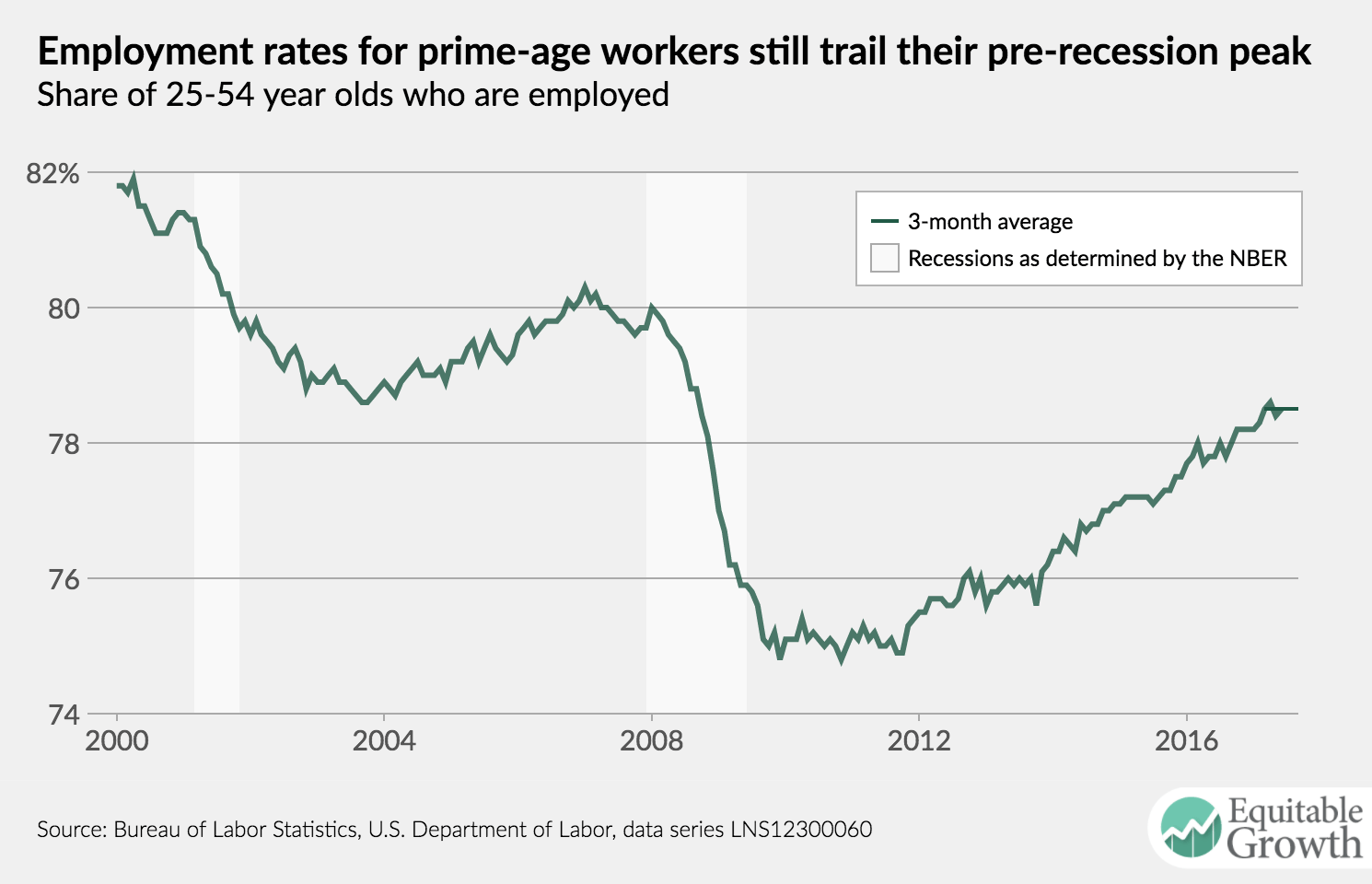
The prime-age employment rate rose by 0.1 percentage points to 78.5 percent in June. Employment is still recovering and looks to have room to run.

a

2.

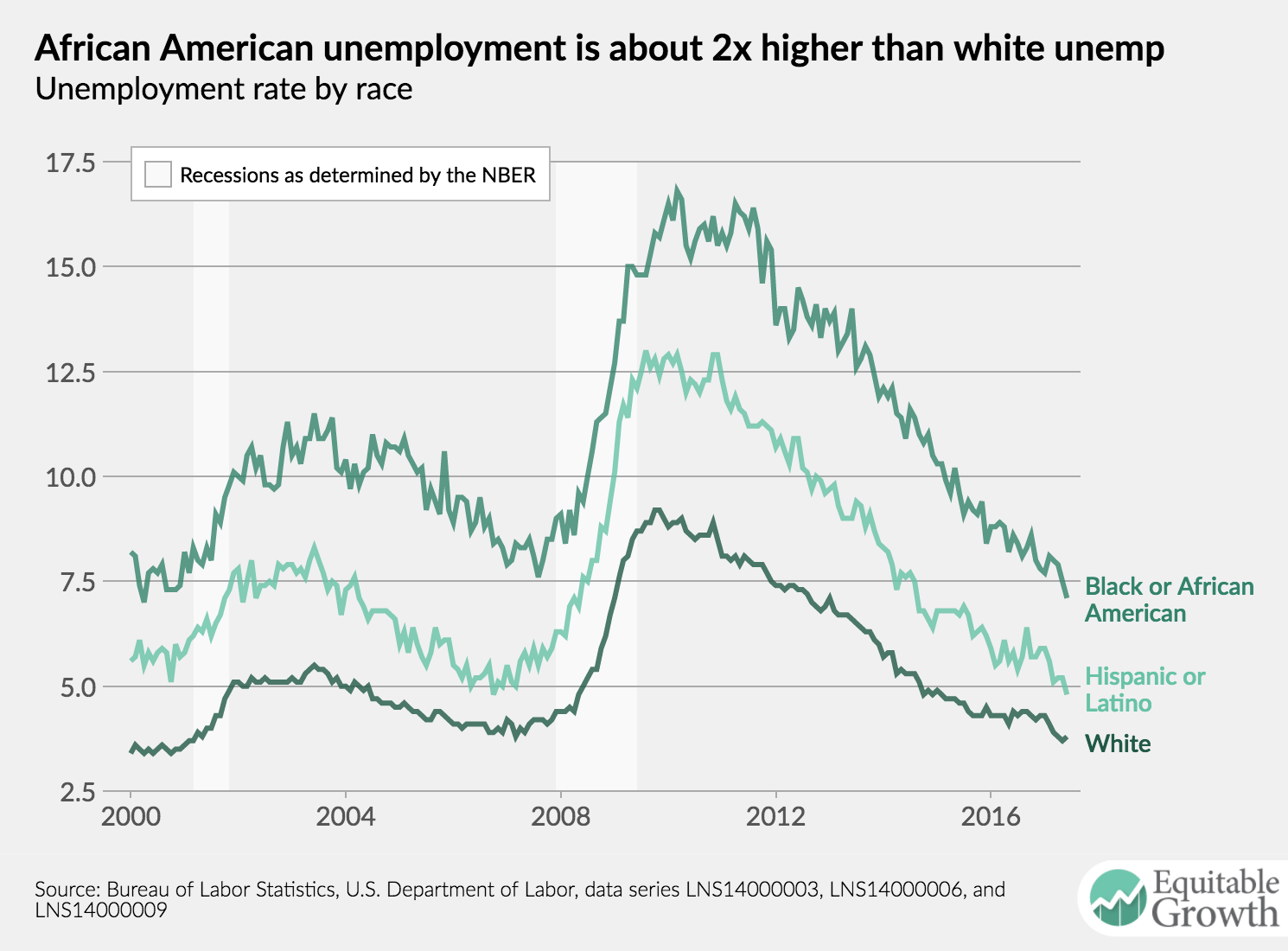
The African-American unemployment rate continues to be significantly elevated, but saw another 0.4 percentage point drop in June as the white unemployment rate rose by 0.1 points.

a

3.

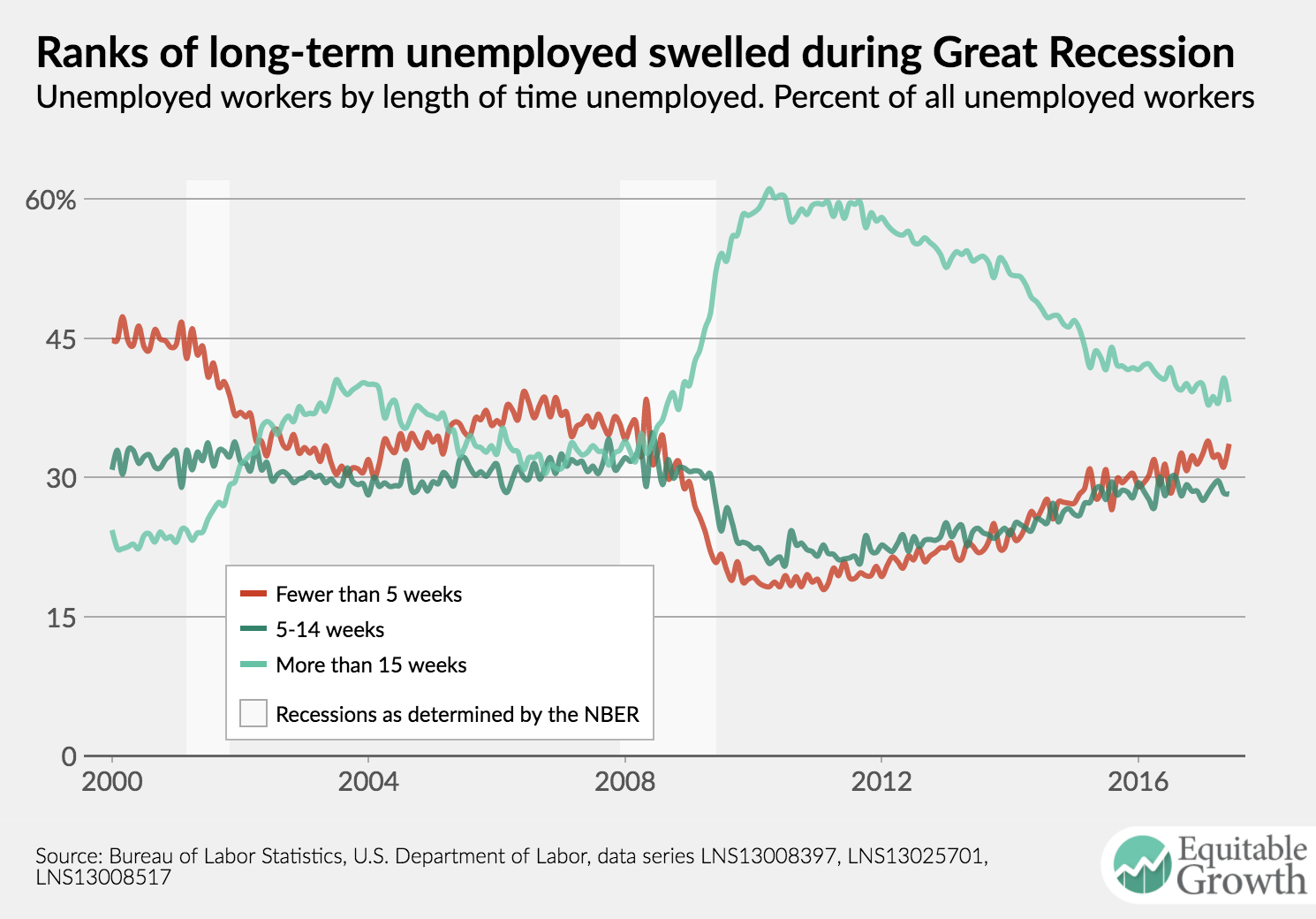
Unemployment spells of 15 weeks or longer dropped significantly in June, with almost all of the decline in unemployment of 15 to 26 weeks long (13.8% from 16.7%).

a

4.

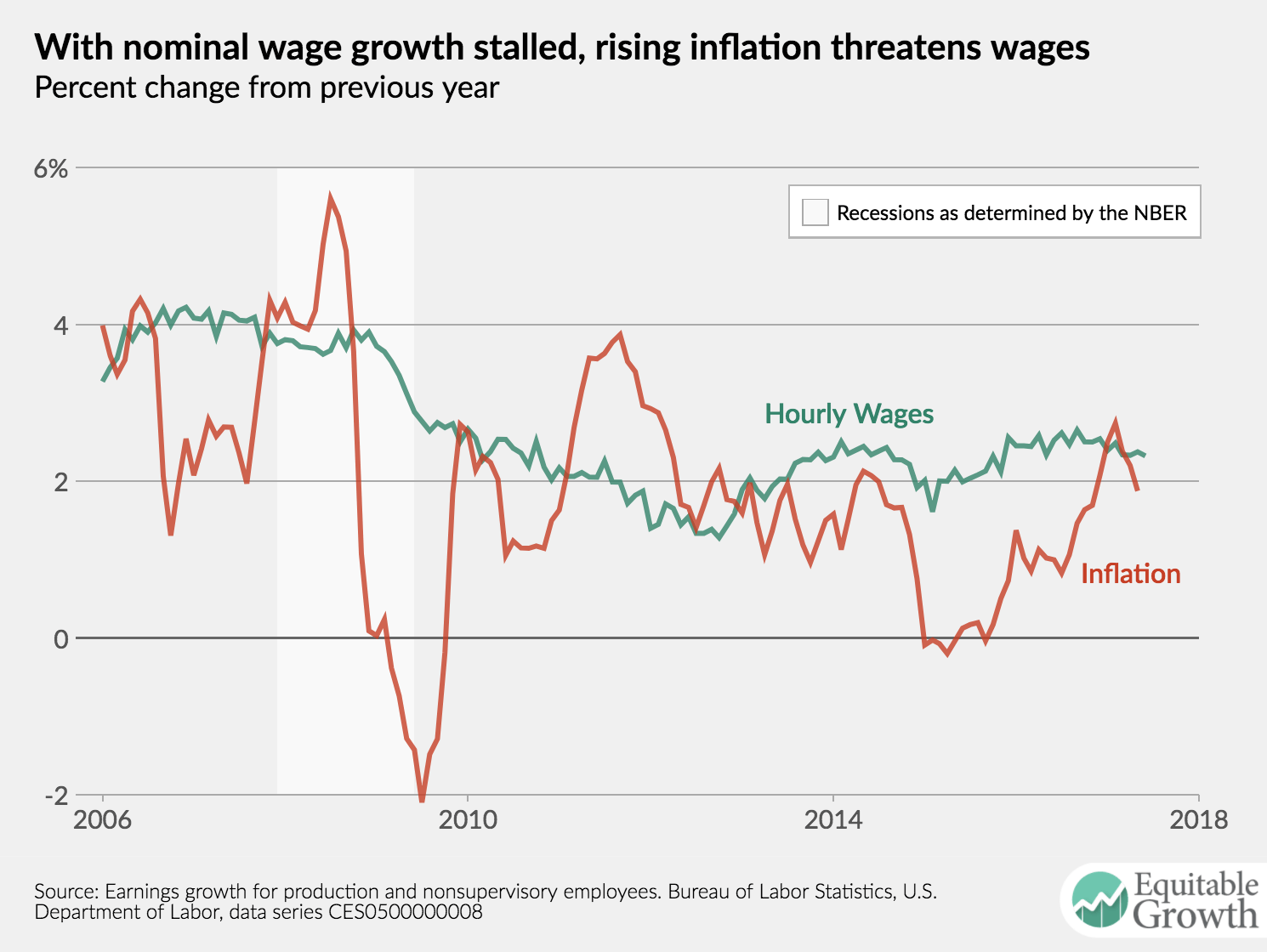
Nominal wage growth, measured by average hourly earnings for production workers, is still muted. It grew 2.3 percent year-over-year in June.

a

5.

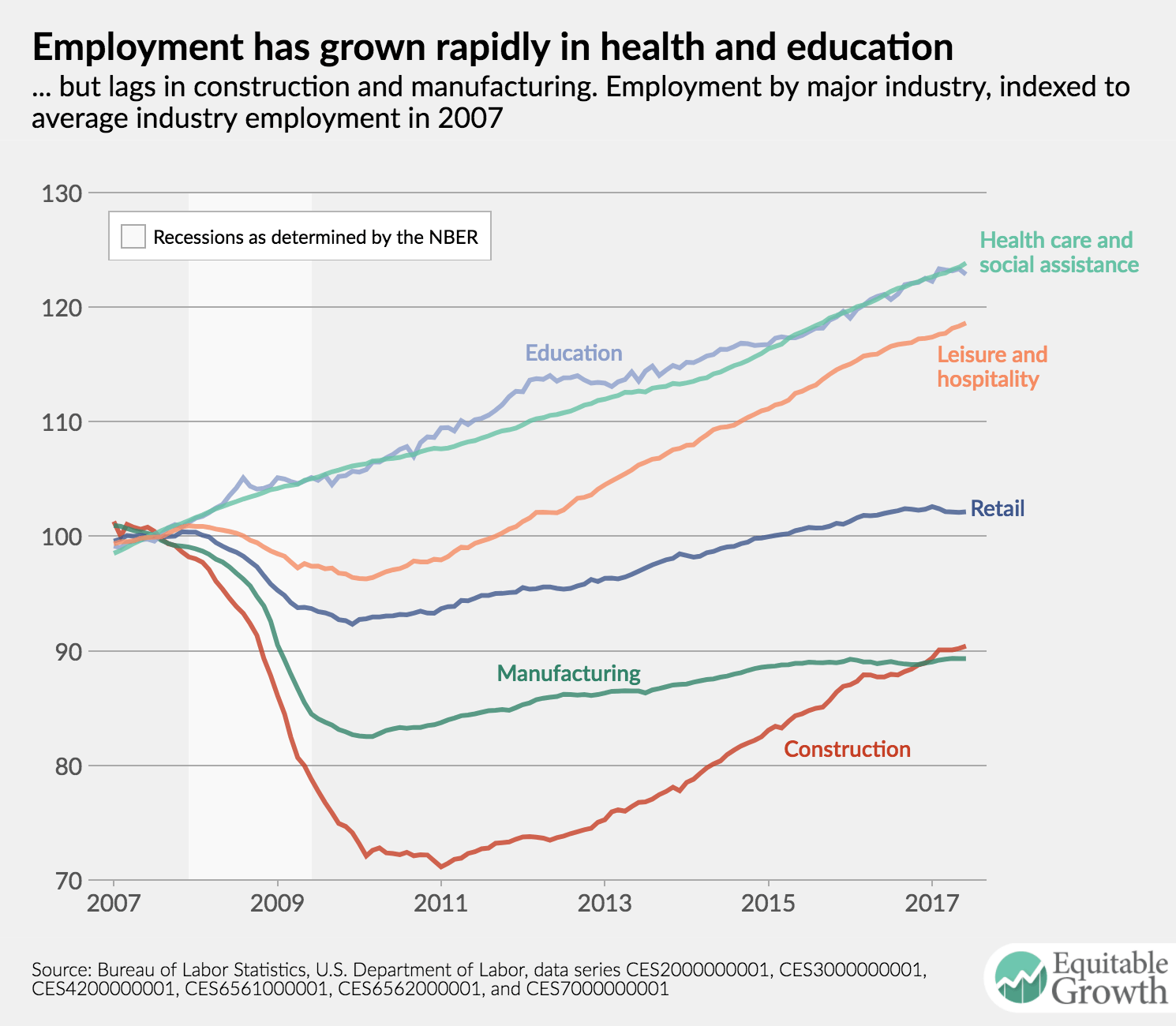
Retail employment saw gains in June, growing by 8,000. Health care continues to lead the pack, adding 37,000 jobs.

a

Must-Read: Roy Elis, Stephen Haber, and Jordan Horrillo: Climate, Geography, and the Evolution of Economic and Political Systems

Must-Read: Roy Elis, Stephen Haber, and Jordan Horrillo: Climate, Geography, and the Evolution of Economic and Political Systems https://economics.barnard.edu/sites/default/files/elis_haber_and_horrillo_march_25_2017.pdf: “The agricultural economies of the hinterlands of the largest city in every country or proto-country circa 1750 predict roughly half of the variance in countries’ per capita GDP today and one-fifth of the variance in countries’ levels of democracy today….

…These facts are: the potential production of storable food kilocalories, the loss of work effort from endemic malaria, and the frequency of droughts severe enough to wipe out all storable food kilocalorie production…. For example, conditional on the historical malarial environment (which reduced potential work effort), and the historical drought proneness of a hinterland, a one standard deviation increase in the ability to generate storable food kilocalories produces roughly half a standard deviation increase in the level of democracy today. These results are robust to the addition of possible confounders such as colonial heritage, participation in the slave trade, or having a petroleum-intensive economy….

Potential production of storable food… endemic malaria, and the frequency of droughts… are also good predictors of the level of urbanization of societies circa 1800 and their level and distribution of human capital circa 1820, 1870, and 1950….

Should-Read: Diane Coyle: Economics in Transition: Adaptive Markets

Should-Read: Diane Coyle: Economics in Transition: Adaptive Markets: “Adaptive Markets, by MIT’s Andrew Lo, gives a superb and fascinating account of thinking on the frontier… https://www.project-syndicate.org/onpoint/economics-in-transition-by-diane-coyle-2017-06

…the kind of approach rooted in biology and psychology that Richard Bookstaber… advocates in the final part of The End of Theory….One of the most effective points made by advocates of Fama’s now-notorious Efficient Markets Hypothesis is that it is in fact difficult to beat the market; profit-making opportunities are swiftly arbitraged away. And, indeed, Lo argues that when financial markets are stable enough for long enough, the rationality-based model is appropriate. But the moment there is any instability, human fear, greed, culture, behavioral norms, storytelling, and imagination kick in. The environment determines the way market participants behave….

The test of the adaptive markets approach, though, must be how it helps to predict, avert, or respond to financial crises…. Financial markets need to be viewed–by investors and regulators alike–as an ecosystem. The lesson from biology is that systems require feedback loops in order to regulate themselves…. Lo urges regulators to think of these feedback loops–literally–systematically, and proposes using network theory to map the whole of the financial regulatory system. Not surprisingly, the outcome of this exercise for the United States is not reassuring…

Should-Read: Martin Sandbu: Central bank rush to ‘normalise’ monetary policy is ill-advised

Should-Read: Martin Sandbu: Central bank rush to ‘normalise’ monetary policy is ill-advised: “An understanding to “normalise” together, if one exists, would not be a suicide pact… https://www.ft.com/content/3ad81df6-6161-11e7-8814-0ac7eb84e5f1

…unlike the universal and premature switch to severe fiscal consolidation in 2010. But it would be one of self-mutilation. As Gavyn Davies explains in his latest column, the global recovery is showing up in economic growth but not in accelerating inflation. Many had expected that… inflation would pick…. But there is no sign of this…. This looks like a positive global supply shock that would push activity and inflation in the opposite direction, as productive capacity expands more than anticipated. If that is indeed the cause of the present “lowflation” regime, monetary policy ought “to shift policy in the same direction as the signal from inflation, in this case towards less tightening”. That is not happening…. We might all be better served by ditching the term normalisation altogether. It implies, incorrectly, that there is something wrong or excessive about the current monetary policy stance. If today’s policy conditions are abnormal, it is an abnormality that policymakers should embrace rather than avoid…

Should-Read: David Cashin, Jamie Lenney, Byron Lutz, and William Peterman: Fiscal Policy and Aggregate Demand in the U.S. Before, During and Following the Great Recession

Should-Read: David Cashin, Jamie Lenney, Byron Lutz, and William Peterman: Fiscal Policy and Aggregate Demand in the U.S. Before, During and Following the Great Recession: “We examine the effect of federal and subnational fiscal policy on aggregate demand in the U.S. by introducing the fiscal effect (FE) measure… https://www.federalreserve.gov/econres/feds/files/2017061pap.pdf

…FE can be decomposed into three components. Discretionary FE quantifies the effect of discretionary or legislated policy changes on aggregate demand. Cyclical FE captures the effect of the automatic stabilizers—changes in government taxes and spending arising from the business cycle. Residual FE measures the effect of all changes in government revenues and outlays which cannot be categorized as either discretionary or cyclical; for example, it captures the effect of the secular increase in entitlement program spending due to the aging of the population.

We use FE to examine the contribution of fiscal policy to growth in real GDP over the course of the Great Recession and current expansion. We compare this contribution to the contributions to growth in aggregate demand made by fiscal policy over past business cycles. In doing so, we highlight that the relatively strong support of government policy to GDP growth during the Great Recession was followed by a historically weak contribution over the course of the current expansion…