Department of “Huh”?!: Where is the Arithmetic in Robert Rubin’s Financial Times Piece? Weblogging

Robert Rubin: Sound government finances will promote recovery: “Debates persist in the US and eurozone about growth and job creation versus fiscal discipline. This false choice diverts fiscal focus away from a balanced approach that could achieve both imperatives….

Our unsound fiscal trajectory undermines business confidence, and thus job creation, by creating uncertainty about future policy and exacerbating concerns about the will of Congress to govern…. A sound fiscal trajectory is also a prerequisite for interest rates conducive to growth…. Unconventional policy decisions by central banks are sometimes justified as the only available tools in the absence of necessary government policies. The right criterion for action, however, is not the absence of alternatives, but an assessment of costs and benefits. In the US, the Federal Reserve’s first programme of quantitative easing was a courageous response to the crisis…. In the US, there are widely posed questions about the benefits of QE3, but the risks are significant…. The Fed’s dramatic expansion of bank reserves could feed excessive credit growth. Along with the possible erosion of Fed credibility on inflation, that could also feed inflationary expectations….

Unconventional monetary policy and stimulus can be part of a successful economic programme for a period of time. But they are no substitute for fiscal discipline, public investment and structural reform…

Here is the arithmetic: Right now the U.S. government can issue a 30-year inflation-protected maturity with a yield of 1.5% per year. Right now if the U.S. spends an extra $100 billion next year it gets $200 billion of increased real GDP and $67 billion of additional tax revenue next year, for $33 billion of additional debt and $500 million of additional annual debt interest in the further future. If $200 billion of additional GDP next year has a long-term boost to GDP of even 1/100 as large–either as extra workers set to work brush-up on their skills, as organizations and capital learn more about how to produce, or as greater corporate cash flow leads to productive private or as government purchases are diverted to productive public investment, the extra annual debt service is more than covered by extra taxes produced by higher potential output. Rubin says that stimulus is “no substitute for fiscal discipline”. But as long as interest rates and economic slack are at their current levels, stimulus is fiscal discipline. It is the failure to undertake fiscal stimulus right now that is long-run fiscal profligacy.

Why doesn’t this arithmetic show up anywhere in Rubin’s piece?

You cannot compare costs and benefits without valuing them–without using numbers. And yet there is not a single number in Robert Rubin’s op-ed…
Worth Reading: Modeled Behavior: Karl Smith and Company: Thursday Focus (January 9, 2014)

Traditionally, I have tried to use Thursdays as a time to let loose on the idiocy–on people who haven’t done their homework, haven’t connected the dots, have decided to degrade the quality of substantive discourse in order to advance a partisan political point of view, haven’t bothered to mark their beliefs to market, haven’t gotten up the energy to think things through.

But it would be more fun, I think, to spend Thursdays pointing out smart people whose work I thick is undervalued in the discourse.

And so, for today’s focus, I want to point out to one and all that I find Modeled Behavior–to be well worth reading. And, I think, in general it is profoundly undercited in the discourse.

For example…

Continue reading “Worth Reading: Modeled Behavior: Karl Smith and Company: Thursday Focus (January 9, 2014)”

President Lyndon B. Johnson’: The War on Poverty: Fiftieth Anniversary Weblogging

President Lyndon B. Johnson’s Annual Message to the Congress on the State of the Union January 8, 1964:

Mr. Speaker, Mr. President, Members of the House and Senate, my fellow Americans….

Unfortunately, many Americans live on the outskirts of hope–some because of their poverty, and some because of their color, and all too many because of both. Our task is to help replace their despair with opportunity.

This administration today, here and now, declares unconditional war on poverty in America. I urge this Congress and all Americans to join with me in that effort.

It will not be a short or easy struggle, no single weapon or strategy will suffice, but we shall not rest until that war is won. The richest Nation on earth can afford to win it. We cannot afford to lose it. One thousand dollars invested in salvaging an unemployable youth today can return $40,000 or more in his lifetime.

Poverty is a national problem, requiring improved national organization and support. But this attack, to be effective, must also be organized at the State and the local level and must be supported and directed by State and local efforts.

For the war against poverty will not be won here in Washington. It must be won in the field, in every private home, in every public office, from the courthouse to the White House.

The program I shall propose will emphasize this cooperative approach to help that one-fifth of all American families with incomes too small to even meet their basic needs.

Our chief weapons in a more pinpointed attack will be better schools, and better health, and better homes, and better training, and better job opportunities to help more Americans, especially young Americans, escape from squalor and misery and unemployment rolls where other citizens help to carry them.

Very often a lack of jobs and money is not the cause of poverty, but the symptom. The cause may lie deeper in our failure to give our fellow citizens a fair chance to develop their own capacities, in a lack of education and training, in a lack of medical care and housing, in a lack of decent communities in which to live and bring up their children.

But whatever the cause, our joint Federal-local effort must pursue poverty, pursue it wherever it exists–in city slums and small towns, in sharecropper shacks or in migrant worker camps, on Indian Reservations, among whites as well as Negroes, among the young as well as the aged, in the boom towns and in the depressed areas.

Our aim is not only to relieve the symptom of poverty, but to cure it and, above all, to prevent it. No single piece of legislation, however, is going to suffice.

We will launch a special effort in the chronically distressed areas of Appalachia.

We must expand our small but our successful area redevelopment program.

We must enact youth employment legislation to put jobless, aimless, hopeless youngsters to work on useful projects.

We must distribute more food to the needy through a broader food stamp program.

We must create a National Service Corps to help the economically handicapped of our own country as the Peace Corps now helps those abroad.

We must modernize our unemployment insurance and establish a high-level commission on automation. If we have the brain power to invent these machines, we have the brain power to make certain that they are a boon and not a bane to humanity.

We must extend the coverage of our minimum wage laws to more than 2 million workers now lacking this basic protection of purchasing power.

We must, by including special school aid funds as part of our education program, improve the quality of teaching, training, and counseling in our hardest hit areas.

We must build more libraries in every area and more hospitals and nursing homes under the Hill-Burton Act, and train more nurses to staff them.

We must provide hospital insurance for our older citizens financed by every worker and his employer under Social Security, contributing no more than $1 a month during the employee’s working career to protect him in his old age in a dignified manner without cost to the Treasury, against the devastating hardship of prolonged or repeated illness.

We must, as a part of a revised housing and urban renewal program, give more help to those displaced by slum clearance, provide more housing for our poor and our elderly, and seek as our ultimate goal in our free enterprise system a decent home for every American family.

We must help obtain more modern mass transit within our communities as well as low-cost transportation between them.

Above all, we must release $11 billion of tax reduction into the private spending stream to create new jobs and new markets in every area of this land.

These programs are obviously not for the poor or the underprivileged alone. Every American will benefit by the extension of social security to cover the hospital costs of their aged parents. Every American community will benefit from the construction or modernization of schools, libraries, hospitals, and nursing homes, from the training of more nurses and from the improvement of urban renewal in public transit. And every individual American taxpayer and every corporate taxpayer will benefit from the earliest possible passage of the pending tax bill from both the new investment it will bring and the new jobs that it will create…

Evening Must-Read: Adrianna Macintyre: Inequality and Morbidity

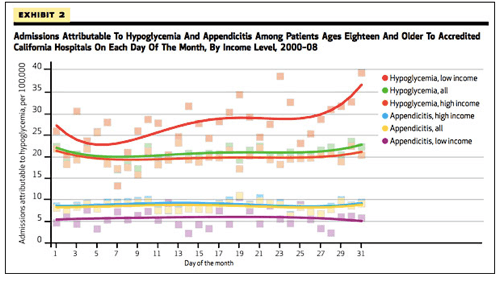
Chart of the Day Being Poor Is Bad for Your Health Mother Jones

Adrianna Macintyre: Sometimes health policy can’t be about about health care:

Toward the end of the month, a household’s resources—income, SNAP, Social Security, and/or other benefits—can become exhausted, ostensibly changing food consumption patterns…. This chart drives the point home. Low-income individuals are at higher risk of hypoglycemia—and that risk changes over the course of a month…. Their high-income counterparts exhibit no significant trend. Appendicitis findings are offered as a “control”…. According to the authors, “hypoglycemia is one of the most common adverse drug events leading to visits to the emergency department”, and it’s been estimated that episodes of care for hypoglycemia have an average cost of $1,186. But it’s not the only condition that constrained food budgets might impact: “It is reasonable to postulate that the exhaustion of food budgets late in the month might also influence admission patterns for other diet-sensitive diseases, such as congestive heart failure.”… Policy wonks have a terrible habit of focusing on insurance and health system design (and here I count myself, because health care financing is the research I find most interesting, so it’s what I write about). This gives short shrift to the “social determinants” of health—upstream factors related to lifestyle, environment, and socioeconomic status—that cannot be corrected by medical interventions. We’re fond of highlighting how much more the United States spends on health services, but an idiosyncrasy that receives less attention is how much less we spend on other social services…

Heroes of Noah Smithian Weblogging: Cory Doctorow

Noah Smith: Heroes of NoahSmithian Weblogging: Cory Doctorow:

Besides being one of my favorite science fiction authors, the founder of BoingBoing… has shaped the blogosphere. In his novels, Doctorow is unrivaled in his ability to portray accurately the culture of modern geeks and nerds, and his blog is basically set up to cater to that segment… cool new technologies, science fiction, weird news, and social commentary. Geek culture itself wouldn’t be what it is without Cory Doctorow (who, by all accounts, blogs from a balloon wearing a red cape and goggles)…. esides being the Alpha Geek of the North American information age… his libertarianism is… ‘pure’, unsullied by any connection with moneyed interests or the ghost of the Confederate States of America. Doctorow’s idea of freedom is all about what makes individual human beings feel free, not about what Robert Nozick or Ayn Rand arbitrarily defined as ‘liberty’ in order to support an anti-leftist agenda. And Doctorow fights passionately for his idea of liberty…. His book Little Brother was the most inspiring treatise I’ve read about the insanity of America’s post-9/11 curbs on civil liberties. To think that it came from a Canadian!

Needed: A Better Theory of Bureaucracy

I find myself absolutely gobsmacked by the extraordinary difference this week in dealing with three pieces of Southwest Airlines: The flight and airport staff in person, the reservation staff on the phone, and the missing baggage staff.

The airport and flight staff are absolutely focused on getting as many people as possible onto the planes as fast as possible so they can take off as soon as the weather will let them.

The reservations staff are absolutely focused on filling the slots on the planes they think will actually take off with as many people as they can to get people as close to their ultimate destination as they can as soon as possible.

The missing baggage staff are absolutely focused on making it as difficult as possible to file a missing baggage report, on informing people with missing baggage that the last person they talked to misinformed them, and on lying to each other on the phone.

Same shareholders. Same Board of Directors. Same CEO. Very different outcomes indeed…

My neoconservative friends blame this on government regulation: if the FAA were not trying to compile statistics on lost and missing baggage, they say, Southwest’s missing-baggage department would not be trying to massage the baggage statistics but would instead focus on finding baggage and reuniting it with its owners. Color me “unconvinced”…

Things to Read on the Morning of January 8, 2014

Must-Reads:

  1. Sam Arbesman: Is our tech making the world too complex?: “It’s one thing to recognise that technology continues to grow more complex, making the task of the experts who build and maintain our systems more complicated still, but it’s quite another to recognise that many of these systems are actually no longer completely understandable.  We now live in a world filled with incomprehensible glitches and bugs…. We have moved steadily toward the ‘Entanglement’, a term coined by the American computer scientist Danny Hillis. The Entanglement is the trend towards more interconnected and less comprehensible technological surroundings…. Whether it’s the entirety of the internet or other large pieces of our infrastructure, understanding the whole–keeping it in your head–is no longer even close to possible.”

  2. Ann Marie Marciarille: PrawfsBlawg: Primed for Hope: “Prime, an investor-owned Ontario, California-based chain of 25 hospitals… buys genuinely distressed hospitals. No, I don’t mean merely struggling hospitals, but distressed hospitals… so financially troubled its board of directors or governing authority has determined it must either be closed or sold…. Hospitals rarely fold quietly. Whether it is wise in all circumstances to prolong the life of an acute care hospital is seldom considered at the community level. The overwhelming presumption is that all hospitals are health-promoting, job-creating, community welfare-enhancing institutions. And Prime acknowledges this with its corporate tag-line: ‘Saving Hospitals, Saving Jobs, and Saving Lives’. Prime’s multi-state acquisition strategy has finally brought it to southern New England…. Is it better to let the facility close or better to embrace Rhode Island’s first for-profit hospital operated by a chain dodged by  billing practices investigations?… The deal was finally approved with a remarkable set of conditions attached  including capital investment requirements, service expansion requirements, a committment to three years guaranteed continued operation and more.”

  3. Mark Kleiman: Global Warming Reality Check: “I’d like to hear the climate-change deniers explain why Monsanto wanted to pay almost $1 billion for a company whose business model is protecting farmers against increasing volatility in the weather, and whose models predict that Kansas will become inhospitable to corn and Alaska a good place to grow wheat.”

Continue reading “Things to Read on the Morning of January 8, 2014”

Worth Noting From Last Summer: James Fallows, Musing About Inequality, Sends Us to Jim Webb on the 47%: Wednesday Focus (January 8, 2014

James Fallows: Jim Webb on ‘Givers’ and ‘Takers’:

I have known, respected, and come very much to like Jim Webb over the course of more than 30 years. We originally met because of deep disagreements about the Vietnam War. He went to Annapolis, served with distinction and bravery as Marine officer, was badly wounded, and then in his novels, movies, essays, and public-affairs work championed the memories and the futures of the people he had served with. I was in college while he was in combat, opposed the war, and deliberately avoided being drafted to serve in it.

Over the years we have come to share similar views about many of America’s biggest challenges, from the pernicious new culture of permanent undeclared war to the increasing polarization of the country on many fronts but especially including economic class. I was living in China six years ago when Webb made his surprising but welcome decision to challenge George Allen for the U.S. Senate seat from Virginia. I wrote then that:

From a partisan perspective, Webb (who served in Ronald Reagan’s administration) is just the kind of candidate the Democrats need: a culturally-conservative populist whose personal and policy toughness no one can possibly doubt. More broadly I think he is the kind of politician the country needs more of: someone getting into politics because he feels so strongly about the issues of the day.

Continue reading “Worth Noting From Last Summer: James Fallows, Musing About Inequality, Sends Us to Jim Webb on the 47%: Wednesday Focus (January 8, 2014”

Afternoon Must-Read: Global Warming Reality Check

Mark Kleiman: Global Warming Reality Check:

I’d like to hear the climate-change deniers explain why Monsanto wanted to pay almost $1 billion for a company whose business model is protecting farmers against increasing volatility in the weather, and whose models predict that Kansas will become inhospitable to corn and Alaska a good place to grow wheat.

Continue reading “Afternoon Must-Read: Global Warming Reality Check”

A Public Education Renaissance?: A Pick-Up Internet Debate: Tuesday Focus (January 7, 2014)

Monday DeLong Smackdown Watch: Michael Froomkin on How a Public Higher Education Renaissance Is Possible

Michael Froomkin: Pricing Public Colleges: “Brad had a gloomy moment:

The old social democratic belief that America should have the best universal free public education system in the world was a principal source of America’s relative prosperity and economic leadership for a century. Now that the political coalition that supported that belief is gone, America will be a much less exceptional place.

I am quite frequently a pessimist, but this is one area where I don’t think we should give in so easily. The US had a strong comparative advantage for post-secondary education due to several factors:

Continue reading “A Public Education Renaissance?: A Pick-Up Internet Debate: Tuesday Focus (January 7, 2014)”