
…There are many Americans who love their country in pretty much the way the president does… special, often an enormous force for good in the world, but also fallible…. You don’t have to be black to see things that way…. There’s the guy who described one of our foreign wars as ‘the most unjust ever waged by a stronger against a weaker nation’… Ulysses S. Grant… [on] the Mexican-American War…. We are becoming… more sophisticated… people do understand that… [those] shouting ‘USA! USA!’… are often less patriotic than the people they’re trying to shout down…. We really are an exceptional country… that has played a special role… [and] always stood for some of humanity’s highest ideals. We are not… about tribalism–which is what makes all the shouting about American exceptionalism so ironic, because it is… an attempt to tribalize…
Lunchtime Must-Read: Mike Konczal: Everyone Should Take It Easy on the Robot Stuff for a While
…surrounding the idea is that a huge wave of automation, technology and skills have lead to a huge structural change in the economy since 2010. The implicit argument here is that robots and machines have both made traditional demand-side policies irrelevant or naïve, and been a major driver of wage stagnation and inequality. Though not the most pernicious story that gained prominence as the recovery remained sluggish in 2010 to 2011, it gained important foothold among elite discussion…
Weekend reading
This is a weekly post we publish on Fridays with links to articles we think anyone interested in equitable growth should read. We won’t be the first to share these articles, but we hope by taking a look back at the whole week we can put them in context.
Links
Productivity growth: an incredibly important economic statistic that no one understands that well. [bloomberg]
Justin Fox on the valuation of Snapchat and the art of valuating businesses itself. [bloomberg view]
Equitable Growth’s Robert Lynch parses the difference between conventional and dynamic scoring. [roll call]
The President’s Council of Economic Advisers released this year’s Economic Report of the President. [the white house]
Izabella Kaminska on negative interest rates and the global cash burn. [ft alphaville]
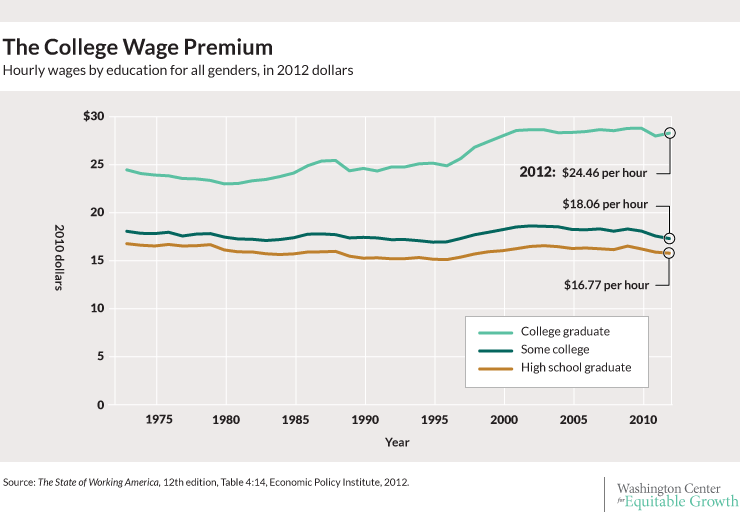
Friday Figure
Morning Must-Watch: Larry Summers and Friends: The Future of Work
http://www.c-span.org/video/?324436-1/discussion-future-work
Larry Summers:
On the diagnosis, I want to make a confession of ignorance, make an observation, and express a worry.
First, my confession of ignorance is this, and I think it should apply to everybody who speaks confidently in this area: On the one hand we have enormous antidotal evidence and visual evidence of the kind that Erik marshals, and it points to technology having huge and pervasive effects. Whether it is in complementing workers and making them much more productive in a happy way–that’s one possibility–or whether it is substituting for them and leaving them unemployed–that is another possibility–it can be debated which. But in either of those scenarios you would expect it to be producing a Renaissance of higher productivity. On the one hand we are convinced of the far-greater pervasiveness of technology in the last few years. On the other hand, the productivity statistics over the last dozen years are dismal. Any fully-satisfactory synthetic view has to reconcile those two observations. I have not heard them satisfactorily reconciled This is something we have to figure out.
If you believe technology happens with a big lag and it’s only going to happen in the future, that’s fine. But then you can’t believe it’s already caused a large amount of inequality and disruption of employment today. That is a major puzzle, It hangs over this subject. I just want to put out there for discussion.
Second, my observation. I think it is a mistake to think of the economy as homogeneous–as producing something called “output”. As we approach these issues, an aspect that doesn’t get enough attention is that sectors through progress work themselves into economic irrelevance. Let me give an example: the illumination sector, the provision of light. It has had about a ten-fold increase in its productivity every decade for a century. We now think of it as a trivial sector in the economy. No doubt we could continue to produce ten-fold increases in productivity every decade. But actually most of us want it to be dark at night. There are more Little League night games than there used to be. There are more parking lots lit more brightly than they used to be. Basically, what has happened is that illumination has become quasi-free. Whereas candle-making was a major industry in the 1800s, illumination is a trivial industry today.
We need to recognize that a sector that has rapid technological progress but of which the world can absorb only so much becomes ultimately unimportant in the economy. Is that kind of thing relevant in thinking about the world? Here’s a fact that continues to astonish me. I concede there are a million measurement problems. But it is a fact. The way they compute the consumer price indices all prices were set to be an index of 100 in 1983. Consider two goods today: a television set, and a year at a university (or I could use a day in a hospital). The consumer price index for the latter two categories is in the neighborhood of 600. the consumer price index for the former category is 6. There has been a hundredfold change in the relative price of TV sets and the provision of basic education and health care services.
If anybody is wondering why governments can’t afford to do the things they used to do, I just gave you a big hint.
If anybody’s wondering where most people are growing to be working in the future, i just gave you a big hint.
If anybody’s completely confident we will have rapid productivity growth in the future, they should be giving pause–because no matter how much productivity we have in agriculture or illumination, it doesn’t really matter for the aggregate economy. Increasingly, that’s becoming true of a larger and larger fraction of what it is that we produce.
Third, my worry: When I was an undergraduate at MIT, and in the 1960s, there was a whole round of concern about will automation displace all the employment. What i was taught as an undergraduate was that basically the people who thought it would were a bunch of idiot Luddites. Obviously there would be enough demand. It would work itself out. If people got more productive at making more, they would spend more Maybe we needed some transition assistance, but it would all be okay.
That is what I thought and what Bob Solow thought. And Bob Solow was a hero. And the other people were all a bunch of goofballs–that was kind of what I learned. I believed that for many years. I actually repeated it often. But it has occurred to me that when I was being taught that about 6% of the men in the United States between the age of 25 and 54 were not working. Today, 16% of the men in the United States between the age of 25 and 54 are not working. It won’t be very different even when the economy is at full employment.
Something very serious has happened with respect to the general availability of quality jobs in our society. We can debate whether it is due to technology or whether it is not due to technology. We can debate whether it is the cause of dependence or whether it is caused by policies that promote dependence. But it is very hard to believe that a society in which the fraction of people–choose whatever your most prime demographic group is–who should be working in that group in which the fraction of them who are not working is doubling in a generation. Is that going to be a society that is going to function well, or function well without major social innovations?
I want to leave you with that concern. Whether you think it is due to technology or to globalization or to the maldistribution of political power, something very serious is happening in our society.
Adam Posen: Morning Must-Read: US Companies Pay Well and Do Better
…to voluntarily announce a raise for all of its lowest-paid employees…. Aetna raised all of its employees’ wages to at least $16 an hour…. It is possible to profit from paying your employees well…. For decades, labour economists have gathered evidence on… [how] higher wages can motivate employees to work harder, to treat customers better, make them more reluctant to leave their jobs and help them to bring fewer worries and distractions to work. That can increase productivity and reduce an employer’s costs…. All jobs can be done better or worse, and that lower-paid workers respond to incentives other than just fear of losing their job. This is not just a relative wage story…. This is also not just a minimum wage story…. Efficiency wage increases will not solve all current economic problems. Fordist fantasies that paying a higher wage would meaningfully stimulate increased purchases, for example, have to be left aside…. Nor will such initiatives take the place of needed training to make sure workers have the proficiencies…. The shortfall of long-term investment in the US, public and private, cannot be made up for with low-skilled labour…
What to worry about on the supply side
A younger observer of the U.S. economy would be forgiven for thinking that the major problem with the economy is always and everywhere a demand phenomenon. The collapse of the housing bubble and resulting economic crisis in 2008 and 2009 caused a massive decline in demand across the economic landscape, with the slump in growth still being felt today. Considering that, we now have a sustained –though unspectacular– economic recovery, perhaps it’s time to consider the potential problems on the supply side of the U.S. economy.
The Wall Street Journal’s Greg Ip does just that in a recent column. Ip notes a variety of potential problems for the long-run growth potential of the U.S. economy. He points out that there appear to be issues with both the growth rate of productivity and the supply of labor, following the conventions of Solow growth accounting.
Ip notes that productivity picked up in the late 1990s and early 2000s but then slowed down in recent years, pinpointing the problem on the economy’s declining ability to efficiently use capital and labor. Research by San Francisco Federal Reserve economist John Fernald pegs this decline on the lack of new advancements in information technology. So an increase in innovation might help boost productivity.
But perhaps a better allocation of already existing technology and workers could be helpful. A new paper by economists Stephen G. Cecchetti of Brandeis International Business School and Enisse Kharroubi of the Bank of International Settlements argues that an over-bloated financial sector can reduce productivity. They contend that by drawing talented workers toward Wall Street, the finance sector lowers the total productivity rate. And because the financial services industry increasingly is focused on mortgage finance (despite the recent housing and financial crises), more resources are funneled toward the less productive construction industry. A possible supply-side reform, then, could be to rein in the finance sector to make the economy more productive.
There are other ways to boost the growth potential of the U.S. economy. As Equitable Growth’s Robert Lynch documents in a recent paper, reducing educational inequality would have a significant effect on the long-run growth of the economy. Raising U.S. students’ test scores to match that of Canadian children, for example, could raise gross domestic product by 6.7 percent in 2050.
It’s important to remember that supply and demand aren’t as easily untangled as we’d like to believe. Ip argues it’s unlikely that many more unemployed workers will return to the labor force. Yet with the lack of acceleration of wage growth, the labor market appears to still have some slack left in it to draw in more jobseekers, which in turn would boost the economy’s long-term growth potential. Short-term considerations can help alleviate our long-run problems.
Our economy still has demand-side issues, especially in the labor market. But we can’t forget about the supply-side problems that lurk further downstream. Our future prosperity depends on it.
Things to Read on the Evening of February 19, 2015
Must- and Shall-Reads:
- : Research in Labor Economics: Vol. 41: ‘Gender Convergence in the Labor Market’ FREE PAPER DOWNLOAD (until March 13, 2015)
- : “The essential points… the goal of the euro system to create a situation where markets can ‘pressurise governments into sound economic policies’… this requires limits on national sovereignty, which will be resisted by democratic governments; and… can only be overcome through the threat of a crisis…”
-
The Hamilton Project (@hamiltonproj) | Twitter: You can watch the full #FutureOfWork forum on @cspan http://cs.pn/1z3WKBP
That concludes our #FutureOfWork event.Thanks to our panelists for a great discussion. Visit http://bit.ly/1BZmC4U for video & audio -
: Endogenous Supply and Depressed Demand: “Without fiscal austerity the US, UK and Eurozone could currently be at output levels that are above current estimates of potential or natural output…. But are these estimates of potential output really independent of the path of actual output?… We know that stylised view is wrong for a variety of reasons. Labour that has been unemployed may become deskilled. Firms that are forced to cut back on investment in a recession may take time to rebuild their productive capacity. However there may be other ways it is wrong for reasons that are much more difficult to quantity. In particular, if investment falls in a recession, new technology that has to be embodied in new machines may fail to emerge, so the rate of technological progress may appear to decline. These processes may not matter too much in normal (mild and short lived) booms and busts. However following a large recession they may become more important…. After a severe recession which appears to result in a loss of capacity, you use policy to explore the boundaries of just how much capacity has really been lost, and run the risk that inflation may rise as you do so. You do not sit back, tell yourself that below target inflation is probably temporary, and do nothing. And, of course, you do not plan for more fiscal austerity.” -
: Income Inequality Over the Business Cycle: “Stephen Rose argues that income inequality has not risen since the end of the Great Recession… takes aim at research by University of California-Berkeley economist Emmanuel Saez showing that 95 percent of the income gains from 2009 to 2012 were captured by the top 1 percent of earners… assert[s claims]… inequality has risen since the Great Recession… based upon a ‘statistical gimmick.’ Rose… look[s] at changes in incomes since 2007, the peak of the last business cycle…. Saez and… Piketty show… income excluding capital gains… [of] the top 1 percent dropped from 18.3 percent in 2007 to 16.7 percent in 2009…. During economic expansions, workers at the bottom of the income ladder see very large gains and those at the top see large gains as well. Those in the middle miss out. And during recessions, the incomes at both ends lose the most…. By starting his measurement from the peak of the last business cycle in 2007, Rose includes the years that have the most income reduction for those at the top. But the expansion beginning in 2009… is not over…. Yes, if 2007 is the benchmark year, incomes at the top have declined. And yes, if 2009 is the benchmark year, incomes at the top have increased dramatically…. What isn’t reasonable is using a peak as a benchmark to claim inequality hasn’t increased over an incomplete business cycle…”
Should Be Aware of:
-
: We Can’t All Live in Interesting Times: Admonishing Jeff Herf: “The person who stood out to me more than anyone else was Herf… averring… that anyone who had opposed the [2003] Iraq War had ‘failed the test of armed anti-fascism.’ Heady words… [that] struck me at the time as full of self-regard and historical pretension. The Democratic party would never win another national election until this historical error was righted and it was the end of liberalism in its entirety, he went on. He had all the hard sectarian left’s grandiosity and picayune concern for the obscure detail grafted like a face transplant onto the values of the hard right…. Some people can’t resist the hifalutin equivalent of dressing up as cowboys and Indians or cops and robbers. Play-acting. Fantasy. At least the Civil War and World War II re-enactors know they’re reenacting. So when I saw [Herf’s] new piece, I thought, are we at another world historical moment with new Churchills and Chamberlains and Islamofascist bad guys? Well, yes we are! Only now Robert Menendez is Scoop Jackson or something like that…. One could be forgiven one episode of war intoxication. But another world historical crossroads so soon? And all over yet another government in the same part of the world to be toppled?” -
: This Street Holds Its Secrets: “Yesterday my kid called me with the news that a former high school classmate, now 19 and attending Cornell, had shot and killed his father in their suburban tract house. The boy’s mother told the 911 dispatcher that the boy was defending himself from the father when he shot his dad multiple times with a shotgun. After the shooting, the boy and mother waited on the snowy driveway of the house for the sheriff’s deputies to arrive. I only knew this young man as a boy who played in the band with my kid. He was friends with some of my kid’s group of friends, but I don’t think he had ever been in our house. Neighbors say that he was always polite and helpful. There had been a number of domestic violence calls to the home. Late yesterday, the boy’s attorney told the press that there had been ‘decades’ of domestic violence and abuse perpetrated by the father on the children. The parents are first- or second-generation Asian immigrants–I don’t know enough about their culture or their family situation to know why nobody asked for more help. I don’t know if the gun was the father’s or the son’s. All I know is that it was there in a terrible situation and now someone is dead. This is the second time in a couple of years that a gun plus a volatile domestic situation has led to death in a generally peaceful little suburb.”
-
: Kris Kobach exposed in phony Kansas voter fraud claim: “U.S. Attorney Barry Grissom…. ‘So we can avoid misstatements of facts for the future, for the record, we have received no voter fraud cases from your office in over four and a half years. And, I can assure you, I do know what I’m talking about.’”
Evening Must-Read: The Hamilton Project: Future of Work Event: Tweets
The Hamilton Project (@hamiltonproj) | Twitter:
You can watch the full #FutureOfWork forum on @cspan http://cs.pn/1z3WKBP
That concludes our #FutureOfWork event.Thanks to our panelists for a great discussion. Visit http://bit.ly/1BZmC4U for video & audio
Who is going to be technologically displaced if machines take away labor jobs? That’s a social problem, concludes @LauraDTyson #FutureOfWork
‘US has great incentives to do #research, but weak incentives to create #jobs and keep profits here’ – @LauraDTyson #labor #FutureOfWork
Given nature of tech changes, a lot is not going to measurable unless you figure what the output is, @LauraDTyson asks panel #FutureOfWork
Prabhakar of @DARPA: A lot of new tech we develop will only be used by DOD, but some depends on grad students, new businesses, entrepreneurs
Maybe the goal in business isn’t to be the next @Google, but to be bought by Google, says @JHaltiwanger_UM discussing new business models
.@JHaltiwanger_UM notes that declining econ dynamism means decreased ability of labor mrkt to absorb workers displaced by tech #FutureOfWork
Audience Question: Is one challenge with business innovation related to increasing shareholder wealth? #FutureOfWork
.@JHaltiwanger_UM: One misleading statistic is on research & development of new technology and business innovation #FutureOfWork
.@LauraDTyson: Let’s think about technological advancements in terms of distribution. How do we allow everyone to get these opportunities?
.@LauraDTyson: What countries are surpassing us in business dynamism? @JHaltiwanger_UM doesn’t believe we’re too behind #FutureOfWork
.@JHaltiwanger_UM discusses how occupational licensing stifles business innovation & dynamism. Read our new paper: http://bit.ly/1Hdqcz7
‘I love @Uber because it’s bringing #jobs in demand back’ – @amcafee @hamiltonproj #FutureOfWork #businessinnovation
Being analytical & ‘geeky’ is a better way to quantify human capital and labor, says @amcafee #FutureOfWork
.@amcafee Discusses how @Uber is a great, innovative business for creating labor, earning wages #FutureOfWork
Prabhakar make important point: tech is much more than IT. ‘Makers’ & 3D printing; synthetic biology; materials; neurology. #FutureOfWork
Through intersecting science & technology, @DARPA is able to ‘free the brain from the limitations of the body’ says Prabhakar #FutureOfWork
Major area of research that @DARPA is excited about is intersecting biology & physical science w/ tech science, says Prabhakar #FutureOfWork
It’s important to find different ways to make these new tech tools available to lots of people, says Prabhakar of @DARPA. #FutureOfWork
Prabhakar of @DARPA: The word ‘technology’s is used synonymously w/ information. Technology is much more broader than that. #FutureOfWork
.@LauraDTyson asks:To what extent are these amazing changes in technology, that are labor displacing, are discouraging the entrepreneurship?
@hamiltonproj: Robots could snag a lead role in ec debate, says @jimtankersley, featuring new @hamiltonProj work http://wapo.st/1A2HPMV
.@JHaltiwanger_UM Maybe the business model in the US has changed & we don’t have to do so much experimentation. #FutureOFWork
.@JHaltiwanger_UM The US has been flexible & fluid in these changing economic times by moving workers to new productive places #FutureOfWork
We’ll be back momentarily w/ our second #FutureOfWork panel: @amcafee of @MITSloan, @JHaltiwanger_UM, the Director of @DARPA & @LauraDTysonGreat first #FutureOfWork panel w/ @LHSummers, @aneeshchopra, @erikbryn & David Autor http://bit.ly/1BZmC4U
.@LHSummers:’We have to think carefully about what the alternative to work is & how meaning & community are found in the absence of work.’
Audience Question: Can growth of technology lead to shorter work wk w/o affecting wages? #FutureOFWork
David Autor of @MIT: We should think of globalization & technology working hand in hand at this point #FutureOfWork
If you’re just joining us, we are live tweeting from our event on the #FutureOfWork in the Machine Age. Tweet your questions!
.@LHSummers argues we need more demand in labor market, not just more training. #FutureOfWork
#FutureOfWork panel turns to discussion on importance of education in the age of the machine http://bit.ly/1A3djml
Do we need to rethink our social contract & policy to help those people left behind in the Machine Age? asks Melissa Kearney #FutureOfWork
Melissa Kearney asks: Will a sufficient amount of people acquire skills & talents to economically prosper in the machine age? #FutureOfWork
A challenge is that people can see disemployment caused by new technology before the impact on productivity, says @LHSummers #FutureOfWork
What do smart machines, robotics & digitization mean for the #FutureOfWork? Read the latest paper from @hamiltonproj: http://invent.ge/1z2vUtI
.@LHSummers notes the growth of unemployment of men, & availability of jobs. Is it due to technology, globalization, policy? #FutureOfWork
When a sector has rapid technological progress but the world can absorb only so much, does it become unimportant? @LHSummers discusses w/ us
.@LHSummers: On one hand we’re convinced of the pervasiveness of technology, & on other hand the productivity proof is dismal. #FutureOfWork
The democratization of entrepreneurship is the most exciting thing I’ve seen, says @aneeshchopra discussing the impact of new technology.
We are now opening big sectors like health care, edu to technology, increasing the productivity, says @aneeshchopra #FutureOfWork
.@aneeshchopra: Health care, energy & edu have not been as plugged into new technology until recently, now new incentives #FutureOfWork
David Autor: What matters is how rapidly technology changes. #FutureOfWork
Our first #FutureOfwork panel is up featuring David Autor of @MIT, @LHSummers, @aneeshchopra & @erikbryn‘We ain’t seen nothing yet when it comes to technological progress,’ says @amcafee #FutureOfWork
.@erikbryn: Technology is a tool. We should use this tool to create shared prosperity. #FutureOfWork
.@erikbryn How we use technology is important to remember. Is has the potential to create enormous wealth w/o as much work. #FutureOfWork
There’s no economic law that tech growth will benefit everyone equally. Some people will be left behind, says @erikbryn #FutureOfWork
Now LIVE on C-SPAN3: Technology and the workplace #FutureOfWork .. via @BrookingsInst & @hamiltonproj
Great improvements in machine intelligence in uniquely human traits like language, writing, muscle, says @erikbryn #FutureOfWork
.@erikbryn discusses The Great Decoupling of U.S productivity, GDP, employment & income & how technology & machine has impacted this.
One of Roger Altman’s takeaways from @erikbryn & @amcafee book about Machine Age: The effects will cause considerable economic disruption.
@hamiltonproj and we are off :) honored to join @LHSummers on the future of workBob Rubin: Will the growth in technology lead to a basic change in our lifestyle, with less work and more leisure? #FutureOfWork
New business formation in the U.S. has decreased significantly. Bob Rubin asks: Is that relevant to business dynamism? #FutureOfWork
Policies focused on edu, job creation, productivity, & research improve the direction of the American worker, says Bob Rubin #FutureOfWorkHow will rapid technological change impact the economy & the #FutureOfWork? Read a new @hamiltonproj paper: http://brook.gs/1A6SJRV
We are live tweeting during today’s #FutureOfWork event, beginning shortly. Send us your questions! http://bit.ly/1BZmC4U
Afternoon Must-Read: Simon Wren-Lewis: Endogenous Supply and Depressed Demand
…could currently be at output levels that are above current estimates of potential or natural output…. But are these estimates of potential output really independent of the path of actual output?… We know that stylised view is wrong for a variety of reasons. Labour that has been unemployed may become deskilled. Firms that are forced to cut back on investment in a recession may take time to rebuild their productive capacity. However there may be other ways it is wrong for reasons that are much more difficult to quantity. In particular, if investment falls in a recession, new technology that has to be embodied in new machines may fail to emerge, so the rate of technological progress may appear to decline. These processes may not matter too much in normal (mild and short lived) booms and busts. However following a large recession they may become more important…. After a severe recession which appears to result in a loss of capacity, you use policy to explore the boundaries of just how much capacity has really been lost, and run the risk that inflation may rise as you do so. You do not sit back, tell yourself that below target inflation is probably temporary, and do nothing. And, of course, you do not plan for more fiscal austerity.
Today’s Economic History: 1870 as the Inflection Point in Trade and Transport
Mid-nineteenth century Massachusetts transcendentalist author and activist Henry David Thoreau’s response to the coming of the railroad was: “get off my lawn!”:
To make a railroad round the world…. Men have an indistinct notion that if they keep up this activity of joint stocks and spades long enough all will at length ride somewhere in next to no time and for nothing, but though a crowd rushes to the depot and the conductor shouts “All aboard!” when the smoke is blown away and the vapor condensed, it will be perceived that a few are riding, but the rest are run over–and it will be called, and will be, “a melancholy accident”…
Indeed, the very first day of operation of the Liverpool and Manchester Railroad, September 15, 1830, George Stephenson’s locomotive, The Rocket, killed the Right Honorable William Huskisson, former President of the Board of Trade–that is, he had been Britain’s Secretary of Commerce (in addition to Secretary of State for War and the Colonies, and Leader of the House of Commons).
The old rule-of-thumb before the railroad was that you simply could not transport agricultural goods more than 100 miles by land. Over that distance the horses or the oxen would have eaten as much as they could have pulled. Either find a navigable watercourse—and it had better be much closer than 100 miles—or find yourself stuck in self-sufficiency for anything other than small and light preciosities, without the ability to buy much made outside your local township that could not be purchased with the (low-value) spinning and weaving labor of your or your neighbors’ womenfolk. For Thoreau on Walden Pond, living deliberately, the fact that it took him a day to walk or ride into Boston was a benefit—part of living deliberately. But that is a (relatively) rich guy’s point of view.
The coming of steam coupled with the metallurgy to cheaply make the rails and the engines of the railroad made a difference. It made transport over land wherever the rails ran as cheap as travel up navigable watercourses or across the oceans had ever been. It made it much faster as well. This was a big difference for people who wanted to move about. The was a big difference for spoilable or time-sensitive goods. This was not much of a difference for durable staples over routes that had been and still could be travelled by water. And since most people had for good reason settled near the water routes, the railroad was a very welcome boost, but not that much more. For the rise of Mexico City—with no water routes to the coasts and thus the world economy—the railroad was a game-change. But for the rise of New York City the game-change was not the Iron Horse but rather the Erie Canal.
The true revolution in transportation? The one that mattered for everyone? That came not in the 1830s with the railroad. That came later: it was the iron-hulled ocean-going coal-fired steamship.
It was the year 1870 thatsaw the Harland and Wolff shipyard of Belfast in northern Ireland launch the iron-hulled (rather than wooden-hulled), steam-powered (rather than wind-powered, but it did still have masts and sails), screw-propellered (rather than paddle-wheeled), passenger steamship the R.M.S. Oceanic. It took 9 days from Liverpool to New York, a journey that in 1800 would have taken more like a month. Its crew of 150 supported 1,000 third-class passengers at a cost of £3–$15–for a third-class passenger. Third class on the Oceanic cost half as much as passage a generation earlier during the Irish Potato Famine had. It coast roughly a fourth as much as in 1800.
£3 in 1870 was the same share of an average person’s earnings then as £2,100 or $3,300 today. Think of it as the equivalent of a business-class transatlantic airfare. Think of it as the rough equivalent of a month and a half’s wages for an unskilled worker. Consider that wage levels in North America or Argentina or Australia or–for white male workers–South Africa or Kenya around 1870 were roughly double those of northwest Europe. The math was clear. If you could find a niche, hold a steady job, and stay out of the bars after the voyage, you could make back your expense in less than a season. Thus after 1870 sending a member of a family across the ocean to work became a possibility open to all save the very poorest of European households. This held for more than Europe: China and India began their own large-scale steamship diasporas in short order.
Moreover, the Oceanic also carried 150 first class passengers at £15 a head. It carried them in sufficient luxury and with sufficient cosseting as to qualify (if you were not prone to sea-sickness) as a vacation. That is the same share of average income then that $17,000 would be today. Thus the rich could and did make global travel a regular part of their normal lives rather than an arduous duty and trial. Railroad baron and heir William Kissam Vanderbilt and suffragette Alva Erskine Smith could take their daughter Consuelo to England to meet and (unhappily) marry Charles Spencer-Churchill, ninth Duke of Marlborough. Speculator Leonard Jerome and Clara Hall could take their daughter Jeanette to England to meet and (happily?) marry Charles’s uncle, Lord Randolph Henry Spencer-Churchill. Randolph and Jeanette appear to have anticipated things, for seven months after their marriage was born Winston S. Churchill, Prime Minister of Great Britain 1940-1945 and 1951-1955—and even the dockyard cranes along the Thames River bowed as his coffin passed by in January 1965.
The falling cost of transporting people marched alongside a falling cost of transporting goods. Flour that cost 1.5 cents per pound more in London than in New York in 1840 cost only 0.5 cents per pound more after 1870 . This was a fall in the price of carrying the raw materials for a loaf of bread across the Atlantic. What had cost the equivalent of 30 minutes’ worth of unskilled labor time in 1840 cost less than ten minutes’ worth come 1870. After 1870 every commodity that was neither exceptionally fragile nor spoilable could be carried from port to port across oceans for less than it cost to move it within any country.
All this mattered for two reasons.
First, it meant that everyplace in the world was, as long as there were connecting harbors, docks, and railroads, cheek-by-jowl to every other place, economically. Everyone’s economic opportunities and constraints depended on what was going on across the globe. This had not been true before. Before just the consumption patterns of the elite depended on what was going on in other countries and on other continents.
Second, wherever you could cheaply move goods in mass you could move other things. Most particularly, you could also move and supply armies. Thus conquest—or at least invasion and devastation—became things that nearly any European power could undertake in nearly any corner of the world.