
Musings on Worker Stickiness, Full Employment, and Productivity Growth

U S labor market tightness hiring and the decline in job switching Equitable Growth

In many businesses, the explicit or implicit human-resources policy is LHFF–last hired, first fired. That means that workers who jump from a job in one firm to a job in another purchase a greater beta with respect to the business cycle along with the higher wages, better working conditions, and more interesting responsibilities that would lead them to jump. This seems the most likely explanation for the fact that more than one-fifth of the hiring we would expect to get at the current aggregate level of unemployment relative to job openings is not there. After the catastrophic downturn of 2008-9 and the subsequent half a decade noncovery, workers’ assessments of the risks taken on in jumping firms and thus going to the back of the tenure-in-job queue are likely to be greatly elevated. Everybody knows people who lost their jobs in 2008-9 and then had the devil’s own time finding another one.

How big a drag is this on productivity growth, if it is indeed the case that diminished risk tolerance is thus affecting not only physical investment but human capital investment in diminishing workers’ willingness to “invest” in a new (and better) employer-employee match? Does this have implications for where full employment is? My first thoughts are:

  1. If workers are indeed stickier, it becomes more expensive for firms to expand employment by raising wages–you have to raise everyone’s wages and yet you attract fewer good workers from other firms. This makes the Phillips Curve even flatter in a boom, and makes inflation less of a threat, meaning we are further from full employment than we thought.

  2. Productivity growth is slower, which means that the NAIRU is higher in any model in which workers have labor market tightness-dependent expectations as to the warranted rate of real wage increase and the NAIRU equilibrates at a level at which that warranted rate is sustainable.

How big are these factors? I don’t even have a back-of-the-envelope guess as to whether they are important, or how important they are.

Nick?


Nick Bunker: Labor Market Tightness and the Decline in Job Switching: “There’s less hiring for each job opening…

…Peter Diamond… and Ayşegül Şahin…. Hires of those out of the labor force are in line with previous recoveries, and hires of those who were unemployed are slightly lower, but… hires of… already employed workers has been quite weak compared to the tightness of the labor market. Such “job switching” has been trending downward for all age groups since 2000…. Something is amiss with either the willingness of workers to switch jobs or employers’ interest in hiring already employed workers…


Peter A. Diamond and Ayşegül Şahin: Disaggregating the Matching Function: :Decompositions of aggregate hires show how the hiring process differs across different groups of workers and of firms…

…Decompositions include employment status in the previous month, age, gender and education. Another separates hiring between part-time and full-time jobs, which show different patterns in the current recovery. Shift-share analyses are done based on industry, firm size and occupation to show what part of the residual of the aggregate hiring function can be explained by the composition of vacancies…

Must- and Should-Reads: January 5, 2016


Interesting Reads:

Should-Read: Timothy Martin: The Champions of the 401(k) Lament the Revolution They Started

Should-Read: Timothy Martin: The Champions of the 401(k) Lament the Revolution They Started: “Herbert Whitehouse, formerly a Johnson & Johnson human-resources executive, was one of the first proponents of the 401(k)…

…His hope in 1981 was that the retirement-savings plan would supplement a company pension that guaranteed payouts for life. Thirty-five years later, the former Johnson & Johnson human-resources executive has misgivings about what he helped start. What Mr. Whitehouse and other proponents didn’t anticipate was that the tax-deferred savings tool would largely replace pensions as big employers looked for ways to cut expenses. Just 13% of all private-sector workers have a traditional pension, compared with 38% in 1979. “We weren’t social visionaries,” Mr. Whitehouse says. Many early backers of the 401(k) now say they have regrets about how their creation turned out….

“The great lie is that the 401(k) was capable of replacing the old system of pensions,” says former American Society of Pension Actuaries head Gerald Facciani, who helped turn back a 1986 Reagan administration push to kill the 401(k). “It was oversold.”… Financial experts recommend people amass at least eight times their annual salary to retire. All income levels are falling short. For people ages 50 to 64, the bottom half of earners have a median income of $32,000 and retirement assets of $25,000…. The middle 40% earn $97,000 and have saved $121,000, while the top 10% make $251,000 and have $450,000 socked away. And the savings gap is worsening…. More than 30 million U.S. workers don’t have access to any retirement plan because many small businesses don’t provide one….

Ms. Ghilarducci wants to ditch the 401(k) altogether. She and Blackstone Group President Tony James are recommending a mandated, government-run savings system that would be administered by the Social Security Administration and managed by investment professionals. While both are Democrats, they believe their solution has bipartisan appeal. “There are a lot of governors and mayors who are Republicans, and the first wave of the crisis will affect states and cities,” Ms. Ghilarducci says…. Others are calling for a national mandate on savings or requiring companies to automatically enroll participants at 6% of pay…

Forthcoming Panel: The Nature of Capitalism and Secular Stagnation

Live from Chicago: American Economic Association: [The Nature of Capitalism and Secular Stagnation][]: Chair: Matias Vernengo…

…Panelist(s): Bradford DeLong, University of California-Berkeley; Han Despin, Nichols College; William Lazonick, University of Massachusetts-Lowell; Deirdre McCloskey, University of Illinois-Chicago; Anwar Shaikh, New School…

Should-Read: Olivier Blanchard: In Light of the Elections: Recession, Expansion, and Inequality

Should-Read: Disagreeing with Olivier, my chances of success are surely less than 50-50. Nevertheless…

As I read the evidence, the short-run fiscal multipliers (1) from government purchases are rather high, (2) from transfer payments to the liquidity-constrained are moderate, and (3) from high-income tax cuts are next to zero. At the moment it looks like effectively all of the Trump fiscal initiative to be will take the form of (3). Some of it will be direct tax cuts. The rest will be tax credits to businesses that are not currently cash-constrained but rather, at the margin, in the share buyback business.

But they will produce a stronger dollar.

Thus I expect next to no effective fiscal stimulus. I expect a larger capital inflow (trade deficit). And I am told we now expect the trade war to start soon.

Thus I do not see why Olivier Blanchard is so optimistic. Where is he coming from? What does he see that I do not?

Olivier Blanchard: In Light of the Elections: Recession, Expansion, and Inequality: “What happens to the US economy depends mainly on the balance between macroeconomic and trade measures…

…Larger fiscal deficits, as a result of both higher infrastructure spending and corporate and personal tax cuts… will lead to higher spending and higher growth for some time… [and] higher inflation….

Will the Fed indeed clamp down on demand and increase interest rates to pre… Trump the candidate criticized Fed Chair Janet Yellen for being too dovish…. To the extent that both growth and interest rates are higher, the dollar is likely to appreciate, leading, ironically, to larger US trade deficits…. This leads me to trade….

The pre-election program emphasized the use of tariffs to reduce imports and reestablish a “level playing field.”… Things could quickly escalate…. And… as fiscal deficits lead to larger trade deficits, the pressure to reduce them through more tariffs, as misdirected as that strategy is, will likely increase. So, in the end, expansion or recession will depend on the balance between macroeconomic and trade measures. My own guess is the first will dominate…

U.S labor market tightness, hiring, and the decline in job switching

A sign along US 90 advertises job openings at the Klausner lumber mill in Live Oak, Fla.

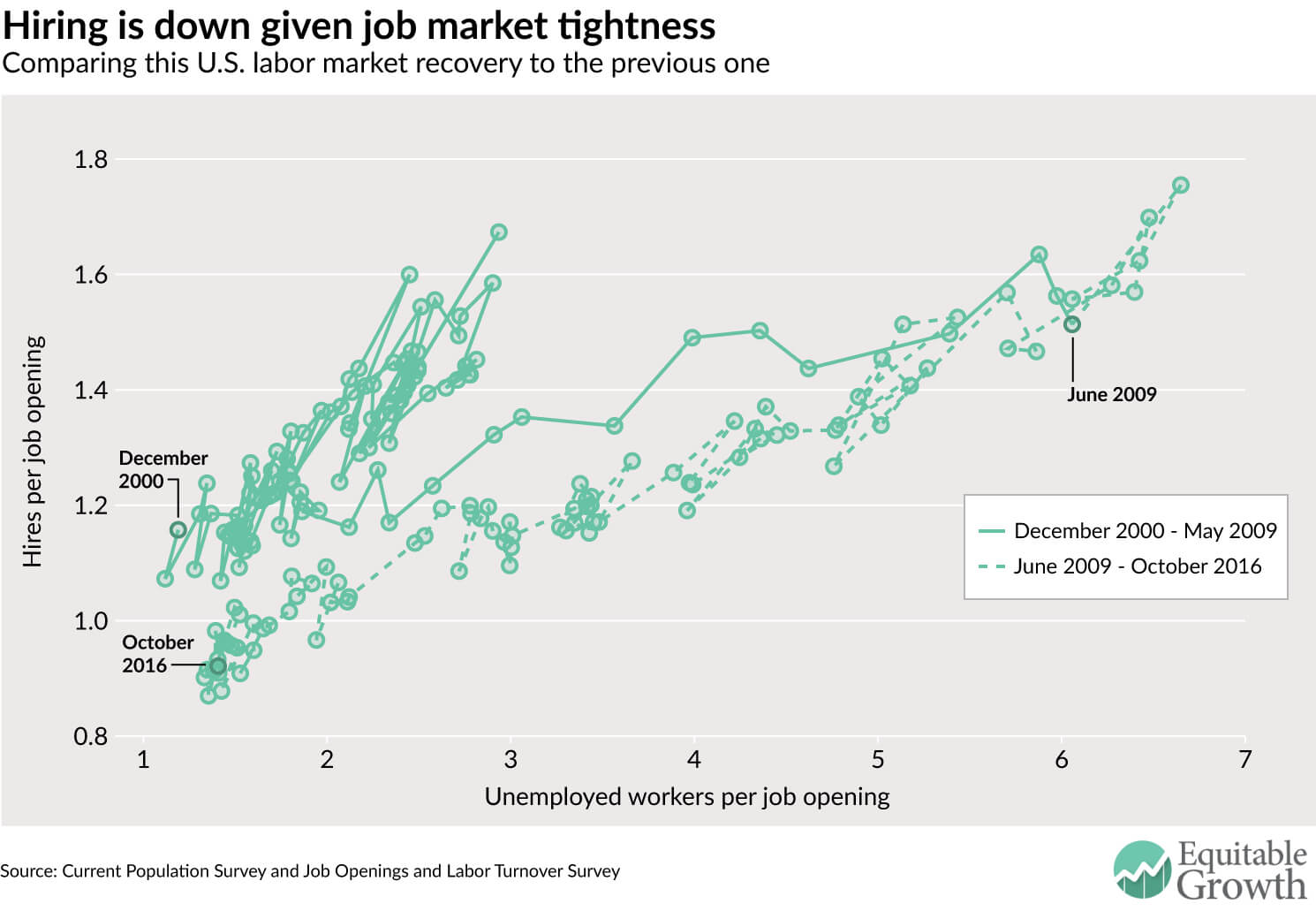
The U.S. labor market is heading toward full employment in 2017. But not every metric of labor market health seems to be in line with previous periods of labor market tightness. There’s less hiring for each job opening, relative to years past. That is, the data indicate that the number of people hired is out of line with our experience during past economic recoveries. Employers are getting fewer hires out of job openings than at similar levels of labor market tightness in the past. (See Figure 1.) New evidence points to a lack of movement between jobs, a problem that has implications for the strength of U.S. wage growth.

A change in the relationship between labor market tightness and the vacancy yield could indicate that something about the process of matching workers to jobs has shifted. It looks like for each job opening, there’s less hiring. This shift may be related to the fact that employers are posting more job openings than in the past, but policymakers need to take into account hiring patterns among different types of job seekers as well.

In a working paper released late last year, economists Peter Diamond of the Massachusetts Institute of Technology and Ayşegül Şahin of the Federal Reserve Bank of New York take a look at this so-called “matching function”—the relationship between hiring and labor market tightness. Specifically, they disaggregate the function for a number of characteristics of workers and employers.

One particularly interesting disaggregation looks at differences in hiring for workers with different labor-force characteristics. Diamond and Şahin compare hiring for workers who were previously out of the labor force, those who were officially unemployed, and those who were previously employed. They find that hires of those who were unemployed and out of the labor force are more sensitive to the overall health of the labor market, which means these new hires rise and fall more (and unemployment rises and falls more) compared to hires of those who were previous unemployed.

Yet looking at hires similar to the way they are presented in Figure 1 but with data going back to 1975, the economists show hires of those who were previously employed during the current recovery are far below the trend from previous recoveries. Hires of those out of the labor force are in line with previous recoveries, and hires of those who were unemployed are slightly lower, but the recent experience for hires of those who are currently employed is way out of line. Hires of these already employed workers has been quite weak compared to the tightness of the labor market.

Such “job switching” has been trending downward for all age groups since 2000. This lack of movement among those with jobs might be a sign that sticking at a job is paying more than in the past, but there’s no evidence that the boost to earnings from longer job tenure has increased in recent years. Something is amiss with either the willingness of workers to switch jobs or employers’ interest in hiring already employed workers. As we look at the labor market moving forward in 2017, this is a trend to keep an eye on.


Should-Read: Mark Wu: The ‘China, Inc.’ Challenge to Global Trade Governance

Should-Read: Mark Wu: The ‘China, Inc.’ Challenge to Global Trade Governance: “The rise of China presents a major challenge to the multilateral trade regime…

…At the heart of this challenge is the fact that China’s economic structure is sui generis — having evolved in a manner largely unforeseen by those negotiating WTO treaty law…. The WTO is equipped to deal effectively with only a limited range of disputes — those in which Chinese policies largely resemble elements of other alternative economic structures. Outside of this set of issues, the WTO faces two very different but equally serious challenges. The first is reinterpreting certain legal concepts to adapt and fit an unforeseen Chinese context. The second is deciding whether to expand the scope of its legal rules to accommodate issues that currently fall outside its jurisdiction…. The most likely outcome is one in which China’s rise will exacerbate the diminishing centrality of WTO law for global trade governance.

Must-Read: Paul Krugman: Trade and Manufacturing Employment

Https www gc cuny edu CUNY GC media LISCenter pkrugman Trade and Manufacturing Employment pdf

Must-Read: Since 1970, manufacturing employment has fallen from 25% to 8.6% of nonfarm payrolls. (Since 1940, from 31% to 8.6%.) With different–I will not say “better”__trade policy, that is, absent China’s joining the WTO and absent NAFTA, we might be at 9%. (If you read carefully, you will find that Autor-Dorn-Hanson estimate the effects of increasing trade with China rather than China’s joining the WTO. Trade with China would have grown in any event.) With better macro-industrial policy–i.e., no Reagan tax cuts, no Bush II tax cuts, no big Republican full-employment budget deficits, no strong dollar policy, proper nurturing of our communities of engineering excellence–we would have an economy more like that of Japan or Germany, and might be at 12%.

But 12% is a far cry from 25% or 30%. And almost all of the paths I can think of for getting back toward 12% are destructive. And every idea I have heard from the Trump camp for getting back toward 12% is (a) destructive, and (b) likely to be counterproductive on its own terms:

Paul Krugman: Trade and Manufacturing Employment: “America used to be a nation where a lot of people worked in manufacturing…

…Today, we basically work in office parks and services. But people aren’t reconciled to the change; and ? (I’m using that symbol for the man who will use the Oval Office to turn us into a banana republic) is promising to bring the jobs back by punishing companies who move jobs abroad…. In conversations with various fairly sophisticated people, I’ve realized that there’s a widespread impression of major disagreement within the field… fed, it has to be said, by some misleading statements by economists themselves…. There’s actually very little disagreement about either the facts or the counterfactuals…. it comes down to which of these two questions you’re trying to answer:

  1. How much of a role did trade play in the long-term decline in the manufacturing share of total employment, which fell from around a quarter of the work force in 1970 to 9 percent in 2015? The answer is, something, but not much.

  2. How much of a role did trade play in the absolute decline in manufacturing employment, down about 5 million since 2000? Here the role is bigger, basically because you’re comparing the same effect with a much smaller denominator; even so, trade is less than half the story, but by no means trivial….

Absent that trade deficit, U.S. manufacturing would probably be about 2 percent of GDP higher… the manufacturing share of employment would also be about 2 percentage points higher… manufacturing would be maybe a fifth bigger than it is…. That wouldn’t make much difference to the long-run downward trend, but looms larger relative to the absolute decline since 2000. But what about the now-famous Autor-Dorn-Hanson paper http://www.ddorn.net/papers/Autor-Dorn-Hanson-ChinaShock.pdf?… It’s… consistent…. The… China shock… 985,000 manufacturing jobs between 1999 and 2011. That’s less than a fifth of the absolute loss of manufacturing jobs over that period, and a quite small share of the long-term manufacturing decline…. The adverse effects on regional economies were large and long-lasting. But… America’s shift away from manufacturing doesn’t have much to do with trade, and even less to do with trade policy.