Weekend reading: “This post has intangible assets” edition

This is a weekly post we publish on Fridays with links to articles that touch on economic inequality and growth. The first section is a round-up of what Equitable Growth published this week and the second is the work we’re highlighting from elsewhere. We won’t be the first to share these articles, but we hope by taking a look back at the whole week, we can put them in context.

Equitable Growth round-up

Corporate profit-shifting is a problem for a source-based U.S. corporate tax system, but it’s also a problem for the measurement of gross domestic product. A new paper shows how increased profit-shifting has caused us to underestimate U.S. productivity growth.

In a paper released this week as part of the Equitable Growth working paper series, Owen Zidar of the University of Chicago finds that “the positive relationship between tax cuts and employment growth is largely driven by tax cuts for lower-income groups.”

Data on labor market flows (hiring, firing, and quitting) from the Job Openings and Labor Turnover Survey for the month of February were released this week. Check out three key graphs from the new data.

Economists are increasingly drawing attention to the influence that firms have on levels of income inequality. A new paper shows that not only do firms decide which rungs workers start on a wage ladder, but also how fast they move up the income ladder.

Links from around the web

“[G]iven the broader trends in the U.S. economy away from manufacturing and toward services, . . . American men may need to move into traditionally female roles in coming years if they want to thrive.” Ana Swanson reports on new research on trends in occupations in the United States. [wonkblog]

Responding to new research, former Federal Reserve Chairman Ben Bernanke looks at how monetary policymakers can react to a world in which there is an increased likelihood of monetary policy hitting the zero lower bound. [brookings]

Why are some firms doing so much better than others these days? Maybe the answer is very simple: they have much better management. Noah Smith writes about new economics research on the impact of management. [bloomberg view]

The Economist writes about a recent conference on the decline of competition in the U.S. economy and concerns about the power of large firms and its interesting location: the University of Chicago. [the economist]

What’s the best macroeconomics model? Well, it depends on what question you want to answer. Former International Monetary Fund chief economist Olivier Blanchard writes about the need for (at least) five different kinds of macro models. [piie]

Friday figure
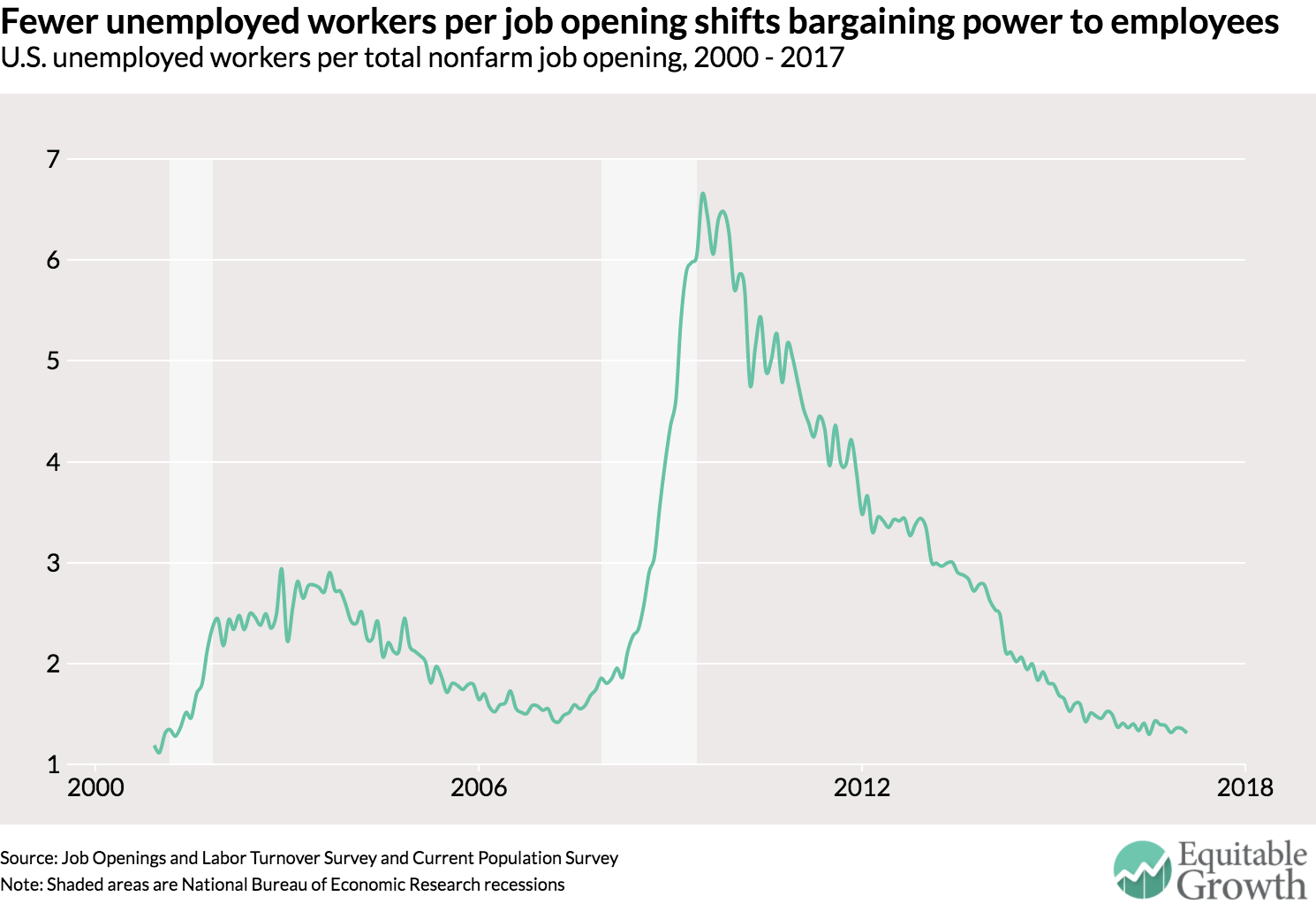
Figure from “JOLTS Day Graphs: February 2017 Report Edition” by Nick Bunker

Must- and Should-Reads: April 14, 2017


Interesting Reads:

Notes: Working, Earning, and Learning In the Age of Intelligent Machines

The key seems to me to build intelligent machines that will assist workers in labor-intensive industries, rather than build intelligent machines that will eliminate workers in capital-intensive industries. The first is a clear win. The second can be a major loss if the things made in capital-intensive industries are close enough substitutes for the products of labor-intensive industries to greatly drop their value.

But what I have to say so far is limited.

It is simply made up of: Five Disconnected Points:

  1. Cast your mind back to 1999. All of this was then viewed not as a threat but as an opportunity. Few things can turn a perceived threat into a graspable opportunity like a high-pressure economy with a tight job market and rising wages. Few things can turn a real opportunity into a phantom threat like a low-pressure economy, where jobs are scarce and wage stagnant because of the failure of macro economic policy.

  2. Those historical cases in which technological progress has been genuinely immiserizing have been relatively few. They have been confined to situations in which technological progress takes the form of greatly amplifying labor productivity in capital-intensive occupations. Those then shed labor massively, as those tasks in which human beings act like robots—filling in the gaps that machines cannot yet do—vanish. But at the same time technological progress must do next to nothing to equip workers in labor-intensive occupations with better tools to assist them. Thus the canonical case is the 19th century handloom weaving industry in Britain and India. That suggests a focus on building robots to serve as tools and assistants for workers in labor-intensive industries, as opposed to further mechanizing and thus replacing workers in capital-intensive industries.

  3. Let me endorse the observation that for the past 200 years the mechanization of manufacturing has to a great degree involved treating humans as if they were robots. We can do better. At least, we hope we can do better.

  4. Let me try to satisfy Barry’s demand for less abstraction and also endorse Nils’s emphasis on human customization by asking you to cast your minds back to the days of Metropolis, Henry Ford, and Brave New World. Henry Ford wanted to satisfy real human needs in the cheapest and most effective fashion by taking massive, mammoth, and total advantage of all possible economies of scale. You can have a car in any color you want: as long as it is black. You can have whatever kind of car you want: as long as it is a Model T. You can wear any clothes you want: as long as they are identical blue overalls. You can play any sport you want: as long as it is Centrifugal Bumble Puppy. That was not the world people wanted. Alfred P. Sloan and General Motors drank Henry Ford’s milkshake by finding a sweet spot, in which you sold everybody mass produced Chevy parts in different, near personalized configurations. We can argue about whether people should value such human touch salesmanship and customization—whether it is a cognitive behavioral mistake stemming from our origin as hunter gatherers seeking to gather the most useful objects. But the fact is we do value such human touch customization. All the evidence suggests that it makes us very happy. That is a very large set of potential labor-intensive occupation that will last for a very long time.

  5. Never forget that back in the environment of evolutionary adaptation we were sociable toolmaking hunter-gatherers—constantly interacting with the complex environment where we would choose and modify objects to advance our purposes—in which we turned ourselves into an anthology intelligence under a geas to learn as much as possible, and immediately tell it to—gossip about it with—everybody else. With the coming of first the Agrarian and then the Industrial Age our jobs became overwhelming boring. Only humans, with our brains being supercomputers that fit into a bread box and draw only 50 watts of power, could be the necessary microcontrollers for animals and machines necessary for first Agrarian Age and then Industrial Age production. But those jobs vastly underutilized the human brain. Do not overromanticize looking at the hind end of a mule or tightening bolt number six on every object coming down the assembly line for four hours without a break.


Reading List:

Must-Read: Barry Eichengreen and Brad DeLong (2013): New Preface to Charles Kindleberger, “The World in Depression 1929-1939”

Must-Read: Barry Eichengreen and Brad DeLong (2013): New Preface to Charles Kindleberger, “The World in Depression 1929-1939”: “Anyone fortunate enough to live in New England in 1970-1985 or so and possessed of even a limited interest in international financial and monetary history… http://delong.typepad.com/sdj/2013/04/new-preface-to-charles-kindleberger-the-world-in-depression-1929-1939.html

…felt compelled to walk, drive or take the T… down to MIT’s Sloan Building… to listen to Kindleberger…. We understood about half of what he said and recognised about a quarter of the historical references and allusions. The experience was intimidating: Paul Krugman… a member of this same group… awarded the Nobel Prize… has written how Kindleberger’s course nearly scared him away from international macroeconomics. Kindleberger’s lectures were surely “full of wisdom”, Krugman notes. But then, “who feels wise in their twenties?” (Krugman 2002).

There was indeed much wisdom in Kindleberger’s lectures, about how markets work, about how they are managed, and especially about how they can go wrong. It is no accident that when Martin Wolf… challenged… Lawrence Summers in 2011 to deny that economists had proven themselves useless… Summers’s response was that, to the contrary, there was a useful economics… of the pioneering 19th century financial journalist Walter Bagehot, the 20th-century bubble theorist Hyman Minsky, and “perhaps more still in Kindleberger” (Wolf and Summers 2011).

Summers was right. We speak from personal experience: for a generation the two of us have been living–very well, thank you–off the rich dividends thrown off by the intellectual capital that we acquired from Charles Kindleberger, earning our pay cheques by teaching our students some small fraction of what Charlie taught us…

Must-Read: Dani Rodrik: A Foreword to Kari Polanyi Levitt

Must-Read: The only big problem with this from Dani Rodrik is that Karl Polanyi got it completely wrong when he wrote that it is “democracy” striking back against the “market”. It is not “democracy” that is striking back against the “market”. To say so is to misread what is going on completely. And I think it is also to misread what went on in what my teacher Jeffrey Williamson calls the first era of “globalization backlash” from… call it 1900-1940.

And Karl Polanyi still needs somebody to play Charlie Kindleberger to his Hyman Minsky. I nominate Dani:

Dani Rodrik: A Foreword to Kari Polanyi Levitt: “I first encountered Karl Polanyi as an undergraduate, in a course on comparative politics… http://rodrik.typepad.com/dani_rodriks_weblog/2017/03/a-foreword-to-kari-polanyi-levitt.html

…“The Great Transformation” was on the course syllabus, sitting somewhat awkwardly amidst more standard political science fare. The assigned reading, on the Speenhamland system and the reform of the Poor Laws in Britain made little impression…. But over the years, I found myself coming back to the central arguments of the book: the embeddedness of a market economy in a broader set of social arrangements, the rejection of an autonomous economic sphere, the folly of treating markets as self-stabilizing. I am lucky that I had been exposed to Polanyi before I became a full-fledged economist. Looking at standard neoclassical fare from the perspective of the Great Transformation kept me alert to the hidden assumptions…. Curiously, the more I became an economist, the more Polanyi’s insights resonated. In my own writings on economic development and globalization, I felt often that I was simply restating the main themes of the Great Transformation for our current era….

It gives me great pleasure to return the favor by writing a few words about Kari Polanyi Levitt’s impressive book, From the Great Transformation to the Great Financialization…. Levitt aptly uses the term “The Great Financialization” to describe the regime that took over after the Keynesian order inscribed in the Bretton Woods arrangements collapsed…. The Bretton Woods arrangements were very much Polanyian in spirit…. Keynes sought an international regime that would be hospitable to international trade among nations, but not so intrusive that it would undercut economic management domestically.

One key requirement of such a regime was that international finance would be kept in check. Keynes made clear that controls on international capital flows were not meant to be simply a temporary expedient, to be removed once global financial stability was achieved. They were a permanent feature of the system…. After the 1980s this understanding was superseded by a new one that once again raised the market–and financial markets in particular–above the needs of society. Europe, America, and eventually most middle-income developing nations embraced financial globalization…. This wasn’t quite the Gold Standard that Karl Polanyi had held responsible for the political upheavals of the early part of the 20th century…. Nevertheless, financial globalization entailed donning the Golden Straitjacket….

As I write these words, Donald J. Trump is one month into his presidency. The reactionary backlash that Levitt foresaw, the second part of Polanyi’s double movement, is in full force not only in the United States but in a large number of European nations as well. In Levitt’s words, “market forces of polarization will disembed the economy from traditional social relations and people will seek solidarities of community, ethnicity, religious belief or other solidarities of the excluded” (p. 105). Or as she puts it elsewhere: “democracy is striking back at economics” (p. 60). We ignore Karl Polanyi at our own peril. And there is no better, richer account of why and how than this wonderful collection of essays.

Must- and Should-Reads: April 12, 2017


Interesting Reads:

A new way to look at how U.S. firms affect their workers’ pay now and in the future

Window washers clean windows on a building in Washington.

Economists and other social scientists have spent years focused almost solely on changes in the attributes of workers in their efforts to understand rising inequality in the United States, examining workers’ ages, education levels, occupations, and union status. More recently, however, economists have set their eyes on the firm as a major source of income inequality.

Recent research on what’s known in economics as “interfirm inequality” shows that differences in wages across firms can explain why workers who appear to be very similar based on their worker attributes can end up being paid very different salaries. Economists’ estimates of the role of interfirm inequality put it at about two-thirds of the overall increase in income inequality. Yet new research highlights another way that firms affect workers’ incomes. Employers affect their workers’ earnings not only now, but into the future as well.

The new paper by economists John M. Abowd of Cornell University and the U.S. Census Bureau, Kevin L. McKinney of Census, and Nellie L. Zhao of Cornell looks at the current wage effect of firms and how a current employer results in higher or lower future wages for workers. To understand their findings, think of the U.S. labor market as a series of ladders, with firms being different ladders and wage levels corresponding to rungs on the ladders. A strong firm effect means that similar workers end up on different rungs of their respective firm ladders. The authors of this paper find that firms can also change the rate at which workers are climbing up their ladders.

Consider three workers who fall into the middle of the skill distribution (skill being the return on things that economists can’t observe in the data) and the wage distribution. Each worker gets put on a different ladder, representing each working for different firms. These employees not only get placed at different rungs on the ladders due to differences in how the firms pay, but also climb up the ladders at different rates.

The first worker, who’s employed by a low-wage firm, has less than a 1 percent chance of getting to the top fifth of his or her firm’s ladder. The second worker, employed at a medium-wage firm, has about a 3 percent chance of getting to the top 20 percent of the rungs. But a worker at a high-wage firm has an almost 12 percent chance of getting near the top of the ladder. The probability of moving up is also better for high-skilled workers at high-wage firms—about 33 percent. This compares to the roughly 5 percent and 14.5 percent chances at low- and medium-wage firms, respectively, for high-skilled workers.

As Peter Orzsag points out at Bloomberg View while writing about this research, policymakers have ignored the importance of what’s going on inside firms for far too long. Concerns about firm behavior often coalesce around its effect on prices. But in an era of increasing business consolidation and seemingly increased market power, policymakers should also be aware of the ability of firms to impact workers’ ascent up an already-rickety job ladder.

There Is an Old Joke About Economists, Keys, and Lampposts That Comes to Mind Here…

Cursor and Lamppost 2 jpg

This is an interesting, if an Aesopian, article by Olivier Blanchard…

He says that we need five kinds of macroeconomic models. He then gives examples of the five kinds. The examples of four of the kinds track—foundational, policy, toy, and forecasting—and we do indeed need those four kinds.

Then we come to the fifth kind, which Blanchard introduces by saying that we need:

DSGE models. The purpose of these models is to explore the macro implications of distortions or set of distortions. To allow for a productive discussion, they must be built around a largely agreed upon common core, with each model then exploring additional distortions…

But two paragraphs down he writes, of all existing DSGE models:

The current core, roughly an RBC (real business cycle) structure with one main distortion, nominal rigidities, seems too much at odds with reality… the Euler equation for consumers and the pricing equation for price-setters…

What is he saying? That all existing DSGE models are worthless. We should throw them away, and start over with respect to building this fifth kind of model. We can call it “DSGE”, but it will not be what has—hitherto at least—been “DSGE”. In his view, it will have to have “nominal rigidities, bounded rationality and limited horizons, incomplete markets and the role of debt”—i.e., real rather than fake microfoundations.

The problem, of course, is that we cannot (yet) set out such a model in a sufficiently tractable form. Thus I think that one inescapable conclusion that we need to draw from Blanchard is that, for now, we need to keep using our four useful kinds of models—foundational, policy, toy, and forecasting. And I think a second inescapable conclusion we need to draw is that we should stop doing DSGE models which involve looking under the lamppost for the key where it is not. We need, rather, to disassemble the lamppost. And then some of us can use its pieces to try to build another lamppost, but this time locate it in a less silly and useless place.

Olivier Blanchard: On the Need for (At Least) Five Classes of Macro Models https://piie.com/blogs/realtime-economic-issues-watch/need-least-five-classes-macro-models: “We need different… five types…

…[of] general equilibrium models….

  1. Foundational models… the consumption-loan model of Paul Samuelson, the overlapping generations model of Peter Diamond…

  2. DSGE models… to explore the macro implications of distortions or set of distortions… built around a largely agreed upon common core, with each model then exploring additional distortions…. The current core, roughly an RBC… seems too much at odds with reality to be the best starting point…. How close [should] these models… be to reality[?]… They should obviously aim to be close, but not through ad-hoc additions and repairs, such as arbitrary and undocumented higher-order costs introduced only to deliver more realistic lag structures…

  3. Policy models. (Simon Wren-Lewis prefers to call them structural econometric models.)… For this class of models, the rules of the game must be different than for DSGEs. Does the model fit well, for example, in the sense of being consistent with the dynamics of a VAR characterization? Does it capture well the effects of past policies? Does it allow one to think about alternative policies?

  4. Toy models… IS-LM… Mundell-Fleming… RBC… New Keynesian model…. [To] allow for a quick first pass at some question, or present the essence of the answer from a more complicated model or class of models….

  5. Forecasting models. The purpose of these models is straightforward: Give the best forecasts…

All models should be built on solid partial equilibrium foundations and empirical evidence.

Should-Read: Noah Smith: Keynesian Economics Is Hot Again

Should-Read: What Noah misses is that international macroeconomists—those who had never taken Prescott or Lucas seriously—were very well-prepared for the collapse of 2007-2010. It’s not that theories needed to be rethought: it’s that doctrines that were always bs needed to be thrown to the side:

Noah Smith: Keynesian Economics Is Hot Again https://www.bloomberg.com/view/articles/2017-04-10/keynesian-economics-is-hot-again: “Lawrence Christiano… after the Great Recession…

…the pendulum should swing decisively in the Keynesian direction:

The Great Recession was the response of the economy to a negative shock to the demand for goods all across the board. This is very much in the spirit of the traditional macroeconomic paradigm captured by the [simple Keynesian] model… The Great Recession seems impossible to understand without invoking…shocks in aggregate demand. As a consequence, the modern equivalent of the IS-LM model—the New Keynesian model—has returned to center stage.

Another way of putting this is that Paul Krugman was right…. As Christiano mentioned, the New Keynesian revolution isn’t so new. Even in the 1990s, economists like Greg Mankiw and Olivier Blanchard were arguing that monetary policy had real effects on demand. And at the same time, international macroeconomists were realizing that Japan’s post-bubble experience of slow growth, low interest rates and low inflation implied that demand shortages could last for a very long time…. Krugman, Adam Posen, Lars Svensson, and others were already referring to a Japan-type stagnation as a liquidity trap in the late 1990s, and warning that standard monetary policy of cutting interest rates wouldn’t work in that sort of situation. But the profession didn’t listen, and only the smallest deviations from the New Classical orthodoxy were accepted into the mainstream.

The idea of fiscal stimulus was still largely taboo. Nobel prizes were awarded to the economists who made theories in which demand shortages can’t exist, while no Nobels were given to New Keynesians for suggesting otherwise. When the Great Recession hit, some prominent macroeconomists pooh-poohed the idea that stimulus could help. Christiano’s essay should serve as a needed rebuke to the profession…

But it also raises an uncomfortable question: Why didn’t macroeconomists catch on until years after disaster struck? One explanation is sociological…. Robert Lucas, Thomas Sargent and Edward Prescott… anti-Keynesians who now have big gold medals from Sweden… scare[d] younger economists away…. Political considerations might have played a role as well….

But… in most scientific fields — biology or astronomy, for example — the weight of evidence is enough to overcome social fads and political bias. Even in most areas of economics, empirical results gradually push the profession in one direction or another. For example, relatively few economists now believe a $15 minimum wage is likely to reduce employment very much…. The right way forward for macro is… to adopt more public humility and caution about… theories…. Someday… macroeconomic models won’t have to be rethought every time a big recession happens.

Should-Read: David L. Ikenberry, Richard L. Shockley, and Kent L. Womack (1998): Why Active Fund Managers Often Underperform the S&P 500: The Impact of Size and Skewness

Should-Read: David L. Ikenberry, Richard L. Shockley, and Kent L. Womack (1998): Why Active Fund Managers Often Underperform the S&P 500: The Impact of Size and Skewness http://www-2.rotman.utoronto.ca/kent.womack/publications/publications/skewness.pdf: “The S&P 500 index… comparison has generally cast an unfavorable impression of active fund managers…

…and has led many investors to embrace index funds. Systematic deviations from the benchmark are affected by two conventional practices of active fund managers: 1) equally-weighting their positions, and 2) holding small numbers of stocks. These two practices accentuate the statistical characteristics of longer-horizon stock returns and cause active manager performance to deviate predictably from broad-based benchmarks such as the S&P 500…. The size premium is not stable, and in recent years when large-cap stocks outperform small cap-stocks, equal-weighted portfolios have worked to the disadvantage of active investors. Cross-sectional skewness… provides a more subtle bias…. The “typical” median stock underperforms the mean…. On average, the impact of cross-sectional skewness appears to be about 20 basis points per annum for investors who hold 35 equal-dollar positions, and even more for less diversified portfolios…