Should-Read: Mark Thoma: Killing Banking Rules Will Invite a Whopper of a Recession

Should-Read: Mark Thoma: Killing Banking Rules Will Invite a Whopper of a Recession: “As for repealing Dodd-Frank, consider this statement by Treasury Secretary Steven Mnuchin… http://www.thefiscaltimes.com/Columns/2017/05/08/Killing-Banking-Rules-Will-Invite-Whopper-Recession

…Speaking at the Milken Global Conference last week, which is attended by key people in the financial industry, he boasted, “You should all thank me for your bank stocks doing better.”… Increasing the risk of another financial meltdown and a large recession, which would once again be paid for mainly by all the people who lose their jobs, homes, retirement savings, and so on rather than the wealthy interests benefitting from the change in policy, is worth making bank stocks do better. If the Financial Choice Act is passed, the risk of a deep and prolonged recession, which would once again hurt millions and millions of households, will go up…

Should-Read: Bruno Caprettini and Joachim Voth: Rage against the machines: New technology and violent unrest in industrialising Britain

Should-Read: Bruno Caprettini and Joachim Voth: Rage against the machines: New technology and violent unrest in industrialising Britain: “New machines have increasingly replaced humans… http://voxeu.org/article/rage-against-machines-new-technology-and-violent-unrest

…even advanced tasks like speech recognition and translation can now be performed by relatively cheap computers and smartphones. This column describes how labour-saving technology appeared to play a key role in one of the most dramatic cases of labour unrest in recent history–the Swing riots in England during the 1830s–serving as a reminder of how disruptive new, labour-saving technologies can be in economic, social, and political terms…

JOLTS Day Graphs: March 2017 Report Edition

Every month the U.S. Bureau of Labor Statistics releases data on hiring, firing, and other labor market flows from the Job Openings and Labor Turnover Survey, better known as JOLTS. Today, the BLS released the latest data for March 2017. This report doesn’t get as much attention as the monthly Employment Situation Report, but it contains useful information about the state of the U.S. labor market. Below are a few key graphs using data from the report. 

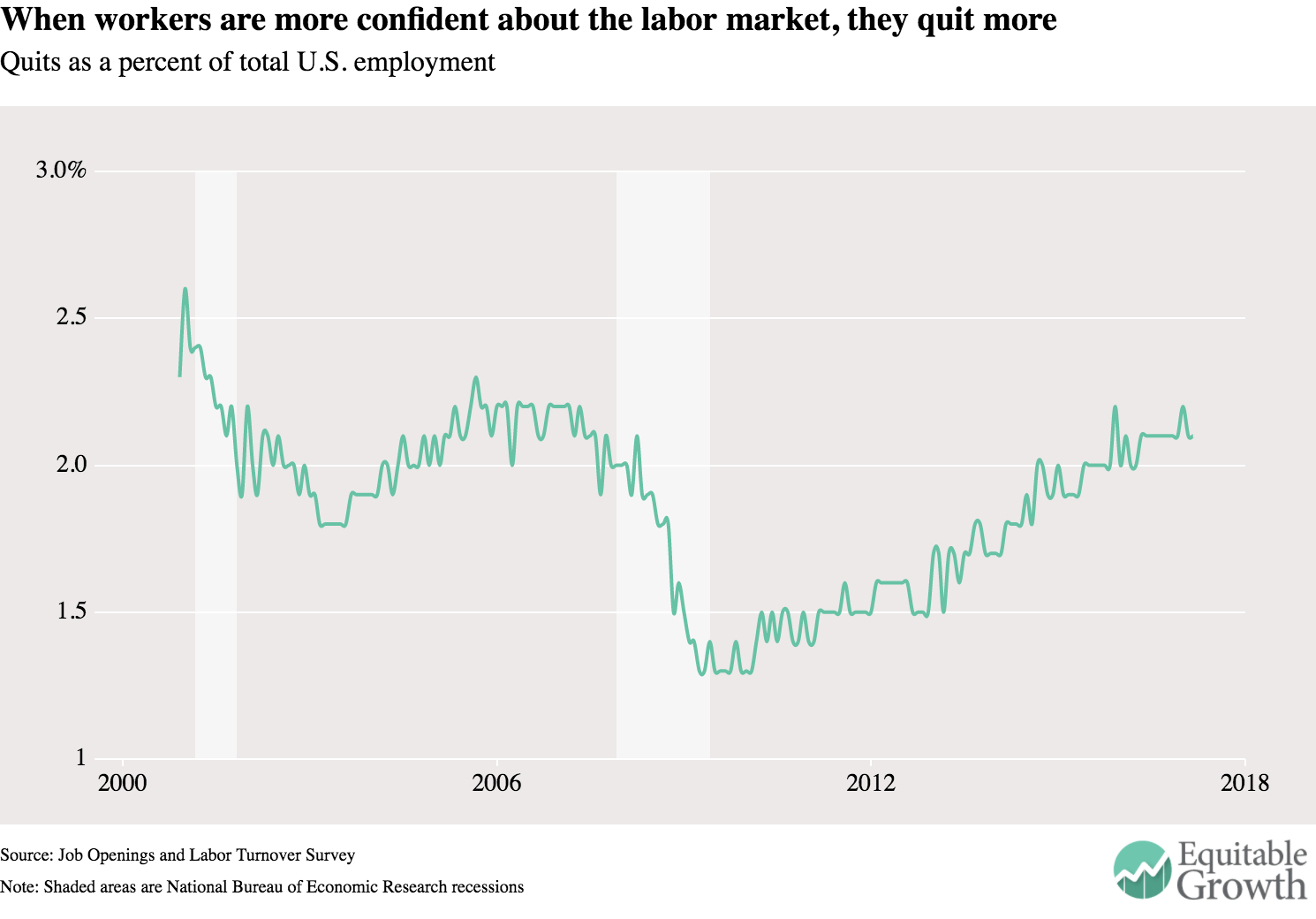
The quits rate remained at 2.1 percent in March, the level it’s been at, except for one month, since May 2016.

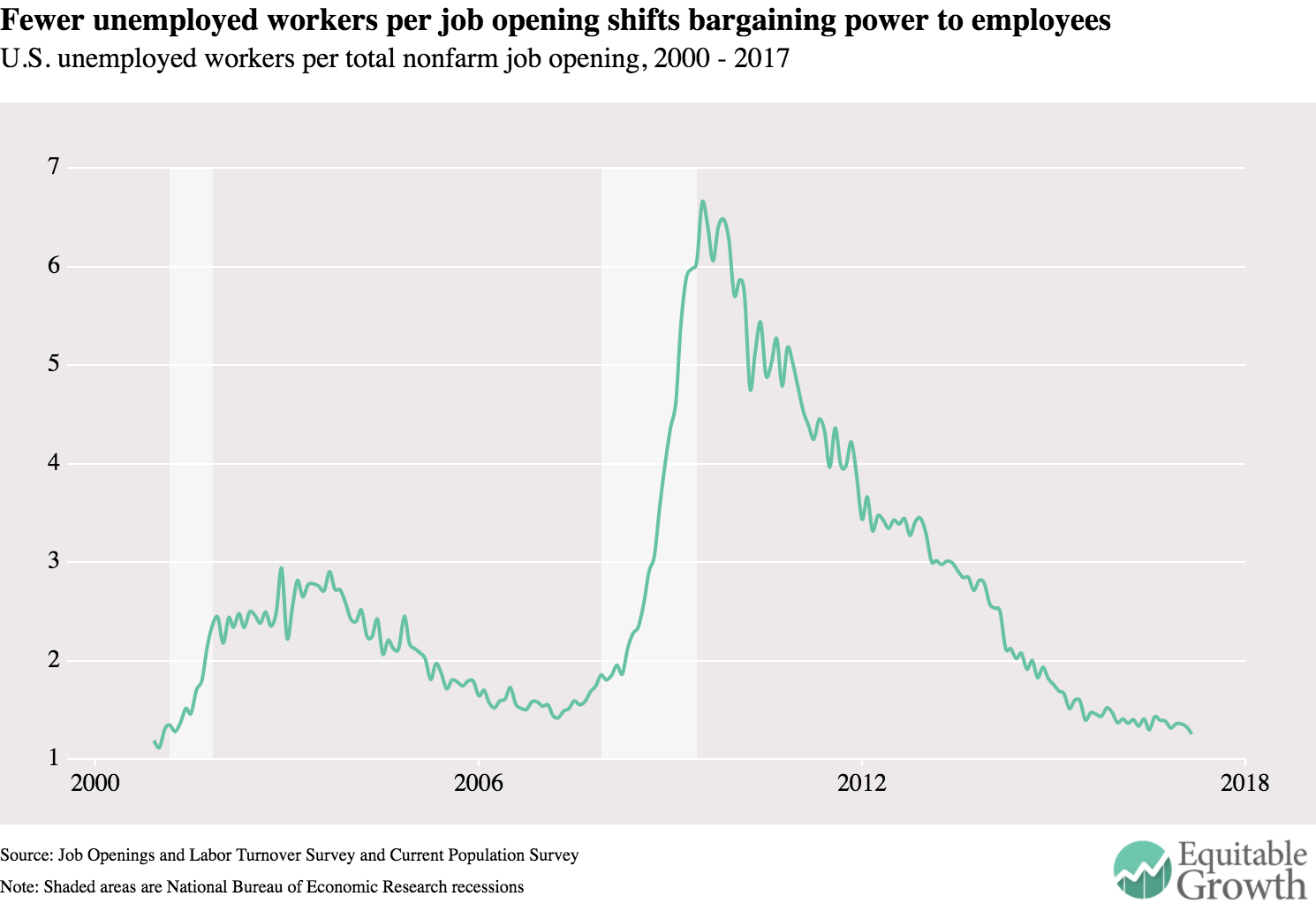
The number of unemployed workers per job opening dropped to 1.25, a low not seen since early 2001.

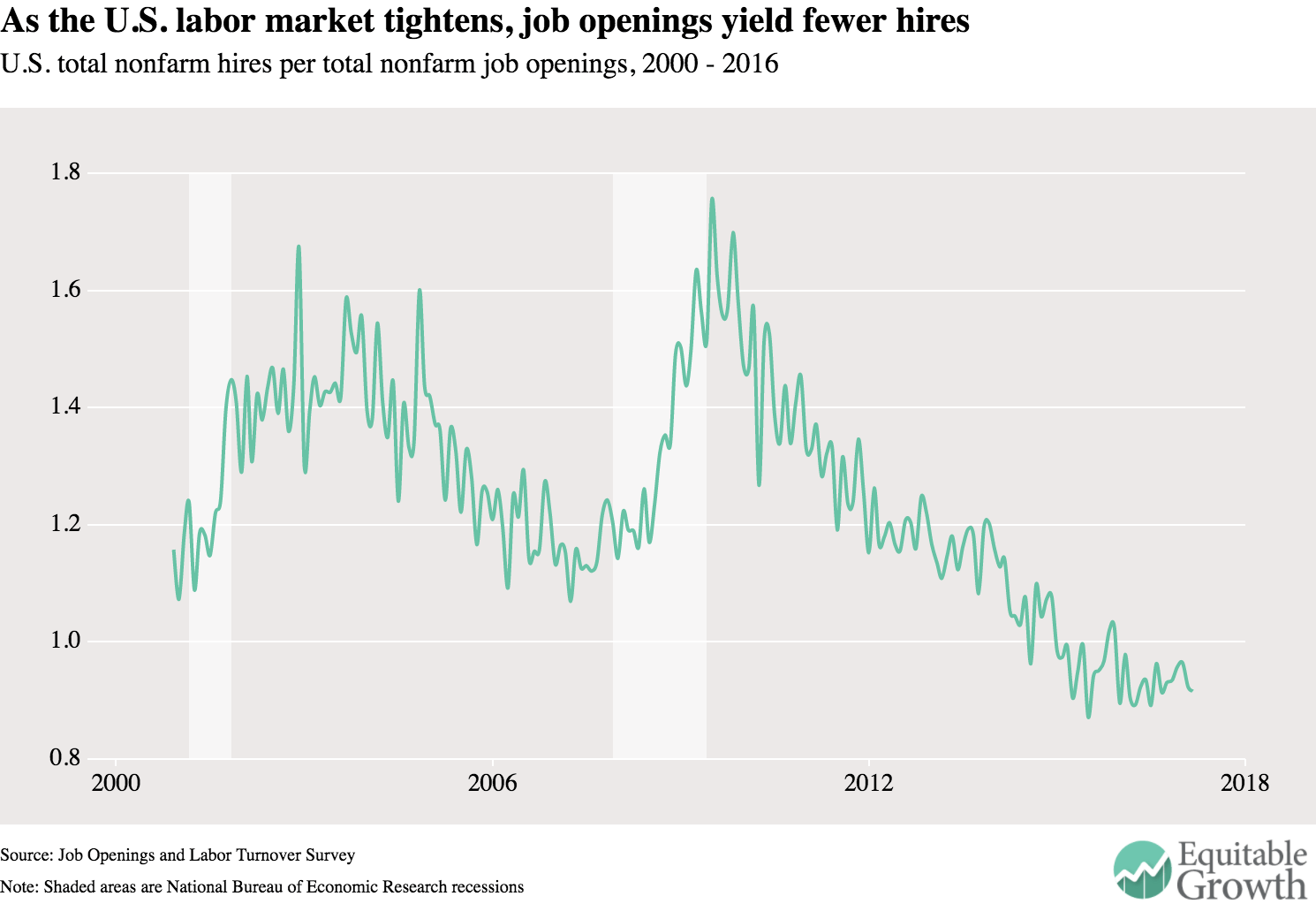
The vacancy yield, or the number of hires per job opening, ticked down slightly to 0.92. The yield has been around this level for a year at this point.

Inclusive AI: Technology and Policy for a Diverse Urban Future

Inclusive AI: Technology and Policy for a Diverse Urban Future https://www.eventbrite.com/e/inclusive-ai-technology-and-policy-for-a-diverse-urban-future-tickets-31896895473: Wed, May 10, 2017 10:30 AM – 5:30 PM

Cursor and 1024px The Garden of Earthly Delights by Bosch High Resolution jpg 1 024×583 pixels

Panel 3: The Future of Work: Automation and Labor

  • Ken Goldberg
  • Brad DeLong,
  • James Manyika
  • Costas Spanos
  • Laura Tyson
  • John Zysman

https://www.icloud.com/keynote/0w1qzB37W6lJ8pGCYZplqbGcw

NewImage NewImage NewImage NewImage NewImage NewImage NewImage NewImage NewImage

Since I get to go first, I will preemptively take the hyper-Olympian and very long-run historical point of view…

The human brain is a massively parallel supercomputer that fits in half a shoebox. It draws 50 W of power. Human fingers are amazingly fine manipulation devices. Human back and leg muscles—especially when testosterone soaked—are quite good at moving heavy objects. And so, back in the environment of evolutionary adaptation, we used our brains, big muscles, and fingers to lead interesting, if stressful and short, lives.

But as history has enrolled we have done other things to add economic and sociological value than use our backs, our fingers, and our brains to innovate and create. Over the long historical sweep, backs and fingers have declined and we have turned many of us into, instead:

  • robots performing repetitive tasks,
  • microcontrollers for domesticated animals and machines,
  • relatively simple accounting and recording software bots,
  • personal servitors,
  • social engineers trying to keep all those things controlled by brains—especially by the testosterone soaked ones—working together harmoniously. With limited success.

while remaining innovators and creators.

Backs started to go out with the domestication of the horse. Fingers with the invention of the spinning jenny. Microcontrollers and accounting ‘bots, we can see, are now on the way out too. So, fortunately, are the jobs that treat humans as simple robots.

That leaves us with a future of work made up of:

  • personal servitors,
  • social engineers,
  • innovators and creators.

Utopia or dystopia? Heaven or hell?

Over to you, James. And, in a broader sense, over to all of you—in the audience, and out there in Internet land…

Must- and Should-Reads: May 8, 2017


Interesting Reads:

Should-Read: Peter Coy: Piketty’s Capital Was So Popular There’s a Sequel

Should-Read: Good for you, Peter, in reading “the introduction, the retrospective by translator Arthur Goldhammer, and bits and pieces of some of the following essays.”

I would recommend that you, next, read Piketty’s response. After that, browse first through “A Political Economy Take on W/Y” [Suresh Naidu], “Increasing Capital Income Share and Its Effect on Personal Income Inequality” [Branko Milanovic], “The Research Agenda after Capital in the Twenty-First Century” [Emmanuel Saez], and “The Legal Constitution of Capitalism” [David Singh Grewal]—those are, I think, the chapters that you are likely to find most accessible.

As I wrote in my Amazon review: As one of the co-editors of this book, I know it very well. I am greatly pleased with how this project came out—we have very serious people, as Bob Solow would put it, writing very serious takes on what Thomas Piketty has accomplished, where he has gone wrong, and what gaps remain to be investigated by others. Social scientists thinking of citing on, working along lines related to, or drawing on Piketty should certainly read this book. People who have read Capital in the Twenty-First Century who are curious about how serious people are reacting to and assessing the book should read it as well.

Peter Coy: Piketty’s Capital Was So Popular There’s a Sequel: “Another hefty volume that looks at the connection between capitalism and inequality… https://www.bloomberg.com/news/articles/2017-05-08/piketty-s-capital-was-so-popular-there-s-a-sequel

…If you’re reading this article, it may be because you’re one of the 2 million people who bought a copy of Capital in the Twenty-First Century by French economist Thomas Piketty. The long, dense academic treatise was the biggest publishing surprise of the year when it came out in English in 2014…. Now comes After Piketty, a book that, at 678 pages, is almost as long and almost as weighty. Released May 8 in the U.S., it’s a sympathetic appraisal of what Piketty got right and what he got wrong. I have read the introduction, the retrospective by translator Arthur Goldhammer, and bits and pieces of some of the following essays….

One recurrent gripe about Capital in the Twenty-First Century… is that it was too deterministic, failing to acknowledge that society could choose…. Another is that the rate of profit has held roughly constant over a long period in a way that Piketty doesn’t account for. “This seems to be a substantial hole in the book,” the editors write…. Boushey says in an interview that… the impetus for the new volume is that Piketty’s ideas haven’t been taken up, or even wrestled with, to the degree that the editors felt they deserved…. The reception that Piketty has received from fellow economists, says Boushey, relates to “a deeper question about the purpose of economics as a social science”…

Should-Read: Thomas Piketty: After Piketty: The Agenda for Economics and Inequality

Should-Read: Thomas Piketty: After Piketty: The Agenda for Economics and Inequality http://amzn.to/2qSUgdl: “Had I believed that the one-dimensional neoclassical model of capital accumulation…

…(based upon the so-called production function Y = F(K,L) and the assumption of perfect competition) provided an adequate description of economic structures and property relations, then my book would have been 30 pages long rather than 800 pages long. The central reason my book is so long is that I try to describe the multidimensional transformations of capital and the complex power patterns and property relations that come with these metamorphoses (as the examples given above illustrate). I should probably have been more explicit about this issue….

Aggregate capital/income ratios and aggregate capital shares tend to move together: they were both relatively low in the mid-twentieth century, and they were both relatively high in the nineteenth century and the early twentieth century, as well as in the late twentieth century and the early twenty-first century. If we were to use the language of aggregate production functions and the assumption of perfect competition, then the only way to explain the fact… would be to assume an elasticity of substitution that is somewhat larger than 1 over long periods…. Standard estimates suggest smaller elasticities (as rightly argued by Devesh Raval in Chapter 4), but they are typically not long-run estimates. It is also possible that technical change and the rise of new forms of machines, robots, and capital-intensive technologies (along the lines described by Laura Tyson and Michael Spence in Chapter 8) will lead to a gradual increase of the elasticity of substitution over time.

Let me make clear, however, that this is not my favored interpretation of the evidence…. At this stage, the important capital-intensive sectors are more traditional sectors like real estate and energy. I believe that the right model for thinking about why capital-income ratios and capital shares have moved together in the long run is a multisector model of capital accumulation, with substantial movements in relative prices, and most importantly with important variations in bargaining power and institutional rules over time. In particular, large upward or downward movements of real estate prices have played an important role in the evolution of aggregate capital values during recent decades, as they did during the first half of the twentieth century. This can in turn be accounted for by a complex mixture of institutional and technological forces….

More generally, the main reason capital values and capital shares are both relatively high in the late twentieth and early twenty-first centuries is that the institutional and legal systems have gradually become more favorable to capital owners (both owners of real estate capital and owners of corporate capital) and less favorable to tenants and workers in recent decades, in a way that is broadly similar (but with different specific institutional arrangements) to the regime that prevailed in the nineteenth century and early twentieth century. In contrast, the legal and institutional regimes prevailing in the mid-twentieth century and during the “Social Democratic Age (1945–1980)” was more favorable to tenants and workers….

This does not mean that changing production functions and elasticities of substitution are not important: I am convinced that this form of mathematical language can be useful to clarify certain concepts and logical relations between concepts. But these notions need to be embedded into a broader social-institutional framework and historical narrative if we want to be able to account for observed evolutions. In some cases, institutional change directly interacts with technological change—as in, for example, the decline of unions and the evolution toward a “fissured workplace” analyzed by David Weil in Chapter 9…

Must-Watch: After Piketty

Must-Watch: I am going to miss this, being on the Wrong Coast on May 11:

After Piketty: “The Graduate Center 365 Fifth Avenue | 1201: Elebash Recital Hall | May 11, 2017: 6:30 PM http://www.gc.cuny.edu/publicprograms

Cursor and After Piketty

…Reservations are full; this event will be LIVE-STREAMED.

Capital in the Twenty-First Century by Thomas Piketty is the most widely discussed work of economics in recent history. (Piketty gave a major talk at the Graduate Center upon its release in 2014.) But are its insights about inequality and economic growth on target? And how should researchers explore the ideas Piketty pushed to the forefront? These questions and more are tackled in the new book After Piketty: The Agenda for Economics and Inequality, which is sure to spark much debate in its own right. Contributors join in a conversation to celebrate its release and discuss how lessons from Piketty can help us understand the current economic and political moment. 

  • Heather Boushey, executive director and chief economist at the Washington Center for Equitable Growth and author of Finding Time: The Economics of Work-Life Conflict.

  • Paul Krugman, Nobel Prize-winning economist; New York Times columnist; and GC distinguished professor of economics and senior scholar at the Stone Center.

  • Branko Milanovic, GC visiting presidential professor and senior scholar at the Stone Center; former lead economist in the World Bank’s research department; and author of Global Inequality: A New Approach for the Age of Globalization.

  • Suresh Naidu, assistant professor of economics and public affairs at Columbia University.

“After Piketty” at Harvard University Press

Cursor and After Piketty Heather Boushey J Bradford DeLong Marshall Steinbaum Harvard University Press

Thomas Piketty’s Capital in the Twenty-First Century is the most widely discussed work of economics in recent history, selling millions of copies in dozens of languages. But are its analyses of inequality and economic growth on target? Where should researchers go from here in exploring the ideas Piketty pushed to the forefront of global conversation? A cast of economists and other social scientists tackle these questions in dialogue with Piketty, in what is sure to be a much-debated book in its own right.

After Piketty opens with a discussion by Arthur Goldhammer, the book’s translator, of the reasons for Capital’s phenomenal success, followed by the published reviews of Nobel laureates Paul Krugman and Robert Solow. The rest of the book is devoted to newly commissioned essays that interrogate Piketty’s arguments. Suresh Naidu and other contributors ask whether Piketty said enough about power, slavery, and the complex nature of capital. Laura Tyson and Michael Spence consider the impact of technology on inequality. Heather Boushey, Branko Milanovic, and others consider topics ranging from gender to trends in the global South. Emmanuel Saez lays out an agenda for future research on inequality, while a variety of essayists examine the book’s implications for the social sciences more broadly. Piketty replies to these questions in a substantial concluding chapter.

An indispensable interdisciplinary work, After Piketty does not shy away from the seemingly intractable problems that made Capital in the Twenty-First Century so compelling for so many.


About the Editors:

Heather Boushey is Executive Director and Chief Economist at the Washington Center for Equitable Growth.

J. Bradford DeLong is Professor of Economics at the University of California, Berkeley.

Marshall Steinbaum is Fellow at the Roosevelt Institute, New York.


Table of Contents:

  1. The Piketty Phenomenon [Arthur Goldhammer]
  2. Thomas Piketty Is Right [Robert M. Solow]
  3. Why We’re in a New Gilded Age [Paul Krugman]
  4. What’s Wrong with Capital in the Twenty-First Century’s Model? [Devesh Raval]
  5. A Political Economy Take on W / Y [Suresh Naidu]
  6. The Ubiquitous Nature of Slave Capital [Daina Ramey Berry]
  7. Human Capital and Wealth before and after Capital in the Twenty-First Century [Eric R. Nielsen]
  8. Exploring the Effects of Technology on Income and Wealth Inequality [Laura Tyson and Michael Spence]
  9. Income Inequality, Wage Determination, and the Fissured Workplace [David Weil]
  10. Increasing Capital Income Share and Its Effect on Personal Income Inequality [Branko Milanovic]
  11. Global Inequality [Christoph Lakner]
  12. The Geographies of Capital in the Twenty-First Century: Inequality, Political Economy, and Space [Gareth A. Jones]
  13. The Research Agenda after Capital in the Twenty-First Century [Emmanuel Saez]
  14. Macro Models of Wealth Inequality [Mariacristina De Nardi, Giulio Fella, and Fang Yang]
  15. A Feminist Interpretation of Patrimonial Capitalism [Heather Boushey]
  16. What Does Rising Inequality Mean For the Macroeconomy? [Mark Zandi]
  17. Rising Inequality and Economic Stability [Salvatore Morelli]
  18. Inequality and the Rise of Social Democracy: An Ideological History [Marshall I. Steinbaum]
  19. The Legal Constitution of Capitalism [David Singh Grewal]
  20. The Historical Origins of Global Inequality [Ellora Derenoncourt]
  21. Everywhere and Nowhere: Politics in Capital in the Twenty-First Century [Elisabeth Jacobs]
  22. Toward a Reconciliation between Economics and the Social Sciences [Thomas Piketty]

Reviews:

The book serves as a fantastic introduction to Piketty’s main argument in Capital [in the Twenty-First Century], and to some of the main criticisms, including doubt that his key equation—r > g, showing that returns on capital grow faster than the economy—will hold true in the long run. It also contains thoughtful interventions in debates about the political economy of inequality.—Aaron Reeves, Nature

Thomas Piketty’s Capital in the Twenty-First Century forcibly entered the public imagination in 2014, but the book’s impact on academic thinking and research is only just starting to be felt. The essays in After Piketty offer new findings and admirably lay out an agenda that will influence future research on inequality, opportunity, and measurement for years to come.—Miles Corak, University of Ottawa

Heather Boushey, Brad DeLong, and Marshall Steinbaum have convened and shaped an ambitious and refreshingly frank conversation about Thomas Piketty’s Capital in the Twenty-First Century. This extraordinary gathering of two dozen authors—working across disciplinary boundaries—interrogates Piketty’s core claims about the causes, correlates, characteristics, and consequences of high and rising levels of income and wealth inequality in the West. The gathered authors celebrate and hone Capital’s far-reaching contributions; they also tackle substantial weaknesses and assess omissions. Readers unfamiliar with Capital will find an accessible synthesis, graduates of the original book will emerge with a more nuanced understanding, and inequality scholars—newcomers and veterans—will revise their research agendas.—Janet C. Gornick, Professor of Political Science and Sociology, Stone Center on Socio-Economic Inequality, City University of New York

Piketty’s work did what decades of rising disparities couldn’t do: it reminded macroeconomists that inequality matters. More starkly, it laid bare just how ill-equipped our existing frameworks are for understanding, predicting, and changing inequality. This extraordinary collection shows that our most nimble social scientists are responding to the challenge, collecting ideas about capital, technology, power, gender, race, and privilege that might help inform a broader understanding.—Justin Wolfers, University of Michigan

Reflecting on Masterclasses in Rhetoric Taught in Recent Videos…

I highly recommend watching my Milken Institute panel last week:


Or, alternatively, at least read the transcript—but watching is better.

The panel is worth watching and reflecting upon and not just because of the ideas discussed. It is also very much that there were two people on that stage who are true masters of rhetoric, and their performances are masterpieces: Gillian Tett and Steve Schwartzman.

  • Gillian Tett provides a master class in how to run a panel. Five panelists, each of whom could’ve gone five different ways–you might will think that she had all 3125 combinations mapped out in her brain beforehand, or else thinks 10 times as fast as a normal human with respect to who she wanted to speak next about what in reaction to what had just gone on before…

  • Steve Schwartzman–I clocked Steve Schwartzman speaking at 80 words a minute with only half of his words being true meaning of words. That both allowed him to hold the floor for the time that he wished and also to put enough thought into each of his meaning words that he could see precisely what he wanted to have said. I guarantee that this is something he has learned to do: I do not think the younger Steve Schwartzman spoke 80 words a minute…

You might also, for a different lesson, take a look at the week before’s CUNY panel: the video, the transcript.

Also excellent. Also wonderful. Also very much worth watching—the intellectual and knowledge payoff is, I think, considerably higher than at Milken because Schwartzman, Ciobo, and Ramirez were there representing the positions of their institutions rather than setting out their own ideas.

But as far as rhetoric is concerned… Let the record show that both David Autor and myself interrupted Ann Harrison’s opening statement. We did so for what seemed to us to be reasons that we thought at the time were good and sufficient, and our interruptions were short. But dollars will get you doughnuts we would not have done so had Ann Harrison been a Y-chromosome type person. We are who we have been trained to be…