Must-Read: Simon Johnson: Trump’s Growth Charade by Simon Johnson – Project Syndicate

Must-Read: The smart and honest Simon Johnson likes the Trumpists’ and Cogan, Hubbard, Taylor, and Warsh’s 3%/year real national product fake forecasts even less than I do:

Simon Johnson: Trump’s Growth Charade by Simon Johnson – Project Syndicate: “Officials in President Donald Trump’s administration frequently talk about getting annual economic growth in the United States back above 3%… https://www.project-syndicate.org/commentary/trump-administration-growth-assumption-by-simon-johnson-2017-07

…Their proposed budget actually assumes that they will succeed…. Unfortunately, left to its own devices, the economy will most likely continue to sputter. And the policies that Trump’s Republican Party has proposed–for health care, taxes, and deregulation–will not make much difference. The assumption of higher growth is more of an accounting smokescreen for tax cuts than anything else. If administration officials acknowledge that a 3% annual rate is not feasible, they would need to face the reality that their forecasts for tax revenues are too high, and that their proposed tax cuts, if enacted, would dramatically increase the budget deficit and the national debt.

The US economy used to grow at more than 3% per year; in fact, this was the norm in the second half of the twentieth century. Since then, however, the US has been forced to confront three major constraints…. The US population is aging… has reduced US potential annual growth by perhaps as much as half a percentage point…. Lurking in the background are potential policies that would restrict legal immigration…. The slowing rate of productivity growth…. The 2008 financial crisis…. Deregulation in the 1990s and early 2000s… leading to slightly higher growth for a while–and then to a massive crash…. Relaxing limits on leverage…. Any boom generated in this way is likely to end badly….

Assuming 3% growth is, to put it generously, wishful thinking. Worse, it is deeply misleading–and potentially dangerous…
Must-Read: Washington Center for Equitable Growth announces fourth round of annual grantmaking, bringing total awards to nearly $3 million

Must-Read: Equitable Growth announces new slate of grantees

The Washington Center for Equitable Growth is excited to announce its 2017 class of grantees. Equitable Growth’s fourth slate of grant awards represents a growing and robust body of research and community of scholars who are bringing data-driven research to bear on some of the most entrenched economic challenges of our time.

Equitable Growth will award 20 grants in its 2017 round of grantmaking. Awards in this year’s grant cycle total $771,930, with an additional $52,000 in co-funding from the Russell Sage Foundation. Combined with the total funding from the three previous grant cycles, Equitable Growth has awarded nearly $2.9 million in grant awards.

https://equitablegrowth.org/press/washington-center-for-equitable-growth-announces-fourth-round-of-annual-grantmaking-bringing-total-awards-to-nearly-3-million/

Should-Read: Avik Roy: An Autopsy of the GOP Effort to Repeal and Replace Obamacare

Should-Read: Avik Roy told a lot of lies in his vain attempt to get BCRA passed.

Now here he is calling for the corruption of the Congressional Budget Office.

Every single former Director of the CBO regards its independence as an extremely valuable national treasure. And Roy’s claim that the CBO was in the pocket of the Democrats is hogwash. In almost the next breath after saying that Democrats had “a deliberate strategy to stack the CBO”, he admits that President Obama “opposed the individual mandate”—if there was an alternative strategy that would have gotten coverage. CBO judged that there wasn’t—that Obama’s preferred bill would not work.

The difference between CBO scores of the Democratic and Republican health care bills is not because the CBO is stacked in favor of Democrats, it is because the Democrats were willing to listen to the CBO and craft bills that the CBO judged were likely to work, while the Republicans were unwilling to listen to the CBO and so crafted bills that the CBO judged were unlikely to work:

Avik Roy: An Autopsy of the GOP Effort to Repeal and Replace Obamacare: “Moderate Republican senators, often representing purple or blue states, were reluctant both philosophically and politically to endorse legislation that increased the number of Americans without health insurance… http://www.nationalreview.com/corner/449943/autopsy-gop-effort-repeal-and-replace-obamacare

…Conservative Republican senators focused on the commitment they (and most of the moderates) had made to repeal and replace Obamacare, and more broadly, their commitment to limited government…. Democrats passed Obamacare… by uniting their ideological and pragmatic wings…. When Democrats retook Congress in 2006, they appointed Peter Orszag to head the CBO, as part of a deliberate strategy to stack the CBO in favor of their health-care agenda. Orszag proceeded to build out the entire health policy wing of the CBO—representing dozens of staffers—with like-minded individuals…. The Affordable Care Act reflects the CBO’s worldview. While Senator Obama opposed the individual mandate, the CBO believed it would add 16 million covered lives to the ACA’s ledger….

Compare and contrast that to the GOP’s effort. When Republicans had the opportunity to appoint a CBO director in 2015, they chose not to hire someone with deep health-care expertise… and instead hired… a labor economist. There was no comparable strategy, either by Hall or by Congress, to rebalance the CBO’s center-left tilt with individuals more knowledgeable about how health insurance markets actually work. Hence… the CBO was poised to make any GOP bill look bad…

Should-Read: Craig Garthwaite: Why replacing Obamacare is so hard: It’s fundamentally conservative

Should-Read: Craig Garthwaite: Why replacing Obamacare is so hard: It’s fundamentally conservative: “As a life-long Republican… I’ve come to an answer that will be hard for many conservatives to swallow… https://www.washingtonpost.com/opinions/why-replacing-obamacare-is-so-hard-its-fundamentally-conservative/2017/07/10/c5d64634-6351-11e7-84a1-a26b75ad39fe_story.html

…Passing an Obamacare replacement is difficult because the existing system is fundamentally a collection of moderately conservative policies…. There simply isn’t much room to the political right of Obamacare for a policy that covers as many people with high-quality insurance. Furthermore, many have realized that there isn’t much political will for a bill that covers meaningfully fewer people or that places low-income individuals in insurance plans with cost-sharing elements they can’t afford….

Before I am drummed out of the party, it’s important that we consider our history…. Even Ronald Reagan saw a role for the government to provide quality health insurance for those who could not otherwise afford access…. The Republican Party was… a party that at its core supported a limited, well-run and efficient government. This fact can be seen in the structure of the social insurance policies we’ve historically supported… welfare reform and the earned-income tax credit… the expanded use of government contractors and outsourcing rather than an ever-growing leviathan… Medicare Part D, supporting Medicare Advantage and advocating premium support in Medicare. Each of these policies involves government intervention where the private market failed, but in a way that focuses on the diligent and effective use of market-based incentives and, where possible, private firms.

This history makes it clear: Obamacare is broadly an extension of traditional Republican beliefs…. Private firms provide health insurance in a free, but appropriately regulated, market…. Economics simply does not allow us to deny the underlying fact that these stable health insurance markets require regulatory guardrails. Furthermore, these Obamacare regulations all work together…. The regulation guaranteeing insurance access for those with preexisting conditions… [is] popular… [but] comes with the necessity of… market interventions such as the individual mandate and sufficiently generous tax subsidies to prevent a death spiral….

Unfortunately, these marketplace realities run afoul of the Republican Party’s newly developed preternatural love for completely unfettered markets—a love that is simply incompatible with reality and our party’s history. Quite simply, addressing adverse selection in health policy doesn’t mean you are surrendering to the long arm of government intervention any more than having the government enforce property rights or contracts is the first step on the slow march to socialism. It simply means we recognize that at times the conditions for healthy markets are missing and must be provided….

The inability to solve the big problems facing our great nation will be the beginning of the end of the [Republican] party.

Should-Read: Antonio Fatas: On Twitter: “Healthcare is complicated”

Should-Read: Antonio Fatas seems annoyed with Greg Mankiw. I think I understand where Antonio is coming from: one has a moral obligation, I think, not just to say “health care is a complicated issue”, but to go on and say what kinds of “regulatory relief” and what kind of “expanded government role” you believe would do more good than harm—and also (we are still looking at you, Marty) not to misreport and misconstrue the solid empirical literature, and also (here we are looking at you, Greg) to say more than that the issues are “hotly debated”:

Antonio Fatas: On Twitter: “Healthcare is complicated but Greg Mankiw should criticize policy proposals that are incoherent or just lie about their benefits…” https://twitter.com/AntonioFatas/status/890979381719511044

Greg Mankiw: Why Health Care Policy Is So Hard: “‘Nobody knew that health care could be so complicated’. President Trump said that in February… https://www.nytimes.com/2017/07/28/upshot/why-health-care-policy-is-so-hard.html

…Anyone who has spent some time thinking about the issue sees its complexity. With the collapse of the Senate health care bills this week, the president has certainly been reminded of it. But Mr. Trump’s epiphany raises some questions: Why is health care so complicated? How does it differ from most of the other goods and services that the economy produces? What makes health policy so vexing?…

The magic of the free market sometimes fails us when it comes to health care. There are several reasons. Externalities abound… vaccines, for instance… medical research…. Consumers often don’t know what they need… and sometimes are not in a position to make good decisions…. Health insurance… means that consumers no longer pay for most of their health care out of pocket…. Insured consumers tend to overconsume…. To mitigate this problem, insurers have co-pays, deductibles and rules limiting access to services. But co-pays and deductibles reduce the ability of insurance to pool risk, and access rules can create conflicts between insurers and their customers. Insurance markets suffer from adverse selection… the death spiral… the insurance market may disappear….

The best way to navigate the problems of the health care marketplace is hotly debated. The political left wants a stronger government role, and the political right wants regulation to be less heavy-handed. But policy wonks of all stripes can agree that health policy is, and will always be, complicated.

Weekend reading: “#hipsterantitrust edition”

This is a weekly post we publish on Fridays with links to articles that touch on economic inequality and growth. The first section is a round-up of what Equitable Growth published this week and the second is the work we’re highlighting from elsewhere. We won’t be the first to share these articles, but we hope by taking a look back at the whole week, we can put them in context.

Equitable Growth round-up

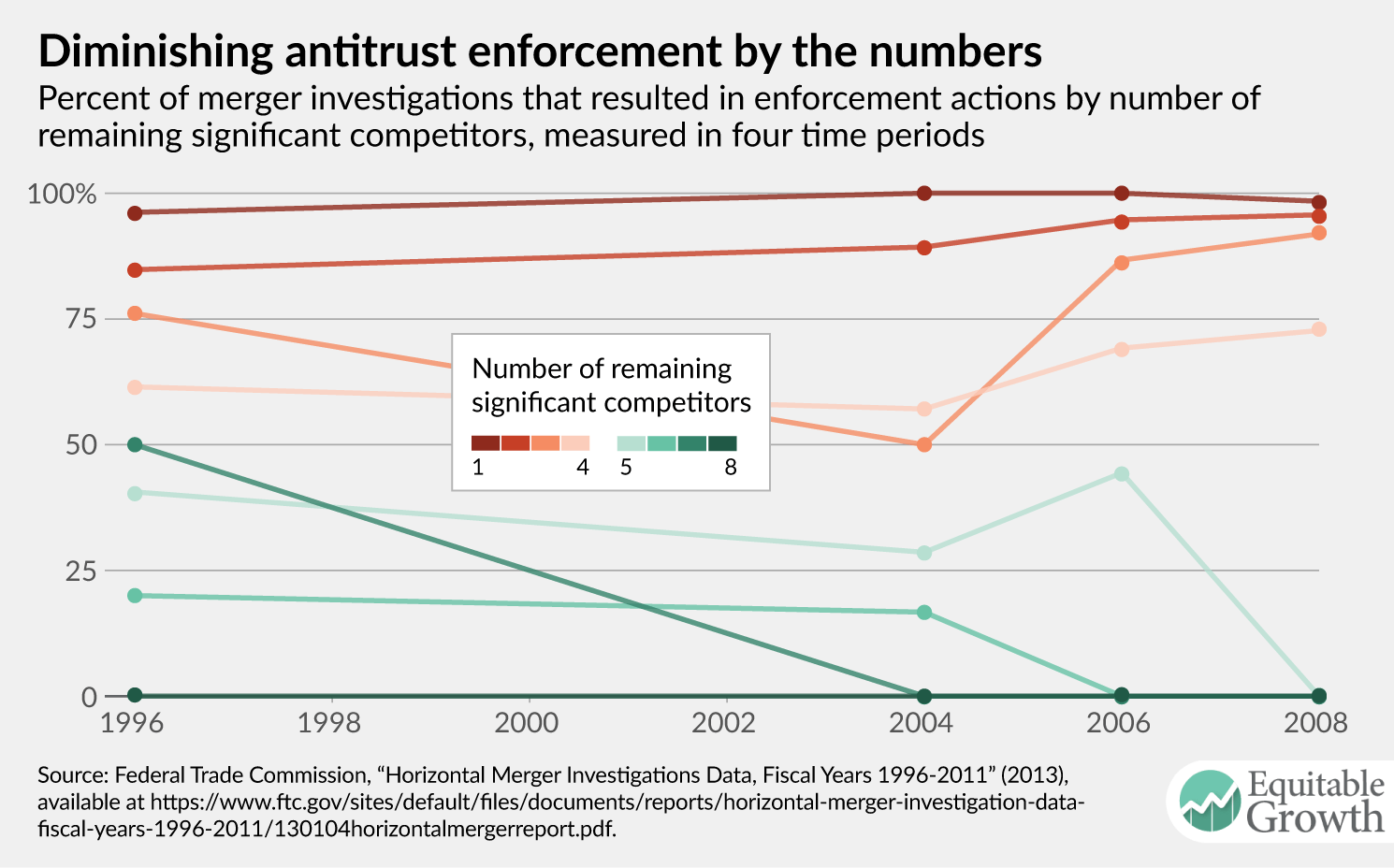
Equitable Growth released a new report this week (along with an issue brief outlining key findings) by John Kwoka, the Neal F. Finnegan Distinguished Professor of Economics at Northeastern University, on how changes in U.S. merger enforcement policy have contributed to rising concentration and reduced competition.

As a growing number of states prove that paid leave based on a social insurance model works for businesses and workers, the momentum around a national paid leave policy grows.

Timely and accurate data is critical to diagnosing and responding to policy problems that affect millions of people across the country. But with U.S. statistical agencies facing major cuts, Austin Clemens asks: Will the United States give up on data collection?

 Links from around the web

The debate around antitrust policy has officially entered the mainstream with the inclusion of this issue in congressional Democrats’ “Better Deal” policy blueprint, which some on the right have branded as #hipsterantitrust. Chris Sagers writes specifically about one promising tenant of the Better Deal antitrust platform: “frequent, independent reviews” of merged firms’ performance along with a “consumer competition advocate.” [slate]

After JP Morgan Chase & Co. categorized a male employee as a “secondary caregiver,” thus not allowing him to take advantage of 16 weeks of paid leave that it provides to women, Bryce Covert discusses why family leave’s “sexism problem” is bad for men—and women. [elle]

Even among legislators on Capitol Hill who ardently raise the alarm about growing inequality, the discussions around tax reform tend to focus on closing loopholes in the current system. Max Ehrenfreund dives into the research on why a fundamental overhaul of the federal tax system is needed to meaningfully address inequality. [wonkblog]

Macroeconomic models tend to be blind to race and gender, assuming that macroeconomic policies affect everyone equally. Former Minneapolis Fed President and current Professor of Economics at the University of Rochester, Narayana Kocherlakota, writes about two new papers highlighting how “quantitative models that ignore such differences can be poor guides to understanding the impact of government programs.”  [bloomberg view]

Alvin Chang writes about how many parents are legally gerrymandering school districts in order to separate their kids away from their “less desirable” peers, which he writes has “resulted in the biggest setback to school integration since Brown v. Board of Education. [vox]

Friday figure

From “U.S. antitrust and competition policy amid the new merger wage” by John E. Kwoka.

Should-Read: Josh Barro: John McCain saved Republicans from themselves by killing Obamacare repeal bill

Should-Read: Josh Barro: John McCain saved Republicans from themselves by killing Obamacare repeal bill: “Lindsey Graham made a demand: He would vote for the terrible healthcare bill being offered before the Senate, a bill he thought would cause health insurance market disaster… http://www.businessinsider.com/john-mccain-vote-health-care-obamacare-bill-2017-7

…as long as he received clear assurances that the House would never… make it law…. Like a lot of the weird things Republicans have said and done on healthcare in the last few months, it makes sense if you understand their underlying political goals. All the options Republicans have left themselves on healthcare are both terrible policy and dreadfully unpopular. So members haven’t set out to make good policy. They have set out to avoid being blamed for whatever becomes law—and also to avoid being blamed if nothing becomes law….

Early Friday morning, McCain arranged to vote out of alphabetical order, so he could shout the “no” that killed the bill to the applause of his Democratic colleagues. He built up as much drama as he could for the moment, telling reporters who asked about his intentions before the vote they would have to “watch the show.” Democratic Sen. Dianne Feinstein hugged him on the Senate floor. If you’ve been asking why McCain is getting so much credit for this hit job, rather than his two female Republican colleagues without whose “no” votes the bill would have also passed, one of the answers is that he has sought to make himself the fall guy. But it’s true: This was a conspiracy of three. And one thing McCain has in common with Sens. Susan Collins and Lisa Murkowski is all three were in an unusually good position to take the blame for killing Obamacare.

Collins represents a state, Maine, that voted for Hillary Clinton… is rumored to want to run for governor of Maine. As long as Obamacare stays the law, there will be a pot of Medicaid expansion funds waiting for the state to unlock, creating a windfall into the state budget Collins would oversee. Murkowski… answers to a truly moderate voter base in Alaska… 2016 with 44% of the vote, against 29% for a candidate to her right and 25% for two candidates to her left…. She can lose a Republican primary and come back to win the general election as a write-in…. McCain? Well, how do you threaten an 80-year-old man who is facing down an aggressive form of brain cancer? By threatening to back his primary challenger in 2022?

One piece of conventional wisdom in the months of debate over healthcare had been that any bill would either pass by a single vote or fail by many. Friday morning’s 49-to-51 defeat proved that wrong…. Maybe the bill needed to fail by a one-vote margin, so the maximum number of Republicans could say tried their hardest…. Republicans… will be glad for the political cover he gave them by taking the fall for a murder many of them wanted to commit, so the party would not have to take ownership of an electorally disastrous policy.

Should-Read: Simon Wren-Lewis: UK slowdown is a result of Brexit and austerity

Should-Read: Simon Wren-Lewis: UK slowdown is a result of Brexit and austerity: “Those who argued that Brexit would bring a short term slowdown have been proved right: they just got their timing slightly wrong… https://mainlymacro.blogspot.co.uk/2017/07/the-uk-slowdown-is-result-of-brexit-and.html

…Have all those who earlier lambasted forecasts of a short term Brexit slowdown offered their apologies? Pigs will fly. Yet in his press release when the figures were announced, Labour’s Chancellor in waiting John McDonnell mentioned the government’s austerity policy but not Brexit. This is surprising…. Both are to blame.

After a pause, fiscal policy (to judge from the OECD’s estimate of the underlying primary balance) started taking demand out of the economy in 2015 and particularly 2016. That will have been an important factor behind the slow growth in both years. However the additional slowdown in the first half of 2017 is likely to be a Brexit phenomenon…. The Brexit depreciation immediately after the vote has led to a fall in real incomes, meaning less consumption. It has not led to any compensating increase in exports because firms are not going to expand markets that might soon disappear because of leaving the Single Market or customs union. The Brexit depreciation has brought forward some of the negative impacts of Brexit on living standards.

Yet austerity is still to blame in the following respect. The Brexit slowdown in 2017 H1 is a slowdown in demand, not supply. Monetary policy did what it could after the Brexit vote, but with interest rates at their lower bound it can do no more. (I trust there are some very embarrassed faces on the MPC right now among those suggesting a rate rise.) Fiscal policy should have helped monetary policy out by filling the demand gap, but those running the Treasury refuse to acknowledge this role for fiscal policy.

So McDonnell is correct to blame austerity, but his failure to also blame Brexit I’m afraid reflects darker political motives. The silence on Brexit as a cause of the current stagnation is because Labour, like the government, supports Brexit. No one wants to say that the Brexit vote is already causing considerable damage. Just like courtiers to a monarch, no one dares tell the king (the 52%) the bad news that their decision have brought harm in case the king takes his anger out on the messenger (the political parties).

Should-Read: Martin Longman: A Glimpse Back at the Old Senate

Should-Read: Martin Longman: A Glimpse Back at the Old Senate: “two stories I found last night while researching my Murkowski-Collins defection piece…

…from the Senate floor on January 5th, 2001 as the agreement on how to organize the 50-50 Senate was being announced and debated. The first story comes from Republican Senator Pete Domenici of New Mexico and talks about his experiences dealing with the legendary Democratic senator, Russell Long of Louisiana:

Did I have any real friends in the Democratic Party who went to exceptional ends to be helpful to me?

Let me tell you a brief story.

I was a pipsqueak in the Senate, and Senator Long was a very big Senator. I was just starting my first term. I passed only one bill. It was a big bill. It imposed a 10-cent gasoline tax–Senator Byrd, you remember that–on the users of the inland waterways. Do you remember that fight?

It went on forever, but I won fair and square, and I went home to campaign. And, believe it or not, a Senator from that side of the aisle, in my absence–I was in New Mexico–was going to undo my victory because they had the votes and he had the floor. A staffer called me and said: You better come back, get off the campaign trail and come over here and defend the only legislative victory you have, of any significance, in the first 6 years. I was prepared to do it.

Guess what the next call was, in about a half hour–Russell Long. I had defeated him on the floor in that debate.

And he said: Pete, they won’t do that.

I said: What? They will not upset your victory. You won. You stay home and campaign.

Think of that, telling a Republican to stay home.

You stay home and campaign and I will take the floor in your place and object to what is contemplated. And the victory that you got will not be undone here on the floor by a Democrat.

That is friendship, right? But, listen, I didn’t agree with Russell Long on a lot of things–and he knew that–here on the floor of the Senate.

I say to my Democrat friends on the other side of the aisle, all kinds of expressions have been used talking about what is going on: “We extend a hand to you,” and all those other wonderful words. All I can say is, I am going to do my best to work with you, and I hope you will do the best you can to work with me on the Budget Committee and get something done.

The second story comes from Republican Senator Ted Stevens of Alaska and likewise involves his early experiences in the Senate:

When I was a very new and appointed Senator, I asked a Senator here who was managing the bill on the other side of the aisle to call me when it came time to offer an amendment. I was tied up in a committee. I was surprised that the bell rang in the committee and the vote was going on. I came to the floor. I am not one to be shy in expressing my opinions, and I went to the then manager of the bill and started to berate him. Senator Mike Mansfield came to me and said: Senator, you should not use language like that on the floor of the Senate. I told Senator Mansfield what had happened. He, as the majority leader, looked at that Senator and said: Is that true? The manager of the bill said: “That’s true, but that amendment would not have passed.” Senator Mansfield said: “Have you got your amendment, Senator?”

He took the amendment from me, he stopped the vote that was going on, he returned the bill to second reading, and he offered my amendment. That amendment passed, and it has benefited my State for a long time.

I merely state it here today to say every Senator on this floor has equal rights. The 50/50 that we have is the result of the voters of the country, but there need not be a division between this body in terms of the 50. We work on the basis of a majority. We can have a tie at almost any time, or a majority with a quorum.

We are looking at a process where every Senator has the right now to understand the responsibility that comes from this agreement that has been reached. I congratulate the Democratic majority leader; I congratulate our future Republican majority leader for reaching this conclusion. I share the feelings of my friend from West Virginia [Sen. Robert Byrd] that this is an act, really, of true statesmanship. I believe those who have not agreed should help us make it work because it will take the relationships that exist between myself and my great friend from West Virginia to make this work. I not only trust the Senator from West Virginia, I trust him with my life, and he knows that. We have never had an argument. I have served with him as chairman; he has served with me as chairman. We have resolved every difference we ever had before we came to the floor. That is what is going to happen now.

Most of the work we do will be in committee. This resolution gives us the ability to work in committee on the basis of trust. I honor the two leaders for what they have done. I am proud of the Senate today.

I can get impatient with pundits and commentators who wax poetic about the good old days in the Senate when everyone went to each other’s homes for dinner and drinks and bipartisanship was in vogue. But there really has been something lost in the last two or three decades, and it has to do with honor and decency.

In my opinion, while it’s true that there is some measure of “both sides” being responsible for the breakdown, by far the most damaging development has been the emergence of Senator Mitch McConnell as the leader of the Republicans. I can get into all the reasons why I believe this some other time, but here I just wanted to give you a little peek at how things used to be different, and better.

Must-Read: Neera Tanden and Tophir Spiro: The bipartisan way to strengthen health care

Must-Read: A good way forward on health care:

Neera Tanden and Tophir Spiro: The bipartisan way to strengthen health care: “Provide greater certainty for insurers by guaranteeing continued payments of ACA subsidies, a step that could help reduce average premiums by as much as 19 percent… https://www.washingtonpost.com/opinions/the-bipartisan-way-to-strengthen-health-care/2017/07/18/b2e2b444-6bef-11e7-b9e2-2056e768a7e5_story.html

…reimburse insurers for covering high-cost patients who need more expensive medical treatments. Such a solution has already proved effective in Alaska, which cut the rate of premium increases by 75 percent, and in Maine, where premiums fell by 20 percent in the first year after it was enacted. We estimate that providing $15 billion to states for this kind of reinsurance would help lower premiums by more than 14 percent. Furthermore, because this funding would lower premiums, it would save money on tax credits—resulting in an overall cost of slightly more than $4 billion per year. Working together, Congress could easily find health-care savings to pay for this reinsurance. There should easily be majority support for both these proposals, as guarantees of ACA subsidies and reimbursements for high-cost patients are already found in the BCRA.

Finally… assist those areas of the country that have one or no insurers. Republican senators such as Bob Corker and Lamar Alexander of Tennessee and Democratic Sen. Claire McCaskill of Missouri have previously supported the idea of filling insurance gaps for these underserved counties. There are several gap-filling options…. In counties that were underserved as of July 1, insurers could be exempted from paying the health-insurance tax. The government could offer a public option in the form of a guaranteed choice plan in communities without sufficient competition, particularly rural areas. People in underserved counties could be allowed to buy into the Federal Employees Health Benefits Program. The three components of this proposed bipartisan solution would quickly earn the overwhelming support of insurance commissioners, actuaries, economists and policy experts from across the political spectrum…