Should-Read: Atif Mian, Amir Sufi, and Emil Verner: How do Credit Supply Shocks Affect the Real Economy? Evidence from the United States in the 1980s

Should-Read: Atif Mian, Amir Sufi, and Emil Verner: How do Credit Supply Shocks Affect the Real Economy? Evidence from the United States in the 1980s: “Does an expansion in credit supply affect the economy by increasing productive capacity, or by boosting demand?… http://www.nber.org/papers/w23802

…We design a test to uncover which of the two channels is more dominant, and we apply it to the United States in the 1980s where the degree of banking deregulation generated differential local credit supply shocks across states.

The stronger expansion in credit supply in early deregulation states primarily boosted local demand, especially by households, as opposed to improving labor productivity of firms. States with a more deregulated banking sector see a large relative increase in household debt from 1983 to 1989, which is accompanied by an increase in the price of non-tradable relative to tradable goods, an increase in wages in all sectors, an increase in non-tradable employment, and no change in tradable employment.

Credit supply shocks lead to an amplified business cycle, with GDP, employment, residential investment, and house prices increasing by more in early deregulation states during the expansion, and then subsequently falling more during the recession of 1990 and 1991. The worse recession outcomes in early deregulation states appear to be related to downward nominal wage rigidity, household debt overhang, and banking sector losses…

Weekend reading: “Triennial data release” edition

This is a weekly post we publish on Fridays with links to articles that touch on economic inequality and growth. The first section is a round-up of what Equitable Growth published this week and the second is the work we’re highlighting from elsewhere. We won’t be the first to share these articles, but we hope by taking a look back at the whole week, we can put them in context.

Equitable Growth round-up

The rise in U.S. income inequality is well known by now. But what is far less well known is that those gains at the top are accruing disproportionately to a few race groups. Jessica Fulton writes about new research on income mobility and inequality between and within racial and ethnic groups in the United States.

The latest release in the Equitable Growth Working Paper series features new research from University of California, Berkeley economist Danny Yagan. His work looks at how the strength of the Great Recession led to such a weak recovery in U.S. employment rates.

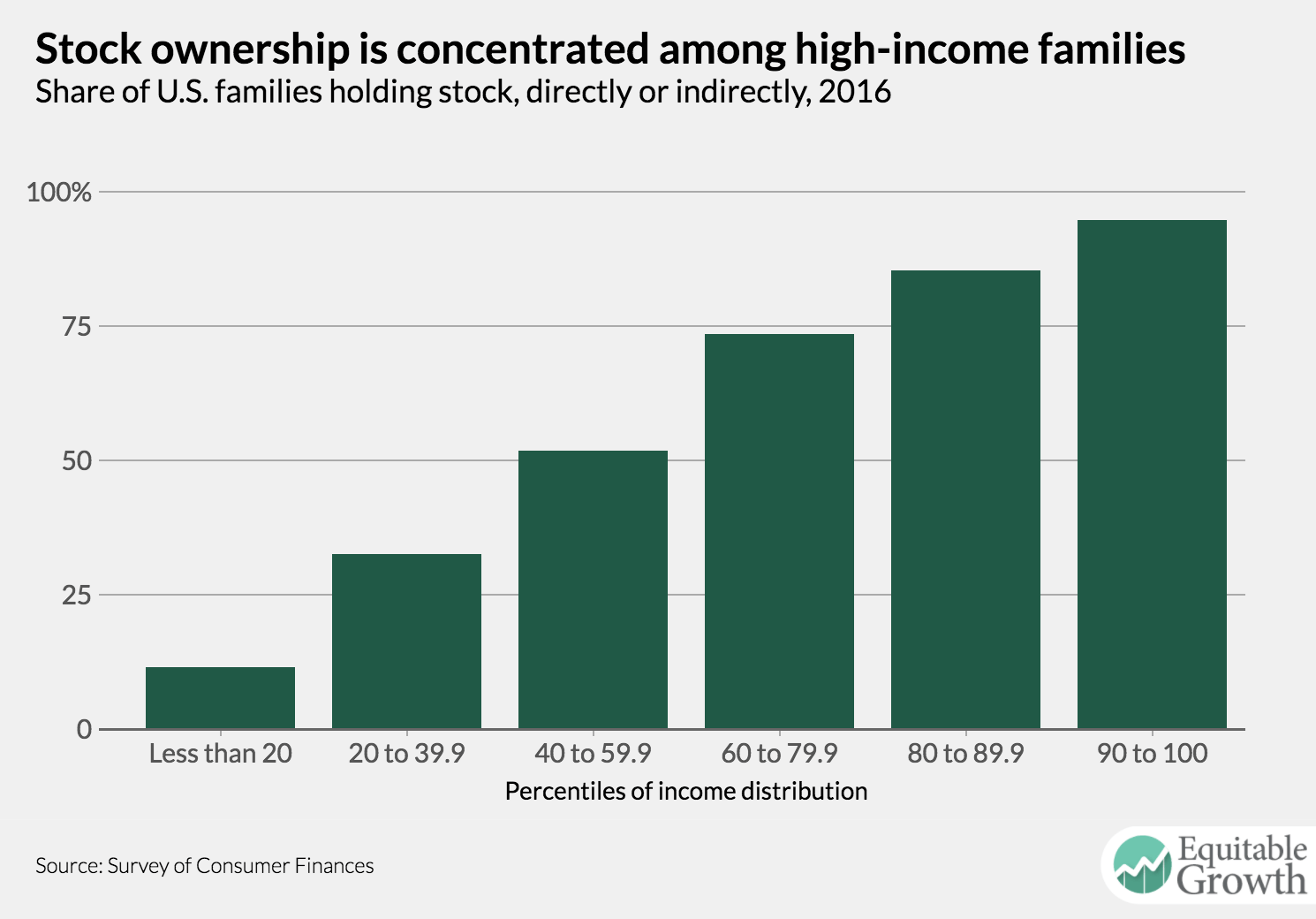
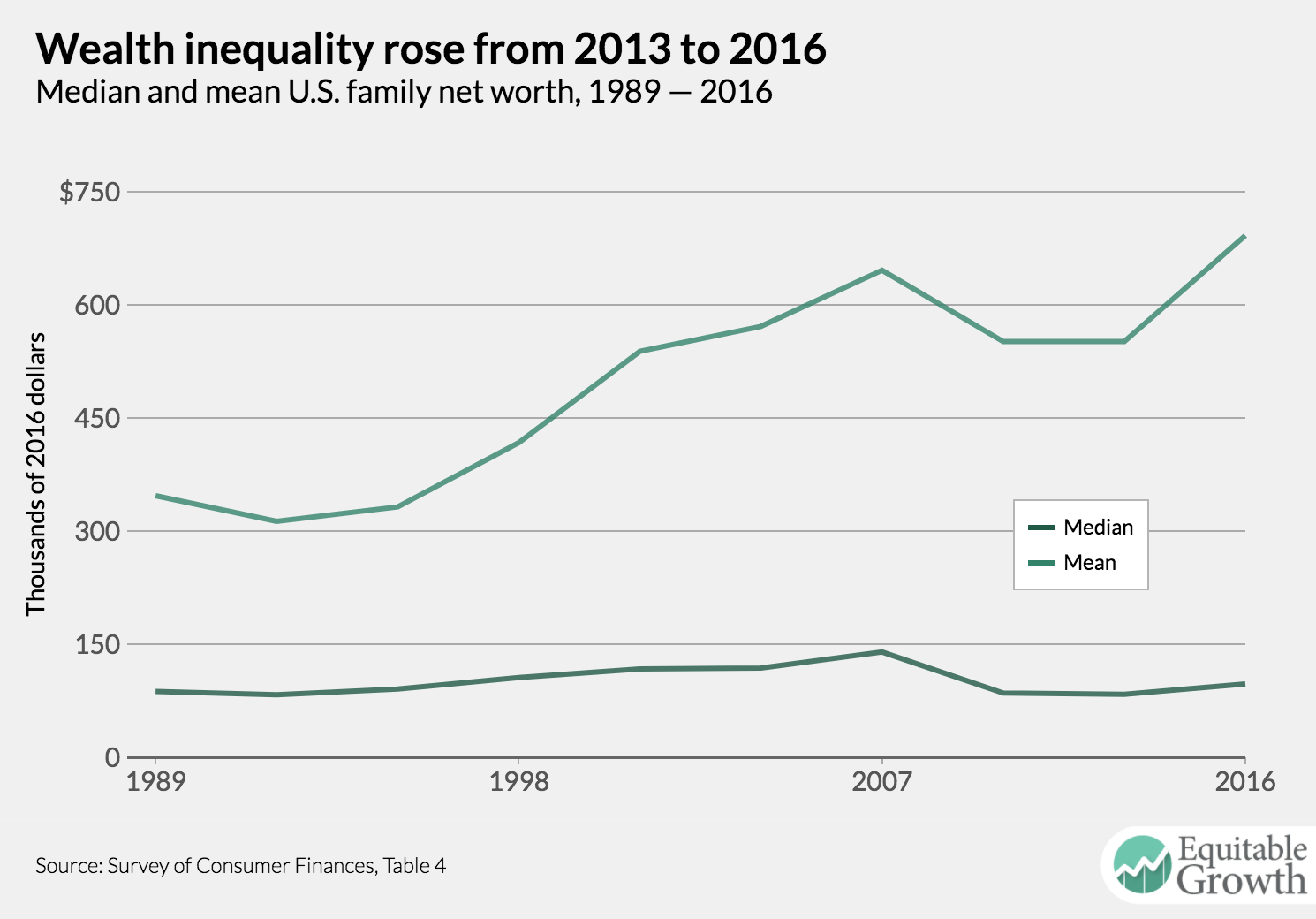
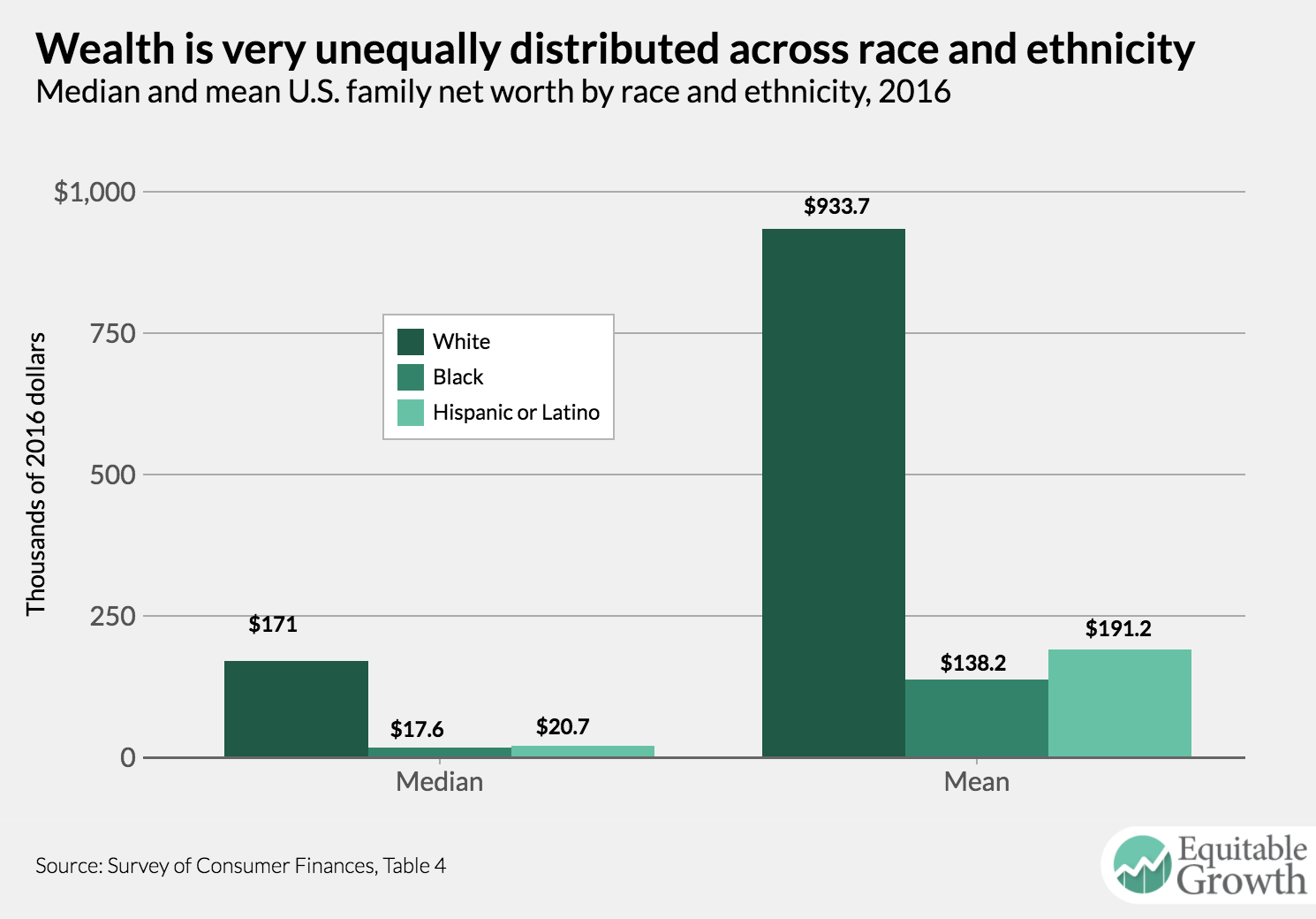
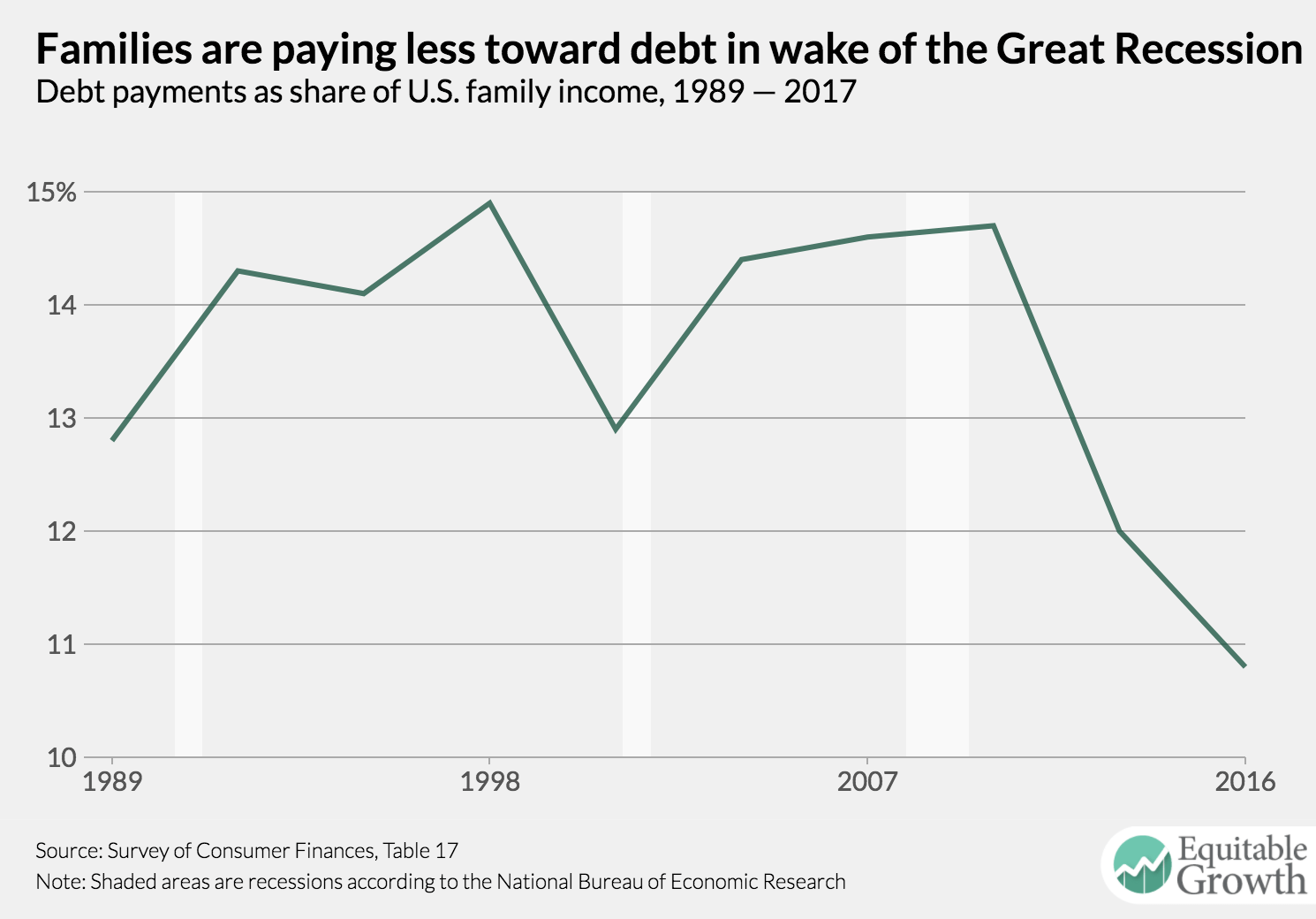
The Federal Reserve releases new data on the U.S. distribution of wealth every three years and the 2016 edition of the Survey of Consumer Finances was released this Wednesday. Here are four charts on the current state of wealth inequality.

In the latest installment of Equitable Growth In Conversation, Elisabeth Jacobs talks to Joan Williams about her recent book on the white working class.

Links from around the web

Job-hopping, a key way for workers to earn a raise, has been on the decline in recent years. There are many reasons for this decline, but Rachel Abrams highlights new research on a nefarious cause: employers conspiring to not poach employees. [nyt]

Why has nominal wage growth in advanced economies been so slow in recent years? Staffers at the International Monetary Fund took a look at the sources of weak wage growth and finds a combination of remaing slack in the labor market and slow productivity growth are to blame. [imf]

New ideas are getting harder to find. New research shows that the rising cost of creating innovation poses a supply-side constraint for innovation. Ryan Avent argues, however, that the demand for innovation shouldn’t be forgotten in an effort to create new ideas. [the economist]

The Federal Reserve has an official inflation target of 2 percent a year, but not many people are aware of that policy. Carola Binder, writing about her research, describes what happens to people’s expectations of inflation when they heard about this target. [quantitative ease]

Business dynamism and start-up activity are declining in the United States. Perhaps another country could serve as a role model. Alana Semuels argues that Sweden might be a good nation to look toward. [the atlantic]

Friday figure

Figure from “An update on the state of wealth inequality in the United States” by Nick Bunker

Should-Read: Jake VanderPlas: Reproducible Data Analysis in Jupyter

Should-Read: OK. We are agree that you should never do anything in Excel. But what should you do?

Jake VanderPlas: Reproducible Data Analysis in Jupyter: “Jupyter notebooks provide a useful environment for interactive exploration of data… http://jakevdp.github.io/blog/2017/03/03/reproducible-data-analysis-in-jupyter/

…A common question I get, though, is how you can progress from this nonlinear, interactive, trial-and-error style of exploration to a more linear and reproducible analysis based on organized, packaged, and tested code. This series of videos presents a case study in how I personally approach reproducible data analysis within the Jupyter notebook…

In conversation with Joan Williams

“Equitable Growth in Conversation” is a recurring series where we talk with economists and other social scientists to help us better understand whether and how economic inequality affects economic growth and stability.

In this installment, Equitable Growth’s Research Director Elisabeth Jacobs talks to Joan Williams, distinguished professor of law, the University of California, Hastings Foundation chair, and director of the Center for WorkLife Law at the University of California, Hastings College of the Law. They talk about Williams’ book on the white working class.

Elisabeth Jacobs: I’m delighted to be here today with Joan Williams. Joan is one of the first academic grantees co-funded by Equitable Growth for her work with University of Chicago professor Susan Lambert on the business-side impacts of scheduling stability. But we are not here to talk about that today. We are instead here to talk about Joan’s new book, White Working Class: Overcoming Class Cluelessness in America, released by Harvard Business Review Press recently. I’d like to kick off the conversation with the question: Why did you write this book, knowing you are a work-life scholar?

Joan Williams: Well, I basically think of myself as a social inequality scholar. I’m chiefly known for my work on gender, but I have also done a lot of work on how the experience of gender bias differs by race. And I have studied social class for 40 years. I married into a white working-class family in 1978, so I have been thinking a lot about how to bridge what I call the class culture gap between the professional, managerial elite and the white working class.

Jacobs: You’ve chosen to write this book about the white working class for all kinds of reasons. But how many of the things in your book do you think are about the white working class per se, and how many of them are actually more broadly applicable to a very diverse working class? African American families have struggled with many of the challenges.

Williams: There are so many overlaps between the white working class and the working class of color. The need and intense desire for stable jobs that will yield a modest middle-class standard of living is not a white working-class thing, it’s something that appeals to nonelites of all races. That’s why it should be such a central concern for both political parties.

The culture wars reflect that there exist a very different set of cultural dispositions among elites and nonelites. Elites value artisanal coffee. Gender roles. Spiritualities. You name it. Among nonelites, the search is less for novelty than for stability, so nonelites of all races put a high value on institutions that anchor stability, including the military, religion, and family values.

All that produces cultural conflict, but it’s not between the elite and the white working class. It’s between the elite and everybody who’s not elite—poor and middle class of all races. The elites often talk disrespectfully of the cultural truths of nonelites—that’s one of things that’s coming back to bite society.

Jacobs: You talk a lot about how, for white working-class people, their social networks, their kin structures, their lives are very much place-based in a way that means that the expectation that people just move to better jobs and the sort of head-scratching by economists about “why don’t people just move to where the jobs are” doesn’t make a lot of sense, if you think about it in the context of people’s social-cultural lives.

From an economic perspective, it doesn’t make much sense, and I think your work is kind of answering why this decline in labor mobility and decline in economic dynamism in the United States might be an economic puzzle, but in some ways, the sociology of it answers the questions.

Williams: Elites have what are called entrepreneurial networks—wide circles of acquaintances that are often national, or even global. And that’s how 70 percent to 90 percent of professionals get jobs. Working-class and poor people typically have place-based clique networks of family, neighbors, and friends they’ve known forever. Nonelites rely on these clique networks to protect them from their disadvantaged market position, by providing childcare, elder care, and help with things such as home repairs.

So, for moving to make sense, nonelites need not only to find a better job; they need to find one that’s so much better that they come out ahead, despite the fact they now have to pay for childcare and elder care because no family is close enough to help out. Another reason nonelites are reluctant to move is that their social honor is not portable. I was just living in the Netherlands; all I had to do is say I am a law professor teaching at one of the leading Dutch universities for people to want to get to know me. I tell the story in my book about going back to a high school reunion in a working-class town, and having someone ask a former classmate what he did for a living. The classmate got very red and snapped, “I sell toilets!” If your job is inglorious, you want to stick around people who know you, and know that you’re a person to be reckoned with—not just a guy who sells toilets.

Another important point: If you’re working class, the people in the communities you’re moving to have the same kind of dense place-based networks you have—and they’re going to make sure that good jobs go to people in their networks, not to you. This is just the kind of erasure of the realities of people’s lives on the ground that, if I can say this respectfully, economists are so good at.

Jacobs: So, what do you do about that? You often speak about the need for upskilling through non-college-based credentialing and vocational education. But what do you do if people are in places where there aren’t jobs? You can upskill all you want, but if the jobs aren’t there, there’s still the question of how do you make the jobs show up?

Williams: We need a new education-to-employment system that builds alliances between community colleges, local universities, and unions that set up alliances with local businesses, some of them existing, some of them attracting new businesses, so that the businesses can depend on a steady supply of certificate-trained workers with the specific job skills that are needed for their jobs. The goal should be certificate programs that are far shorter than a four-year degree, offered on family-friendly schedules because workers will need to retrain not once, but often several times, for new jobs, as old jobs morph or disappear. This idea and many others come from a very important book out of a Markle Foundation working group, and the book is called America’s Moment, and the initiative is called Rework America. Part of the reason American politics has turned so bitter is that America did globalization wrong, resulting in the loss of many middle-class jobs. We need to do automation right.

Jacobs: That seems like a good note to wrap on. Thank you so much.

Williams: Thanks a lot. I appreciate it.
Boushey testifies before congressional forum

Heather Boushey, Executive Director and Chief Economist of the Washington Center for Equitable Growth, testified on September 27, 2017, at a forum conducted by House Ways and Means Committee Democrats on issues related to tax reform.

Download File
Boushey testifies before the Ways and Means committee

Read the full PDF in your browser

In her testimony, Boushey reviewed the longer-term economic challenges facing U.S. families, including slow income growth and rising inequality, and addressed a number of substantive tax reform issues, telling the panel that “the focus of reform should be the living standards of American families, particularly middle-class families and families striving to reach the middle class.”

Must-Read: Ben Thompson: Defining Aggregators

Must-Read: Ben Thompson: Defining Aggregators: “Value has shifted away from companies that control the distribution of scarce resources to those that control demand for abundant ones… https://stratechery.com/2017/defining-aggregators/

…The purpose of this article is to catalog exactly what the latter look like. Aggregators have… Direct Relationship with Users… Zero Marginal Costs For Serving Users… Demand-driven Multi-sided Networks with Decreasing Acquisition Costs…. Aggregation is fundamentally about owning the user relationship and being able to scale that relationship.

That said, there are different levels of aggregation based on the aggregator’s relationship to suppliers…. Level 1 Aggregators acquire their supply; their market power springs from their relationship with users, but is primarily manifested through superior buying power… Netflix…. Level 2 Aggregators… incur transaction costs in bringing suppliers onto their platform… industries with significant regulatory concerns that apply to the quality and safety of suppliers…. Level 3 Aggregators do not own their supply and incur no supplier acquisition costs (either in terms of attracting suppliers or on-boarding them). Google is the prototypical Level 3 Aggregator…. Social networks are also Level 3 Aggregators…. Level 3 aggregators are predicated on massive numbers of users, which means they are usually advertising-based (which means they are free to users)…. Super-Aggregators operate multi-sided markets with at least three sides — users, suppliers, and advertisers — and have zero marginal costs on all of them. The only two examples are Facebook and Google…

Should-Read: Christopher Jeffery: Fed’s [John] Williams floats co-ordinated shift from 2% targets

Should-Read: Christopher Jeffery: Fed’s [John] Williams floats co-ordinated shift from 2% targets: “Williams… believes 2% inflation targets adopted by most of the developed world’s central banks will prove to be suboptimal over the next 10 years… https://www.centralbanking.com/central-banks/monetary-policy/operating-framework/3301501/feds-williams-floats-co-ordinated-shift-from-2-targets

…Real productivity and the associated natural rate of interest (used in the Taylor rule, for example) are both in decline – and there is no reason to believe this will change in the next decade or so. “There could be a mutual benefit for countries to change their price-stability policies together,” says Williams in the in-depth interview, to be published tomorrow…. “QE is viewed – fairly or unfairly (I would say unfairly) – as a ‘beggar-thy-neighbour’ policy,” he says. “Research has indicated that if several countries are at the lower bound, while these policies primarily work by boosting demand, they also result in shifting demand from one country to another. So maybe co-operation and co-ordination should be happening in the discussion about frameworks.”… If all central banks stick with “current low inflation targets”, when one country has to stimulate the economy via QE, “a lot of the effect will happen through demand shifting, or beggaring thy neighbour”: “The scary scenario is a repeat of what we’ve seen, where everybody’s at the lower bound – not because of a crisis, but due to the reasons recessions happen – and we’re all stuck with uncomfortable choices.”…

“If you want to see my gloomy view of the future, just open up your computer and look at the last five years,” he says. “I’m not saying that we’re going to have another financial crisis, it’s just that the challenges of using interest rates to keep the economy on track and inflation stable are going to be very difficult.” Instead of people calling for central banks to co-ordinate regular policy actions – which Williams says is “almost impossible, tactically, in most circumstances” – they should engage in a “true policy strategy debate”.

Must-Read: Josh Barro: Trump, GOP tax plan is looming political disaster

Must-Read: Josh Barro: Trump, GOP tax plan is looming political disaster: “President Donald Trump tweeted Wednesday morning, hours before the announcement of the latest Republican tax proposal, that… http://www.businessinsider.com/trump-gop-tax-plan-political-disaster-2017-9

…”virtually no President has accomplished what we have accomplished in the first 9 months.” This is probably a good time to reflect on George W. Bush. While Trump likes to talk about “massive tax cuts,” Bush actually signed one less than five months into his term in office. Bush’s proposal was popular and attracted substantial Democratic support. And much of it is still the law today. Bush understood the politics of tax cuts in a way that Trump and House Speaker Paul Ryan do not — which is why Ryan and Trump have produced a tax plan that is a political time bomb.

Tax cuts are more popular if they don’t increase taxes on people
A key talking point the Bush administration used repeatedly to sell their tax plan was that it would “reduce taxes on everyone who pays income taxes.” This statement was right there in the first paragraph of Treasury Department’s announcement of the tax proposal — which, I would note, was released in February of Bush’s first year in office, not September. Most importantly, the statement was true…. The proposal was explicitly designed to have extensive benefits for middle-income families, so he could go around the country and accurately say it offered a tax cut for everyone who paid income taxes and that nobody’s income taxes would go up.

Trump is about to propose to raise taxes on a lot of middle-income people to cut taxes for the rich. Because a lot of details of the Republican tax plan have yet to be filled in, we can’t say yet who would pay what…. But… we can identify a group of taxpayers likely to face tax increases from this proposal: people with moderate to upper-moderate incomes who take itemized deductions, like those for mortgage interest and state and local taxes paid…. While these taxpayers would lose key tax benefits, rich taxpayers would come out ahead….

“A tax cut for everyone who pays income taxes” was popular. Republicans won’t be able to say that this time. “A tax increase for many ordinary families to pay for a tax cut for the rich” is what Democrats will say. They’ll be right. And it will make this plan impossible to pass.

Must- and Should-Reads: September 26, 2017


Interesting Reads: