An end to summer tariff peace threatens U.S. economic growth
Key takeaways:
- Resurgent uncertainty over U.S. trade policies, rising tariff rates, and looming action against Canada risk significant harm to U.S. businesses and consumers reliant on low-tariff imports.
- Direct and indirect tariff costs could further fuel inflationary pressures already growing under the weight of the war in Iran, buttressing the case for further interest rate hikes by the Federal Reserve by the end of the year. Such an increase in borrowing costs would suppress investments across the U.S. economy and could push the main engines of private sector growth—AI firms and their suppliers—into a financial crunch as debt levels become more difficult to manage.
- A new Congress next year will have opportunities to course-correct tariff policies through a combination of oversight and legislative action to curtail executive power and promote comprehensive industrial strategy policymaking to protect the U.S. manufacturing base and its workers.
- What this means for growth: A low-inflation, low-uncertainty environment is a necessary foundation for stable long-term economic growth, particularly amid the historic technological upheaval brought by the rise of AI. Current tariff policies put the United States on a high-inflation and high-uncertainty trajectory, making it harder for everyday people to start businesses, find work, and pay bills.
Overview
The summer months of relative tranquility in U.S. trade policy could be shattered as announced tariff escalations with Canada take effect, translating into higher costs for U.S. businesses and consumers, and as a lasting trade détente with China appears distant despite recent progress. The looming threats to economic ties with two of our nation’s largest trading partners could disrupt the relative stability in summer tariff rates paid by U.S. importers and stoke greater inflation already buoyed by the intractable war in Iran, pushing up borrowing costs and undermining growth in the U.S. broader economy.
Investments in AI, arguably one of the biggest drivers of economic activity this year despite environmental and employment concerns, is at particular risk because tariff rates on AI-intensive imports are beginning to tick up and borrowing costs could constrain firms’ ability to finance new data center construction and other projects. Non-AI infrastructure and tech projects reliant on borrowing to fund operations also will suffer. All corners of U.S. manufacturing would also suffer under potential new tariffs on imported industrial robots and machinery, which could come in the next six months depending on the outcome of negotiations with trade partners.
The Trump administration faces something of a self-imposed political crisis, as its insistence on disrupting global trade undermines the very economic goals upon which the administration has staked its own future. An incoming Congress in 2027 could provide crucial oversight on trade policymaking and enforcement, helping ensure stability and transparency for the broader economy while retaining targeted tariffs as one of many tools to protect U.S. workers and strategic industries.
Rising uncertainty means rising costs for U.S. businesses and consumers alike
Tariff costs are dual—direct costs, in large part passed down to consumers, are incurred by U.S. importers when duties are collected at ports, while import-reliant businesses and industries suffer an additional uncertainty cost when volatility in trade policy pushes firms to hold off on new projects over fear of unexpected direct costs. The uncertainty cost comes in the form of lost income as firms hold off on growth-driving investments, dragging on the broader economy.
Indeed, the most recent Federal Reserve Beige Book makes repeated mention of tariff costs to businesses and consumers as uncertainty mounts, particularly around trade with Canada. The Fed region covering Ohio and parts of Kentucky and Pennsylvania reported that manufacturers were raising prices to cover a “double whammy” of high fuel costs and tariffs, while new construction faced delays over tariff uncertainty. In at least one Fed region, an attorney reported increased demand for bankruptcy services due to higher tariffs and the elevated interest rates required to combat inflation. In the New York region, firms reported in the Beige Book that tariff uncertainty caused customers of manufactured goods “to delay capital projects and had complicated planning.”
The uptick in uncertainty can be captured in several different models and indexes, including a Trade Policy Uncertainty Index developed by a group of Federal Reserve economists to track discussion of trade policy volatility in major newspapers. The Fed researchers found in a landmark 2019 paper that increases in the TPU Index were associated with declines in business investment. The Index recorded a massive spike around the Trump administration’s self-proclaimed “liberation day” tariff announcements in the spring of 2025, receding in fits and starts over the following months as the Trump administration walked back its most forceful tariff threats while imposing other, commodity-specific levies. The index finally relaxed to 2024 levels following the U.S. Supreme Court decision in February 2026 to annul the bulk of the Trump administration’s country-specific tariffs. But recent tariff threats, particularly toward Canada, caused the Index to rise nearly 25 percent from August to September, suggesting renewed trade uncertainty and associated costs. (See Figure 1.)
Figure 1
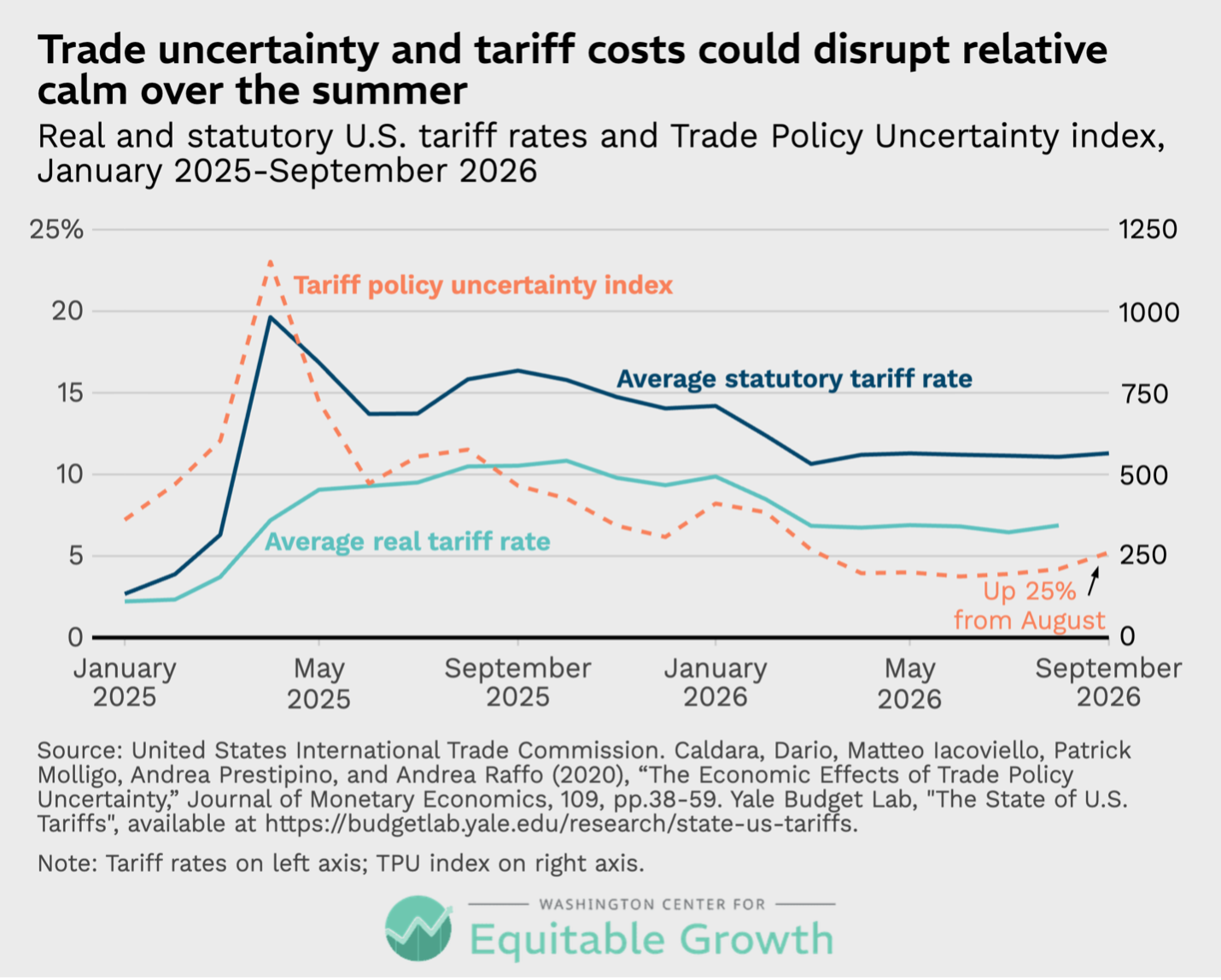
In addition to renewed uncertainty costs, tariff-exposed U.S. businesses could face increased direct costs as tariff bills rise. Much of those costs could ultimately be passed along to consumers, though some firms will be forced to absorb costs in the form of reduced profits, lower spending in other areas, or bankruptcy. Some direct costs could be mitigated, however. As data show over the past two years, average statutory tariff rates established in administration policy have never actually been paid in full due to a combination of avoidance and evasion.
Larger firms with robust lobbying and compliance staff are likely better positioned to engage in this sort of direct-cost mitigation compared to small firms with limited in-house technical expertise. Deep-pocketed firms and industries have also been able to spend on lavish gifts to President Trump, presumably in exchange for tariff relief, undermining the credibility of U.S. trade policy.
How to lose friends and allies over tariffs
Direct costs from Canadian tariffs are ticking up, according to the latest data from the U.S. International Trade Commission, threatening industries and consumers reliant on imports that have until now largely escaped the brunt of the Trump administration’s tariff push. Average tariffs on Canadian imports stood at roughly 0.11 percent before “liberation day” last year, and climbed to a peak rate of 3.81 percent in September 2025.
Tariff rates on Canadian imports then relaxed following the February 2026 U.S. Supreme Court ruling, but began climbing again recently and reached nearly 3.2 percent in August. In comparison, the average tariff rate for imports from countries other than Canada reached a peak of 11.7 percent in September 2025 before plateauing out at more than 7 percent in the wake of the court decision. Research shows that roughly half of an increase in import and producer prices is passed down to consumers in the form of higher retail prices.
While most Canadian imports are still shielded from tariffs by the shaky United States-Mexico-Canada Agreement, the administration’s recent orders on Canadian alcohol, dairy, auto, and related goods (plus unrelated goods such as hockey sticks) suggest an appetite for further escalation. Though an off-ramp still appears to exist—President Trump has hinted on the campaign trail of a possible trade deal to be “settled pretty soon” and moved to adjust some U.S. tariffs on Canadian goods prior to the November 3 midterm congressional elections—increased policy volatility toward Canada is already appearing to weigh on trade volumes. (See Figure 2.)
Figure 2
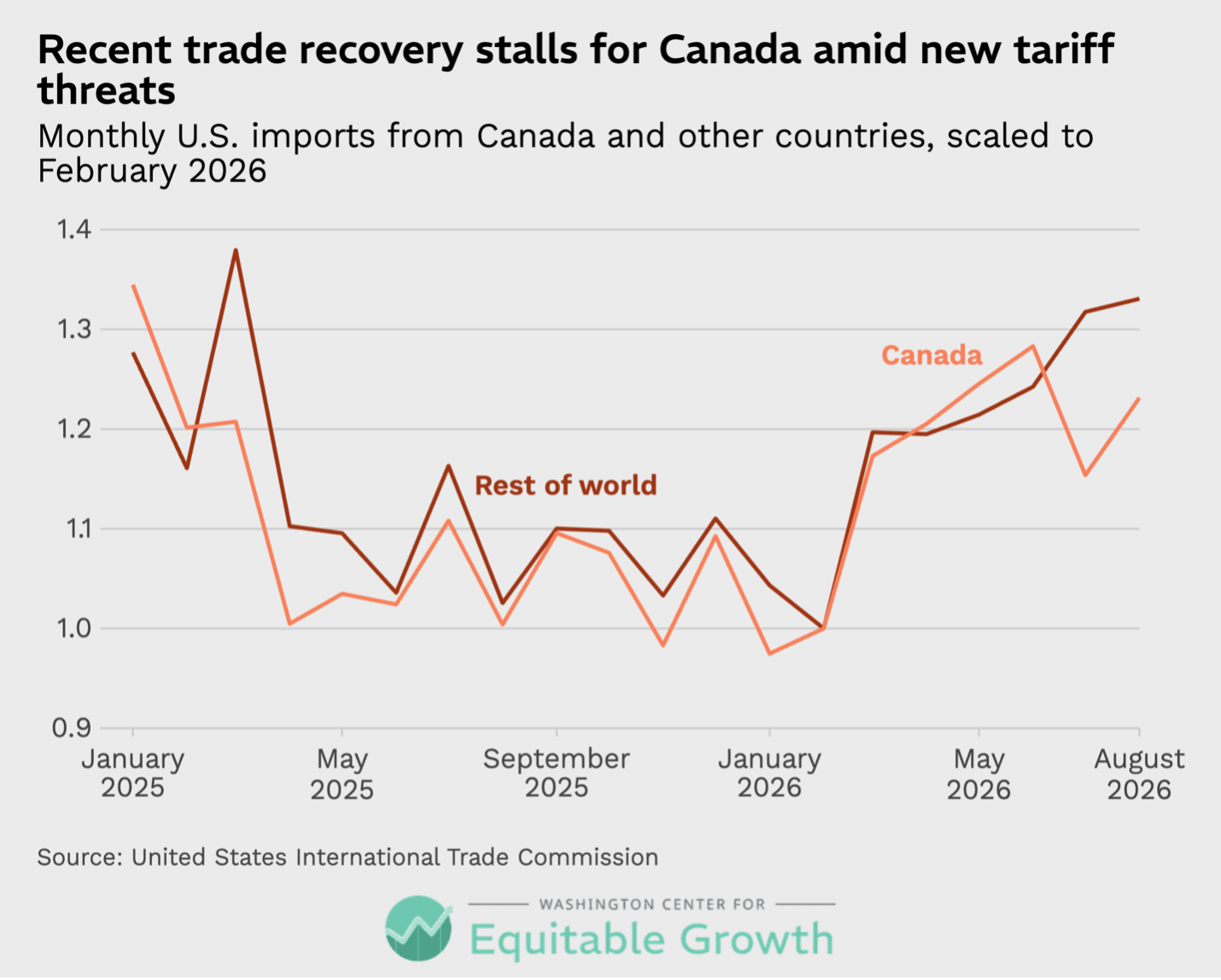
Import volumes from all U.S. trading partners declined precipitously following liberation day, stoking inflation as costs and shortages mounted, and recovered at almost the same pace following the February U.S. Supreme Court ruling, reaching roughly pre-liberation day levels by the summer of 2026. Canadian imports, however, have stalled in their post-ruling rebound.
This stagnation in trade with Canada reflects deep policy uncertainties as businesses rush to find likely costlier alternative sources of inputs or pull back on economic activity to wait for the administration’s chaotic tariff policies to stabilize. U.S. consumers, workers, and small businesses are likely to be harmed the most by continued trade escalation with Canada as direct tariff costs are passed down to retail buyers and businesses suppress wage growth to contain costs. Canada’s tit-for-tat retaliatory tariffs on U.S. goods also harm U.S. producers as export demand shrinks for the very manufacturing industries ostensibly targeted for revitalization by U.S. tariff policy.
AI’s economic promise could hinge on tariffs
Just as Canadian imports have escaped the worst of the Trump administration tariff push thus far, imports associated with AI infrastructure have also been spared. Setting aside legitimate concerns about the AI build-out—including environmental effects, impacts on the quality and quantity of human work, and ultimate productivity gains—spending on AI infrastructure has driven much of the recent growth in U.S. employment and economic output. Boosting direct and indirect costs on the boom via tariff policies could stymy that growth.
Indeed, tariff rates and import volumes diverge significantly depending on an import’s importance to the AI industry. Translating import categories established by Minneapolis Federal Reserve economist Michael Waugh from Harmonized System codes to the NAICS codes used in Equitable Growth’s tariff project, we confirm lower tariff rates and larger import volume growth for AI-related imports.
Imports used intensively by firms associated with the AI build-out, such as computers, printed circuit assemblies, and network communications equipment, have on average faced substantially lower tariff rates compared to non-AI intensive imports. Tariffs on AI-intensive imports peaked at just over 4 percent in September 2025, compared to an October 2025 peak of more than 13 percent for non-AI imports. After the February 2026 U.S. Supreme Court ruling, AI-intensive rates dropped to a little over 1 percent, compared to a roughly 9 percent tariff rate plateau for non-AI imports.
Rates for both categories ticked back up in August, with the acceleration quicker for AI-intensive imports. This suggests potential future retail price increases, particularly for electronics and other tech commodities that use AI-related imports. Future months of data will confirm whether the acceleration in tariff rates for AI-related goods is a momentary blip or a longer-term trend.
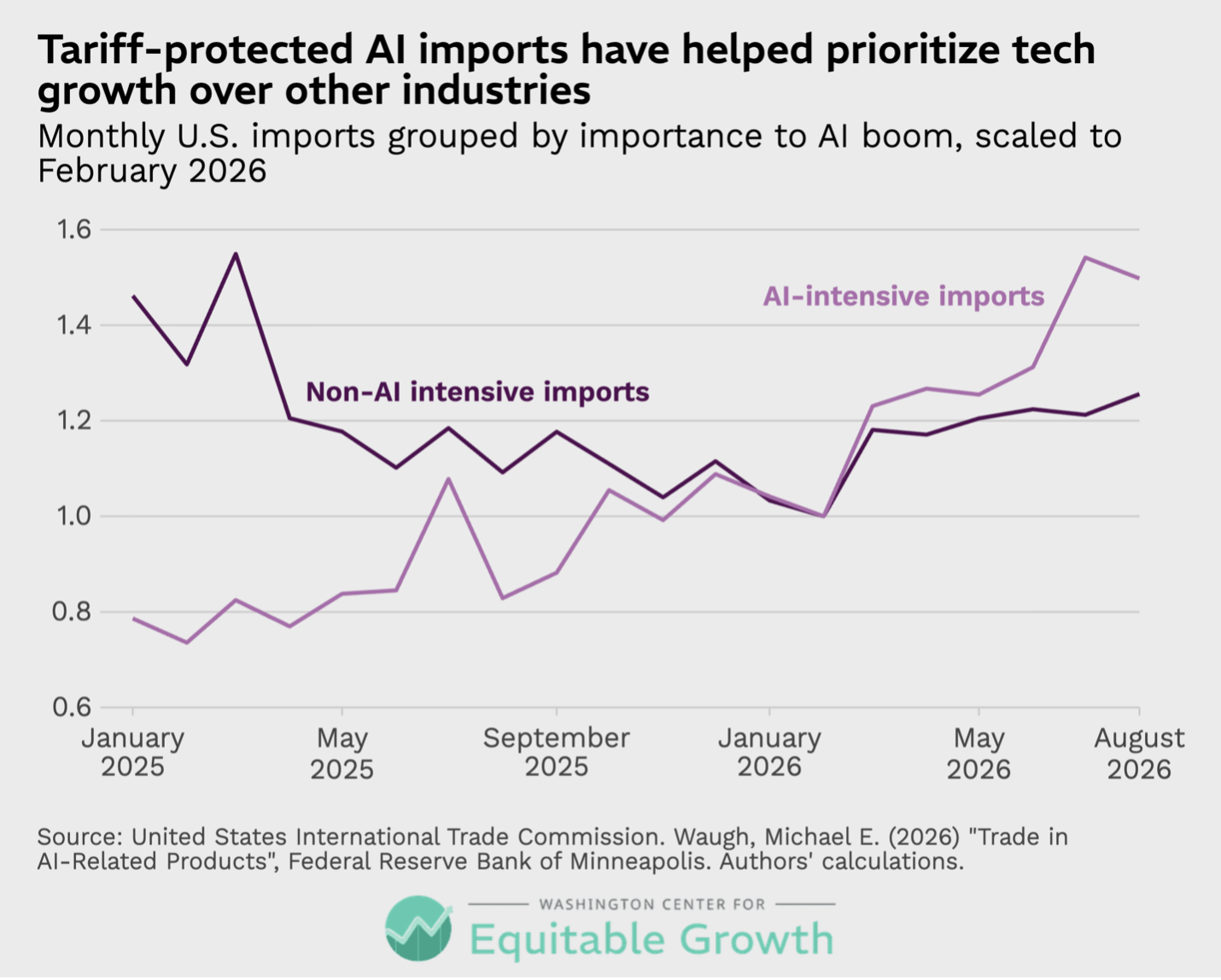
Differences in import volumes reflect the gap in tariff rates between the AI and non-AI categories. AI-related imports steadily rose throughout the past two years, largely uninterrupted by the trade policy uncertainty and tariff costs plaguing other industries. In contrast, imports largely unrelated to the AI boom have followed a predictable tariff-driven path: plummeting following the liberation day tariff announcement and rebounding following the February 2026 U.S. Supreme Court ruling.
These data sketch a possible counterfactual to the volatile and significant tariff policy changes of the past two years: other U.S. industries, had they not been burdened with the direct and indirect costs of tariff policies, could have grown instead of stagnated or shrunk. The gravity of the AI build-out and promises of efficiency gains and enrichment likely means AI imports would have grown faster than other imports regardless of the tariff hikes, but favorable treatment for AI-intensive imports has accelerated that divergence. (See Figure 3.)
Figure 3
The AI build-out, while possibly a financial bubble that could well burst and wreak havoc on the U.S. economy, has been responsible for the bulk of recent U.S. economic growth and is threatened by two key tariff-related factors. First, AI-related imports are sourced from countries that could face heightened tariff scrutiny or other trade disruptions in the coming months. The largest sources of AI-related imports include Mexico, Vietnam, Thailand, and Malaysia, countries that the Trump administration has threatened with additional trade action for engaging in so-called “transshipments” to evade high tariffs on Chinese imports. China itself was the seventh-largest source of U.S. AI imports in August, with such imports tariffed at a roughly 10 percent rate. In comparison, AI imports from Thailand and Vietnam were tariffed at a roughly 1 percent rate. If the Trump administration acts to raise tariffs on countries it deems to engage in harmful transshipments, then direct tariff costs for the domestic AI industry could grow substantially.
The second significant tariff-related threat to the AI boom is the cost of borrowing. AI companies are increasingly using debt rather than cash to finance data center construction and other projects, risking a financial crunch as interest rates increase. The Federal Reserve under new Chair Kevin Warsh has signaled a commitment to returning U.S. inflation to the long-run target of 2 percent, and investors largely expect the central bank to raise its benchmark interest rate at least once more before the end of the year.
Increases in the Fed rate are intended to contain inflation, and monetary policymakers worried about replicating the COVID-19-era spike in inflation by moving too slowly may continue to resist political pressure from the White House to lower rates. Inflationary pressures—from the intractable Iran war, a labor shortage-inducing immigration crackdown, and lingering effects from last year’s tariff volatility—will likely climb if tariff escalation is pursued against Canada, China, and other trading partners.
Additional inflation risks further increases to the central bank’s benchmark Federal Funds Rate, raising borrowing costs for the AI industry just as cracks are beginning to show in what many economists have warned could be a financial bubble ready to burst. Tariff uncertainties are only one factor in the Fed’s future calculations, but they are certainly a key factor.
Next steps for the new U.S. Congress
Rising tariff costs, both direct and indirect, will drag on the U.S. economy in the coming months without policy course corrections. The incoming 120th U.S. new Congress next year could act to mitigate those costs in a number of ways. The new Congress could provide oversight in the creation and enforcement of tariff policies to ensure even-handedness and stability for impacted businesses. It could pass legislation to curtail Executive Branch latitude in enacting tariffs under dubious legal authority. And it could pursue comprehensive industrial strategy policymaking to protect the U.S. manufacturing base that combines targeted tariffs with public investment in good jobs.
Without these kinds of tariff policy actions, the current tariff trajectory is likely to deepen policy uncertainty, raise costs for U.S. businesses and households, and drag on the AI boom and other sources of economic growth.
Did you find this content informative and engaging?
Get updates and stay in tune with U.S. economic inequality and growth!