The United States can simultaneously foster an equitable AI boom and a clean energy economy
Key takeaways
- A recent Equitable Growth event convened experts on artificial intelligence and the clean energy transition to discuss how the rising adoption of emerging technologies may affect the environment, economic growth, and inequality.
- The panelists highlighted that the economic effects of AI expansion and the energy transition are not predetermined. It will take coordinated policymaking, stronger institutions, and long-term planning to ensure that AI and energy transformations do not have negative ramifications on local communities and the electricity grid.
- What this means for growth: The economic growth potential of these technological transformations is significant but not guaranteed to be broadly shared. AI and electrification could accelerate productivity, innovation, and scientific discovery, potentially expanding overall economic growth. But without deliberate policies, gains may remain concentrated.
Overview
The Washington Center for Equitable Growth recently hosted a timely discussion exploring how the rapid expansion of artificial intelligence is colliding with—and reshaping—the clean energy transition. Bringing together researchers and former policymakers, the virtual event highlighted that the infrastructure, policy, and governance choices made today will determine whether this transformation delivers broad-based economic prosperity or deepens existing inequalities.
The online webinar, titled “AI and the Energy Transition: Implications for U.S. Economic Growth and Inequality,” kicked off with opening remarks from Equitable Growth Vice President of Policy and Programs Lily Roberts, who framed AI and the energy transition as deeply interconnected forces, both dependent on shared infrastructure and public capacity. She also previewed that the event would cover the scale of the impending economic transformation and the policy choices that will shape who benefits from it. Not only is technological progress at stake, Roberts explained, but how its gains are distributed is, too: “When the benefits of innovation are concentrated, the ensuing inequality is a drag on growth and undermines trust in our governing institutions,” she said.
Policy choices and design matter in moments like this, she reiterated. The desire to build expediently must be balanced with the desire to ensure meaningful development and shared economic prosperity.
A ‘Grid New Deal’ for the AI era
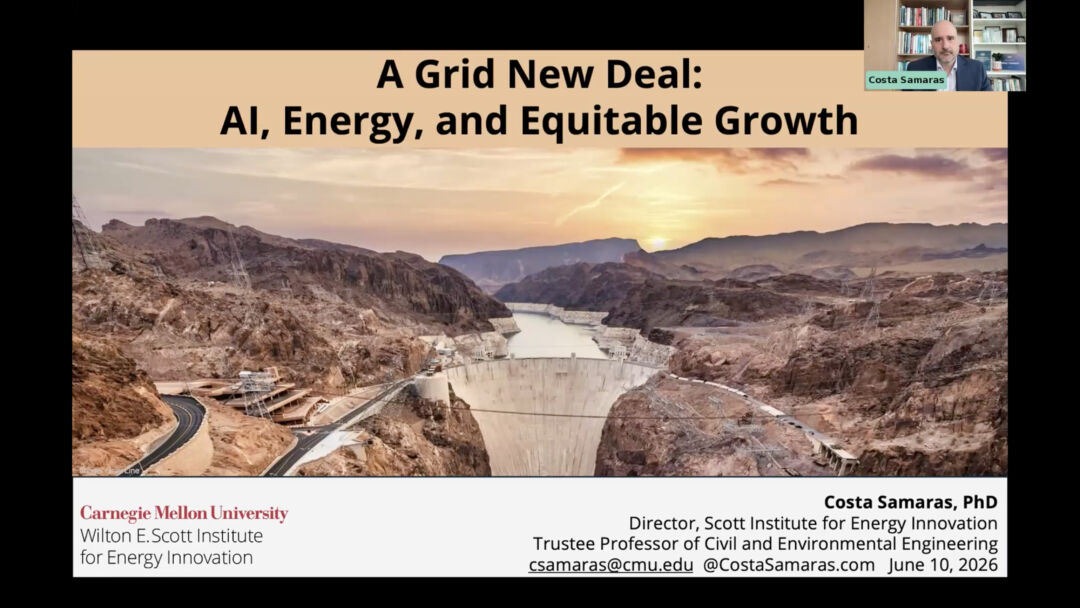
Before kicking off the panel discussion around these topics, Roberts turned the microphone over to Costa Samaras, a leading researcher on the energy transition and AI expansion, the director of the Wilton E. Scott Institute for Energy Innovation, and a trustee professor of civil and environmental engineering at Carnegie Mellon University. In his keynote, Samaras argued that the United States needs a dramatic expansion and modernization of the electric grid—what he calls a “Grid New Deal”—to meet the demands of AI and decarbonization.
Electricity, he emphasized, is “the economic infrastructure for this entire century,” as well as “the foundational layer to enable the growth of artificial intelligence.” Yet the system is under strain from climate risks, aging infrastructure, and rising demand. Data centers already account for about 4 percent to 5 percent of U.S. electricity consumption and could reach as much as 9 percent to 17 percent by the end of the decade. At the same time, affordability concerns are mounting, with more than 60 percent of households reporting that utility bills are adding to their financial stress and with electricity prices rising faster than inflation.
Samaras then dove into the interconnection between AI and the energy transition, highlighting growing popular support across the United States for data center moratoriums and how the existing electricity grid is going to need to at least double in capacity to keep up with demand. These competing realities mean a national effort is needed to ensure we both lead the way in the AI transformation of the economy and that clean energy drives this innovation.
While AI presents opportunities to improve affordability, climate outcomes, and innovation, Samaras stressed that those benefits will not materialize automatically. Instead, his Grid New Deal framework argues that people, policies, and investments must align to generate broadly shared economic gains. On people, Samaras called for expanding workforce and public-sector capacity, including new institutions such as an American Grid Corps to support public utility commissions and local decision-makers. On policies, he emphasized the importance of federal industrial policy tools and community-benefit frameworks. On investments, he argued for treating the grid as a national asset through coordinated public and private investments, including mechanisms such as a National Grid Trust Fund, while rebuilding infrastructure to withstand the climate challenges of this century.
More broadly, Samaras called for strong institutions and investments, arguing that “we should be leaning in to delivering … a stronger, more resilient, a cleaner, more affordable, and reliable electricity system.”
Surging energy demand amid uncertainty about the future of AI
The event then turned to a panel discussion, moderated by former deputy director of the National Economic Council and Equitable Growth board member Sameera Fazili and featuring Samaras, Heather Boushey of the University of Pennsylvania, Neil Thompson of the Massachusetts Institute of Technology, and Jigar Shah of Multiplier, a clean energy and clean-tech advisory services firm.
The panel kicked off with a discussion around what society should ask for in return for the surging energy demand of AI expansion. Boushey highlighted the need to place the discussion in the context of decades of rising economic inequality and policies that have not focused on investing in people and places. She also touched upon two big challenges: defining who owns the technology and who benefits from it, as well as how we should think about the trade-offs of AI’s rise for the broader economy.
Thompson then described an industry shaped by competing, fast-moving forces. On one hand, energy demand is poised to grow significantly as AI and tech adoption expands; only about 10 percent of U.S. firms have deeply integrated AI so far. On the other, the dominant approach to improving AI performance—scaling models—dramatically increases energy use.
Yet countervailing forces are equally strong. Hardware and algorithmic efficiency improvements are rapidly reducing the energy required per computation. The result, he explained, is a fast-moving race between surging demand and falling per-unit costs, making long-term forecasting highly uncertain and unpredictable. That uncertainty poses a major challenge for policymakers and utilities, who must plan infrastructure investments years in advance without knowing which trends will dominate and how.
Shah then argued that while policy frameworks are imperfect, many useful tools already exist that policymakers can build on. The challenge is not only in designing new policies, but also in better deploying existing ones and improving planning. Shah later discussed the idea of putting data centers on an interruptible tariff, meaning their share of energy consumption would be cut amid any problems with the grid.
Another key issue, he continued, is the lack of reliable data. Much of the public discussion on AI and new data centers focuses on oversized projections rather than actual projects. At the same time, AI itself is already helping utilities identify untapped grid capacity and enabling more efficient use of existing infrastructure. This could help dramatically lower costs.
Once a map of the grid for the entire country is drawn out, which Shah estimated would cost the federal government approximately $50 million, existing policies and tools can be tapped to help solve the main concerns with energy demand from AI—programs such as the Energy Dominance Financing Program, which offers loans to states to upgrade their transmission systems.
At the same time, Shah cautioned against poorly designed interventions, particularly those that distort markets. Without clear rules, policies such as government equity stakes can “send a signal … that the U.S. government has chosen a winner,” potentially discouraging broader private investment.
Who pays for—and who benefits from—AI’s demand on the grid?
The panel discussion then turned to how the costs and benefits are distributed across communities, industries, and workers. Samaras highlighted early warning signs that the current build-out is uneven. While the growth of data centers is creating jobs and investments, it is also increasing local pollution and encouraging new fossil-fuel generation in some places. Without thoughtful and proactive policy designs at all levels of government, he warned, the system will “trend toward a more fossil-heavy and more expensive grid.”
Samaras argued for a more deliberate approach rooted in community partnerships, including what he termed “earned speed”—the linking of faster project approvals to meaningful local benefits and investments. “If you want to go fast, go together,” he said, emphasizing that infrastructure projects must align with community needs and offer tangible benefits to those living near this new infrastructure. Boushey then pointed to industrial policy efforts under the Biden administration as evidence that equity-focused approaches can work. Requiring firms to engage with communities and workers, she argued, often improves outcomes without slowing projects down.
Thompson then described some of the benefits of AI, highlighting that, so far, the gains have been fairly measured for companies that develop and deploy AI. One reason for that, he continued, is that benefits are actually larger in some areas but are also tied to new and higher costs, leveling out the benefits somewhat. He also highlighted the potential for AI to boost innovation, which could lead to a substantial acceleration of economic growth that would benefit everyone.
Boushey placed these concerns in a broader historical context. The United States has seen decades of rising inequality, often because technological gains were not widely shared. While innovation can expand economic output, she emphasized that growth alone is not enough: “The pie’s got to grow. That’s necessary, but that is not sufficient for that growth to be shared.”
Looking ahead
The discussion concluded with a shared recognition that the convergence of AI and energy is as much a governance challenge as a technological one. When asked where researchers still lack the data, analytical tools, and frameworks to evaluate policies, panelists highlighted the need for better evidence on AI adoption and energy demand, as well as greater transparency on how the costs and benefits of AI-driven growth will be distributed across communities. As Samaras put it, the goal is to ensure that policymakers and researchers can answer fundamental questions: “who wins, who loses, and who’s paying the price, and who’s gaining the benefits.”
Ultimately, the event made clear that the outcome of this transition is deeply uncertain. With coordinated policymaking, stronger institutions, and intentional attention to equity, however, the AI and energy transformations could reinforce one another to drive inclusive growth.
This column was written with assistance from Microsoft Copilot.
Did you find this content informative and engaging?
Get updates and stay in tune with U.S. economic inequality and growth!



Stay updated on our latest research