Paul Krugman puts this in the proper context:
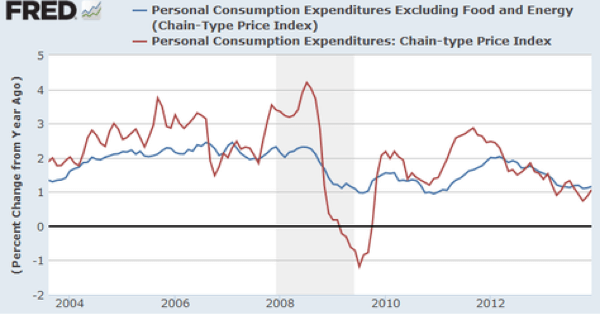 Paul Krugman: The Urge To Tighten: “People are going through the Fed’s 2008 transcripts, and finding that most officials had no idea what was going down… really surprising… dismaying… a number of Fed officials were… focused on inflation… eager to raise rates…. A fair number… very much not, however, including Janet Yellen… would, if they could, have echoed the ECB’s big mistake. What’s… shocking… is that official Fed doctrine is to focus on core inflation… headline inflation has swung widely, while focusing on core inflation has been a much better (though not perfect) guide to appropriate policy. Were Fed officials just not on board with this doctrine?
But things are actually much stronger than Paul says: in the three decades since the start of the late lamented “Great Moderation”, of the 15 substantial divergences between core and headline inflation, core inflation is a better guide to what headline inflation will be in two years in 13 of the 15–and core inflation is a better guide to what core inflation will be in 2 years, and hence what headline inflation will be in 4, in 14 of the 15.
So we are surprised when somebody like Richard Fisher, President of the Dallas Fed, says things like: “whatever inflationary pressures were building up toward the end of the summer – and they were significant…” Did nobody on his staff teach him about the difference between core and headline inflation–and the superior reliability of core? Did the teaching just not take?
The distinction between core and headline inflation was a genuine and important macroeconomic insight, developed by Robert J. Gordon in 1975: Robert J. Gordon, (1975), <a href="http://www.brookings.edu/~/media/Projects/BPEA/1975%201/1975abpeagordon.PDF”>”Alternative Responses of Policy to External Supply Shocks”, Brookings Papers on Economic Activity 1975:1 (Spring), pp. 183–206. Yet it has apparently dropped out of at least one of the wings of macroeconomics–Chris House, for example, makes no reference to core inflation in his defense of Federal Reserve inflation hawks in 2008:
Chris House: The Fed in 2008: “There were people who were concerned about inflation.
This seems odd given what we know followed (and odd given that a bit more inflation would be welcome news today) but, at least to a small extent, it was part of the data at the time. Some commodity prices, and oil in particular, were both rising which seemed odd given what policy makers were hearing from lenders. Jim Bullard has an interesting recent presentation on this in which it seems like he is arguing that oil supply shocks may have shaped the Fed’s assessment of the problem that summer…
It is a mistake to take moves in headline inflation that are deviations of core inflation as signals of anything.
And it is only by looking at what we got wrong in the past that we can mark-our-beliefs-to-market and do better in the future. So we are even more alarmed when people like Fisher demand that people not engage in Monday-morning quarterbacking of 2008. How can you mark your beliefs to market if you do not compare what you thought to what was true?
Yet a great many FOMC meeting participants appear to have been unaware of the distinction between core and headline inflation in 2008:
Continue reading “Federal Reserve Fretting About Inflation in 2008: Monday Focus: February 24, 2014” →