The state of the U.S. economy one year into the second Trump administration

Key Takeaways
- Across a range of metrics, U.S. economic performance in 2025 was quite similar to 2024, with a weaker labor market.
- U.S. GDP grew just 2.2 percent, while new job creation almost disappeared, hiring declined, unemployment grew, wages went down, and inflation did not meaningfully go down.
- Americans also expressed much disappointment and frustration with the state of the economy, even more so than in recent years.
Overview
President Donald Trump will soon give his annual State of the Union speech before Congress, one year into his second term in the White House. Ahead of his remarks, now is a natural moment to take stock of the U.S. economy over the past year, looking at various metrics of economic well-being and how they compare to recent years. (See Table 1.)
Table 1
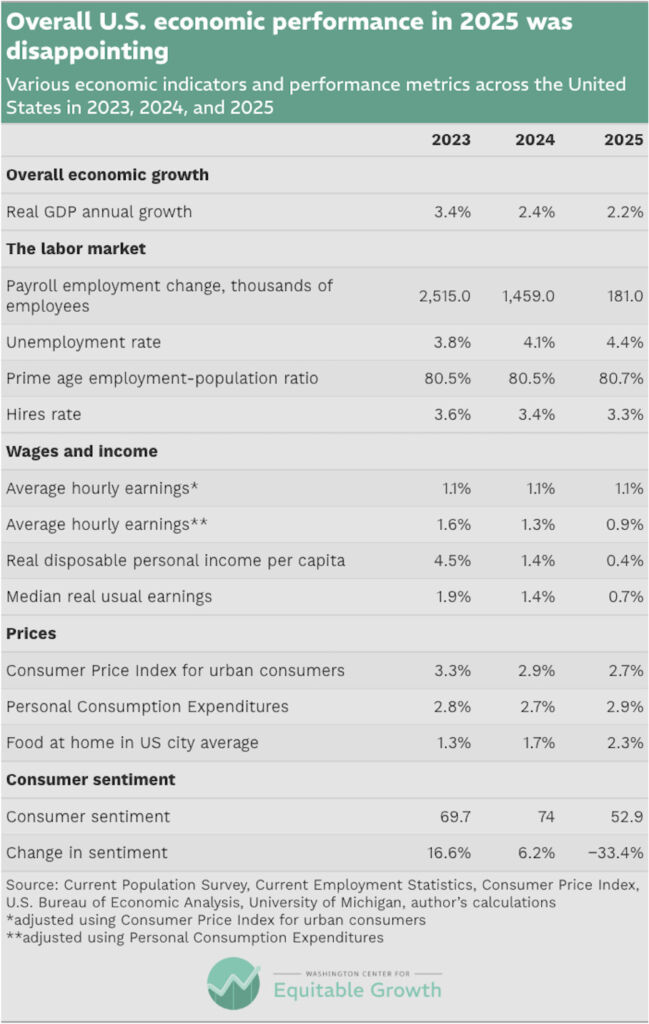
The bottom line is that overall economic performance in 2025 was, in many ways, similar to 2024, with certainly no meaningful improvements but also very little notable deterioration except in one key area: the U.S. labor market, which was certainly weaker in 2025 than in 2024 and which bears the most watching as we enter 2026. Despite relatively similar overall economic performance, Americans reported a lot of disappointment and frustration with the economy, even more than in previous years. This disappointment might reflect the weaker labor market, the lack of major improvement in inflation, widening inequality, or some combination of those and other factors.
It is important to clarify that no single metric or number can fully capture something as complex, diverse, and ever-changing as the U.S. economy. Instead, we can only do our best to measure certain aspects of the economy and be sure to include metrics that reveal different important characteristics. Too often, economic analyses try to boil the economy down to just one number—typically Gross Domestic Product or the Dow Jones stock market index—but those measures cannot come close to fully describing the experience that most people have within the U.S. economy. As analysts take stock of U.S. economic performance in 2025, it is certainly important to use topline descriptive aggregates, but they also should look more closely at things such as prices, wages, and jobs, which tend to be more characteristic of how people actually interact with the economic ecosystem around them.
Additionally, even considering multiple economic data points and metrics, we should remember that the United States is a big country. Even if something is true “on average” or at the median, it may not be true for millions of people.
With that, let’s turn first to how the overall economy fared in 2025.
Overall economic growth
The U.S. Bureau of Economic Analysis reported that total real (that is, adjusted for inflation) economic growth in 2025 was just 2.2 percent. That means total economic growth actually decelerated a bit from 2024’s rate of 2.4 percent. That said, last year’s growth was a bit higher than some projections of GDP growth at the beginning of 2025. In January 2025, for example, the Congressional Budget Office projected just 2.1 percent growth in 2025.
Yet overall growth, while important, is not a sufficient marker of economic health, even when it is robust, if that growth does not result in improvements in living standards for most Americans. And while it will be some time before we know for sure how growth in 2025 was distributed among the overall U.S. population, the metrics described below indicate that the benefits of last year’s somewhat tepid growth were not widely shared.
The U.S. labor market
The vast majority of U.S. workers earn their income through employment. The GDP growth number means little to everyday workers if it does not translate into better job opportunities. Unfortunately, as mentioned above, this is the one major economic area that noticeably deteriorated in 2025. New job creation almost entirely disappeared, hiring declined slightly, and the unemployment rate crept up.
In 2024, the U.S. economy added about 1.5 million new jobs, a significant slowdown from 2023’s total of 2.5 million but still very robust. While forecasters expected that job growth in 2025 would be lower than in 2024—the Congressional Budget Office, for example, forecast about 900,000 new jobs would be created in 2025—the actual total for last year was fewer than 200,000 jobs, according to the Bureau of Labor Statistics. To put that into context, 2025 saw the slowest job creation in a nonrecession calendar year in more than two decades.
Not surprisingly, other metrics that look at aspects of the labor market also softened in 2025. The rate at which employers hired new employees dropped in 2025 to 3.3 percent, down slightly from the 3.4 percent rate at the end of 2024. The hiring rate in both 2024 and 2025 was lower than it was before the COVID-19 pandemic hit the economy in 2020. Just as concerning, the overall unemployment rate ticked up over the course of 2025 to reach 4.4 percent by the end of the year. That was 0.3 percent higher than in December 2024.
Not every measure of the labor market pointed downward, however. There were some measures that slightly improved, such as the prime age employment-to-population ratio, or the total percentage of workers between the ages of 25 and 54 who are employed. That rate slightly increased from 2024 and remains higher than pre-pandemic levels.
Nevertheless, such low job creation, weak hiring, and creeping unemployment paint a picture of a job market that is all but frozen. Though 2025 did not see massive job losses, those workers looking to upgrade or get back to work likely found a frustrating dearth of opportunities.
Income and wages
Most people’s experience of the economy boils down to their own bottom line, which is largely defined by household income. Given that most people’s incomes are tied to their jobs, and that the job market weakened last year, it is no surprise that labor income also weakened in 2025.
At a very high level, total employee compensation growth—including both wages and other employee benefits such as health care coverage—was 3.4 percent in 2025, down from 3.7 percent in 2024. Yet workers tend to be more sensitive to changes in wages and salaries than overall compensation. Average hourly wage growth for nonsupervisory workers declined very slightly in 2025, compared to 2024 rates. The degree of the decline depends on the measure of inflation, but both of the most common metrics reveal a slight deterioration in real wage growth over 2025.1
Other metrics also suggest that real income growth declined in 2025. Median weekly earnings growth dropped to just 0.7 percent in 2025, compared to twice that in 2024. And annual real disposable income growth—that is, the money households have after expenses and taxes are taken out—dropped to just 0.4 percent in 2025.
These metrics suggest that workers did not enjoy robust income growth last year, and that many people actually experienced a noticeable slowdown in compensation over the course of 2025 compared to previous years.
Prices
Price growth does not appear to have meaningfully moderated in 2025. Certainly, progress toward reducing inflation fell far short of expectations. Of course, there are many ways to measure inflation and price changes, but, by and large, economists tend to use two main metrics: the Consumer Price Index for urban consumers and the Personal Consumption Expenditures price index. Both of these main metrics declined slightly in 2025, compared to 2024.
Unfortunately, in 2025, these two measures pointed in slightly different directions. Indeed, according to the Consumer Price Index, the rate at which prices increased in 2025 was slightly slower than in 2024. Specifically, this index says price growth declined to 2.7 percent in from 2.9 percent in 2024.2 Yet according to the Personal Consumption Expenditures index, in 2025, overall inflation was 2.9 percent, up slightly from 2024’s rate of 2.7 percent.
Both metrics, despite pointing in slightly different directions, suggest that there simply was not a lot of progress made toward reducing inflation in 2025. Furthermore, two additional dark spots should be noted. First, progress on inflation in 2025 was substantially worse than expected by forecasters. In January 2025, the Congressional Budget Office projected that 2025’s inflation rate would be 2 percent and 2.2 percent, using CPI and PCE respectively. By that standard, 2025 was a clear and significant disappointment.
The other important note when it comes to prices is that while the inflation rate dipped on average in 2025, there are some notable goods to which consumers are particularly sensitive that actually saw inflation accelerate. The inflation rate for food at home, for example, went up from 1.7 percent in 2024 to 2.4 percent in 2025. Health care inflation also accelerated compared to the previous year.
Of course, other goods and services improved significantly over 2024, but it is notable that some of these very-high salience costs did not. After housing and transportation, food and health care are two of the largest household expenditures on average. Without robust wage growth, increased costs in these specific areas might help explain why American families are feeling squeezed.
Americans aren’t happy with the state of the economy
One really striking feature of the U.S. economy in 2025 is the degree to which U.S. consumers soured on it. Of course, as has been widely discussed, it is not as if Americans were thrilled about the state of the economy going into 2025. Indeed, consumer sentiment at the end of 2024 was much lower than it had been prior to the COVID-19 pandemic, according to the University of Michigan survey of consumer sentiment, but it was slightly better at the end of 2024 than it had been in 2023. Over the course of 2025, however, consumer sentiment absolutely cratered, dropping a whopping 33 percent to one of the lowest levels ever recorded.
To some degree, this extreme frustration can be difficult to fully explain. The overall economy did not deteriorate nearly as much as the consumer sentiment numbers might suggest. But economic policymakers must grapple with the fact that Americans have been sour on the economy for several years, even as it recovered strongly from the COVID-19 pandemic and recession.
Perhaps the collapse in consumer sentiment in 2025 is tied to the slowdown in the labor market, combined with little progress on easing inflation. Or perhaps it reflects the fact that many people did not end the year with much more disposable income than they had in 2024. Or perhaps it reflects disappointment with the actual outcomes, compared to expectations. It also could be all of these things, along with many other factors that these metrics do not capture.
Regardless, a fair look at the state of the U.S. economy in 2025 reveals that it was not significantly different from the economy in 2024—certainly not better, but also not much worse. Though the labor market especially seemed to struggle, the most glaring weakness, in some ways, is the simple fact that the American people are furious about economic conditions going into 2026.
Did you find this content informative and engaging?
Get updates and stay in tune with U.S. economic inequality and growth!
End Notes
1. The Bureau of Labor Statistics reports nominal average hourly wages. Using CPI-U as the deflator, real average wages declined very slightly from 2024 levels, but using the PCE price index, the decline was slightly more significant.
2. To be clear, when we say that inflation declined, we do not mean that prices themselves declined but rather that prices increased at a slower rate over the year. On average, prices actually went up in 2025, as they have done in almost every year for which data are available.






Stay updated on our latest research