Should-Read: Manu Saadia: Why Peter Thiel Fears “Star Trek”

Should-Read: Manu Saadia: Why Peter Thiel Fears “Star Trek”: “Asked… whether he was a bigger fan of ‘Star Wars’ or ‘Star Trek’…

…Thiel replied that, as a capitalist, he preferred the former. “‘Star Trek’ is the communist one,” he said…. In “Star Wars,” criminal potentates hire bounty hunters to recover debts from roguish smugglers. Robots are menial servants and sycophants rather than colleagues, and human slavery persists. Unelected tyrants and religious zealots make policy by fiat…. Fate and the lottery of birth reign supreme. It is a libertarian’s fever dream….

This, rather than the liberal-democratic setting of the U.S.S. Enterprise, is the political environment in which Thiel seems to feel most comfortable. In his Cato essay, he places “confiscatory taxes, totalitarian collectives, and the ideology of the inevitability of the death of every individual” in opposition to “authentic human freedom.” Only the strong and lucky, like Han Solo, should survive…

Weekend reading: “Thawing out from #ASSA2017” edition

This is a weekly post we publish on Fridays with links to articles that touch on economic inequality and growth. The first section is a round-up of what Equitable Growth published this week and the second is the work we’re highlighting from elsewhere. We won’t be the first to share these articles, but we hope by taking a look back at the whole week, we can put them in context.

Equitable Growth round-up

The annual meeting of the Allied Social Science Associations was this past weekend in Chicago. Here are the highlights of presentations Equitable Growth staff saw during the first, second and final days of the meeting.

Among the highlights was a new paper by several economists on the decline in labor’s share of income. The research points to rising concentration of businesses and the rise of “superstar firms” as a major contributor to the decline in the labor share of income.

The continued existence of the Affordable Care Act is an open question these days. Kavya Vaghul looks at the potential distributional effects if the health care law is repealed.

Links from around the web

Claudia Sahm reflects on the 2017 meeting of the ASSA and comes up with three stories from the conference about economists and economics research. [claudiasahm]

Milton Friedman famously suggested that a people’s consumption responds more to changes in their permanent income than to temporary changes in income. Noah Smith argues that hypothesis is dead wrong. [bloomberg view]

Riffing on Robert Shiller’s American Economic Association Presidential address, Martin Sandbu writes about the importance of narratives for understanding not just economics but also how those narratives affect the economy. [free lunch]

Is the zero lower bound a technical problem that can be solved by policymakers, an intractable problem for modern macroeconomics, or not a special case at all? J.W. Mason raises these questions. [slackwire]

Guy Rolnik interviews Sandra Black, a member of President Obama’s Council of Economic Advisers, on the influence of labor market monopsony, or the ability of employers to set wages. [pro-market]

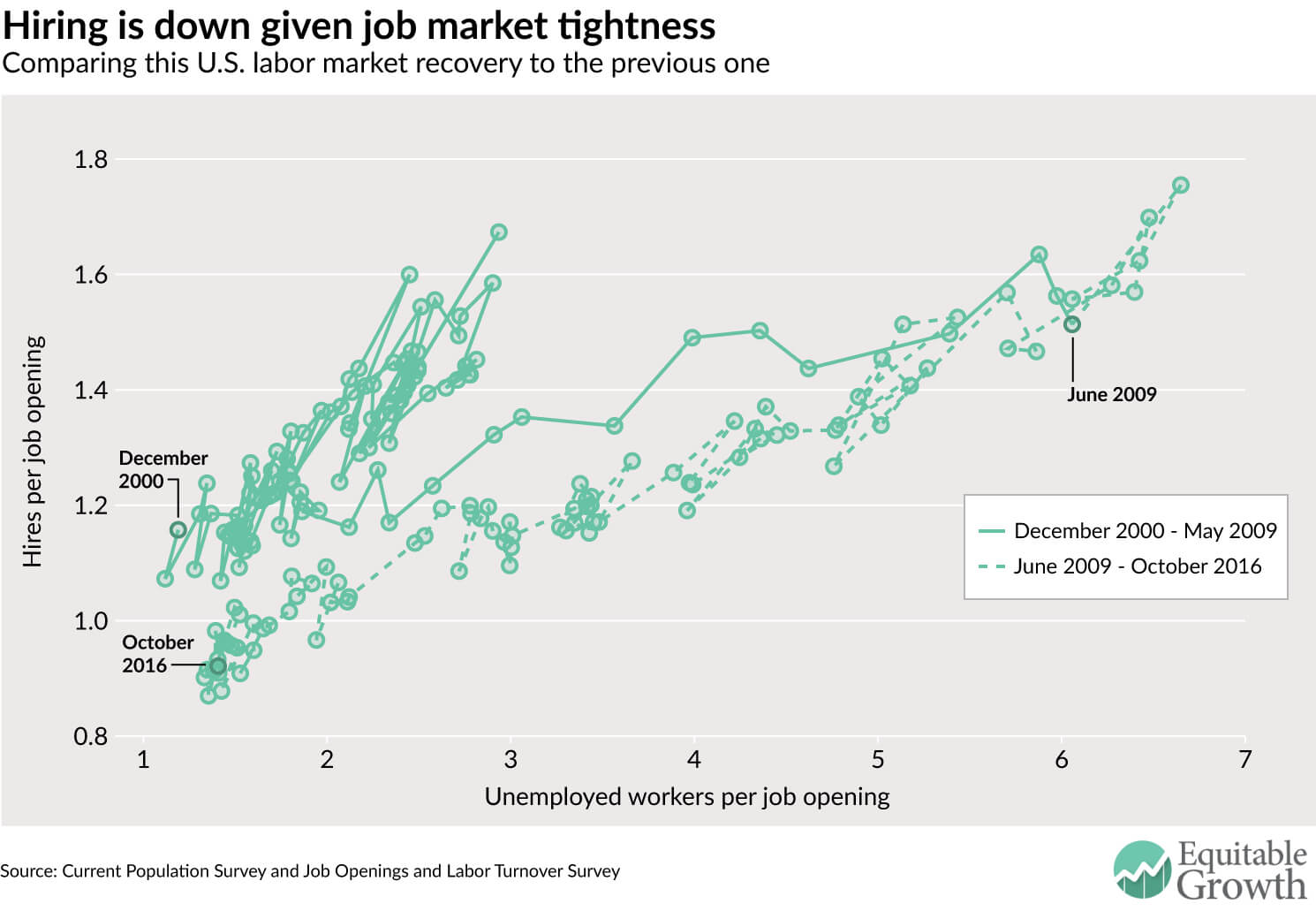
Friday figure

Figure from “U.S labor market tightness, hiring, and the decline in job switching” by Nick Bunker

Should-Read: Matthew Yglesias: Obama to Working Class Trump Voters: You Played Yourselves

Should-Read: Matthew Yglesias: Obama to Working Class Trump Voters: You Played Yourselves: “‘If every economic issue is framed as a struggle between a hardworking white middle class and undeserving minorities’…

…he said, “then workers of all shades will be left fighting for scraps while the wealthy withdraw further into their private enclaves.” It does not take a genius to understand who is whom in this parable. Donald Trump… was born rich and lives in a gold-plated tower… can withdraw further into his private enclaves. So is his son-in-law and senior advisor Jared Kushner. So is… Betsy DeVos… Wilbur Ross. So is the Goldman Sachs executive he’s tapped to run the National Economic Council and the Goldman Sachs trader turned hedge fund manager he’s tapped to run the Treasury…. This crew is laughing all the way to the bank as white working class votes install a new regime based on regressive tax cuts and bank deregulation.

And… Obama mercifully spared us the tired pieties…. He didn’t balance the ledger with a slam on identity politics… didn’t argue that white people’s economic pain is somehow more authentic or meaningful. He identified… the economic woes of [the] working class… [as] caused, to a large extent, by the racism of a sub-set of the working class that leads them to prefer a politics of white supremacy to a politics of economic uplift. This commitment to white supremacy is, Obama argued, deadly to the future of the country:

If we decline to invest in the children of immigrants, just because they don’t look like us, we diminish the prospects of our own children – because those brown kids will represent a larger share of America’s workforce. And our economy doesn’t have to be a zero-sum game. Last year, incomes rose for all races, all age groups, for men and for women….

Trump is proposing to bring back the exact policy mix of tax cuts for millionaire and deregulation for banks and fossil fuel extractors that brought the global economy to its knees under George W Bush. Economic policy will be crafted at the highest levels by and for the inheritors of large fortunes…. [Obama’s] message… is clear enough: white working class Trump supporters played themselves…

Must- and Should-Reads: January 12, 2017


Interesting Reads:

Repealing the Affordable Care Act could exacerbate U.S. income and health inequality

This week, Congress is beginning to take steps to repeal the Affordable Care Act. New research shows that repeal could have significant consequences for U.S. income and health inequality. The research estimates that 22.5 million people could be uninsured by 2019, swiftly reversing the gains in health equity over the past three years, while those at the tippy top of the income ladder would reap hundreds of thousands of dollars in income gains.

Let’s first examine the U.S. income inequality projections. According to recent microsimulation model calculations produced by the Tax Policy Center, repealing all of the Affordable Care Act’s tax provisions would, on average, reduce households’ taxes by $180, increasing after-tax income by 0.3 percent in 2017. A longer-term forecast to 2025 estimates that the average household would save $530 in taxes and see 0.6 percent gains in their after-tax income.

Looking across the entire income spectrum, though, reveals more detail about who really benefits from these tax cuts. (See Figures 1 and 2).

Figure 1
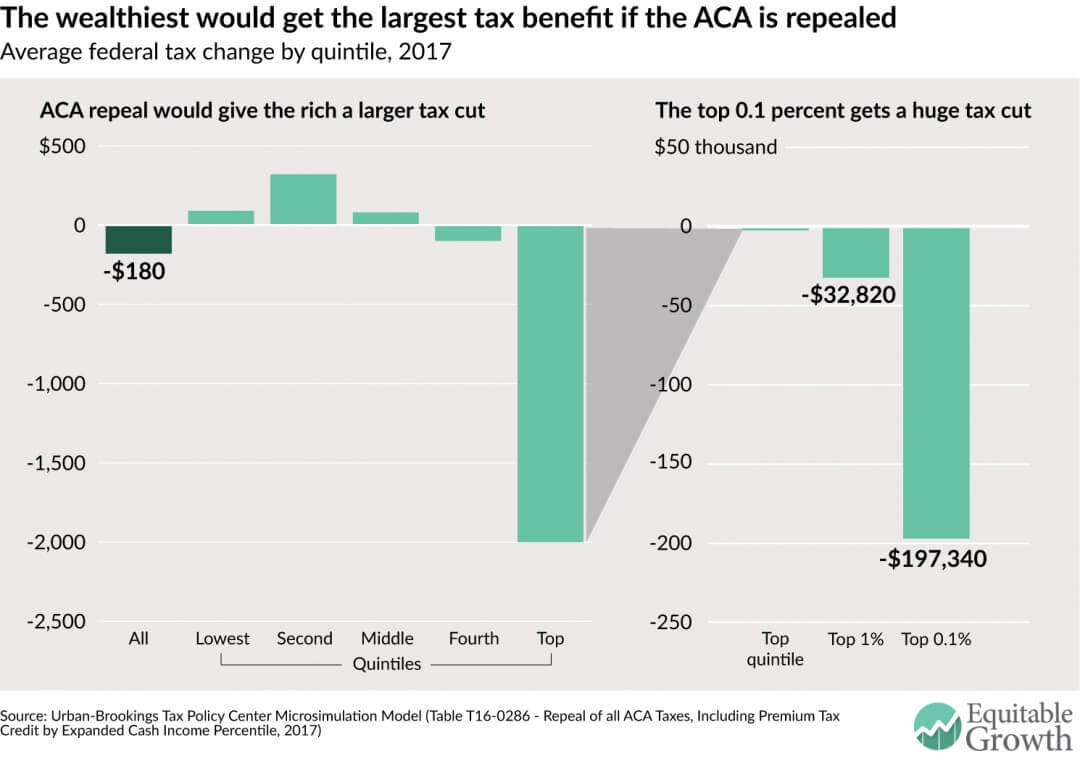
Figure 2
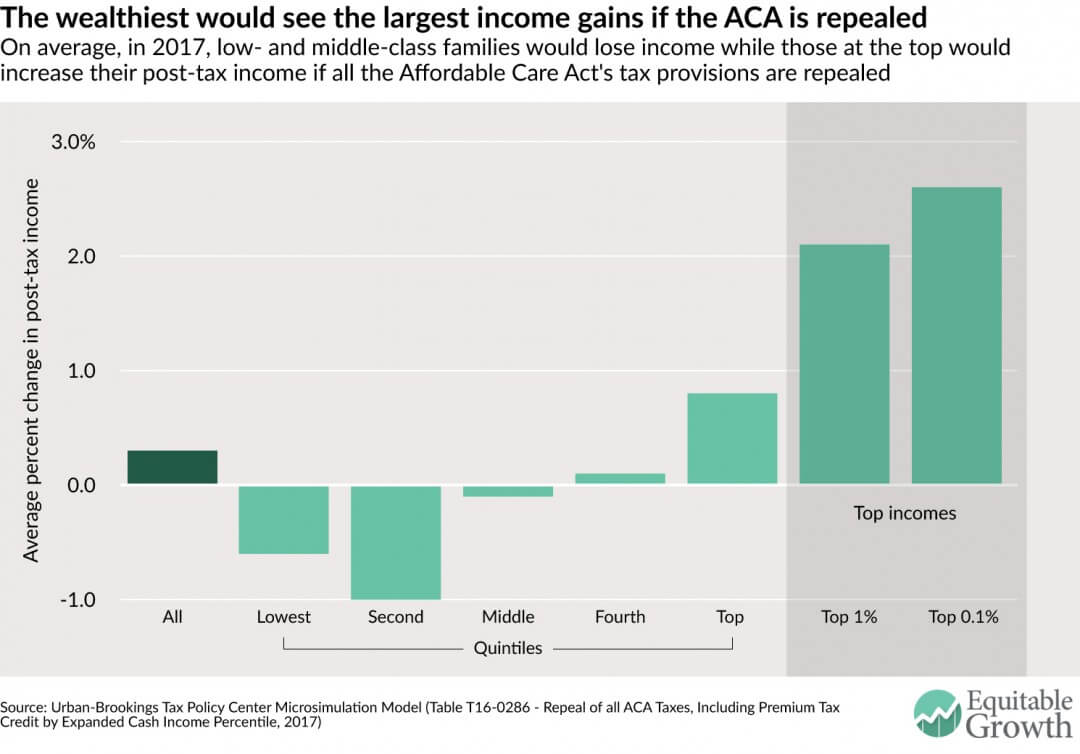
In 2017, U.S. households in the bottom three income quintiles—those earning less than $24,800, between $24,800 and $48,000, and between $48,000 and $83,300—would, on average, actually owe $90, $320, and $80, respectively, more in taxes. In other terms, these low- and middle-income households would lose 0.6 percent, 1.0 percent, and 0.1 percent, respectively, of their after-tax incomes. These projected changes can largely be attributed to the potential elimination of the Premium Tax Credit provision, which is designed to help low- and middle-income families pay health insurance premiums for plans purchased on the Marketplace.

Further up the income ladder, richer households would disproportionately benefit from a repeal of the Affordable Care Act. This is because any repeal of the Affordable Care Act is expected to include the removal of the 0.9 percent Additional Medicare Tax and the 3.8 percent Net Investment Income Tax, both of which apply only to individuals with an income above $200,000 or couples with an income above $250,000. In 2017, households in the top income quintile—those making more than $143,100—would see an average tax cut of $2,000 (or a 0.8 percent increase in post-tax income). At the top one percent of the income ladder, households earning more than $699,000 would save $32,820 in taxes, while those multimillionaires earning more than $3,749,600 (the top 0.1 percent) would save a whopping $197,340 in taxes. This equates to a 2.1 percent and a 2.6 percent after-tax income increase for the top one and top 0.1 percent, respectively.

The Tax Policy Center’s analysis of repealing the Affordable Care Act raises even more concerns about widening disparities between low- and middle-income families and those at the very top, especially given what we know about income inequality. Recent research by University of California-Berkeley’s Emmanuel Saez, for example, demonstrates that while the incomes for the bottom 99 percent of families grew since the Great Recession—and increase of 3.9 percent—the top one percent of families experienced a 7.7 percent increase in their income. Another working paper by Saez, Paris School of Economics’ Thomas Piketty, and UC-Berkeley’s Gabriel Zucman finds that there has been a surge in pre-tax income inequality. And repealing the Affordable Care Act would cause serious ramifications for post-tax income inequality, too. The three economists’ working paper highlights that the top one percent’s share of national income has been rising whether you are looking at before- or after-tax income levels while the share for the bottom 50 percent has experienced significant declines.

Then there are the projections of rising health inequality. The repeal of the Affordable Care Act would place the individual- and employer-sponsored insurance mandates and the expansion of Medicaid in jeopardy. In a new report, Linda Blumberg, Matthew Buettgens, and John Holahan of the Urban Institute find that between erasing the individual insurance mandate, Medicaid expansions, and the Premium Tax Credit, 22.5 million people would become uninsured by 2019. Uninsurance could mean more out-of-pocket expenditures and could lead to larger disparities in health outcomes, particularly for the low- and middle-income families and other vulnerable groups most at risk of losing their health insurance through a repeal.

There are still many uncertainties about how the process of repealing the Affordable Care Act will play out in Congress and how many of its provisions will be replaced, discarded, or reformed. The Affordable Care Act is unlikely to be repealed in full because Congress plans to use a process known as budget reconciliation that will only allow for changes to be made to the components of legislation that have direct implications for tax, spending, revenues, or the federal debt limit.

Within the Affordable Care Act, there are only a handful of items that are connected to the federal budget. This means elements such as protections for individuals with preexisting conditions and essential health benefit requirements could stay intact. But the easiest targets for repeal through budget reconciliation include the tax and spending provisions that, if removed, would end up exacerbating income and health inequalities in the United States. Without a replacement option for the Affordable Care Act lined up to address the gaps left by these key provisions, ensuring equity in economic and health outcomes for all Americans will be challenging.
Should-Read: Olivier Blanchard: The US Phillips Curve: Back to the 60s?

Should-Read: Olivier Blanchard: The US Phillips Curve: Back to the 60s?: “Low unemployment still pushes in ation up; high unemployment pushes it down….

…Put another way, the US Phillips curve is alive. (I wish I could say “alive and well,” but it would be an overstatement: the relation has never been very tight.) Inflation In ation expectations, however, have become steadily more anchored…. The slope of the Phillips curve… has substantially declined…. [since] the 1980s… The standard error of the residual in the relation is large…

Must-Read: Jared Bernstein: More on the non-mystery of non-work

Must-Read: Jared Bernstein: More on the non-mystery of non-work: “Employment rates of prime-age workers…

…What’s important… is that the German labor market has been hit with the same two factors typically raised to explain the increase in non-work: globalization and technology. Why have German prime-age men and women fared so much better than those in the US?

  • Much more union coverage, and German unions work with both management and government to support employment through apprenticeships, training programs, and export-oriented manufacturing policies.

  • This last bit is supported by their undervalued currency; as the strong man in the eurozone, the German currency would rise if it could float. As it is, their current account surplus is a whopping 8% of GDP, meaning they’re essentially importing labor demand from weaker eurozone economies.

  • They’re just more “we’re-in-this-together” when it comes to labor market policies…. In the recession… broad swaths of workers took reduced hours with part of their lost earnings replaced through gov’t support….

  • Don’t assume that accelerating, labor-saving technology–faster productivity growth, robotics–in manufacturing is what’s dinging these guys long-term….

Conservative Nick Eberstadt, according to the NYT would:

like to intensify social pressure on the cadre of men who have stopped looking for work. “Why haven’t we had the same sort of conversation about stigmatizing or shaming unworking men that we had 20 years ago about mothers on welfare?

he said. “They were not idle; they had little kids.”

I say before we go to the shaming place, let’s get the policy right…. A clear cyclical response… around the negative trend… the cyclical responsiveness has increased over time…. CEA… assigned less than 10% of the decline in prime-age male work to the disability rolls…. The evidence of jobs leaving workers is more persuasive than that of workers leaving jobs.

Should-Read: Dani Rodrik: Trump’s Defective Industrial Policy

Should-Read: Dani Rodrik: Trump’s Defective Industrial Policy: “Sociologists Fred Block and Matthew Keller have provided perhaps the best analysis of the US “developmental state”…

…a reality that they say the reigning market-fundamentalist ideology has obscured…. A “decentralized network of publicly funded laboratories” and an “alphabet soup” of financing initiatives, such as the Small Business Innovation Research (SBIR) program, work with private firms and help them commercialize their products… the extensive role of both federal and state governments in supporting the collaborative networks on which innovation rests…. Such industrial policies, based on close collaboration and coordination between the public and private sectors, have of course been the hallmark of East Asian economic policymaking….

Unlike China, of course, the US purports to be a democracy. And industrial policy in a democracy requires transparency, accountability, and institutionalization…. Government agencies need to be close enough to private enterprises to elicit the requisite information about the technological and market realities on the ground…. But they cannot get so close to private firms that they end up in companies’ pocket, or, at the other extreme, simply order them around. And that is where industrial policy à la Trump fails to pass the test….

We can expect the Trump administration’s industrial policy to vacillate between cronyism and bullying. That may benefit some; but it will do little good for the overwhelming majority of American workers or the economy as a whole.

Must- and Should-Reads: January 11, 2017


Interesting Reads:

Should-Read: Noah Smith: Sometimes It’s Hard to Explain Market Failures

Should-Read: Noah Smith: Sometimes It’s Hard to Explain Market Failures:

I propose we minimize our use of the show-me-the-market-failure argument. Sometimes there are policies that people have tried in the past, which seem to work even though it’s hard to tell exactly why. Public education is a great example. It seems to make economies more prosperous, and most economists support it, but no one can point to just why the free market doesn’t educate enough people on its own. Road-building is another — there are essentially no countries with mostly private high-quality road systems, and economists struggle to explain why.

We know these government interventions work; figuring out why they work is a task for the future. Like the people who chewed tree bark to relieve pain long before the discovery of aspirin, or the engineers who used lithium-ion batteries without quite understanding the physics, sometimes it pays to go with evidence even before you have a theory in hand.