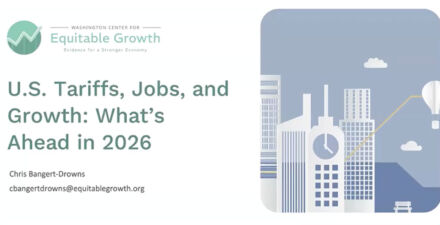
U.S. Tariffs, Jobs, and Growth: What’s Ahead in 2026
An expansive and ever-changing tariff policy regime has shaped the U.S. economy for more than a year, increasing costs and causing uncertainty for businesses, consumers, and policymakers alike. The recent Supreme Court decision barring tariffs under the International Emergency Economic Powers Act is unlikely to spell an end to tariffs altogether, as the White House has signaled a willingness to broadly use alternative statutory authorities.
This uncertain economic terrain prompts several questions. Have tariffs helped or hurt U.S. economic growth and affordability? Should U.S. households expect prices to increase further? How do tariffs impact the U.S. labor market, and are all workers impacted equally? What would tariff refunds mean for the federal deficit and the economy more broadly?
The Washington Center for Equitable Growth held a virtual discussion on the macroeconomic and labor market effects of the current tariff regime, including a presentation of the latest findings from Equitable Growth’s novel project, mapping first-order tariff costs by U.S. industry. This evidence-backed discussion will provide clarity for journalists, policymakers, and researchers seeking to make sense of U.S. tariff policy.
Participants:
Josh Boak (moderator), White House reporter at the Associated Press
Chris Bangert-Drowns, research assistant at the Washington Center for Equitable Growth
Carola Binder, associate professor at the University of Texas at Austin
Riley Ohlson, legislative representative for trade and manufacturing policy at the AFL-CIO
Elena Patel, co-director of the Urban-Brookings Tax Policy Center
Watch video of the event:
Please direct questions related to event content to Chris Bangert-Drowns, Research Assistant.
Please direct questions related to event logistics to Shanteal Lake, Senior Manager, Events and External Relations.
Related
Explore the Equitable Growth network of experts around the country and get answers to today's most pressing questions!